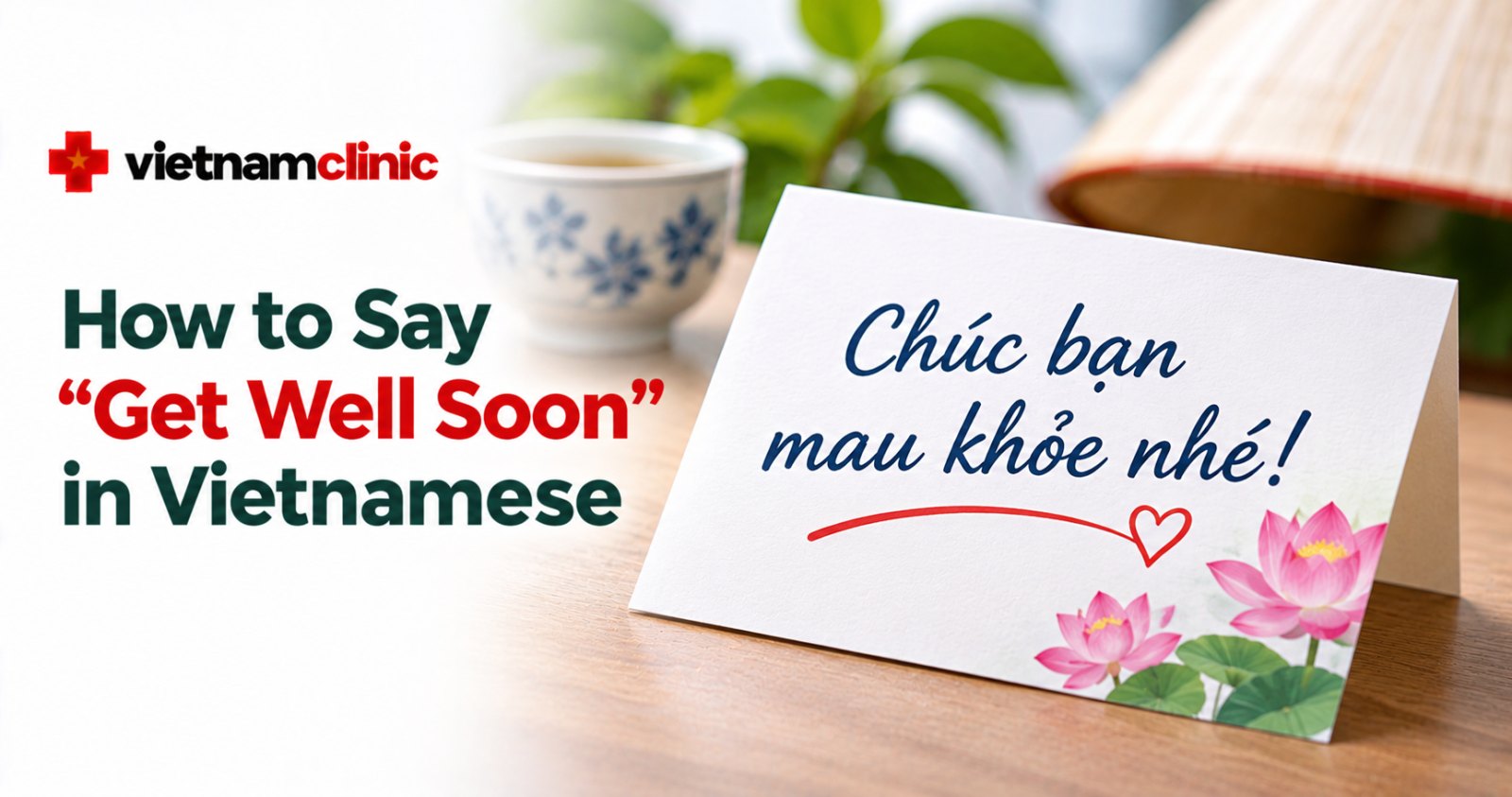
The simplest way to say "Get well soon" in Vietnamese is:
Mau khỏe nhé!
A natural English translation is "Get well soon!" or "Feel better soon!"
You will also hear expressions such as Chúc bạn mau khỏe, Mong bạn sớm khỏe lại and Chúc bạn sớm bình phục. They express the same basic idea, but the tone changes depending on whether you are writing to a close friend, a colleague, an older person or someone recovering from a more serious illness.
Vietnamese also relies heavily on pronouns and relationship terms. Instead of using the neutral word bạn in every message, Vietnamese speakers often use anh, chị, em, cô, chú or another term that reflects the relationship between the people speaking.
How do you say "Get well soon" in Vietnamese?
Here are several common options:
| Vietnamese | Natural English meaning | Tone |
|---|---|---|
| Mau khỏe nhé! | Get well soon! | Casual, warm |
| Chúc bạn mau khỏe! | Get well soon! | Neutral and friendly |
| Mong bạn sớm khỏe lại. | I hope you feel better soon. | Gentle and natural |
| Chúc bạn sớm bình phục. | Wishing you a speedy recovery. | More formal |
| Mong bạn mau khỏi bệnh. | I hope you recover soon. | Caring and direct |
Mau khỏe nhé is particularly useful in everyday conversation. Mau means quickly or soon, khỏe relates to being healthy or well, and nhé softens the phrase and makes it sound friendly rather than like a command. Vietnamese learning resources commonly translate mau khỏe nhé and chúc bạn mau khỏe as equivalents of "get well soon."
25 get-well messages in Vietnamese
The following messages are written to sound natural rather than as literal word-for-word translations from English.
1. Mau khỏe nhé!
English: Get well soon!
This is one of the shortest and most natural choices for a friend, partner, sibling or someone you know well.
2. Chúc bạn mau khỏe!
English: Get well soon!
Adding chúc turns the sentence explicitly into a wish. This works well when you want something simple but slightly more complete than Mau khỏe nhé.
3. Mong bạn sớm khỏe lại.
English: I hope you feel better soon.
Mong expresses hope. This version sounds gentle and works well in a text message to someone who is sick at home.
4. Chúc bạn sớm bình phục.
English: Wishing you a speedy recovery.
Bình phục means to recover from illness or injury. This wording is a little more formal and is suitable after an operation, accident or more significant illness.
5. Mong bạn mau khỏi bệnh.
English: I hope you get over your illness soon.
Khỏi bệnh means to recover from an illness. It is more explicitly about being sick than the broader word khỏe.
6. Nghỉ ngơi nhiều và mau khỏe nhé!
English: Get plenty of rest and get well soon!
A friendly message for someone with a cold, flu or another short-term illness.
7. Nhớ giữ gìn sức khỏe và nghỉ ngơi nhiều nhé.
English: Take care of yourself and get plenty of rest.
This sounds caring without putting pressure on the person to recover quickly.
8. Hy vọng bạn sẽ sớm cảm thấy khỏe hơn.
English: I hope you feel better soon.
This is close to the English phrase "I hope you feel better soon" and is useful when the person is uncomfortable but may not have a serious illness.
9. Chúc bạn nhanh chóng hồi phục sức khỏe.
English: Wishing you a quick recovery.
This is more formal than Mau khỏe nhé and works well in writing.
10. Mong bạn sớm hồi phục hoàn toàn.
English: I hope you make a full recovery soon.
This is appropriate when someone is recovering from surgery, an accident or an illness that may take more time.
11. Mau khỏe lại nhé, mọi người nhớ bạn lắm!
English: Get well soon, everyone misses you!
A warm option for a colleague, classmate or friend who is temporarily absent.
12. Mau khỏe để còn đi chơi với tụi mình nhé!
English: Get well soon so you can come out with us again!
Very informal. This works between close friends but would be inappropriate in a formal or serious medical situation.
13. Cố gắng nghỉ ngơi nhé, mong bạn sớm khỏe lại.
English: Try to get some rest. I hope you feel better soon.
This feels softer than simply telling someone to recover quickly.
14. Chúc bạn có thật nhiều sức khỏe và mau bình phục.
English: Wishing you strength and a speedy recovery.
A warmer, more supportive message that works well in a card.
15. Mong mọi chuyện sớm ổn và bạn nhanh khỏe lại.
English: I hope everything gets better soon and that you recover quickly.
Useful when illness is only one part of a stressful situation.
16. Hy vọng mỗi ngày bạn sẽ thấy khỏe hơn một chút.
English: I hope you feel a little better every day.
This is especially suitable when recovery is expected to be gradual.
17. Đừng lo lắng quá, cứ nghỉ ngơi và chăm sóc bản thân nhé.
English: Don't worry too much. Just rest and take care of yourself.
This is supportive rather than focused on a deadline for recovery.
18. Mong bạn có một quá trình hồi phục thật thuận lợi.
English: I hope your recovery goes smoothly.
This is a good message after surgery or a significant medical procedure.
19. Chúc anh mau khỏe nhé!
English: Get well soon!
Use anh when addressing an older male or a man you naturally call anh in Vietnamese.
20. Chúc chị sớm khỏe lại nhé!
English: I hope you feel better soon!
Use chị for an older woman or someone you normally address as chị.
21. Em mau khỏe nhé!
English: Get well soon!
This can be affectionate when speaking to someone younger than you or a partner you address as em.
22. Mong anh sớm bình phục và trở lại công việc khi thấy khỏe hơn.
English: I hope you recover soon and return to work when you're feeling better.
This is more considerate than telling a sick colleague to come back quickly.
23. Chúc chị hồi phục tốt sau ca phẫu thuật.
English: Wishing you a good recovery after your surgery.
A natural choice when the context is specifically postoperative recovery.
24. Cả nhà đều mong bạn sớm khỏe lại.
English: Everyone in the family hopes you feel better soon.
This works when sending wishes on behalf of several people.
25. Chúng tôi chúc bạn sớm bình phục và luôn mạnh khỏe.
English: We wish you a speedy recovery and continued good health.
This is one of the more formal options and can work in a professional message, card or communication from a group.
"Mau khỏe nhé" versus "Chúc bạn mau khỏe"
Both are natural, but there is a slight difference in feel.
Mau khỏe nhé! is short, conversational and affectionate. It sounds like something you might send in a chat message.
Chúc bạn mau khỏe! explicitly means that you are wishing the other person a quick recovery. It can work in both speech and writing and is slightly more complete.
For a person you know well, either is fine.
What does "chóng khỏe" mean?
You may also encounter phrases built with chóng, which can mean quickly or rapidly.
For example:
Chúc bạn chóng khỏe.
means approximately:
"I wish you a quick recovery."
However, mau khỏe and sớm khỏe lại are often easier and more natural choices for foreign learners in everyday messages.
How to address the person naturally
Vietnamese pronouns depend heavily on age and relationship.
Instead of translating English you as bạn every time, you can replace it with the appropriate form.
| Vietnamese form | Typical use |
|---|---|
| bạn | Friend or neutral peer |
| anh | Older male, male partner in some relationships |
| chị | Older female |
| em | Younger person, partner in some relationships |
| cô | Older woman, teacher, aunt-like age relationship |
| chú | Older man, uncle-like age relationship |
| bác | Significantly older adult |
For example:
Chúc anh mau khỏe.
means "Get well soon" to someone you call anh.
Chúc chị sớm bình phục.
means "Wishing you a speedy recovery" to someone you call chị.
If you are unsure of the correct relationship term, bạn is the easiest option for a peer, but it can sound unnatural when speaking to someone clearly older or younger than you.
Messages for a close friend
With a close friend, shorter language usually sounds more natural than a formal recovery wish.
Good choices include:
- Mau khỏe nhé!
- Nghỉ ngơi nhiều vào nhé.
- Mau khỏe để còn đi chơi nhé!
- Hy vọng mai sẽ thấy đỡ hơn.
The last sentence means "Hopefully you'll feel better tomorrow."
You can make the message more personal by mentioning what you hope to do together after they recover.
Messages for a boyfriend or girlfriend
Vietnamese couples normally use relationship-specific pronouns rather than bạn.
A simple affectionate message might be:
Em nghỉ ngơi nhiều nhé. Mau khỏe lại, anh lo cho em lắm.
English: Get plenty of rest. Get well soon, I'm really worried about you.
Or, when speaking to a male partner:
Anh mau khỏe nhé, nhớ chăm sóc bản thân.
English: Get well soon and remember to take care of yourself.
The correct use of anh and em depends on the relationship and who is older, so copying these forms blindly can produce the wrong tone.
Messages for a colleague
For a colleague, especially one you do not know closely, a slightly more restrained message usually works better.
For example:
Chúc anh/chị sớm bình phục và giữ gìn sức khỏe.
English: Wishing you a speedy recovery. Please take care of yourself.
Or:
Mong anh/chị sớm khỏe lại. Công việc cứ để mọi người xử lý nhé.
English: I hope you feel better soon. Don't worry about work, we'll take care of it.
The second version can be particularly reassuring because it avoids making the sick person feel pressured to return immediately.
What to write after surgery
After surgery, bình phục and hồi phục are particularly useful words because they refer more clearly to recovery.
Natural options include:
Chúc bạn hồi phục tốt sau ca phẫu thuật.
English: Wishing you a good recovery after surgery.
Mong bạn sớm bình phục và mỗi ngày đều thấy khỏe hơn.
English: I hope you recover soon and feel stronger every day.
For someone facing a longer recovery, these can sound more appropriate than a cheerful Mau khỏe nhé!
What to say when someone is seriously ill
A simple "get well soon" can sometimes sound too casual when the person has a serious or chronic illness.
In that situation, it may be better to focus on support rather than speed.
For example:
Mong bạn luôn vững vàng. Mọi người luôn ở bên bạn.
English: I hope you stay strong. We're always here for you.
Or:
Mong bạn có thật nhiều sức khỏe và mọi việc điều trị diễn ra thuận lợi.
English: Wishing you strength and hoping your treatment goes smoothly.
This avoids implying that the person should simply recover quickly from a condition that may require lengthy treatment.
"Take care" in Vietnamese
A related phrase is:
Giữ gìn sức khỏe nhé.
It means roughly:
"Take care of yourself" or "Look after your health."
It is useful on its own or after a recovery wish:
Mau khỏe nhé, nhớ giữ gìn sức khỏe.
English: Get well soon, and take care of yourself.
Another very natural expression is:
Nhớ chăm sóc bản thân nhé.
English: Remember to take care of yourself.
Useful Vietnamese recovery vocabulary
| Vietnamese | English |
|---|---|
| khỏe | healthy, well |
| mau | quickly, soon |
| sớm | soon |
| bệnh | illness, disease |
| khỏi bệnh | recover from an illness |
| bình phục | recover, recuperate |
| hồi phục | recover, regain health or function |
| nghỉ ngơi | rest |
| sức khỏe | health |
| chăm sóc bản thân | take care of yourself |
| phẫu thuật | surgery |
| điều trị | treatment |
Knowing these words makes it easier to personalise a message rather than relying on one fixed phrase.
Can you simply say "Mau khỏe"?
Yes, but adding nhé generally makes the expression warmer and more natural in friendly conversation:
Mau khỏe nhé!
The particle nhé is difficult to translate directly into English. In this context it softens the statement and gives it a friendly, encouraging tone.
Is "Chúc bạn mau khỏe" formal?
It is polite but not highly formal.
For a formal card or professional message, something like:
Chúc anh/chị sớm bình phục và luôn mạnh khỏe.
is more appropriate.
It means:
"Wishing you a speedy recovery and continued good health."
For a friend, that version can sound unnecessarily ceremonial, so a shorter Mau khỏe nhé! is usually better.
What to remember
The easiest everyday translation of "Get well soon" in Vietnamese is "Mau khỏe nhé!"
Chúc bạn mau khỏe is another simple and widely understandable choice, while Chúc bạn sớm bình phục sounds more formal and is useful after surgery or a more significant illness.
The most natural wording depends on the relationship. Vietnamese speakers frequently replace bạn with pronouns such as anh, chị or em, and a message for a close friend will usually sound much shorter and more casual than one for a colleague or older person.
When someone is seriously ill or facing a long recovery, consider using language that expresses support rather than telling them to recover quickly.
Frequently Asked Questions
How do you say "Get well soon" in Vietnamese?
A simple and natural way is "Mau khỏe nhé!" You can also say "Chúc bạn mau khỏe," meaning "Get well soon," or "Mong bạn sớm khỏe lại," meaning "I hope you feel better soon."
What does "Mau khỏe nhé" mean?
It means "Get well soon" or "Feel better soon." Mau means quickly or soon, khỏe means healthy or well, and nhé gives the expression a softer, friendly tone.
What is a formal way to say get well soon in Vietnamese?
"Chúc bạn sớm bình phục" is a more formal option and means "Wishing you a speedy recovery." For an older person or colleague, bạn can be replaced with the appropriate form such as anh or chị.
How do you say "I hope you feel better soon" in Vietnamese?
You can say "Mong bạn sớm khỏe lại" or "Hy vọng bạn sẽ sớm cảm thấy khỏe hơn." Both express the hope that the person will feel better soon.
What should you say in Vietnamese after someone has surgery?
A natural message is "Chúc bạn hồi phục tốt sau ca phẫu thuật," meaning "Wishing you a good recovery after surgery." You can also say "Mong bạn sớm bình phục," meaning "I hope you recover soon."
Is "Mau khỏe nhé" appropriate for someone who is seriously ill?
It can sound too casual in a serious situation. For a long or difficult illness, a supportive message such as "Mong bạn có thật nhiều sức khỏe và mọi việc điều trị diễn ra thuận lợi," meaning "Wishing you strength and hoping your treatment goes smoothly," can be more appropriate.
Sources

Writer
Tan Nguyen
Medical writer
Medical writer for Vietnam Clinic. MD, Vietnam National University Ho Chi Minh City.
View profile