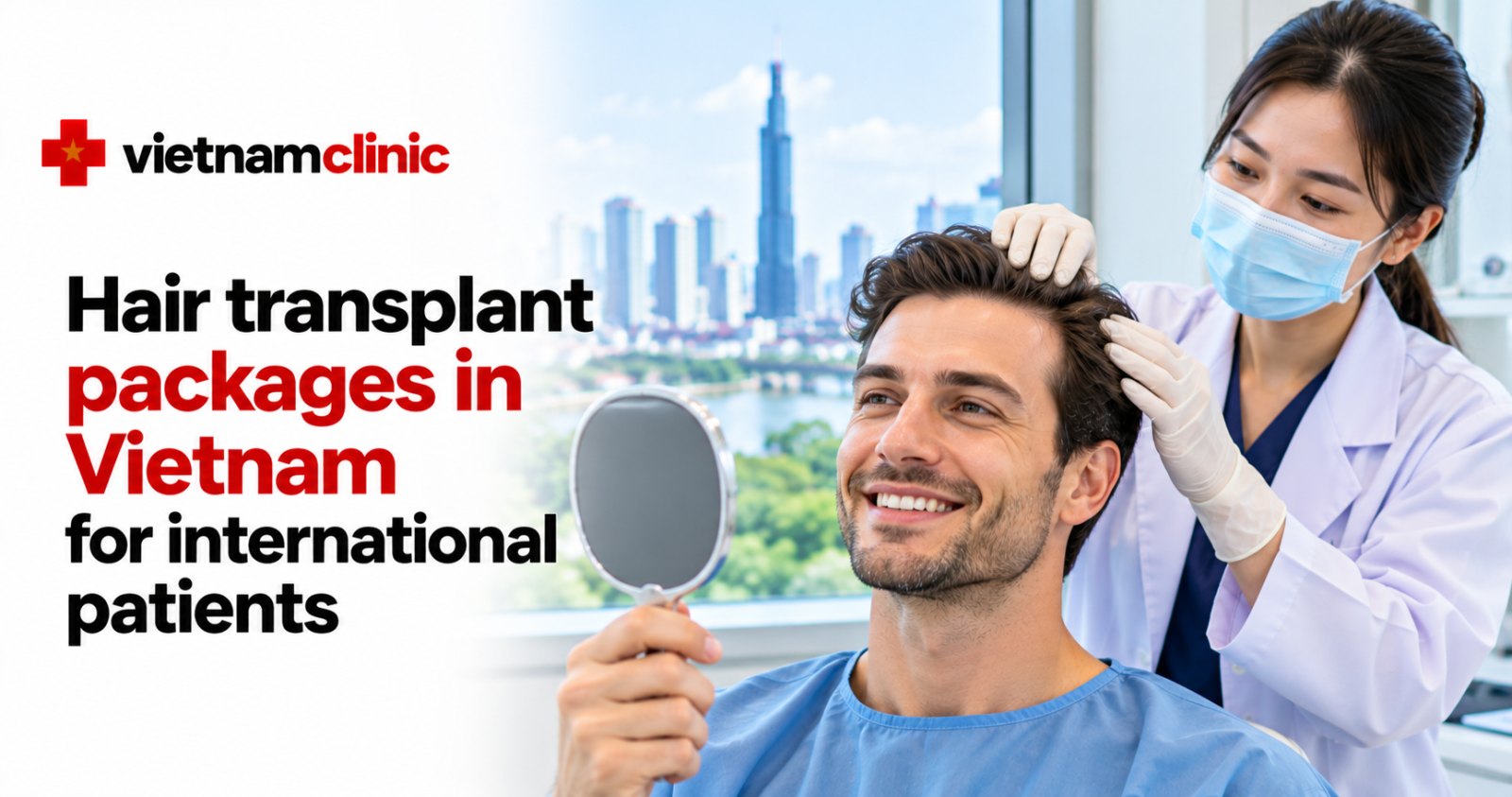
Hair transplant packages in Vietnam are increasingly marketed to international patients who want to combine surgical hair restoration with a short stay abroad. Depending on the provider, a package may include the procedure, preoperative consultation, medication, postoperative care and assistance with accommodation or airport transfers.
The difficulty is that hair transplant packages are not standardised. One clinic may advertise a fixed price for a specified number of grafts, while another quotes an individual surgical fee and arranges travel services separately. Even packages described as all-inclusive may exclude flights, additional medication, complications or follow-up treatment after returning home.
This guide explains what international patients should expect from hair transplant packages in Vietnam, how prices are structured, what FUE and DHI packages may include, and which medical and practical details to confirm before booking. It focuses on the complete patient experience rather than simply comparing the cheapest advertised surgical price.
What is included in a hair transplant package in Vietnam?
A hair transplant package combines surgical treatment with some of the services required before and after the procedure. The exact contents depend on the clinic, technique and individual treatment plan.
Commonly advertised components include:
- Initial consultation and scalp assessment
- Hairline design and graft planning
- FUE or DHI hair transplantation
- Local anaesthesia and surgical consumables
- Initial postoperative assessment
- Medication and scalp-care products
- Written postoperative instructions
- Follow-up appointments
- Airport transfers or local transport, when specified
- Hotel accommodation, when specified
- Remote follow-up after leaving Vietnam
The inclusion of these services should never be assumed. Some providers sell surgery-only packages, while others advertise broader arrangements for overseas patients.
For example, Hair Transplant Vietnam describes packages that may include medication, postoperative care, airport transfers and, in some cases, accommodation. These are the provider's published descriptions, not a guarantee that every package contains those benefits.
Before paying a deposit, request an itemised quotation identifying every included service and any possible additional charges.
How much do hair transplant packages cost in Vietnam?
Published package prices vary according to the clinic, number of grafts, surgical technique and services included.
Hair Transplant Clinics lists published package prices for HuanMDClinic in Ho Chi Minh City ranging from approximately USD 1,600 to USD 7,200 across different treatment options. These figures reflect the prices reported by that listing and should be confirmed directly with the provider.
Bookimed publishes a Vietnam FUE market estimate of approximately USD 2,400 to USD 5,200, with a reported average of USD 3,800. Its figures are marketplace estimates rather than a national medical tariff.
| Package or pricing reference | Published example |
|---|---|
| HuanMDClinic hairline restoration | USD 1,600 to 2,400 |
| HuanMDClinic crown restoration | USD 2,400 to 4,000 |
| HuanMDClinic extensive restoration | USD 4,800 to 7,200 |
| Bookimed FUE market estimate in Vietnam | USD 2,400 to 5,200 |
These figures are not directly equivalent. The graft count, technique, accommodation, medication and follow-up arrangements may differ.
For a more detailed discussion of procedure prices and graft-based calculations, see Hair transplant cost in Vietnam: Prices, FUE, DHI and what to expect.
FUE hair transplant packages
Follicular Unit Excision, usually abbreviated FUE, involves extracting individual follicular units from a donor area and transplanting them into the recipient area.
An FUE package may include scalp assessment, hairline planning, donor extraction, recipient-site preparation, implantation and postoperative care.
Some providers advertise a fixed graft allowance, while others calculate the final fee after assessing the donor area and the extent of hair loss.
A graft is a follicular unit that may contain more than one hair. Consequently, a package offering 2,000 grafts is not necessarily offering 2,000 individual hairs.
Patients should ask how the proposed graft count was determined, who performs the extraction and recipient-site creation, and what happens if the surgeon determines that fewer grafts are appropriate.
DHI hair transplant packages
Direct Hair Implantation, or DHI, is a commercial term commonly associated with implantation using specialised instruments such as implanter pens.
DHI packages may be advertised at higher prices than conventional FUE packages. However, the terminology is not applied consistently by every clinic, and DHI does not automatically describe a completely different donor-extraction technique.
Ask the provider to explain the extraction method, recipient-site preparation and implantation process. The presence of an implanter pen does not by itself establish better graft survival or a superior cosmetic result.
The treating surgeon should explain why the proposed technique is suitable for your hair characteristics, donor resources and treatment objectives.
All-inclusive hair transplant packages: What does that mean?
The phrase all-inclusive is commonly used in medical tourism advertising, but it does not have one universal meaning.
A package may include the operation, hotel and airport transfers but exclude flights and additional medical treatment. Another may include surgery and postoperative medication while leaving accommodation entirely to the patient.
Before accepting an all-inclusive quotation, ask for written confirmation of:
- The exact surgical procedure.
- The proposed number of grafts.
- The surgeon responsible for treatment.
- The hospital or clinic where surgery takes place.
- Medication and consumables included.
- Preoperative tests and consultations.
- Accommodation and the number of nights.
- Airport and clinic transfers.
- Postoperative appointments.
- Remote follow-up after returning home.
- Charges for complications or additional treatment.
- Cancellation, postponement and refund conditions.
A package should be evaluated as a medical treatment agreement with associated services, rather than as an ordinary holiday booking.
Are flights and hotels included?
International flights are not necessarily included in hair transplant packages. Some providers arrange accommodation or local transfers, while others only provide recommendations.
If a hotel is included, confirm its location, room type, check-in and check-out dates, and whether extending your stay creates additional charges.
It is also worth checking whether the accommodation is convenient for postoperative reviews. Travelling across a large city immediately after surgery may be uncomfortable, especially when the scalp is swollen or sensitive.
A package that excludes accommodation may still be suitable, but the total travel budget should reflect the actual length of stay recommended by the treating team.
How long should international patients stay in Vietnam?
The recommended stay depends on the procedure, individual recovery and postoperative schedule.
A published HuanMDClinic profile describes international patients typically staying five to seven days, including surgery and initial postoperative care. This is one provider-specific example, not a standard requirement for every patient.
A patient should confirm the recommended arrival date, consultation date, surgery date and postoperative appointments before booking flights.
Ask when the surgeon expects to examine the scalp after surgery and whether there are any restrictions on flying, strenuous activity, sun exposure or wearing headwear.
Do not shorten the recommended recovery period simply to fit a cheaper flight schedule.
Hair transplant packages in Ho Chi Minh City
Ho Chi Minh City has providers offering hair transplantation to domestic and international patients. Some advertise FUE, DHI and treatment packages covering different areas of hair loss.
HuanMDClinic is one published example with prices listed for hairline, crown and extensive restoration. Its third-party profile also describes remote postoperative follow-up for international patients.
These details establish what the provider or listing publishes. They do not independently demonstrate surgical outcomes, complication rates or the quality of care delivered to every patient.
When comparing providers in Ho Chi Minh City, ask whether English-language communication is available throughout the medical consultation, consent process and postoperative care.
Hair transplant packages in Hanoi
Patients considering Hanoi should distinguish between general aesthetic services, medical hair-loss assessment and clinics that actually perform surgical hair transplantation.
A facility may advertise hair restoration without offering FUE or DHI surgery. Some providers focus on dermatology, medical management or nonsurgical treatments.
Before travelling, confirm the procedure offered, the identity and qualifications of the surgeon, the location where surgery will take place and whether the clinic can provide a complete written quotation.
If accommodation or transport is offered, ask whether those services are included in the medical package or arranged by an independent third party.
Hair transplant packages in Da Nang
International patients may also investigate hair restoration services in Da Nang, particularly if they already live in central Vietnam or plan to spend time there.
However, the availability of specialist surgical hair transplantation and international-patient packages should be confirmed individually. A provider offering hair-loss consultations or aesthetic treatments does not necessarily perform graft transplantation.
If a clinic proposes surgery in another city, clarify which medical facility will carry out the procedure and where postoperative reviews will occur.
The most convenient location is not always the most appropriate choice if it creates difficulties with surgical follow-up.
What medical assessment should happen before surgery?
A hair transplant should begin with a medical assessment of the cause and pattern of hair loss.
Not every form of hair loss is suitable for transplantation. The surgeon should assess scalp health, donor density, hair characteristics, previous treatment and the likely progression of hair loss.
Depending on the medical history and proposed procedure, additional investigations may be recommended. Patients should not assume that a standard package automatically includes every test they may need.
The International Society of Hair Restoration Surgery emphasises the importance of a properly trained and licensed physician being responsible for diagnosis, surgical planning and relevant surgical procedures.
An online photograph or video consultation can help with preliminary planning, but it should not replace the appropriate examination before surgery.
Who actually performs the hair transplant?
This is one of the most important questions for international patients.
Hair transplantation involves surgical procedures, including donor harvesting and the creation of recipient sites. The ISHRS warns about the risks of unlicensed personnel performing surgical tasks that require appropriate medical qualifications.
Ask the clinic to identify the surgeon who will personally assess you, design the hairline and perform or supervise each part of the operation. Request an explanation of which tasks are delegated and whether that delegation is permitted under the applicable professional rules.
A clinic's promotional use of terms such as doctor-led or specialist team is not a substitute for knowing who will perform the procedure.
Risks and complications to discuss
Hair transplantation is surgery, even when it is advertised as minimally invasive or performed under local anaesthesia.
Possible complications include infection, bleeding, scarring, poor graft survival, uneven density, donor-area thinning, altered sensation and an unsatisfactory cosmetic result.
Patients should also discuss the possibility that hair loss will continue in untreated areas, potentially affecting the appearance of the transplant over time.
Ask how the clinic handles postoperative problems, who provides emergency advice and whether additional treatment would incur extra fees.
If you develop fever, spreading redness, increasing swelling, severe pain or concerning discharge after surgery, contact the treating team promptly. Seek urgent local medical care for severe or rapidly worsening symptoms.
Postoperative care after returning home
Follow-up is especially important for patients who leave Vietnam shortly after their procedure.
Before departure, obtain written instructions covering scalp washing, medication, exercise, sun exposure, sleeping position and the signs of complications.
Ask whether the clinic offers video consultations, photographs-based reviews or other remote follow-up arrangements. Confirm how quickly the treating team can respond if a problem develops.
Remote follow-up may be useful for routine progress checks, but it cannot replace an in-person examination when a complication requires direct medical assessment.
Keep a copy of the treatment report, medication details and contact information for the surgical team. These records can help another clinician understand the procedure if you need care after returning home.
How long does it take to see results?
Hair transplant results develop gradually. Temporary shedding of transplanted hairs can occur during the early postoperative period, and new growth usually becomes visible over subsequent months.
The final cosmetic result may take around a year or longer to assess, depending on the procedure and individual circumstances.
A package promising immediate permanent density or guaranteed graft survival should be approached cautiously. Hair transplantation has biological limitations, and outcomes cannot be guaranteed by a marketing package.
The surgeon should explain realistic expectations before treatment, including the possibility of continued hair loss outside the transplanted area.
Is a hair transplant package cheaper than booking everything separately?
A package can be convenient because it combines several arrangements under one quotation. However, it is not necessarily cheaper than booking surgery, accommodation and transport separately.
To compare fairly, request a surgery-only price and an itemised package price from the same provider when available.
Then add accommodation, transport, medication, postoperative visits and any other services you would otherwise need to arrange independently.
The more important question is whether the package includes the medical services required for safe treatment and follow-up. A small saving on hotel accommodation is less important than clarity about surgical responsibility or complication management.
Insurance, payment and cancellation
Hair transplantation for cosmetic hair loss is generally treated as an elective procedure and is commonly excluded from standard medical insurance policies.
Patients should confirm coverage directly with their insurer if the procedure is proposed for reconstructive reasons or following a medical condition.
Before paying a deposit, request the total price, payment schedule, accepted currencies and refund conditions in writing.
Ask what happens if the surgeon advises against surgery after an in-person examination, if fewer grafts are appropriate than initially estimated, or if a medical issue requires postponement.
Travel insurance should not be assumed to cover elective hair transplantation or complications arising from planned medical tourism. Check the wording of any policy before relying on it.
How to compare packages without choosing solely on price
A useful comparison should consider the complete medical and practical arrangement.
Look at the proposed graft count, technique, surgeon qualifications, facility authorisation, postoperative care and total price. Confirm which services are included and what additional expenses may arise.
Ask for the surgeon's name and professional credentials rather than relying on general descriptions of the clinic's team. Review the donor-area assessment and long-term treatment plan.
For broader information about accessing private healthcare, see How hospitals work in Vietnam.
A lower advertised price does not automatically indicate poor care, just as a premium package does not guarantee a good result. Transparent documentation and appropriate medical assessment are more useful than promotional labels.
Conclusion
Hair transplant packages in Vietnam for international patients can combine surgical treatment with consultation, accommodation, transfers and postoperative support. However, the services included vary considerably, and all-inclusive does not have a standard meaning.
Published examples show packages ranging from relatively modest hairline procedures to more extensive restoration costing several thousand US dollars. Prices should be compared only after checking graft count, surgical technique and the services included.
Before booking, obtain an individual medical assessment, verify the treating surgeon's credentials and request an itemised written quotation. Make sure postoperative care and arrangements for complications are clear before paying a deposit or making travel plans.
Frequently Asked Questions
How much does a hair transplant package cost in Vietnam?
Published package examples range from approximately USD 1,600 to USD 7,200, depending on the provider and treatment. The price may include surgery and selected additional services, but accommodation, transfers and follow-up should be confirmed individually.
Are hair transplant packages in Vietnam all-inclusive?
Some packages include medication, postoperative care, transport or accommodation, while others cover surgery only. There is no universal definition of all-inclusive, so request an itemised quotation before booking.
Do Vietnam hair transplant packages include hotels and flights?
Some providers offer accommodation or airport transfers, but international flights are not necessarily included. Check the number of hotel nights, transport arrangements and additional charges directly with the provider.
How long should I stay in Vietnam after a hair transplant?
The recommended stay depends on the procedure and postoperative plan. One published provider profile describes international patients staying five to seven days, but your surgeon should determine the appropriate schedule for your case.
Can international patients get FUE and DHI hair transplants in Vietnam?
Yes, some Vietnamese providers advertise both FUE and DHI services for international patients. Confirm the exact technique, surgeon's role, graft count and postoperative arrangements before booking.
Is it cheaper to book a hair transplant package or surgery separately?
Either arrangement may be less expensive depending on what is included. Compare a surgery-only quotation with the total package price after accounting for accommodation, transport, medication and follow-up.
What happens if I have complications after returning home?
Ask the clinic about remote follow-up, emergency contact arrangements and access to medical records before travelling. Some problems require an in-person medical assessment, and additional treatment may not be included in the original package.
Does travel insurance cover hair transplant surgery abroad?
Standard travel insurance should not be assumed to cover elective hair transplantation or complications related to planned medical tourism. Review the policy exclusions and obtain written confirmation from the insurer.
Sources

Writer
Tan Nguyen
Medical writer
Medical writer for Vietnam Clinic. MD, Vietnam National University Ho Chi Minh City.
View profile
Medical review
John Maitland
Medical reviewer
Medical reviewer for Vietnam Clinic. MD, University of Pennsylvania.
View profile