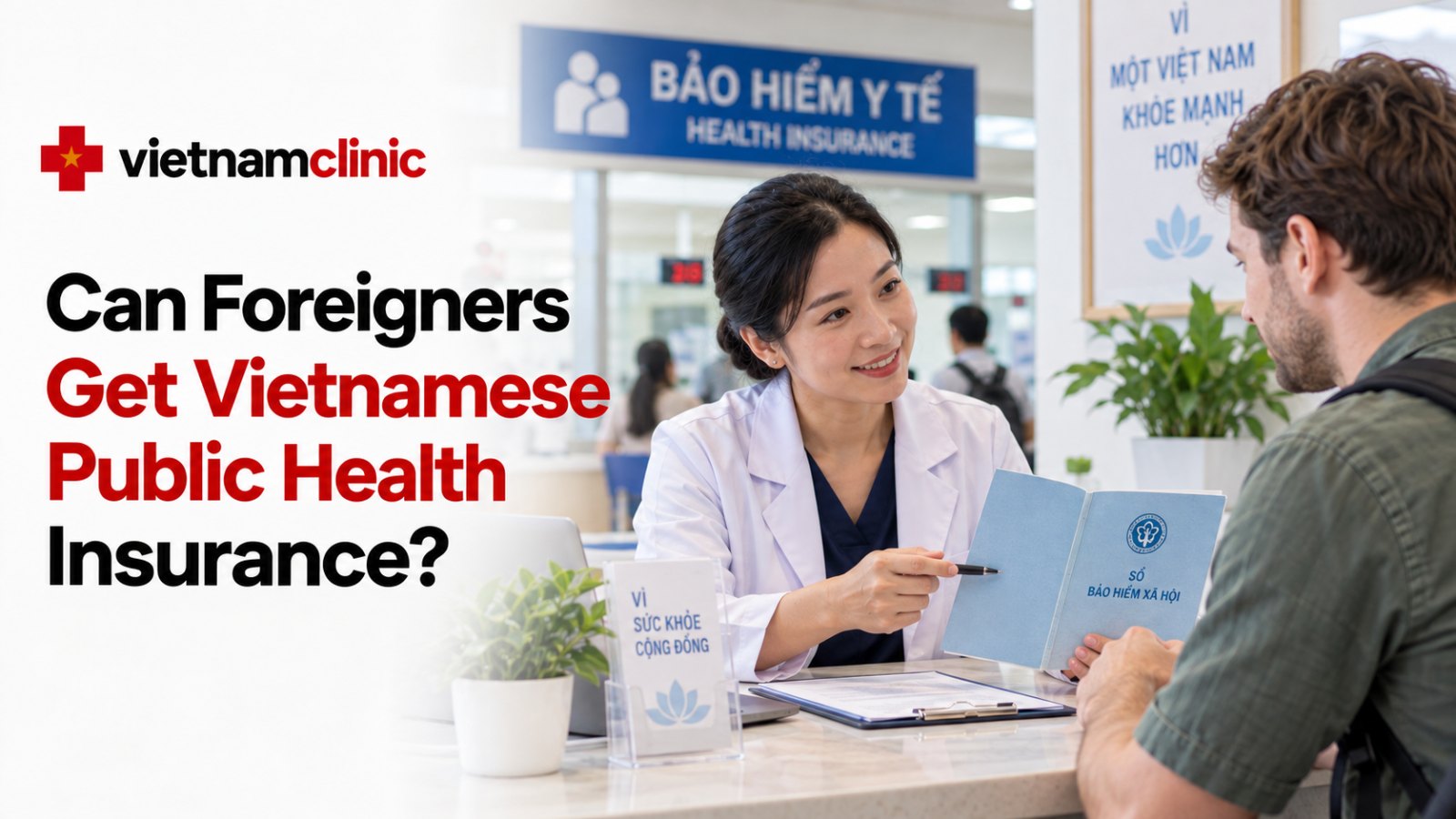
Foreigners can receive Vietnamese public health insurance (BHYT), but there is no single enrolment route open to every foreign resident. The clearest route is employment: Vietnam Social Security states that a foreign employee working under an indefinite contract or a fixed-term labour contract of at least three months is subject to compulsory health-insurance participation. Other foreign residents should not assume that a temporary-residence card, marriage, retirement visa or long stay automatically lets them buy household BHYT. Their eligibility depends on the category created by law and should be confirmed with the local social-insurance authority.
That distinction matters because Vietnam’s public scheme is not a commercial policy. It is a statutory, non-profit system with rules on eligible participants, registered facilities, referrals, covered services and payment levels. It can materially reduce the cost of eligible care, yet it does not promise unrestricted treatment at any hospital. Foreign residents therefore need to establish two separate facts: whether they are enrolled correctly and how their card will work when they seek care.
Which foreign workers must join Vietnamese public health insurance?
The practical starting point is the employment contract. In a July 2025 answer, Vietnam Social Security said that foreign citizens working in Vietnam under an indefinite labour contract or a fixed-term contract lasting three months or more are subject to health-insurance participation. This health-insurance threshold should not be confused with the rules for compulsory social insurance, which use different criteria. An employee can therefore receive inaccurate advice if an employer treats BHYT and social insurance as though they always have identical eligibility tests.
For an eligible employee, enrolment is normally handled through the employer rather than through an individual retail purchase. The commonly applied monthly contribution is 4.5% of the salary used as the contribution base: the employer pays 3% and the employee pays 1.5%. The payroll department should be able to explain the registered salary base, the date contributions began, the employee’s participant number and the primary medical facility attached to the record.
Contract wording and the real employment relationship matter. A foreign consultant invoicing a client, a company owner who does not have a qualifying labour contract, an intra-company transferee, and an employee on a short contract may not all fall into the same category. Immigration status alone does not answer the question. If the arrangement is unusual, request a written assessment from payroll or the provincial social-insurance office rather than relying on a colleague’s card or an insurer’s sales explanation.
Public health insurance is also distinct from benefits for sickness, maternity, occupational injury, retirement and survivorship under social-insurance law. A BHYT card concerns payment for eligible medical examination and treatment. It does not by itself prove entitlement to salary-replacement benefits or a pension.
Can non-employed foreigners buy BHYT voluntarily?
This is where a cautious answer is essential. Vietnam’s health-insurance law lists participation groups, such as employees, pensioners, people supported by the state and household participants. Some categories expressly cover particular foreigners, including certain foreign students receiving Vietnamese state scholarships. But the existence of household BHYT does not mean that every foreign national living at a Vietnamese address can automatically enrol as a household member. Administrative practice must follow the statutory category and the documents accepted for that category.
A foreign spouse, retiree, remote worker or self-employed resident should ask the district or provincial Vietnam Social Security office whether their exact status is eligible. Bring the passport, valid residence document, proof of address, marriage or family documentation when relevant, and any existing social-insurance number. Ask which legal participation group applies, which application form is required, when the card becomes valid and which primary facility may be selected. A verbal statement that “foreigners cannot join” or “any resident can join” is too broad unless it is tied to the person’s actual category.
If statutory enrolment is unavailable, the alternatives are private local health insurance, international medical insurance or, for short stays, travel medical insurance. These products operate under contracts rather than BHYT law. Their provider networks, exclusions, deductibles and territorial limits differ substantially. Our guide to local insurance plus travel cover versus international insurance explains why combining inexpensive policies does not always reproduce comprehensive medical cover.
What does Vietnam’s public health insurance cover?
BHYT pays for medical examination and treatment within the statutory benefits package. In practice, this can include consultations, diagnostic tests, inpatient treatment, surgery, medicines and medical supplies when the service is clinically indicated, included in the covered scope and provided under the applicable rules. Payment is based on regulated entitlements and prices, not necessarily the full invoice charged for every service or room choice.
Many ordinary participants receive 80% of eligible costs when care follows the correct route, while some legally protected groups receive 95% or 100%. “Eighty per cent covered” does not mean 80% of everything on a hospital bill. A patient may still pay for services outside the benefits package, items above payment limits, a premium room, optional screening, non-covered medicines or treatment obtained without satisfying referral and administrative rules.
The amended Health Insurance Law, effective from 1 July 2025, updated participation and benefit rules. Because implementation details and facility classifications can change, patients should check current guidance before planned treatment. The card or digital record should be active on the treatment date, and the identity information must match the documents presented.
Public BHYT is especially valuable for access to Vietnam’s broad public provider system and for sharing the cost of covered hospital care. It is not designed as an international plan. Routine care outside Vietnam, repatriation, treatment chosen overseas and medical evacuation are not ordinary BHYT benefits. Those risks require separate cover if they matter to the resident.
Registered facilities, referrals and emergency care
Every participant should know the primary medical facility recorded for initial care. Starting there, or following a valid referral when required, helps preserve the intended benefit level. The exact rules depend on the service, the facility level and current law. A patient who independently attends a higher-level hospital may still receive some payment in specified circumstances, but should never assume that the normal rate will apply to all outpatient and inpatient services.
Before a non-urgent specialist visit, contact the registered facility or the destination hospital’s BHYT desk. Ask whether a referral is needed, whether the proposed department accepts BHYT for that service and which documents to bring. For choosing a provider more generally, the Vietnam Clinic guide to checking services and credentials provides a practical checklist.
Emergency care is treated differently from an elective visit, but the hospital must document the clinical situation. In an emergency, seek appropriate care first and present the available BHYT and identity information as soon as possible. After stabilization, ask the hospital how continued treatment, transfer or referral will be recorded. Do not delay urgent treatment merely to travel to the facility printed on the card.
Foreign patients may encounter language barriers at administrative desks even when clinical care is available. Bring a Vietnamese-speaking colleague or interpreter if needed. Keep copies of the admission note, referral, prescriptions, discharge summary and itemised statement, particularly if a private insurer may cover amounts left after BHYT.
How to verify enrolment and use the card
First, ask the employer for the BHYT participant number and the effective date. Check that the passport name, date of birth and other identifying data are correct. An error can complicate registration at a hospital even if contributions have been paid. Vietnam Social Security’s digital systems may allow participants to view coverage information, but foreign users can face account-verification or identification issues; the employer or local office can help correct the record.
Second, confirm the registered primary facility. Location is important, but so are opening hours, relevant departments and the referral process. A facility convenient for routine care may not be the place a resident would choose for complex treatment. The public scheme can still be useful, but the resident should understand the route from primary care to an appropriate higher-level hospital.
Third, take the accepted proof of entitlement and identity to the visit. Requirements can evolve as electronic records are integrated, so confirm them before a planned appointment. At the hospital, state at registration that you intend to use BHYT; presenting the card only after discharge may be too late for the normal billing process. Ask for an explanation before agreeing to optional services outside the covered package.
Finally, review payslips and coverage after changing employers. A job transition can create a contribution gap or change the registered facility. Anyone taking leave, ending employment or moving to independent work should ask when employer-sponsored eligibility stops and whether another lawful participation category is available.
What BHYT does not replace
A BHYT card and a private policy solve different problems. BHYT follows statutory tariffs, covered services and referral rules. Private insurance may provide access to a specified private network, higher room limits, outpatient benefits, treatment abroad or direct billing, but only under its policy terms. Holding both can be sensible, yet coordination is not automatic. The hospital and insurer must clarify which payer is billed first and what evidence is needed for the remainder.
Dental treatment illustrates the boundary. Public or private cover may pay for medically necessary services in limited circumstances, while routine, cosmetic and implant treatment is often excluded or tightly capped. The separate guide on whether health insurance in Vietnam covers dental treatment explains the questions to ask before treatment begins.
Age also changes the available options. Public eligibility depends on legal category, whereas commercial insurers can impose entry ages, renewal rules and age-related premiums. Older residents should compare these factors early; our guide to health insurance for retirees in Vietnam discusses those limits in detail. Neither public nor private cover should be treated as a substitute for confirming a hospital’s payment arrangements before a costly planned admission.
A practical decision checklist for foreign residents
If you have a Vietnamese employer, begin with HR rather than buying a replacement policy immediately. Confirm whether your contract triggers compulsory BHYT, whether contributions appear on payroll, the effective date and the registered facility. If HR says you are excluded, ask which provision supports that conclusion. This is particularly important when the contract lasts at least three months but the employer discusses only the separate one-year social-insurance threshold.
If you are not employed under a qualifying contract, contact the competent social-insurance office with your documents and request an eligibility decision for your situation. Do this before paying an intermediary. A legitimate application needs a recognized participation category; a residence address by itself is not proof. If you cannot enrol, compare private options using the hospitals, countries and major medical risks you actually need, rather than selecting the longest benefits list.
Once enrolled, learn how to use the scheme before illness occurs. Save the participant number, identify the registered facility, check referral procedures and keep an emergency plan. For planned surgery or expensive diagnostics, ask both the hospital and the social-insurance desk for an estimate of covered and self-paid items. The accurate answer is therefore conditional: many foreign employees can and must receive Vietnamese public health insurance, while other foreigners need an individual eligibility check and may require private cover instead.
Frequently Asked Questions
Can every foreign resident buy Vietnamese public health insurance?
No. BHYT participation follows categories defined by law. Eligible foreign employees have the clearest route, while retirees, self-employed residents and family members should ask the local Vietnam Social Security office which category, if any, applies to them.
When must a foreign employee join BHYT?
Vietnam Social Security states that a foreign employee working under an indefinite contract or a fixed-term labour contract of at least three months is subject to health-insurance participation. Individual circumstances and current documents should still be checked with the employer or competent office.
How much do an employee and employer contribute?
The commonly applied total is 4.5% of the relevant monthly salary base. The employer pays 3% and the employee pays 1.5%, subject to the legal contribution-base rules.
Does BHYT pay the entire hospital bill?
Not necessarily. Many participants receive 80% of eligible costs when they follow the correct route, but non-covered services, payment limits, optional rooms and referral issues can leave a balance.
Do foreigners still need private health insurance?
It depends on their needs. Private insurance may cover private-hospital networks, treatment abroad, medical evacuation or benefits outside BHYT, but exclusions, limits and deductibles must be checked carefully.
Sources
- Vietnam Social Security — Are foreign workers required to participate in health insurance?
- Government of Vietnam — Law No. 51/2024/QH15 amending the Law on Health Insurance
- Vietnam Social Security — Contribution rates for foreign employees
- Vietnam Social Security — Health-insurance benefits and payment levels

Writer
Jonathan García-Allen
Psychologist, book author and digital strategist specializing in mental health. He co-founded Psicología y Mente, one of the world’s most visited mental health websites, with more than 20 million visits per month. He has more than 10 years of experience creating health content and helping psychologists, therapists and clinics grow their online presence through content, SEO and digital marketing