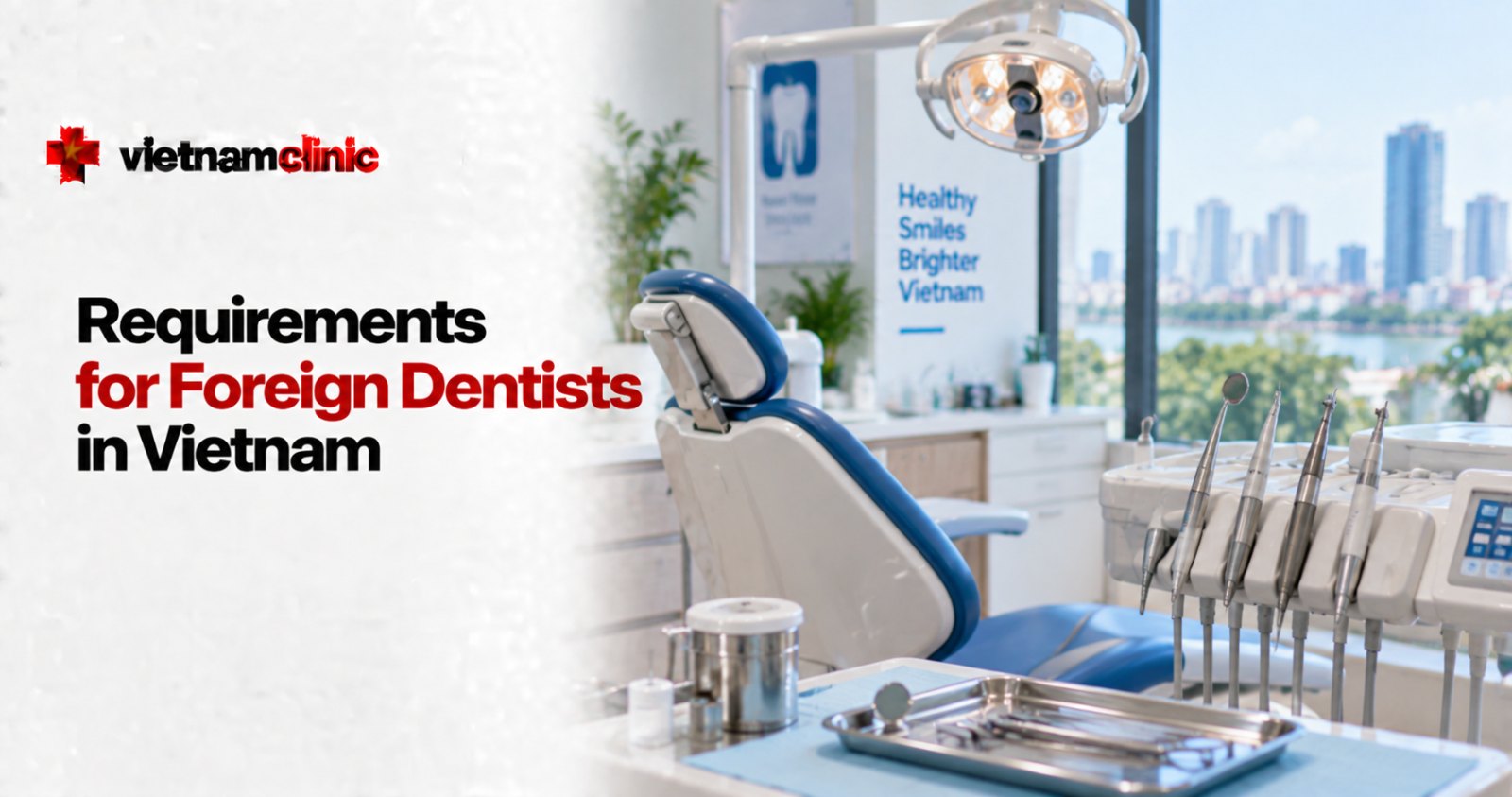
Foreign-qualified dentists can potentially practise in Vietnam, but a dental degree or licence from another country does not automatically authorize someone to treat patients in Vietnam.
Vietnam regulates dentists within its medical examination and treatment framework. In Vietnamese law and administrative procedures, dentistry is generally covered by the professional scope of bác sĩ răng hàm mặt, or oral and maxillofacial doctor/dentist. A foreign dentist therefore needs to establish that the overseas qualification and professional licence correspond to the Vietnamese dental professional scope.
Professional authorization is only one part of the process. A foreign dentist who takes employment in Vietnam must also comply with the rules governing foreign workers, while a dentist who wants to establish a clinic faces additional facility and business requirements.
Can a foreign dentist work in Vietnam?
Yes. Vietnam's regulatory framework allows foreign healthcare practitioners to obtain professional authorization when the applicable requirements are satisfied.
Dentistry is not an unregulated activity that a foreign professional can begin simply because a private clinic is willing to hire them.
A foreign dentist may need to address:
- Recognition of the overseas professional licence
- Recognition or verification of the dental qualification
- Vietnamese practising-licence requirements
- The appropriate dental scope of practice
- Language requirements
- Registration of professional practice
- Employer credentialing
- Work authorization as a foreign national
- Immigration requirements connected with employment
These processes overlap, but a work permit does not replace a healthcare practising licence, and a practising licence does not automatically grant permission to work for a particular employer.
How Vietnam classifies dentists
Vietnamese regulations refer specifically to bác sĩ răng hàm mặt, which corresponds to a doctor practising within the oral and maxillofacial or dental scope.
Decree 96/2023/ND-CP provides that qualifications eligible for the doctor professional title with a dental scope include a dental or oral and maxillofacial doctor degree. This can include a qualification issued by an overseas educational institution when it is recognised at the appropriate Vietnamese educational level.
The framework also provides a route involving certain medical degrees combined with supplementary dental training under Vietnamese rules.
For a foreign-trained dentist, the important point is that authorities look at what the qualification legally represents, not simply whether the English-language diploma contains the word "dentistry".
Does Vietnam recognise foreign dental degrees?
Foreign educational qualifications may need to be recognised by the competent Vietnamese education authority for the professional licensing route being used.
Vietnam's implementing rules expressly contemplate dental qualifications issued by foreign educational institutions, but they refer to those qualifications being recognised at the level corresponding to a Vietnamese dental doctor qualification.
This can make degree documentation important.
A foreign dentist should be prepared to provide more than a diploma title. Authorities may need information such as:
- Degree certificate
- Academic transcript
- Programme duration
- Clinical training
- Curriculum information
- Internship or supervised-practice information
- Postgraduate specialty training where relevant
Do not assume that a dental degree recognised for practice in one country will automatically be treated as equivalent in Vietnam without review.
Can Vietnam recognise an overseas dental licence?
Yes, Vietnamese law provides a procedure for considering recognition of practising licences issued by competent foreign authorities.
A foreign practising licence can be considered when the legal conditions are met, including that the licence remains valid and represents a professional title corresponding to a regulated healthcare profession in Vietnam.
Recognition can depend on the relationship between Vietnam and the foreign licensing system and whether the issuing authority has been accepted under Vietnam's recognition framework.
In 2026, Vietnam's published administrative procedure provides a route for submitting a foreign practising licence for recognition and distinguishes between licensing authorities that have already been assessed and those that still require evaluation.
Recognition should never be assumed solely because the dentist is fully licensed in their home country.
Why recognition of a foreign licence can be important
Recognition can substantially change the licensing pathway.
Under Vietnam's healthcare law, a person whose foreign practising licence is formally recognised is exempt from the standard practice-period requirement and from the professional competency assessment that otherwise forms part of the licensing framework.
For an experienced foreign dentist, this can be a major distinction.
If the overseas professional licence is not recognised, the applicant may instead need to satisfy the standard Vietnamese route, including the qualification and competency requirements applicable at the time of application.
This is why another foreign dentist's experience is not necessarily a reliable template for your own application.
Do foreign dentists need a Vietnamese practising licence?
For ordinary clinical practice, a dentist needs the professional authorization applicable in Vietnam.
Recognition of an overseas licence does not simply mean that the foreign document itself becomes a permanent substitute for Vietnamese licensing procedures. It is used within the Vietnamese regulatory process.
Vietnamese practising licences specify the professional title and scope of practice, and current licences are issued for a limited period rather than indefinitely.
The authority handling the application depends on the healthcare facility and jurisdiction involved. The Ministry of Health handles certain professionals working at facilities under its management, while provincial health authorities handle many other civilian healthcare professionals.
A dentist considering employment should ask the clinic or hospital which authority will process the professional licence and which dental scope will appear on it.
Do dentists have to take Vietnam's competency assessment?
Vietnam is introducing professional competency assessment in stages.
The National Medical Council begins competency assessment for the doctor professional title from 1 January 2027. Dentistry falls within the doctor category for this purpose, with regulations specifically identifying the doctor title with an oral and maxillofacial dental scope.
The qualification rules expressly include foreign dental degrees recognised at the appropriate level among the qualifications that can be used for the competency-assessment pathway.
However, there is an important exception: a practitioner whose foreign practising licence is formally recognised in Vietnam is exempt from the competency assessment under the current law.
For a dentist planning to apply around 2027, the first question should therefore be whether the overseas licence qualifies for recognition.
What if you apply before 2027?
Vietnam's healthcare law contains transitional rules for the introduction of competency assessment.
The National Medical Council starts assessing the doctor professional title from 1 January 2027. Applications made during the transitional period before that date are therefore handled under the applicable transitional licensing framework rather than the new doctor competency assessment.
That timing does not remove the other requirements concerning qualifications, health, language, professional scope and lawful practice.
Anyone planning an application close to the transition should obtain current guidance before relying on an older description of the procedure.
Do foreign dentists need to speak Vietnamese?
Vietnamese is the standard language used in medical examination and treatment, but the law provides specific arrangements for foreign healthcare practitioners.
Foreign practitioners can use another registered language in circumstances allowed by the law, including when treating foreign patients or patients who can communicate in the registered language.
Current licensing procedures also recognise arrangements involving Vietnamese-language proficiency or a medically qualified interpreter, depending on the practitioner's situation.
For a dentist who mainly expects to treat expatriates or medical tourists, this can be particularly relevant.
However, working in an international clinic does not mean Vietnamese becomes irrelevant. Dental practice can require communication with:
- Dental assistants
- Nurses
- Laboratory technicians
- Reception staff
- Pharmacists
- Other specialists
- Vietnamese patients and relatives
Emergency communication, consent, medical records and treatment coordination also need to work safely within the local system.
For the patient perspective, How to Choose an English-Speaking Clinic in Vietnam explains why a clinic advertising in English does not necessarily mean every part of care operates entirely in English.
Does the language requirement change in the future?
Vietnam's 2023 healthcare law includes a staged implementation of the Vietnamese-language proficiency requirement for foreign practitioners.
The statutory proficiency requirement is scheduled to apply from 1 January 2032, with transitional arrangements operating before then.
Foreign dentists planning a long-term career in Vietnam should therefore not assume that the language framework in place in 2026 will remain unchanged indefinitely.
Even where an interpreter arrangement is legally acceptable, an employer may independently prefer or require dentists who can communicate directly in Vietnamese.
What documents should a foreign dentist prepare?
The exact file varies according to the licensing route, but it is sensible to prepare a detailed professional dossier before relocating.
Documents may include:
- Passport
- Dental degree
- Academic transcript
- Detailed curriculum
- Clinical-training evidence
- Current foreign dental licence
- Certificate of professional standing where required
- Previous employment certificates
- Specialist dental qualifications
- Continuing professional development records
- Health documentation
- Language documentation where relevant
- Other documents required by the licensing authority
Foreign documents may need translation, authentication or legalization depending on the procedure.
Obtaining detailed university records before leaving the country where you trained can save considerable time later.
What about dental specialists?
A basic right to practise dentistry does not automatically establish that a dentist can perform every specialist procedure.
An orthodontist, implant dentist, oral surgeon, prosthodontist or other specialist may need evidence supporting the requested professional scope or the clinic's internal credentialing decision.
Useful documents can include:
- Postgraduate degrees
- Residency or specialist training
- Procedure logs
- Previous hospital or clinic appointments
- Professional references
- Continuing education
The healthcare facility also has responsibility for ensuring practitioners perform within an appropriate professional scope.
This is particularly relevant for complex procedures such as implant surgery. From the patient side, How Much Does a Dental Implant Cost in Vietnam? illustrates how Vietnam's private dental market includes implant and restorative treatment aimed at both local and international patients.
Do foreign dentists need a work permit?
Professional dental licensing and foreign-worker authorization are separate.
Vietnam's current framework for foreign workers is governed principally by Decree 219/2025/ND-CP, effective from 7 August 2025.
A foreign dentist employed by a dental clinic, hospital or healthcare company generally needs to satisfy the employment rules applicable to foreign workers unless a specific exemption applies.
The employer is normally closely involved because the work authorization relates to a particular employment arrangement.
Do not assume that any of the following alone grants permission to work clinically:
- A tourist visa
- Residence in Vietnam
- A foreign dental licence
- A Vietnamese practising licence
- A signed employment contract
The professional and employment requirements need to be considered together.
Can you work while the licence is being processed?
A foreign dentist should not assume that clinical dental work can begin merely because an application has been submitted.
Vietnamese law requires healthcare professionals performing regulated examination and treatment to satisfy the applicable practising conditions.
There are limited frameworks for supervised practice, medical training, humanitarian activity and technical transfer, but these should not be treated as a general shortcut for normal paid dental employment.
A dental company may potentially employ someone in a genuinely non-clinical position while professional licensing is incomplete, but the actual duties matter more than the title.
For example, international patient coordination is different from examining a patient, administering anaesthesia, preparing a tooth or placing an implant.
Where might foreign dentists find work?
The most realistic opportunities are likely to be within private dental organisations serving international patients or requiring expertise that the employer specifically values.
The largest markets include:
- Ho Chi Minh City
- Hanoi
- Da Nang
These cities have significant private dental sectors, international residents and medical-tourism activity.
Potential employers include:
- Private dental clinics
- Dental hospitals
- Multispecialty private hospitals
- International patient centres
- Dental groups serving medical tourists
When contacting an employer, ask a precise question:
"Do you currently employ foreign dentists who hold Vietnamese practising licences?"
That provides much more useful information than simply asking whether the clinic employs foreigners.
Why dental tourism may create opportunities
Vietnam has developed a visible private dental market serving both Vietnamese and international patients.
Dental implants, crowns, cosmetic dentistry and restorative procedures are among the treatments that can attract patients travelling for care.
A foreign dentist with relevant clinical experience and language skills may therefore be useful to certain employers, particularly when the clinic treats patients from the dentist's home market.
However, medical-tourism demand does not create an exemption from licensing rules.
Medical Tourism in Vietnam: A Step-by-Step Guide explains the broader international-patient market in which many private healthcare providers operate.
Is speaking English enough?
No. English can be commercially valuable, but it is not a replacement for professional qualifications, Vietnamese regulatory compliance or safe communication within the dental team.
Additional languages may be valuable in clinics treating patients from countries such as South Korea, Japan, Australia, the United States or European markets.
But a dentist's value to an employer also depends on factors such as:
- Clinical experience
- Specialty training
- Treatment outcomes
- Ability to manage complications
- Professional references
- Patient communication
- Ability to work within the local clinical team
Language is one part of the professional profile rather than the entire qualification.
What about salaries for foreign dentists?
There is no reliable single salary specifically for foreign dentists in Vietnam.
Private dental compensation can vary according to:
- Experience
- Specialty
- Patient volume
- Procedures performed
- Employer
- City
- Working schedule
- Commission or revenue-sharing arrangements
Private dentistry often uses compensation structures that differ from fixed public-sector salary systems.
A contract may include a base salary plus a percentage of treatment revenue, or another performance-linked arrangement.
Foreign dentists should therefore ask whether a quoted figure is:
- Guaranteed salary
- Expected total income
- Salary plus commission
- Procedure-based compensation
- Maximum earnings under performance targets
Can a foreign dentist open a dental clinic?
Obtaining an individual practising licence does not by itself authorize someone to establish and operate a dental clinic.
Healthcare facilities have separate licensing requirements covering matters such as:
- Premises
- Equipment
- Professional staffing
- Technical scope
- Responsible clinical leadership
Vietnam's Ministry of Health has confirmed that the person responsible for the professional and technical operations of a dental clinic must practise full time at the facility, have an appropriate dental scope and generally have at least 36 months of practice in that scope for the relevant responsibility requirement.
Foreign ownership or investment can introduce additional corporate and investment-law questions.
A foreign dentist considering ownership should therefore distinguish among three separate issues:
- Personal professional licensing
- The healthcare facility's operating licence
- The legal structure of the business and investment
Can you simply rent a chair in an existing clinic?
The commercial arrangement does not remove professional regulation.
Whether a dentist is salaried, paid commission, contracted by session or working under another arrangement, performing regulated dental treatment still requires the appropriate professional scope and legal employment structure.
A clinic should also ensure that procedures performed fall within its licensed technical activities.
A casual arrangement with a clinic should not be accepted as proof that all regulatory requirements have been completed.
How long does a Vietnamese practising licence last?
Under the current Law on Medical Examination and Treatment, a practising licence is valid for five years.
A foreign dentist planning to remain in Vietnam long term therefore needs to consider renewal rather than treating initial licensing as a permanent authorization.
Employers should also monitor professional credentials as part of clinical governance.
A practical pathway for a foreign dentist
A sensible sequence is:
- Keep your overseas dental licence valid. A current foreign licence may be important for recognition.
- Collect your educational records. Obtain the dental degree, transcript, curriculum and evidence of clinical training.
- Prepare specialty documentation. Include postgraduate qualifications if you intend to practise orthodontics, oral surgery or another advanced area.
- Identify clinics that genuinely employ foreign dentists. Prior experience with foreign practitioners can make the administrative process clearer.
- Establish whether your foreign practising licence can be recognised in Vietnam.
- Confirm recognition of the dental qualification where required.
- Clarify language requirements or interpreter arrangements.
- Determine whether the competency assessment applies to your route and application date.
- Complete the Vietnamese practising-licence process.
- Complete the foreign-worker process with the employer.
- Complete the clinic's own credentialing before treating patients.
Several stages may overlap when an employer assists with the process.
Questions to ask a dental clinic before accepting a job
Before signing a contract or relocating, ask:
- Have you employed foreign dentists before?
- Do your current foreign dentists hold Vietnamese practising licences?
- Which authority will handle my professional application?
- Can my foreign dental licence be recognised?
- Does my overseas degree require additional recognition?
- What dental scope will appear on my licence?
- Will I need the competency assessment?
- What language will I register for clinical practice?
- Will a medical interpreter be required?
- Who pays for translation and legalization?
- Who handles the work permit?
- Which procedures will the clinic credential me to perform?
- What happens if the professional licence is delayed?
A legitimate healthcare employer should understand that professional licensing and work authorization are separate processes.
What to remember
Foreign dentists can potentially practise in Vietnam, but overseas dental qualifications and licences do not automatically transfer.
Vietnam treats dental practice within the regulated doctor framework, specifically the professional scope for oral and maxillofacial dentistry. Foreign dental qualifications can be considered within the Vietnamese system, and foreign practising licences can be formally recognised when the legal conditions are satisfied.
Recognition matters because a recognised foreign licence can exempt the practitioner from the ordinary practice-period and competency-assessment requirements.
For dentists following the standard pathway, the doctor competency-assessment framework begins from 1 January 2027.
The dentist must also satisfy the applicable language arrangements and separately comply with Vietnam's rules for foreign workers.
Before relocating, the most useful step is to approach potential employers and the competent health authority with your exact dental qualification, current professional licence and intended clinical scope. That provides a much more reliable answer than assuming that the route used by another foreign dentist will apply to you.
Frequently Asked Questions
The questions below cover common searches about the requirements for foreign dentists in Vietnam.
Can a foreign dentist work in Vietnam?
Yes. Foreign dentists can potentially practise in Vietnam when they satisfy the professional licensing, qualification, language and foreign-worker requirements applicable to their situation.
Does Vietnam recognise foreign dental licences?
Vietnam has a formal procedure for considering recognition of practising licences issued by competent foreign authorities. Recognition is not automatic for every licence or country and depends on the statutory conditions and the issuing authority.
Does a foreign dental degree need to be recognised in Vietnam?
Vietnam's licensing rules expressly contemplate dental qualifications issued by foreign educational institutions when they are recognised at the appropriate Vietnamese educational level. The exact recognition requirements depend on the applicant's licensing route.
Do foreign dentists need to take an exam in Vietnam?
The competency-assessment framework for the doctor professional title begins from 1 January 2027, and the dental or oral and maxillofacial doctor scope falls within that framework. A practitioner whose foreign practising licence is formally recognised in Vietnam is exempt from the competency assessment under the current law.
Do foreign dentists need to speak Vietnamese?
Vietnamese is the standard healthcare language, but foreign practitioners can use another registered language in situations allowed by law. Transitional rules and qualified interpreter arrangements may apply, although employers may still require Vietnamese for practical clinical communication.
Does a foreign dentist also need a work permit?
Professional dental licensing and foreign-worker authorization are separate. A dentist employed in Vietnam generally needs to comply with the foreign-worker framework under Decree 219/2025/ND-CP unless a specific exemption applies.
Sources

Writer
Tan Nguyen
Medical writer for Vietnam Clinic. MD, Vietnam National University Ho Chi Minh City.