Source-based provider information
About Binh Dan Da Nang Hospital
Binh Dan Da Nang Hospital's Physical Therapy and Rehabilitation Department is a hospital-based service at 376 Tran Cao Van in Thanh Khe, Da Nang. The department treats inpatients and outpatients with needs related to medical illness, surgery, orthopaedic injury and neurological conditions. Its official description includes physiotherapists, speech and language therapists, and orthotics and prosthetics personnel, with patients ranging from infants and children to adults and older people.
This profile focuses on rehabilitation rather than every specialty available at the 100-bed private general hospital. Being inside a hospital can be useful when rehabilitation needs medical review, imaging, surgery follow-up or coordination with another department. It does not mean that every patient needs hospital admission, or that every treatment named on an older department page is appropriate without a current assessment.
Assessment and individual rehabilitation planning
The department says rehabilitation staff assess functional condition and build a programme around the patient's needs. Published elements include manual techniques, massage, therapeutic exercise and home or activity guidance. For an international patient, the most important first step is to clarify the diagnosis, current restrictions and measurable goal: for example, safer transfers, greater joint movement, walking with an aid, improved balance, return to daily activity or communication support.
Bring recent medical notes, operation reports, imaging, medication details and any existing rehabilitation plan. If documents are not in Vietnamese, ask whether an English summary is sufficient and whether interpretation can be arranged. The hospital does not publish a department-level language list, so an English website or a telephone booking should not be taken as proof that an English-speaking therapist will be available throughout treatment.
Orthopaedic, spine and pain-related rehabilitation
The official department page lists rehabilitation for neck and back pain, cervical and lumbar degeneration, disc-related conditions, sciatica, shoulder and neck pain, and knee, shoulder and hip disorders. It also describes recovery after fractures, dislocations and surgery. These categories are broad. A therapist should distinguish a routine mobility problem from symptoms that need medical assessment before exercise or physical modalities begin.
Published movement work includes joint-range exercises, gait correction and balance training. Treatment may also involve manual therapy or massage. Ask how progress will be measured, which activities are safe between visits and what would trigger a change of plan. Do not assume that a machine or passive modality can replace progressive activity, strength work or review of an unresolved diagnosis.
Neurological recovery and walking practice
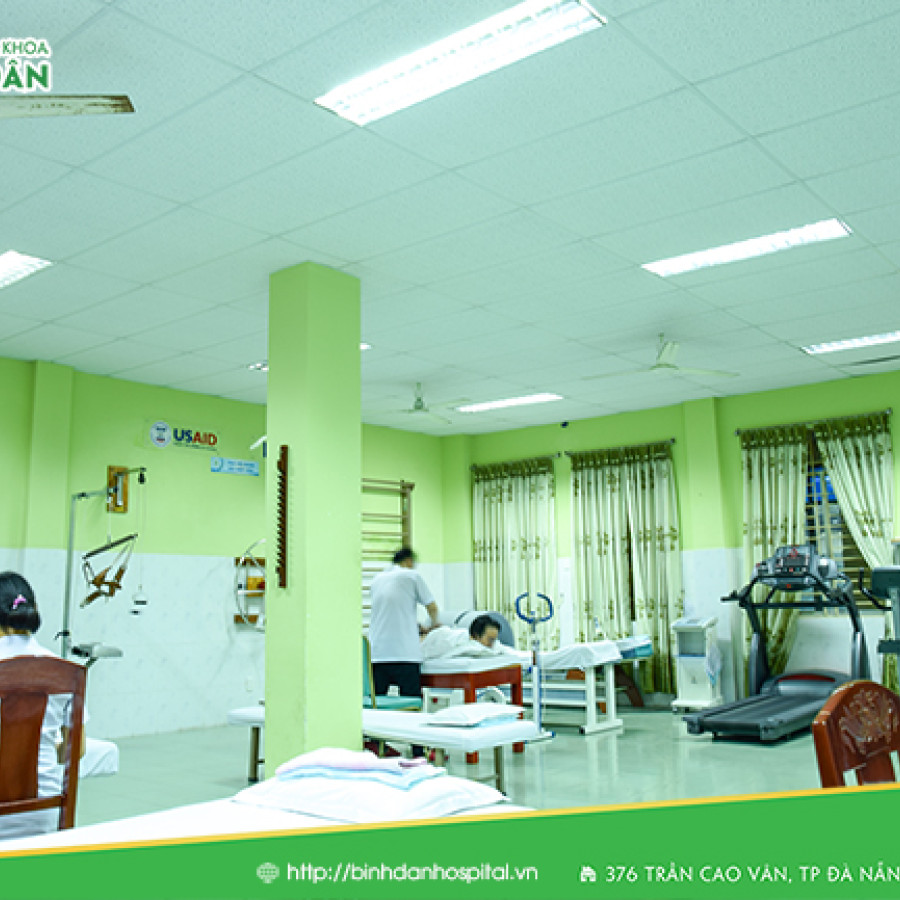
Post-stroke rehabilitation is a stated part of the department's work, together with peripheral nerve problems and residual weakness. The equipment list includes parallel bars, rehabilitation stairs, standing and seated exercise bicycles, a treadmill, balance boards, wall bars and exercise balls. Separate practice areas are described for people with restricted mobility and for standing work.
Stroke rehabilitation may involve mobility, balance, transfers and daily-function goals; the department also identifies speech and language expertise. Ask whether the relevant professional is available on the proposed day and whether the patient needs a physician referral. Sudden facial droop, new limb weakness, speech disturbance, severe headache or loss of balance is not a routine rehabilitation issue: it requires urgent stroke assessment rather than waiting for a therapy appointment.
Rehabilitation for children and developmental movement needs
The department says it works with infants, children and adolescents with postural and motor-development disorders. Paediatric rehabilitation should be matched to a child's age, diagnosis and family priorities. Parents should ask who will perform the assessment, what paediatric training that professional has, how goals are set and whether caregiver exercises will be demonstrated.
Bring previous developmental assessments, neurology or orthopaedic reports, school or therapy notes and information about mobility or communication equipment. A general list of paediatric conditions does not prove availability for every complex developmental need. Confirm whether the hospital can provide the required frequency and multidisciplinary follow-up before starting a course, particularly if the family will leave Da Nang soon.
Speech, language, orthotics and prosthetics support
The department's team description names speech and language therapists and professionals working with orthotic devices and artificial limbs. These are distinct services, not interchangeable parts of general physiotherapy. Ask specifically whether speech assessment, swallowing work, communication rehabilitation, brace fitting or prosthetic review is offered for the current condition and whether an appointment with another department is required first.
For an existing brace or prosthesis, bring the device and any fitting records. Describe pressure areas, skin problems and changes in walking. A device may require adjustment rather than simply more exercise. For speech or swallowing symptoms after a neurological event, request the appropriate clinician; coughing with meals, recurrent choking, unexplained weight loss or aspiration concerns may also require medical and swallowing assessment.
Physical modalities and treatment equipment
The department lists infrared treatment, electrical stimulation, therapeutic ultrasound, cervical and lumbar traction, electromagnetic treatment, short-wave therapy and acupuncture. It also mentions electrotherapy for pain relief. These modalities have different indications and contraindications, and the page does not establish that every option is currently available or suitable for every diagnosis.
Before treatment, disclose pregnancy, implanted electronic devices, reduced skin sensation, circulation problems, cancer treatment, recent surgery and any metal or hardware near the treatment area. Ask why a modality is proposed, what benefit is expected, how many sessions will be reviewed and what active rehabilitation accompanies it. Avoid claims of guaranteed pain relief or complete recovery: the hospital's promotional outcome wording is not evidence for an individual prognosis.
Preparing for a hospital rehabilitation visit
Wear clothing that allows the relevant joint or limb to be examined and bring stable footwear plus any cane, walker, brace or prosthesis normally used. Carry identification, hospital records, prescriptions, imaging and insurance documents. Write down when symptoms began, what worsens them and what daily tasks are limited. Patients after surgery should bring the surgeon's weight-bearing, wound and movement restrictions.
The hospital's appointment process asks for the patient's name, telephone number, reason for consultation and intended date. It advises booking at least one day in advance, waiting for confirmation and reporting to customer service in the main lobby on arrival. Because the rehabilitation page does not publish a direct department number, use the hospital booking channel and explicitly request Khoa Vật lý trị liệu – Phục hồi chức năng.
Hours, booking and the Thanh Khe location
The current hospital footer publishes Monday-to-Saturday hours of 07:30–12:00 and 13:00–16:30, while an older appointment notice gives a different general timetable. These are hospital hours, not a guarantee that every rehabilitation professional or modality operates for the entire period. Confirm the department's session time in the appointment response before travelling.
The customer-service number is 0236 7105 888 and the official site also publishes 02363 714 030. The address is 376 Tran Cao Van, Thanh Khe, Da Nang. Ask which entrance and floor to use, whether assistance is available from the drop-off point, and how early a first assessment should arrive. Google-derived claims about parking, accessibility, payment or ownership have been removed because they were not verified on the hospital's own pages.
Costs, Vietnamese health insurance and written estimates
The hospital states that it accepts Vietnam's social health insurance, or BHYT, and its older rehabilitation page discusses coverage for patients registered there as their initial facility. Eligibility, referral rules, co-payments and covered techniques can change, so the historic percentage and promotional self-pay prices are not presented here as current guarantees. International travel and private insurance are separate arrangements.
Before a course begins, request the assessment fee, price per session, expected number of visits and separate charges for equipment or other departments. Ask whether direct billing is available or whether payment and reimbursement documents must be handled by the patient. Obtain invoices, clinical notes and a treatment summary if claiming from an overseas insurer or continuing rehabilitation in another country.
When another department or urgent care is needed
Rehabilitation is appropriate only after urgent problems have been recognised. New severe weakness, loss of bladder or bowel control, saddle numbness, major trauma, a hot swollen joint with fever, wound infection, chest pain or serious breathing difficulty needs prompt medical assessment. A rapidly worsening neurological problem should not be managed as a standard therapy session.
Hospital-based care can support referral when a patient needs orthopaedic, neurological, surgical or diagnostic review, but confirm the route at registration. Visitors who want to compare the practical differences between hospital departments and independent providers can use our guide to physiotherapy and rehabilitation centres in Da Nang. The right setting depends on diagnosis, medical stability, language needs, equipment, follow-up time and the qualifications required for the specific goal.
Services and facilities
- Rehabilitation assessment
- Individual rehabilitation planning
- Therapeutic exercise
- Joint range-of-motion training
- Gait training
- Balance training
- Post-stroke rehabilitation
- Postoperative rehabilitation
- Fracture and dislocation rehabilitation
- Paediatric motor rehabilitation
- Speech and language therapy
- Orthotics support
- Prosthetics support
- Manual therapy
- Electrotherapy
- Therapeutic ultrasound
- Spinal traction
- Infrared therapy
- Short-wave therapy
- Acupuncture
Specialties
- Physical medicine and rehabilitation
- Physiotherapy
- Neurological rehabilitation
- Orthopaedic rehabilitation
- Paediatric rehabilitation
- Speech and language therapy
- Orthotics and prosthetics