Source-based provider information
About Dr. Van Truong Aesthetics
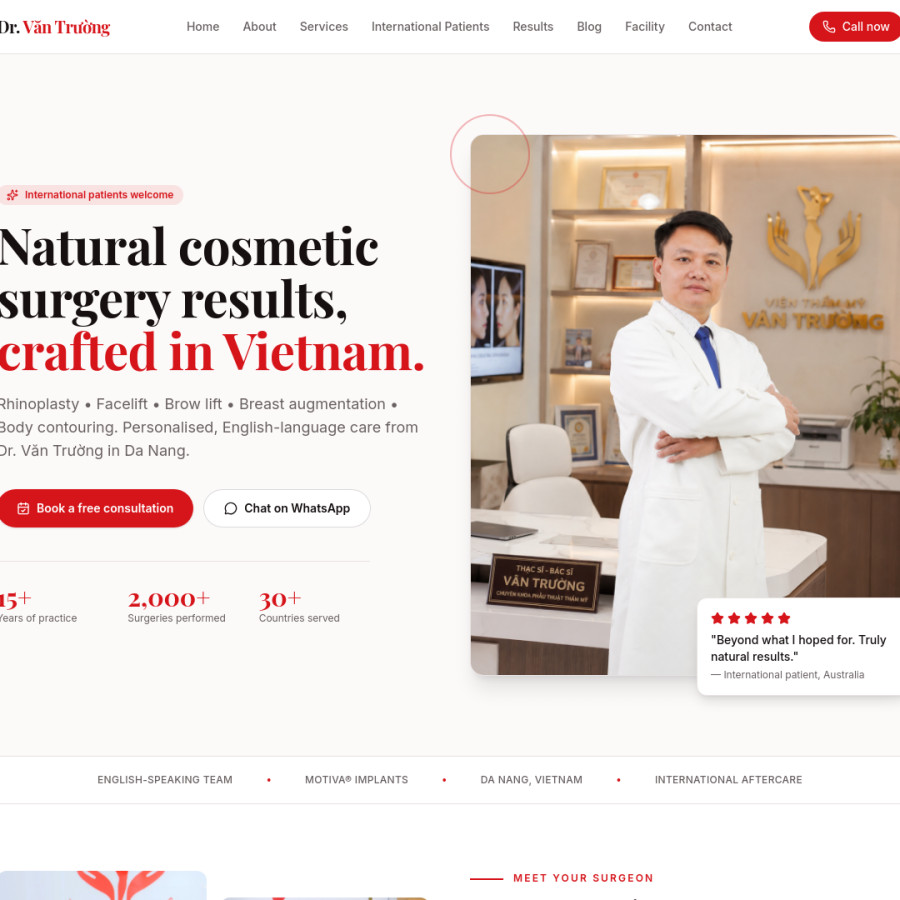
Dr. Van Truong Aesthetics is a cosmetic-surgery practice at 67 Nguyen Tri Phuong, Da Nang. Its published surgical focus includes primary and revision rhinoplasty, eyelid and brow procedures, facelift, breast augmentation and body contouring. The practice markets directly to international patients and provides an English-language pathway from remote consultation through in-person assessment, surgery and follow-up.
The website identifies Dr. Van Truong as a Master of Plastic and Aesthetic Surgery and describes more than twenty years in practice. Those credentials and experience figures are provider-published statements; prospective patients should still ask to see the current practitioner licence, facility operating documentation and the exact hospital or theatre details before surgery. No verifiable licence number is displayed on the official pages reviewed, so this profile does not invent one.
A surgeon-led rather than network model
The practice is built around a named surgeon rather than a large multi-department hospital brand. That can make responsibility easier to identify, but it also makes it important to establish who handles every stage. Ask whether Dr. Van Truong personally conducts the consultation, performs the whole operation and attends postoperative reviews, and who provides cover if he is unavailable.
The website states that an anaesthesiology team supports surgery and shows an operating theatre, recovery facilities and an international patient room. Before booking, confirm the legal facility name and address where the operation will occur. A consultation address, operating location and overnight recovery location are not always the same in private aesthetic care.
Primary and revision rhinoplasty
Rhinoplasty is the most detailed service on the official site. The practice describes assessment of facial proportions, skin thickness, nasal structure, bridge height, tip projection and the relationship between the nose, chin and jawline. Primary rhinoplasty is offered for people without previous nasal surgery, while revision work addresses earlier operations, asymmetry, implant problems, loss of support, scar tissue or breathing concerns.
A revision procedure may require cartilage grafting or structural reconstruction and is generally less predictable than a first operation. Bring every available operative note, implant record and earlier photograph. Ask where graft material would come from, what will happen to an existing implant and whether functional breathing issues need assessment by an ear-nose-throat specialist. Cosmetic improvement and airway treatment should not be assumed to be the same operation.
Eye rejuvenation and brow lift
The signature menu includes eyelid surgery, under-eye fat treatment and brow lift. These procedures address different anatomical causes of a tired or heavy appearance. Removing eyelid tissue, repositioning fat and lifting the brow are not interchangeable, and combining them can change recovery and risk.
Tell the surgeon about dry eyes, previous eye surgery, vision problems, thyroid disease and use of contact lenses. Ask about eyelid closure, asymmetry, scarring, altered sensation and the possibility of revision. Someone with functional visual-field obstruction or active eye disease may need an ophthalmic assessment rather than purely aesthetic planning.
Facelift and facial rejuvenation
Facelift is presented for the mid and lower face, alongside non-specific anti-ageing and facial-rejuvenation care. The exact depth and extent of surgery matter more than the word “facelift.” Ask whether the plan involves skin only, deeper tissue, neck work, fat transfer or another combined procedure.
Clarify incision placement, anaesthesia, drains, overnight observation and how long visible swelling or bruising may affect travel. A subtle appearance is a goal rather than a guaranteed result. Facial nerve injury, haematoma, wound-healing problems, hairline changes and asymmetry belong in the consent discussion even when marketing emphasises natural outcomes.
Breast augmentation
The practice advertises breast augmentation with Motiva implants. A brand name is only one part of informed choice. Patients should receive the implant model, size, profile, surface, placement, incision, warranty information and a permanent device record after surgery. Ask how sizing is decided and what alternative would be recommended if the preferred implant is unsuitable.
Discuss capsular contracture, infection, changes in nipple sensation, asymmetry, rupture, future imaging and the possibility of further surgery. Anyone planning pregnancy, breastfeeding or major weight change should mention the timing. Confirm how postoperative concerns are managed after returning home and whether a local clinician can receive the operative and implant documentation.
Liposuction and body contouring
Body contouring on the site includes liposuction and sculpting, with photographs of abdominal and back-fat cases. It is not a treatment for general obesity and cannot guarantee smooth or symmetric contours. The safe plan depends on treated areas, total volume, skin quality, medical history and whether fat transfer or another operation is combined.
Ask what technique is proposed, who administers anaesthesia, whether an overnight stay is expected and how clot prevention and early mobilisation are handled. A compression garment, wound care and activity restrictions should be specified before travel. Combining several large procedures for convenience may lengthen anaesthesia and recovery, so the rationale should be clinical rather than purely logistical.
Remote consultation for international patients
The practice offers a free video consultation through WhatsApp or Zoom. Patients can send photographs and goals and receive a preliminary plan, quotation and timeline. This is useful for travel planning, but photographs cannot replace physical examination, anaesthetic assessment or final consent. The plan may need to change after arrival.
Send images only through a channel whose privacy terms you accept and ask how they will be stored. Include an accurate medical history rather than only aesthetic photographs. Never make travel or payment non-refundable until the practice explains what happens if in-person assessment finds that surgery should not proceed.
English-language coordination and travel support
The official site explicitly offers an English-speaking team, international coordination, airport pickup and hotel assistance. Confirm which services are included in the surgical quote and which are simply arranged on the patient's behalf. Ask whether the coordinator is an interpreter, a nurse or an administrative contact; these roles carry different responsibilities.
English support should cover consent, medicine instructions and urgent follow-up, not only sales messages. If anaesthesia or complex risk is being discussed, verify that the clinician and patient can communicate directly or through a competent medical interpreter. Keep written copies of all instructions for use after leaving Vietnam.
Planning the length of stay
The rhinoplasty page suggests that many international patients plan 10–14 days in Da Nang, depending on the procedure. This is guidance, not a universal clearance to fly. Breast, facelift, body-contouring or combined surgery may require a different stay and recovery milestones.
Build time for the in-person examination, testing, operation, early review and any suture or drain management. Ask the surgeon when long-haul flying, swimming, exercise, sun exposure and lifting luggage are permitted. A return ticket should allow change if healing is slower than expected. Travelling alone immediately after anaesthesia is unwise; arrange a responsible adult for at least the early recovery period.
Anaesthesia, theatre and recovery
The site describes a hospital-grade operating theatre, full anaesthesia support and a recovery area. These are important statements but do not replace documentary verification. Ask for the facility's current operating licence, the anaesthesiologist's credentials, emergency equipment, transfer agreement and the general hospital used if higher-level care is needed.
Pre-operative testing and fasting instructions must come from the clinical team. Disclose smoking and nicotine, allergies, sleep apnoea, previous anaesthetic problems and every medicine or supplement. Do not independently stop anticoagulants, diabetes medication, hormones or psychiatric treatment to fit an operation date.
Aftercare once the patient returns home
The practice advertises in-clinic aftercare followed by WhatsApp contact after departure. Before surgery, obtain a written schedule showing who reviews wounds, when photographs are expected, what symptoms need a call and how quickly the surgeon responds across time zones. Remote follow-up cannot examine a wound, measure vital signs or perform imaging.
Request an operative report, anaesthetic record, implant details where relevant, discharge summary and medicine list. Identify a clinician at home willing to assess the patient if needed. Severe bleeding, breathing difficulty, chest pain, fainting, increasing one-sided swelling, high fever or signs of infection require urgent local care rather than waiting for a chat reply.
Costs and payment options
The official rhinoplasty FAQ says the practice accepts international wire transfer, major credit cards and on-site cash or card payment. Ask which payment is used for a deposit, when the balance is due, what currency conversion applies and whether bank or card fees are extra. Obtain a receipt and an itemised written quote.
The quote should name the procedure, surgeon, facility, anaesthesia, implants or garments, medicines, room, follow-up and transport or hotel support. Ask what is refundable if assessment changes the plan, the patient becomes unwell or travel is disrupted. Cosmetic surgery is usually not covered by health insurance; no direct-billing arrangement is published.
Location and appointments
The consultation address is 67 Nguyen Tri Phuong, Da Nang, with telephone and WhatsApp contact at +84 907 405 678 and email at thammybacsitruong@gmail.com. No universal opening timetable is published on the current official site, so hours are intentionally left blank. Arrange a precise time rather than arriving on the assumption that an operating practice accepts walk-ins.
Travellers comparing other licensed settings can consult our guide to plastic surgery clinics in Da Nang. Compare the named surgeon, verified facility, anaesthesia, postoperative availability and transfer plan—not only price, testimonials or the convenience of an English landing page.
Questions that should be answered before booking
Ask for the surgeon's current practice licence, the facility operating licence and the exact location of surgery. Confirm the procedure, anaesthesia, foreseeable risks, realistic alternatives, recovery time, emergency transfer arrangements and revision policy. Establish whether before-and-after images represent the same surgeon and comparable anatomy.
A good consultation should also make room for deciding against surgery. Do not proceed if answers are vague, pressure is applied to pay immediately or the final operator differs from the person consulted. Elective aesthetic surgery can be postponed; that is an important safety advantage.
Services and facilities
- Online cosmetic-surgery consultation
- In-person plastic-surgery consultation
- Primary rhinoplasty
- Revision rhinoplasty
- Structural rhinoplasty planning
- Eyelid surgery
- Under-eye fat treatment
- Brow lift
- Facelift
- Facial rejuvenation surgery
- Breast augmentation
- Motiva implant consultation
- Liposuction
- Body contouring
- International patient coordination
- Postoperative follow-up
Specialties
- Plastic and aesthetic surgery
- Rhinoplasty
- Revision rhinoplasty
- Eyelid and brow surgery
- Facelift surgery
- Breast augmentation
- Liposuction and body contouring
Languages
- English