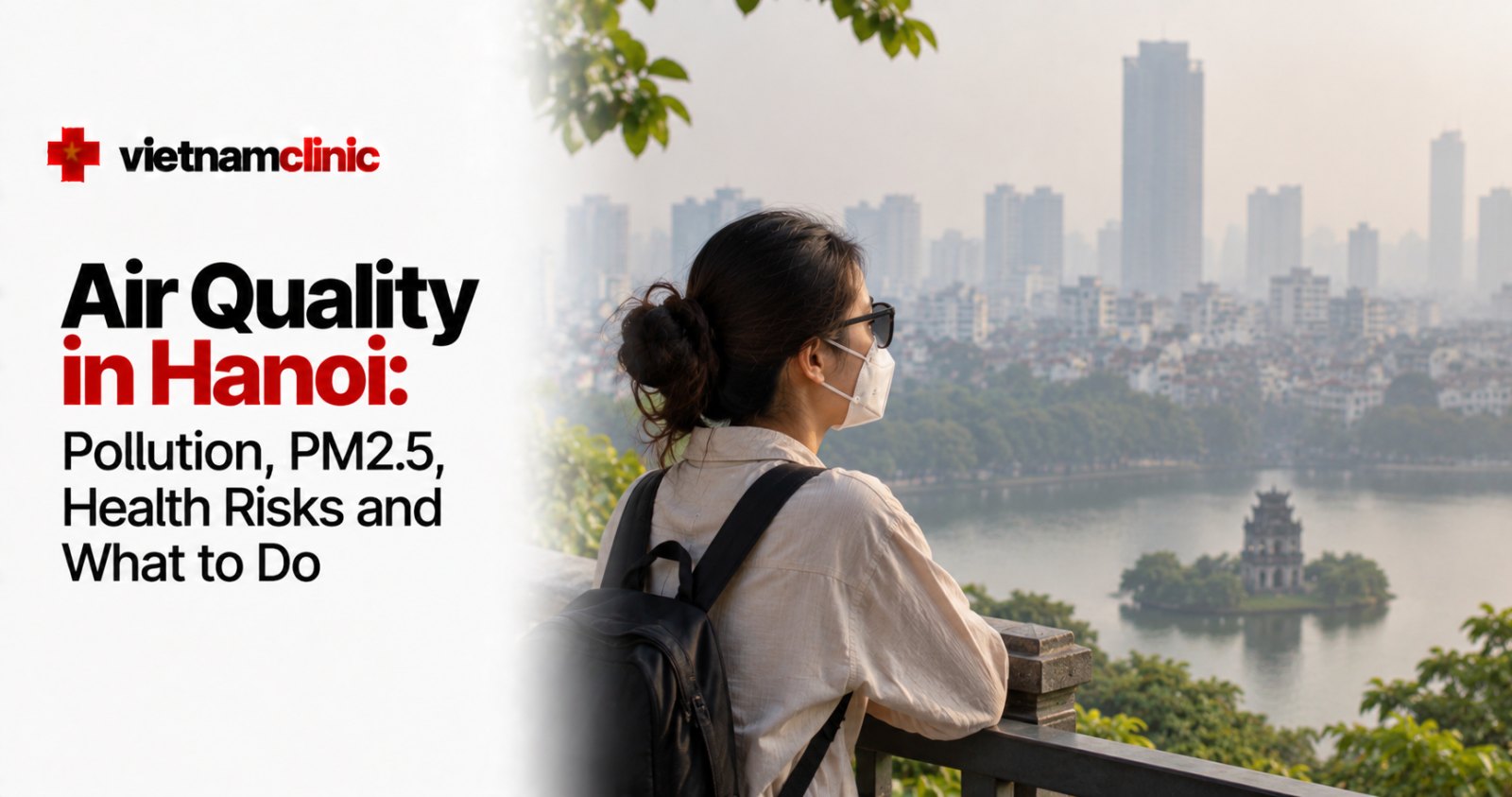
Air quality in Hanoi can vary considerably from day to day, but fine particulate pollution, particularly PM2.5, is a recurring environmental health problem in the Vietnamese capital. Pollution episodes are especially common during the cooler and drier part of the year, when weak winds and atmospheric conditions can prevent pollutants from dispersing.
Hanoi experienced several severe pollution episodes during late 2025 and early 2026. On December 2, 2025, the Vietnamese Government reported an Air Quality Index (AQI) of 283, categorized as very unhealthy. In February 2026, monitoring stations around the city again reported poor to unhealthy conditions, with some individual readings considerably higher.
Air quality can change within hours and differs between neighborhoods, so a single reading should not be treated as representative of the entire city. Residents and travelers should check current local monitoring data, particularly before prolonged outdoor exercise.
Is the air quality in Hanoi bad?
Hanoi regularly experiences periods of poor air quality, particularly when concentrations of PM2.5 rise.
Vietnamese environmental officials have described fine particulate pollution as a serious problem in Hanoi and the surrounding Red River Delta.
During pollution episodes, AQI readings can move into categories considered unhealthy or very unhealthy. Conditions are not permanently bad, however. Rain, stronger winds and changes in weather can improve air quality rapidly.
This means the most useful question is not simply whether Hanoi has polluted air, but what the air quality is today and how long the current pollution episode is expected to last.
What is PM2.5?
PM2.5 refers to airborne particles with a diameter of 2.5 micrometers or less.
Because these particles are extremely small, they can penetrate deep into the respiratory system and can also enter the bloodstream.
The World Health Organization identifies particulate matter as one of the air pollutants with the strongest evidence of harmful health effects.
PM2.5 exposure is associated with increased risks of:
- Respiratory disease
- Cardiovascular disease
- Stroke
- Chronic obstructive pulmonary disease
- Lung cancer
- Respiratory infections
Short periods of high exposure can also worsen symptoms in people who already have respiratory or cardiovascular conditions.
Why is Hanoi's air polluted?
There is no single source responsible for Hanoi's air pollution.
Vietnamese environmental authorities and researchers identify several contributors, including:
- Road traffic
- Vehicle emissions
- Road dust
- Construction activity
- Industrial emissions
- Open burning of waste
- Burning agricultural residues
- Other combustion sources
Weather conditions also strongly influence how much pollution remains near ground level.
In periods of low wind and atmospheric stability, pollutants can accumulate instead of dispersing.
Traffic and air pollution in Hanoi
Traffic is one important contributor to urban pollution.
Hanoi has extremely high volumes of motorcycles, cars, buses and commercial vehicles moving through densely populated streets every day.
Pollution associated with traffic includes both direct exhaust emissions and road dust that is disturbed and resuspended by moving vehicles.
Vietnamese environmental officials reported in late 2025 that fine dust directly associated with vehicles contributed an estimated 12–15% of pollution in the analysis they discussed, while road dust related to traffic activity contributed around 20–30%.
These percentages should not be interpreted as fixed figures for every day or every part of Hanoi because pollution sources vary according to location, weather and season.
Construction and dust
Construction is another significant source of particulate pollution in Hanoi.
Dust can come from:
- Demolition
- Excavation
- Building materials
- Trucks entering and leaving construction sites
- Uncovered materials
- Dust deposited on nearby roads
During severe pollution episodes in December 2025, Hanoi authorities ordered stricter dust-control measures at construction sites, including shielding, cleaning vehicles before they left construction areas and using water mist to reduce dust.
Industrial pollution
Industrial facilities in Hanoi and neighboring provinces can also contribute to regional PM2.5 pollution.
Air pollution does not stop at administrative boundaries. Emissions generated outside central Hanoi can be transported into the city depending on wind and atmospheric conditions.
This is one reason pollution needs to be considered at the scale of Hanoi and the wider Red River Delta rather than only street by street.
Waste and agricultural burning
Open burning can produce substantial smoke and particulate matter.
Vietnamese authorities have identified the burning of household waste, agricultural residues and other materials as contributors to pollution episodes.
Hanoi has introduced measures aimed at detecting and reducing illegal burning, particularly during periods when air pollution is severe.
When is air pollution worst in Hanoi?
Hanoi tends to experience more severe pollution during the cooler and drier months, particularly from late autumn through winter and into early spring.
Vietnamese environmental specialists have repeatedly identified winter as a particularly problematic period.
Several factors contribute:
- Lower wind speeds
- Dry conditions
- Temperature inversions
- Reduced vertical mixing of air
- Accumulation of emissions near the ground
Severe episodes were reported in November and December 2025 and again during February 2026.
Air pollution can occur at other times of year as well, so season alone should not be used to predict daily conditions.
Is Hanoi air quality worse in winter?
Often, yes.
During winter, cooler air near the ground can sometimes become trapped beneath warmer air above it, a phenomenon known as a temperature inversion.
This limits the normal vertical movement of air and can trap PM2.5 and other pollutants close to where people live and breathe.
Low winds can make the situation worse.
When a stronger cold front, wind or rain arrives, pollution levels can sometimes fall rapidly as particles are dispersed or removed from the atmosphere.
Is air quality better after rain?
It often improves temporarily.
Rain can remove some airborne particles, while weather systems associated with rain may also bring stronger winds that disperse pollutants.
However, the improvement may not last if emissions continue and stagnant atmospheric conditions return.
Hanoi experienced this pattern in December 2025, when stronger winds and rain temporarily improved air quality before pollution returned as winds weakened.
What does Hanoi AQI mean?
AQI stands for Air Quality Index.
It converts measurements of air pollutants into a simpler scale intended to help people understand how polluted the air is and whether health precautions may be needed.
Different countries and platforms can calculate or label AQI slightly differently.
This is important when comparing readings from different apps.
As a general principle, higher AQI means worse air quality and potentially greater health risk.
When checking Hanoi's air quality, look not only at the overall AQI but also at the concentration of PM2.5, which is often the main pollutant driving poor readings in the city.
Why do different Hanoi air quality apps show different numbers?
Air quality can differ significantly across Hanoi.
Two monitoring stations may produce different readings because they are located near different sources, such as:
- Major roads
- Residential neighborhoods
- Construction areas
- Industrial zones
- Parks
Apps can also use different monitoring stations, sensors, averaging periods and AQI calculation methods.
A very high reading from one neighborhood does not necessarily mean the entire city has exactly the same pollution concentration.
For this reason, check several nearby stations when possible rather than relying exclusively on a citywide ranking.
Hanoi air quality and health
The health consequences of air pollution depend on both the concentration and duration of exposure.
The World Health Organization states that fine particulate pollution can contribute to respiratory and cardiovascular disease and has associations with stroke, ischemic heart disease, chronic obstructive pulmonary disease, respiratory infections and lung cancer.
Short-term pollution can also trigger or worsen symptoms such as:
- Coughing
- Throat irritation
- Wheezing
- Shortness of breath
- Chest discomfort
- Eye irritation
Many people will not experience obvious symptoms during every polluted day, but absence of symptoms does not mean there is no exposure.
Who is most vulnerable to poor air quality?
Some groups are more likely to experience health effects from air pollution.
These include:
- Children
- Older adults
- Pregnant women
- People with asthma
- People with COPD
- People with cardiovascular disease
- People with other chronic illnesses
WHO guidance identifies children, older people and people with pre-existing medical conditions among populations particularly vulnerable to polluted air.
People in these groups may need to reduce exposure earlier than healthy adults during pollution episodes.
Air pollution and asthma in Hanoi
Air pollution can aggravate asthma symptoms.
Fine particles and other pollutants can irritate and inflame the airways and may contribute to:
- Wheezing
- Cough
- Chest tightness
- Shortness of breath
- Increased need for prescribed reliever medication
People with asthma living in or visiting Hanoi should follow their existing asthma management plan and keep prescribed medication available.
Persistent or worsening breathing difficulty should be medically assessed.
Severe breathlessness, difficulty speaking because of shortness of breath, blue or grey lips or other signs of a serious asthma attack require urgent medical care.
Can Hanoi air pollution cause a sore throat or cough?
Air pollution can irritate the nose, throat and respiratory tract.
During polluted periods, some people may experience:
- Dry or irritated throat
- Cough
- Nasal irritation
- Eye irritation
- Headache
- Breathing discomfort
However, these symptoms can also result from infections, allergies and other conditions.
Do not assume that every cough or sore throat in Hanoi is caused by pollution.
Should you exercise outside when Hanoi air quality is bad?
Reducing prolonged or intense outdoor exercise can lower the amount of pollution inhaled during a severe episode.
This is because exercise increases breathing rate and the volume of air entering the lungs.
During periods of poor air quality, consider:
- Moving training indoors
- Exercising at another time when pollution is lower
- Reducing exercise intensity
- Avoiding heavily trafficked roads
People with asthma, heart disease or other conditions that can be affected by pollution should be particularly cautious.
Is morning air quality worse in Hanoi?
It can be, particularly during some winter pollution episodes.
Low temperatures, weak winds and temperature inversions can allow pollutants to accumulate overnight and during the early morning.
However, there is no rule that every morning will be more polluted than every afternoon.
The most practical approach is to check actual monitoring data before outdoor exercise instead of choosing a time based solely on the clock.
Should you wear a mask for air pollution in Hanoi?
A well-fitting respirator designed to filter fine particles can reduce inhalation of particulate pollution.
For PM2.5, masks such as properly fitted N95, KN95 or comparable particle-filtering respirators generally provide better particle filtration than loose cloth or basic surgical masks.
Fit matters. Air that leaks around the sides of a mask is not being filtered through the respirator material.
Masks do not remove all air-pollution risks and are not a substitute for reducing exposure when pollution is extremely high.
Do surgical masks protect against PM2.5?
Surgical masks are primarily designed for purposes other than creating a tight respirator seal around the face.
They may reduce exposure to some particles, but a properly fitted respirator such as an N95 or equivalent is generally more suitable when the objective is to reduce inhalation of fine particulate pollution.
People who cannot comfortably use a respirator because of a medical condition should seek professional advice.
Do air purifiers help in Hanoi?
Portable air cleaners equipped with suitable particle filtration can reduce indoor particulate concentrations when correctly sized and used.
For PM2.5, HEPA filtration is commonly used.
When choosing an air purifier, consider:
- Room size
- Clean air delivery rate
- Filter availability
- Noise level
- Cost of replacement filters
A small purifier designed for a bedroom may not be adequate for a large open apartment.
How to keep indoor air cleaner
During severe outdoor pollution episodes, practical steps can include:
- Closing windows when outdoor air quality is poor
- Using an appropriately sized air purifier
- Checking that air-conditioner filters are maintained
- Avoiding indoor smoking
- Avoiding unnecessary candles or incense
- Reducing other indoor combustion sources
When outdoor air improves, ventilation may again be useful.
The objective is not necessarily to keep a home permanently sealed but to limit the introduction of heavily polluted outdoor air during the worst periods.
Can air conditioning remove PM2.5?
Standard air conditioning should not automatically be treated as an air purifier.
Its ability to remove fine particles depends on the filtration system and equipment configuration.
Some air-conditioning systems mainly regulate temperature while providing limited particle filtration.
A dedicated air purifier with an appropriate particle filter may therefore be useful during periods of elevated PM2.5.
Should tourists worry about Hanoi air pollution?
Most travelers can still visit Hanoi, but pollution is worth considering, especially during winter.
A tourist staying for several days has a different exposure profile from someone who lives in the city for years, but short periods of severe pollution can still cause symptoms and aggravate respiratory conditions.
Travelers can reduce exposure by:
- Checking AQI before long outdoor activities
- Carrying a particle-filtering mask
- Avoiding strenuous exercise during severe pollution
- Choosing indoor activities during the worst periods
- Keeping prescribed asthma or respiratory medication available
People with significant respiratory or cardiovascular disease may want to discuss travel plans with their healthcare professional before departure.
Is Hanoi safe to visit when air quality is poor?
Poor air quality does not automatically mean that everyone must leave the city.
The appropriate response depends on:
- Pollution severity
- Duration of the episode
- Individual health
- Planned activities
- Ability to reduce exposure
During exceptionally severe episodes, Hanoi authorities have introduced measures to limit outdoor activities, particularly for children.
In December 2025, city authorities stated that schools should be instructed to suspend or adjust activities when severe pollution reached an AQI of 301 or higher.
Travelers should adapt plans to the actual conditions rather than assuming that normal outdoor activity is appropriate regardless of AQI.
What should you do when Hanoi air quality is unhealthy?
Practical steps include:
- Check reliable air-quality monitoring data.
- Look at nearby monitoring stations rather than only one citywide score.
- Reduce prolonged outdoor activity.
- Avoid intense exercise near major roads.
- Use a well-fitting particle-filtering respirator when appropriate.
- Keep windows closed during severe outdoor pollution.
- Use an air purifier indoors if available.
- Follow your normal treatment plan if you have asthma or another respiratory condition.
- Seek medical care if significant symptoms develop.
People with existing respiratory or cardiovascular disease should be particularly cautious.
When should you seek medical attention?
Pollution-related irritation is often mild, but significant respiratory or cardiovascular symptoms should not simply be attributed to air quality without assessment.
Seek medical care if you develop persistent or concerning symptoms such as:
- Significant shortness of breath
- Persistent wheezing
- Chest pain
- Severe coughing
- Fainting
- Symptoms that do not improve after leaving the polluted environment
Emergency symptoms require urgent medical assessment.
Is Hanoi doing anything about air pollution?
Yes. Hanoi and national authorities have announced several measures aimed at reducing pollution.
In late 2025 and 2026 these included tighter control of:
- Construction dust
- Vehicle emissions
- Industrial emissions
- Open waste burning
- Agricultural residue burning
Authorities have also discussed expanding monitoring and introducing low-emission zones.
Vietnam's National Assembly has called for Hanoi to reduce its annual average PM2.5 concentration by approximately 20% by 2030 compared with 2024 levels.
Hanoi officials have discussed a target of bringing the annual average concentration below approximately 40 µg/m³ by 2030.
These targets show that local authorities consider PM2.5 pollution an ongoing problem rather than a temporary phenomenon.
Is Hanoi's air quality improving?
Air quality varies substantially from year to year and even from week to week.
Vietnamese environmental officials reported that Hanoi experienced four prolonged pollution periods in late 2024. They said conditions in 2025 were less severe overall than in 2024, partly because extreme weather conditions conducive to pollution were less frequent.
However, Hanoi still experienced serious episodes in late 2025 and early 2026.
It is therefore too simplistic to describe the city's air as either steadily improving or steadily worsening based on individual days.
Long-term trends should be assessed using annual PM2.5 measurements rather than daily city rankings.
Frequently Asked Questions
Is air quality bad in Hanoi?
Hanoi regularly experiences periods of poor air quality, particularly because of high PM2.5 concentrations. Conditions vary substantially according to season, weather and location within the city.
What causes air pollution in Hanoi?
Important sources include traffic, road dust, construction, industrial emissions, waste burning and agricultural burning. Low winds and temperature inversions can also cause pollutants to accumulate.
When is Hanoi air pollution worst?
Pollution is often more severe during cooler and drier months from late autumn through winter and into early spring, although poor air quality can occur at other times.
Is Hanoi air quality worse in winter?
It often is. Low winds, dry conditions and temperature inversions can reduce the dispersion of PM2.5 and other pollutants during winter.
Should I wear a mask for air pollution in Hanoi?
During high PM2.5 periods, a properly fitted N95, KN95 or comparable particle-filtering respirator can help reduce inhalation of fine particles.
Do air purifiers help in Hanoi?
An appropriately sized air purifier with effective particle filtration such as HEPA filtration can reduce indoor particulate levels when used and maintained correctly.
Should I exercise outside when Hanoi's AQI is high?
Reducing prolonged or intense outdoor exercise can reduce pollution exposure during poor air quality because exercise increases the amount of air inhaled. Check current local readings before training.
Can Hanoi air pollution make asthma worse?
Yes. Air pollution can aggravate asthma and contribute to wheezing, coughing, chest tightness and shortness of breath. People with asthma should follow their prescribed treatment plan and seek care for significant or worsening symptoms.
Conclusion
Air quality in Hanoi remains an important health and environmental issue, with PM2.5 responsible for many of the city's most serious pollution episodes. Traffic, road and construction dust, industrial activity, open burning and regional emissions all contribute, while winter weather can trap pollution close to the ground.
Conditions are highly variable. Hanoi can experience relatively clear days followed by periods when AQI reaches unhealthy or very unhealthy levels. Severe episodes were recorded repeatedly during late 2025 and early 2026, and Vietnamese authorities are implementing measures intended to reduce PM2.5 concentrations over the coming years.
Residents and travelers do not need to react to every change in AQI in the same way. The practical approach is to monitor current local data, reduce strenuous outdoor exposure during heavily polluted periods, use an appropriate particle-filtering mask when needed and improve indoor air filtration where possible.
People with asthma, cardiovascular disease or other conditions that make them more vulnerable to air pollution should take particular care and seek medical attention if significant symptoms develop.
Sources
- World Health Organization - Air Pollution in Viet Nam
- World Health Organization - Ambient Outdoor Air Pollution and Health
- Government News - Ha Noi Launches Urgent Measures to Cope With Air Pollution
- Vietnam News - Ha Noi Must Tighten Emissions Control and Improve Air Quality
- Voice of Vietnam - Hanoi Targets 20% Reduction in PM2.5 Levels

Writer
Tan Nguyen
Medical writer for Vietnam Clinic. MD, Vietnam National University Ho Chi Minh City.