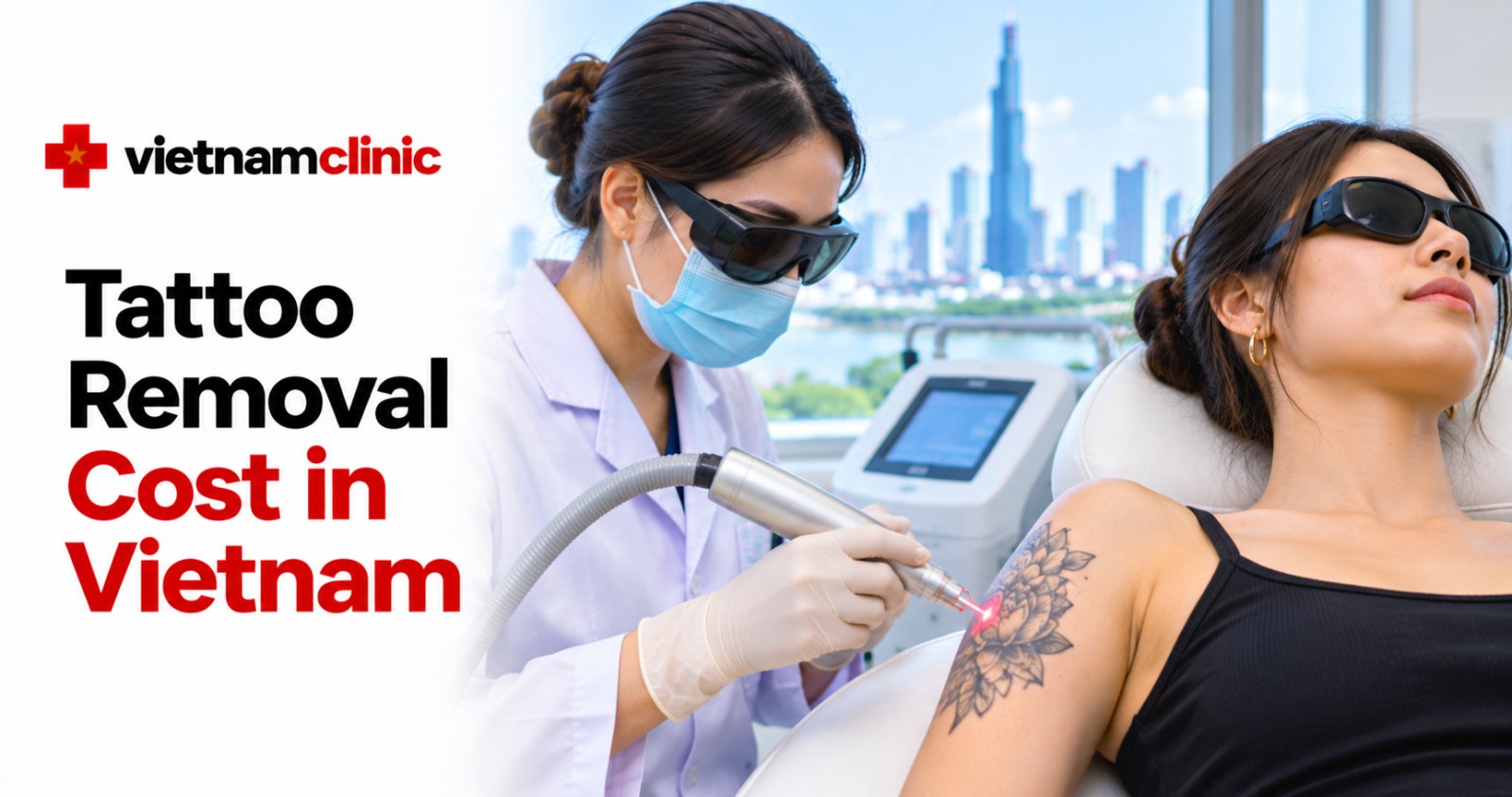
Tattoo removal in Vietnam is available through dermatology hospitals, private skin clinics and aesthetic centres. Laser treatment is the most commonly used approach, but prices vary substantially according to tattoo size, colour, location and the technology used.
Published Vietnamese price lists show sessions starting at approximately VND 500,000 for small tattoos, while larger treatment areas can cost several million dong per visit. Since most tattoos require repeated treatments, the price of one session rarely represents the complete cost of removal.
This guide examines tattoo removal costs in Vietnam using published provider prices, explains the differences between laser technologies and helps residents and international visitors understand treatment planning, recovery and the questions worth asking before booking.
How much does tattoo removal cost in Vietnam?
Tattoo removal is commonly priced per session and according to the size of the treated area. The Ho Chi Minh City Hospital of Dermato-Venereology publishes separate prices for Q-switched and picosecond laser tattoo removal.
Its published price list includes the following examples:
| Tattoo size | Q-switched laser | Picosecond laser |
|---|---|---|
| Under 5 cm² | VND 500,000 | VND 1,000,000 |
| 5 to 10 cm² | VND 1,000,000 | VND 1,500,000 |
| 10 to 15 cm² | VND 1,500,000 | VND 2,000,000 |
| 15 to 20 cm² | VND 2,000,000 | VND 2,500,000 |
| 20 to 30 cm² | VND 3,000,000 | VND 3,500,000 |
| 30 to 50 cm² | VND 4,000,000 | VND 4,500,000 |
These are published hospital service prices, not a national tariff or guaranteed current quotations. The hospital also lists different prices from the third treatment onward for certain services.
Private clinics use their own pricing structures. WeDo Skin Clinic in Ho Chi Minh City publishes Q-switched tattoo removal prices of VND 1 million for areas under 10 cm², VND 2.5 million for 10 to 20 cm² and VND 4.5 million for 30 to 50 cm².
In Da Nang, Neva Beauty publishes prices starting at VND 500,000 for a 3 by 5 cm tattoo, increasing according to the dimensions of the treated area. These examples show why patients should compare the actual tattoo measurements rather than relying on descriptions such as small or medium.
How much does complete tattoo removal cost?
The total cost depends on the number of sessions required. A tattoo priced at VND 1 million per session would cost VND 5 million over five sessions, before any additional fees. Eight sessions at VND 2 million each would total VND 16 million.
These are calculations illustrating how repeated sessions affect the budget, not predictions of how many treatments a particular tattoo needs.
The American Academy of Dermatology explains that tattoo ink is deposited in layers and cannot generally be removed safely in one treatment. The skin also needs time to heal between sessions while the body gradually clears fragmented pigment.
A clinician should examine the tattoo before estimating the number of visits. Even then, complete clearance cannot be guaranteed. Some tattoos retain visible pigment despite repeated treatment.
What affects tattoo removal prices?
Tattoo size and coverage
Larger tattoos generally require more treatment time and can cost more per session. However, two tattoos covering the same area may differ considerably in ink density and complexity.
Ink colour
Black and dark blue pigments are generally easier to treat than some other colours. The US Food and Drug Administration identifies green, red and yellow among the more challenging colours.
A multicoloured tattoo may require different laser wavelengths, which can influence the treatment plan and overall cost.
Tattoo age and ink depth
The age of the tattoo, pigment depth and previous treatments can affect the response. Professional tattoos may contain substantial amounts of pigment deposited at different depths.
Skin characteristics
Skin tone, pigmentation tendencies and a history of raised scars are important when selecting treatment settings and assessing risks. A lower-priced treatment is not necessarily appropriate for every skin type.
Laser technology
Clinics may charge different rates for Q-switched nanosecond lasers and picosecond systems. The higher price of a device or treatment does not guarantee better results for every tattoo.
Q-switched vs picosecond tattoo removal
Q-switched lasers deliver short pulses of energy that target tattoo pigment. They have been used for many years in tattoo removal and remain available at Vietnamese dermatology facilities.
Picosecond lasers deliver even shorter pulses and may offer advantages for certain pigments or treatment situations. However, results depend on the wavelength, tattoo characteristics, treatment settings and clinician's experience.
The published Ho Chi Minh City dermatology hospital price list demonstrates the difference: removing a tattoo under 5 cm² costs VND 500,000 with its listed Q-switched service compared with VND 1 million for its picosecond service.
Patients should ask which laser is proposed and why it is appropriate for their tattoo. A clinic should be able to explain the expected benefits, limitations and risks without promising complete removal.
Eyebrow tattoo and permanent makeup removal
Removing eyebrow tattoos or permanent makeup requires particular care because cosmetic pigments can behave differently from conventional tattoo inks.
The Ho Chi Minh City Hospital of Dermato-Venereology lists eyebrow tattoo removal at VND 1.5 million using its Q-switched service and VND 2 million using its picosecond service. WeDo Skin Clinic also publishes eyebrow tattoo removal at VND 1.5 million per session.
The FDA warns that certain flesh-coloured, white and permanent makeup pigments may darken when exposed to laser treatment. This can complicate further removal.
Because treatment near the eyes presents additional hazards, appropriate eye protection and professional expertise are essential. Ask whether the provider has experience with the particular type of permanent makeup you want removed.
Tattoo removal in Ho Chi Minh City
Ho Chi Minh City offers tattoo removal through dermatology hospitals and private aesthetic facilities. The Hospital of Dermato-Venereology publishes a detailed service price list covering multiple tattoo sizes and laser technologies.
Private providers such as WeDo Skin Clinic also publish prices for body tattoos, eyebrow tattoos and eyeliner removal.
When comparing facilities, check whether the consultation is conducted by a qualified medical professional, what laser is used and whether the quotation includes postoperative care.
The existence of a published price list does not establish that one provider offers better treatment than another. For an overview of public and private healthcare facilities, see how hospitals work in Vietnam.
Tattoo removal in Hanoi
Hanoi has dermatology services and private aesthetic providers where patients can enquire about laser tattoo removal.
Before arranging treatment, confirm that the facility performs tattoo removal rather than only other laser skin procedures. Ask whether it treats your tattoo's colours, location and size.
Patients with previous scarring, pigment changes or unsuccessful removal attempts may benefit from an assessment by a dermatologist experienced in laser treatment.
For international visitors, confirm English-language assistance, appointment availability and the recommended follow-up schedule before travelling.
Tattoo removal in Da Nang
Da Nang also has aesthetic providers advertising laser tattoo removal. Neva Beauty publishes a size-based price list ranging from VND 500,000 for a 3 by 5 cm area to VND 5.5 million for a 21 by 30 cm area.
These are the provider's advertised prices. They do not establish the number of sessions required or the suitability of treatment for an individual patient.
If you are visiting Da Nang temporarily, consider whether you can complete the recommended treatment schedule. Tattoo removal usually requires multiple appointments separated by healing periods, so a short holiday may allow only an initial consultation or session.
How many laser sessions are needed?
There is no reliable universal session count. Tattoo size, colour, depth, density, location and individual response all influence treatment.
Some tattoos fade substantially after several sessions, while others require a longer course. Complete removal may not be achievable in every case.
The FDA notes that laser tattoo removal involves repeated treatments separated by several weeks to allow skin recovery. Your clinician should determine the interval based on the treatment performed and your skin's response.
Be cautious about packages guaranteeing complete removal within a fixed number of sessions before a proper assessment.
Is laser tattoo removal painful?
Laser tattoo removal can be uncomfortable. The FDA compares the sensation to a thin rubber band snapping against the skin.
Pain varies according to the treatment area, tattoo size, laser settings and individual sensitivity. A clinician may offer appropriate pain management, including topical anaesthetic in selected circumstances.
Ask whether anaesthesia is included in the quoted price and whether there are any restrictions or precautions associated with the proposed method.
Do not apply strong numbing products or take medication without appropriate instructions from the treating professional.
Recovery and aftercare
Redness, swelling, tenderness and some blistering can occur after laser tattoo removal. The treated skin needs time to heal before another session.
The American Academy of Dermatology recommends following the dermatologist's wound-care instructions and protecting treated skin from sunlight. Its guidance advises covering the area from sun exposure for three months after treatment.
This is particularly relevant in Vietnam, where outdoor activities, beach visits and prolonged sun exposure may complicate aftercare planning.
Do not pick crusts or blisters. Follow the prescribed cleaning and dressing instructions, and ask when swimming, exercise and cosmetic products can be resumed.
If redness spreads, pain becomes severe, discharge develops or you experience fever, contact a medical professional promptly. Seek urgent care for severe or rapidly worsening symptoms.
Risks of tattoo removal
Potential complications include burns, infection, scarring, changes in skin texture and lighter or darker patches of skin.
Some pigmentation changes improve over time, but others can persist. The AAD notes that temporary lighter or darker areas may take months to resolve.
Permanent makeup and certain light-coloured pigments can also darken after laser exposure.
A qualified clinician should discuss these risks before treatment, particularly if you have a history of keloid scars, abnormal pigmentation or previous skin reactions.
The person performing the procedure and the suitability of the equipment are important considerations, regardless of the advertised price.
Can you remove a tattoo in one session?
Complete removal in one session is generally unrealistic for an established professional tattoo.
The laser fragments pigment, but the body needs time to clear the particles. Multiple pigment layers cannot necessarily be treated safely during a single visit.
A small or lightly pigmented tattoo may respond differently from a dense multicoloured design, but an individual assessment is still necessary.
If a provider promises immediate complete removal without discussing the tattoo's characteristics, ask for clarification before agreeing to treatment.
Are tattoo removal creams effective?
The FDA has not approved tattoo removal creams or do-it-yourself removal kits. It reports no evidence that these products safely and effectively remove pigment located in the deeper skin.
Products containing irritating chemicals or strong acids can cause burns, rashes and scars without removing the tattoo.
Home methods involving salt abrasion or attempts to damage the skin are also unsafe alternatives to professional treatment.
If you are concerned about cost, discuss staged laser treatment or other medically appropriate options with a qualified provider rather than attempting home removal.
Tattoo removal vs tattoo cover-up
Not everyone needs complete tattoo removal. Some people want to lighten an existing tattoo before covering it with a new design.
Partial fading may require a different treatment goal from complete removal, but it still carries the risks associated with laser treatment.
If you are considering a cover-up, explain that objective during the consultation. The clinician can discuss whether laser lightening is appropriate, while the tattoo artist can explain the practical requirements of the new design.
Do not assume that a tattoo can be covered successfully after a particular number of laser sessions.
Does health insurance cover tattoo removal?
Tattoo removal performed for cosmetic reasons is generally considered elective and is commonly excluded from standard health insurance coverage.
Different considerations may apply if a medical complication or another clinically significant condition requires treatment, but coverage depends on the policy and circumstances.
Ask the insurer for written confirmation before assuming reimbursement. A clinic accepting insurance for other dermatology services does not mean cosmetic tattoo removal is covered.
Questions to ask before booking
Before paying for laser tattoo removal, confirm:
- What is the price per session for the measured tattoo area?
- Which laser technology will be used?
- Who will perform the procedure?
- What qualifications and experience does the clinician have?
- How many sessions might be required?
- What factors could prevent complete removal?
- Are consultation and anaesthesia included?
- What aftercare is provided?
- How long should you wait between sessions?
- What complications are possible?
- Are package discounts conditional on completing a fixed course?
- What happens if treatment must be stopped or postponed?
Ask for the estimated total treatment cost rather than only the first-session price. If the provider offers a package, clarify whether unused sessions are refundable and whether additional treatments cost extra.
Conclusion
Tattoo removal costs in Vietnam vary according to tattoo size, laser technology and the number of sessions required. Published prices include approximately VND 500,000 for small Q-switched treatments at a dermatology hospital, while larger areas and picosecond procedures can cost several million dong per visit.
The total budget can be substantially higher than the advertised session price because tattoo removal usually requires repeated treatments. Complete clearance is not guaranteed, and skin pigmentation changes or scarring are possible.
Before booking, arrange an assessment with an appropriately qualified provider, request a written quotation and discuss the expected number of sessions, risks and aftercare. Comparing the complete treatment plan is more useful than selecting a clinic solely on its lowest advertised price.
Frequently Asked Questions
How much does tattoo removal cost in Vietnam?
Published prices start at approximately VND 500,000 per session for certain small tattoos. Larger areas and picosecond laser treatments can cost several million dong per visit. The total depends on the number of sessions required.
How much does it cost to remove a small tattoo in Vietnam?
The Ho Chi Minh City Hospital of Dermato-Venereology lists Q-switched removal for tattoos under 5 cm² at VND 500,000 and picosecond removal at VND 1 million. Confirm current prices and any additional fees directly.
Is picosecond laser tattoo removal more expensive?
It can be. Published hospital prices show higher per-session charges for picosecond treatment than Q-switched treatment across several tattoo sizes. The appropriate technology depends on the tattoo and clinical assessment.
How many sessions does tattoo removal take?
Most tattoos require multiple treatments, but there is no universal session count. Ink colour, density, depth, tattoo size and skin response influence the course. Complete removal cannot always be achieved.
How much does eyebrow tattoo removal cost in Vietnam?
Published examples include VND 1.5 million per session for Q-switched eyebrow removal and VND 2 million for picosecond eyebrow removal at the Ho Chi Minh City Hospital of Dermato-Venereology. Cosmetic pigments require particular care because some can darken after laser treatment.
Is tattoo removal painful?
Laser tattoo removal can cause discomfort similar to a rubber band snapping against the skin. Pain management may be available depending on the treatment area and provider. Ask about anaesthesia before booking.
Can a tattoo be completely removed?
Many tattoos can be substantially lightened or removed with laser treatment, but complete clearance is not guaranteed. Certain colours, deep pigments and cosmetic inks can be especially difficult to treat.
Can I get tattoo removal in Hanoi, Ho Chi Minh City or Da Nang?
Tattoo removal services are advertised in these cities, although specific technologies, prices and availability vary. Confirm that the provider performs the procedure you need and can arrange appropriate follow-up.
Does tattoo removal leave scars?
Scarring is a possible complication, although modern laser treatment performed appropriately can reduce this risk. Burns, infection and changes in pigmentation or skin texture may also occur. Discuss your skin history with the treating clinician.
Does health insurance cover tattoo removal in Vietnam?
Cosmetic tattoo removal is generally excluded from standard medical insurance. If treatment is required for a medical reason, ask your insurer whether any relevant benefit applies and obtain written confirmation.
Sources
- Ho Chi Minh City Hospital of Dermato-Venereology - Official Service Price List
- WeDo Skin Clinic - Tattoo Removal Prices and Treatment Information
- Neva Beauty Da Nang - Laser Tattoo Removal Price List
- American Academy of Dermatology - Tattoo Removal: Lasers Outshine Other Methods
- US Food and Drug Administration - Tattoo Removal: Options and Results

Writer
Tan Nguyen
Medical writer
Medical writer for Vietnam Clinic. MD, Vietnam National University Ho Chi Minh City.
View profile
Medical review
John Maitland
Medical reviewer
Medical reviewer for Vietnam Clinic. MD, University of Pennsylvania.
View profile