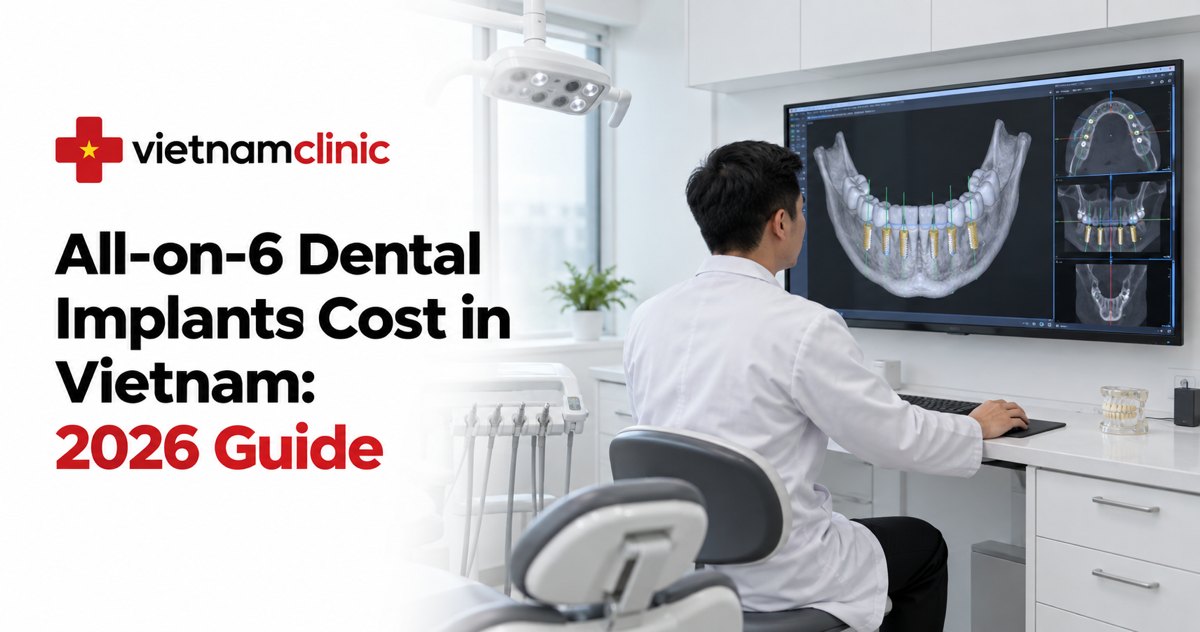
Public All-on-6 dental implant prices in Vietnam range from VND 150 million for a six-implant line item to VND 486 million for a stated complete package per arch, but those figures are not equivalent. Some providers publish a promotional complete treatment with temporary and final zirconia bridges; others list the six fixtures separately from temporary and definitive teeth. All-on-6 replaces one upper or lower arch with a fixed bridge supported by six implants. The comparison requires an itemized, case-specific quotation showing every surgical and prosthetic stage.
What do All-on-6 dental implants cost in Vietnam?
Nha Khoa Kim publishes the clearest high-end complete-package examples for 2026. Its prices run from VND 321 million per arch for Biotem or Megagen implants with a titanium framework to VND 486 million for Nobel Biocare implants with a Hybrid BioHPP framework. The provider states that these packages cover six implants, multi-unit components where indicated, a first-stage bridge, and the later fixed restoration. Different framework and implant combinations account for the intervening VND 336 million, VND 341 million, VND 356 million and VND 471 million options.
HCMC Dental publishes complete packages with both a temporary and final zirconia bridge. Its advertised online-booking prices are VND 265 million for standard Neodent or B&B, VND 320 million for premium Straumann SLA and VND 350 million for Straumann Active. The corresponding walk-in prices displayed on the same page are VND 441,666,667, VND 533,333,333 and VND 583,333,333. Because the discount is tied to the booking route, patients should ask the clinic to confirm eligibility, validity dates, refund terms and exactly what remains payable.
Three other providers show why headline prices need their inclusions beside them. Elite Dental lists VND 250 million to VND 300 million per arch, including implant surgery and a final restoration with a CAD/CAM metal framework and ceramic crowns. Picasso Dental publishes VND 180 million with Osstem, VND 210 million with ETK or Neodent, and VND 300 million with Nobel Biocare or Straumann; its price guide describes six implants plus a fixed full-arch bridge and includes CBCT and consultation. Nha Khoa An Nguyên lists the six-implant stage at VND 150 million with Biotem, VND 210 million with Hiossen and VND 270 million with Straumann or Nobel Biocare, then separately lists VND 20 million for a temporary full-arch prosthesis, VND 45 million for a final composite restoration or VND 65 million for a final all-ceramic restoration. These are provider prices reviewed in September 2026, not a national average or a guaranteed total for another patient.
What All-on-6 means clinically
All-on-6 is a fixed full-arch rehabilitation. Six implants are positioned to support a bridge replacing a complete row of teeth. The phrase does not identify one brand, bridge material or surgical protocol. A design may use straight or angled implants, multi-unit abutments, guided or conventional surgery, and several forms of temporary and definitive prosthesis. Two clinics can therefore use the same treatment label while offering materially different components.
The number six is not a quality score. Extra implant support may help distribute load and reduce the length of unsupported bridge extensions in a suitable jaw, but six usable positions are not available in every case. Bone volume, sinus anatomy, nerve location, gum condition, bite and restorative space all affect the design. The clinician must plan the final teeth before deciding where implants should go.
All-on-6 differs from an implant-retained removable overdenture. A fixed bridge is removed by a professional; an overdenture is designed for the patient to remove. Both may be appropriate but differ in cleaning, repair and cost. Ask the dentist to name the proposed prosthesis.
All-on-6 versus All-on-4: why the price is not the only difference
All-on-4 uses four implants to support one full arch, often using angled posterior fixtures to make use of available bone. All-on-6 uses two additional implants. The latter may provide more support in selected cases, yet it can require adequate bone in more positions and may involve additional surgery. It is not automatically safer or longer-lasting for every person.
Published provider lists illustrate the financial difference, but not through one universal surcharge. At Elite Dental, All-on-4 is VND 210 million to VND 260 million and All-on-6 is VND 250 million to VND 300 million. Picasso Dental lists Osstem All-on-4 at VND 125 million and Osstem All-on-6 at VND 180 million. Those are examples within each provider's own package structure; they do not prove that adding two implants will cost the same amount in another case. The clinical benefit must justify the selected plan.
Ask the clinician to show both plans on the scan when both are feasible. The explanation should cover implant positions, bridge span, expected loading, hygiene access and what would happen if one fixture failed. If opinions differ substantially, a second assessment is reasonable before irreversible extraction of remaining teeth.
Items that belong in an itemized quotation
A useful quotation names the jaw, implant manufacturer and model, six fixtures, multi-unit abutments, prosthetic screws, temporary bridge and definitive bridge. It identifies the framework and visible tooth material, number of teeth in the bridge and whether the restoration is screw retained. Terms such as “premium ceramic” are insufficient unless the actual material and framework are specified.
Diagnostic and surgical items need the same clarity. Ask whether the estimate includes examination, panoramic imaging, cone-beam CT, digital planning, surgical guide, local anaesthesia, sedation, extractions, bone grafting, sinus treatment, prescriptions and scheduled reviews. Confirm which additions remain possible after an in-person examination. A remote opinion cannot establish implant positions or bone quality.
Match payments to delivered treatment. Establish the deposit, surgical payment, laboratory payment and final balance. Request cancellation, refund, remake and failure terms in writing. A “lifetime warranty” may cover only an implant component and require specified recalls; it rarely covers travel, bridge wear and every future procedure.
What can make the final bill higher?
Active infection, difficult extractions, inadequate bone or complex anatomy can add treatment. Some published packages include grafting, while others charge it separately. Sedation, medical clearance and hospital support may also affect the fee. Patients taking anticoagulants or medicines associated with jaw-bone effects need individualized assessment; medication should never be stopped solely to fit a travel schedule.
Prosthetic choices often create the largest difference after surgery. An acrylic provisional, a reinforced temporary, a titanium framework with composite teeth and a monolithic zirconia restoration are not interchangeable. Laboratory complexity, digital design, tooth characterization and the ability to repair the bridge influence cost. Ask whether a lower fee provides only the first-stage teeth.
People travelling for treatment should add flights, accommodation, transport, food, time away from work and a possible return visit. The Vietnam dental tourism cost guide explains why the clinic invoice is only part of the budget. Leave contingency time: swelling, a provisional adjustment or laboratory remake can change a departure plan.
Assessment, surgery and delivery of the final bridge
Planning begins with medical and dental history, examination, gum assessment, bite records and appropriate imaging. The team decides whether existing teeth are maintainable and compares fixed and removable options. When surgery proceeds, teeth may be extracted, sites prepared and six implants placed. Immediate provisional teeth are possible only when the implants and overall case meet the clinician’s stability criteria.
Immediate teeth are not the definitive bridge. A provisional helps protect the surgical plan and allows early assessment of speech, appearance and bite, but the patient still has to follow a modified diet and hygiene instructions. Bone integration takes time. The definitive prosthesis is normally designed after healing, with new records and trial stages where required.
For general context on fixture, abutment and crown pricing, see the guide to dental implant costs in Vietnam. A full-arch quote cannot be calculated by multiplying a single-tooth package by six because it includes different abutments, a connected bridge, laboratory planning and full-jaw biomechanics.
Choosing a provider in Vietnam
Ask who will perform surgery, who will plan and deliver the bridge, and who takes responsibility for complications. Review relevant training and full-arch experience rather than relying on a promotional case gallery. Confirm that the facility can provide required imaging, sterile surgery, traceable components and emergency contact after treatment.
Readers can use the comparisons of dental clinics in Ho Chi Minh City or dental clinics in Da Nang to identify providers for further questions. A listing is not an endorsement. Each clinic must still provide a case-specific diagnosis, alternatives, materials, schedule and total fee.
If significant medical conditions or hospital coordination matter, the overview of hospital-based dental services in Vietnam presents another setting to consider. Clinic size alone does not determine quality. The named clinicians, treatment planning, prosthetic design and continuing access to care are more useful decision points.
Risks and maintenance costs after All-on-6
Surgical risks include bleeding, infection, nerve injury, damage to nearby anatomy and failure of an implant to integrate. Later biological problems include mucosal inflammation and peri-implantitis with bone loss. Mechanical issues include loose or fractured screws, chipped teeth, framework complications and altered bite. The treating clinician should relate these risks to the scan, health history and proposed materials.
Daily cleaning is mandatory even though the bridge cannot be removed by the patient. Its underside and contours should permit effective plaque control with tools recommended by the dental team. The American College of Prosthodontists advises risk-based professional maintenance and says routine removal of a stable full-arch screw-retained restoration is discouraged unless disease, inadequate hygiene access or a mechanical issue warrants it.
Budget for professional reviews, cleaning, clinically indicated radiographs and eventual repairs. Before leaving Vietnam, obtain implant labels, component identifiers, scans, clinical records and bridge specifications. Ask whether a dentist at home can obtain compatible parts and who will pay for care if a problem requires another trip.
A practical decision before paying a deposit
Reduce each proposal to the same checklist: one named arch, six specified implants, abutments, first-stage teeth, definitive framework and tooth material, surgery, imaging, possible additions, reviews and maintenance terms. Mark anything excluded or conditional. Only then compare the VND totals; otherwise, the lowest price may simply represent fewer completed stages.
Do not commit because a temporary promotion is ending. Confirm that the recommended six-implant plan is supported by examination and imaging, that alternatives were discussed, and that travel allows enough time for recovery and adjustment. Obtain all payment and cancellation conditions before transferring money.
The best value is a serviceable restoration with a clear clinical reason, realistic schedule and accessible long-term care. Public price lists can establish an initial budget, but the final cost comes from the signed, case-specific plan. Keep that plan, component records and maintenance schedule so another clinician can understand the work years later.
Frequently Asked Questions
Is the All-on-6 price in Vietnam for one jaw or both?
Published fees are generally per arch, meaning one upper or lower jaw. Ask the clinic to state the treated arch explicitly; restoring both jaws normally requires two separate plans and fees.
Does All-on-6 always cost more than All-on-4?
It often does because two additional implants and components are used, but package inclusions and bridge materials can matter more than implant count. Compare itemized plans rather than labels.
Can the final All-on-6 bridge be fitted immediately?
The bridge fitted soon after surgery is commonly provisional. The definitive restoration is usually made after healing and bite assessment. Confirm the clinic’s sequence and both fees in writing.
Will I need bone grafting for All-on-6?
Possibly. The answer depends on bone at the proposed six implant sites, anatomy and the restorative plan. A clinical examination and appropriate three-dimensional imaging are needed.
What should I take home after All-on-6 treatment in Vietnam?
Request scans, the treatment summary, implant labels and model numbers, abutment details, bridge specifications, medication information, maintenance instructions and emergency contact details.
Sources

Writer
Tan Nguyen
Medical writer for Vietnam Clinic. MD, Vietnam National University Ho Chi Minh City.