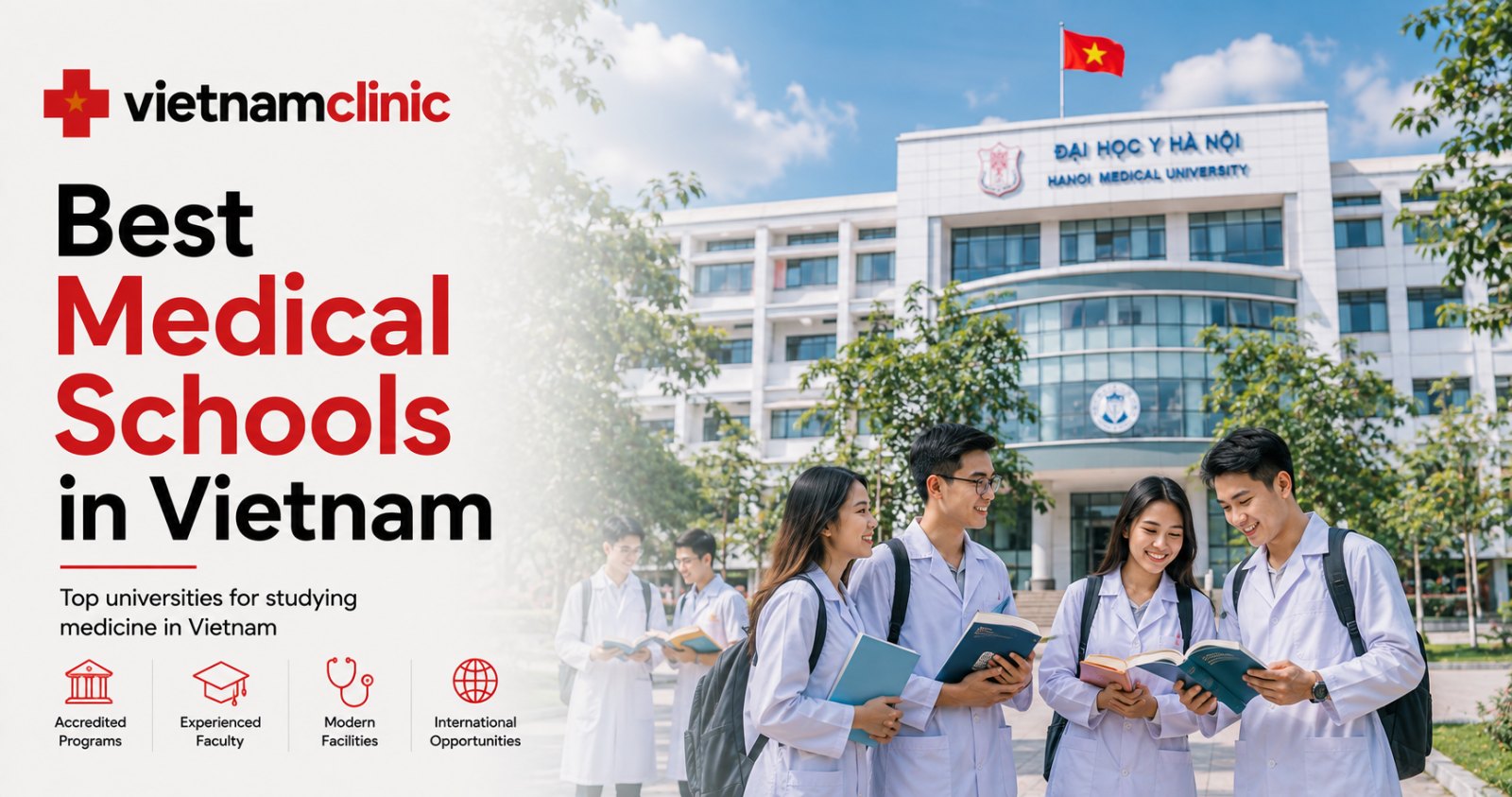
Vietnam has a long tradition of medical education, with several universities training doctors for decades and newer institutions introducing international curricula, simulation facilities and expanded research programmes. Hanoi and Ho Chi Minh City remain the country's largest centres for medical training, but important schools are also located in Hue, Can Tho, Thai Nguyen, Hai Phong and Da Nang.
There is no single official national ranking of Vietnam's medical schools that determines which institution is best for every student. This list therefore highlights 12 leading institutions based on factors such as their history in medical education, breadth of health science programmes, postgraduate training, clinical teaching environment, research activity and current institutional development. The numbering is an editorial structure rather than a definitive government ranking.
Prospective students should check the exact 2026 admissions requirements directly with each university. Language of instruction, tuition, eligibility for foreign applicants and available places can differ substantially between programmes.
1. Hanoi Medical University
Location: Hanoi
Hanoi Medical University is one of Vietnam's oldest and most established medical education institutions. Its roots go back to the medical school founded in Hanoi during the French colonial period, and the university remains closely associated with medical education, research and specialist training in northern Vietnam.
The university provides undergraduate medical education alongside extensive postgraduate training, including residency, master's, doctoral and specialist programmes.
Its Hanoi location gives students access to one of the country's largest clinical environments. The capital contains major national and specialist hospitals, creating opportunities for exposure to a broad range of medical specialties during training.
Hanoi Medical University is particularly relevant for students looking for:
- A long-established medical university.
- Extensive postgraduate education.
- A large academic medical community.
- Clinical exposure in Hanoi.
- Research and specialist training opportunities.
Students interested in the wider clinical environment can also explore hospitals in Hanoi.
2. University of Medicine and Pharmacy at Ho Chi Minh City
Location: Ho Chi Minh City
The University of Medicine and Pharmacy at Ho Chi Minh City, commonly referred to as UMP HCMC, is one of the country's major health science universities and an important training centre for southern Vietnam.
Its faculties cover medicine and other health disciplines, and the institution combines undergraduate education with postgraduate medical training, research and healthcare activities.
The university's location is a major advantage. Ho Chi Minh City has Vietnam's largest concentration of private hospitals, specialist centres and major public healthcare facilities, giving medical students access to a diverse clinical environment.
UMP HCMC is particularly relevant for students seeking an established public medical university in southern Vietnam with access to a large metropolitan healthcare system.
For context on the city’s healthcare infrastructure, see Vietnam Clinic’s comparison of hospitals in Ho Chi Minh City.
3. Hue University of Medicine and Pharmacy
Location: Hue
Hue University of Medicine and Pharmacy is one of Central Vietnam's most important medical education institutions and forms part of Hue University.
The school currently reports 16 undergraduate programmes and more than 100 postgraduate specialisations, illustrating the breadth of its health science training. Its programmes extend beyond medicine into pharmacy, nursing, public health and related disciplines.
Quality assurance has become an important part of the university's development. In 2026, several doctor training programmes underwent external assessment using ASEAN University Network Quality Assurance standards.
Hue's role as a regional medical centre also gives the university an important position in training healthcare professionals for Central Vietnam and neighbouring areas.
4. Vietnam Military Medical Academy
Location: Hanoi
The Vietnam Military Medical Academy is one of the country's major medical training institutions and operates under the Ministry of National Defence.
The academy trains doctors, pharmacists and other healthcare professionals while also conducting medical research. Its educational role is closely connected with military medicine, but its academic and clinical activities extend across many areas of medicine.
Clinical education is supported by major military medical facilities associated with the academy, including Military Hospital 103 and the Le Huu Trac National Burn Hospital.
Admission is different from that of an ordinary civilian university. Military applicants must meet additional requirements established by the Ministry of National Defence, including military selection and health standards.
For that reason, prospective applicants should check the academy's current admissions route carefully rather than treating it as interchangeable with a civilian medical school.
5. Can Tho University of Medicine and Pharmacy
Location: Can Tho
Can Tho University of Medicine and Pharmacy is a major medical education institution serving the Mekong Delta and southern Vietnam.
Its 2026 undergraduate admissions plan includes 15 health science and related programmes, with thousands of places across regular undergraduate and other training routes.
The university's regional role is particularly important. Can Tho is the largest urban and medical centre in the Mekong Delta, and the school contributes to training doctors and healthcare professionals for provinces throughout southern Vietnam.
Students looking for medical education outside Hanoi and Ho Chi Minh City may find Can Tho particularly relevant, especially if they expect to work within the Mekong Delta healthcare system.
6. Pham Ngoc Thach University of Medicine
Location: Ho Chi Minh City
Pham Ngoc Thach University of Medicine is a public health sciences university managed by Ho Chi Minh City.
It developed from the city's former health personnel training centre and became a university in 2008. Its stated mission includes medical education, scientific research and community healthcare.
The university includes medicine alongside pharmacy, odonto-stomatology, nursing, medical technology and public health. It also operates postgraduate programmes and continuing medical education.
One of its main advantages is its close relationship with Ho Chi Minh City's healthcare system. This gives students access to a large urban network of hospitals and clinical teaching environments.
For applicants primarily interested in studying and later practising medicine in Ho Chi Minh City, Pham Ngoc Thach University of Medicine deserves consideration alongside UMP HCMC.
7. Thai Nguyen University of Medicine and Pharmacy
Location: Thai Nguyen
Thai Nguyen University of Medicine and Pharmacy has trained healthcare professionals since 1968 and is an important medical university for northern and mountainous regions of Vietnam.
Its undergraduate programmes currently include:
- Medicine.
- Preventive medicine.
- Odonto-stomatology.
- Pharmacy.
- Nursing.
- Medical laboratory technology.
The Medicine programme lasts six years and is taught in Vietnamese. The university also offers a substantial range of postgraduate training, including residency, master's, specialist and doctoral programmes.
Its medical and nursing programmes have undergone assessment through the ASEAN University Network Quality Assurance framework, adding an international quality-assurance dimension to the institution's development.
Thai Nguyen may be particularly relevant for students interested in community medicine and healthcare issues affecting populations outside Vietnam's largest metropolitan areas.
8. Hai Phong University of Medicine and Pharmacy
Location: Hai Phong
Hai Phong University of Medicine and Pharmacy is one of northern Vietnam's established health science universities.
The institution describes its mission as training healthcare professionals, conducting scientific research, transferring technology and providing healthcare services, with an additional focus on maritime and island medicine.
It offers undergraduate and postgraduate medical education and is connected with Hai Phong Medical University Hospital, giving it a direct clinical component.
Hai Phong is also one of northern Vietnam's largest cities and an important port and industrial centre, providing a different clinical and public health environment from Hanoi.
9. VNU University of Medicine and Pharmacy
Location: Hanoi
VNU University of Medicine and Pharmacy is a member university of Vietnam National University, Hanoi. It became a full member university in 2020 after developing from VNU's School of Medicine and Pharmacy.
Its current undergraduate programmes include:
- Medicine.
- Odonto-stomatology.
- Pharmacy.
- Nursing.
- Medical imaging technology.
- Medical laboratory technology.
The Medicine programme lasts six years.
The university is expanding its postgraduate education as well. VNU reports master's and residency programmes across multiple clinical specialties, and it has introduced master's programmes taught entirely in English in areas including internal medicine, surgery, pediatrics, radiology and nuclear medicine.
VNU UMP is therefore particularly interesting as a younger medical university embedded within one of Vietnam's major multidisciplinary national universities.
10. VinUniversity College of Health Sciences
Location: Hanoi
VinUniversity represents a different model from Vietnam's long-established public medical universities.
Its College of Health Sciences offers a Medical Doctor programme, nursing education, graduate medical education and health science research. The curriculum has been developed with international collaboration, including work with the University of Pennsylvania.
VinUniversity also highlights clinical training opportunities through Vinmec and several major public hospitals. Its facilities include a medical simulation centre and teaching laboratories designed for preclinical education.
For students comparing medical schools in Vietnam, VinUniversity stands out for:
- International curriculum development.
- English-oriented academic environment.
- Medical simulation facilities.
- Integration with the Vinmec healthcare system.
- International faculty and academic partnerships.
Prospective students should check current tuition, scholarship availability and admissions criteria because its financial and admissions model differs significantly from public medical universities.
11. Da Nang University of Medical Technology and Pharmacy
Location: Da Nang
Da Nang University of Medical Technology and Pharmacy is a specialised health sciences university under Vietnam's Ministry of Health.
The institution offers training in medicine alongside pharmacy, nursing, dentistry-related disciplines, medical laboratory technology, public health, rehabilitation and other health sciences.
Its current structure includes a Faculty of Medicine and specialised centres for preclinical skills and medical diagnostics. The university also provides postgraduate specialist training.
Its location makes it particularly important for Central Vietnam and the Central Highlands, where the demand for healthcare professionals extends well beyond Da Nang itself.
Students considering medical education in the city can explore the broader clinical environment through Vietnam Clinic’s comparison of hospitals in Da Nang.
12. Duy Tan University School of Medicine and Pharmacy
Location: Da Nang
Duy Tan University is a private multidisciplinary university with an established School of Medicine and Pharmacy.
Its Doctor of Medicine programme was introduced after approval from Vietnam's education authorities and lasts six years. The university currently offers medicine alongside dentistry, pharmacy, nursing, medical laboratory technology and other health science programmes.
Duy Tan has invested in simulation, laboratory and technology-based medical education and has developed academic relationships with overseas universities.
Its position in Da Nang makes it an alternative to the city's public medical university for students who prefer a private university environment.
As with other private programmes, prospective students should compare tuition, clinical placements, curriculum structure and admissions requirements directly rather than assuming that the experience will be the same as at a public medical school.
How we selected these medical schools
This list is not based on a single international ranking because no ranking adequately measures every part of medical education in Vietnam.
We considered several practical factors:
- Established role in medical education.
- Availability of a Doctor of Medicine or equivalent medicine programme.
- Breadth of health science education.
- Postgraduate and residency training.
- Clinical training opportunities.
- Research activity.
- Quality assurance and international development.
- Importance within the healthcare system of the surrounding region.
The result includes both traditional public medical universities and newer institutions pursuing different models of medical education.
How long does medical school take in Vietnam?
A standard undergraduate medicine programme in Vietnam generally lasts six years. Official programme information from institutions such as Thai Nguyen University of Medicine and Pharmacy, VNU University of Medicine and Pharmacy and Duy Tan University confirms six-year medical training.
Graduation from the university programme is only part of becoming an independently practising doctor. Professional licensing and practice requirements are governed separately by Vietnamese healthcare law and can change over time.
Anyone planning to practise medicine in Vietnam should therefore distinguish between admission to medical school, graduation and the later requirements for professional practice.
Can international students study medicine in Vietnam?
Some Vietnamese universities accept international students, but this should not be assumed for every programme.
The most important issue is language. Clinical medicine requires communication with patients, medical staff and teaching hospitals, and many standard medical programmes are primarily taught in Vietnamese.
Thai Nguyen University of Medicine and Pharmacy, for example, explicitly identifies Vietnamese as the language of instruction for its six-year Medicine programme.
Some universities are developing more English-language education, particularly at postgraduate level. VNU University of Medicine and Pharmacy currently offers several master's programmes entirely in English, while VinUniversity has a much more internationally oriented educational model.
International applicants should ask each university directly about:
- Eligibility for foreign students.
- Language of instruction.
- Vietnamese-language requirements for clinical placements.
- Entrance examinations.
- Recognition of previous qualifications.
- Tuition fees.
- Visa documentation.
- Accommodation.
- Recognition of the degree in the country where they eventually want to practise.
Medical school in Hanoi or Ho Chi Minh City?
Hanoi has the greatest concentration of institutions on this list, including Hanoi Medical University, the Military Medical Academy, VNU University of Medicine and Pharmacy and VinUniversity.
Ho Chi Minh City has two particularly established public options in UMP HCMC and Pham Ngoc Thach University of Medicine.
Both cities offer extensive hospital systems and opportunities for clinical exposure. Choosing between them should depend more on the individual programme, admissions route, tuition and career plans than on the city alone.
Students should also consider the cost of living and where they are likely to complete clinical rotations.
What to check before applying
Medical education is highly regulated, and admissions requirements can change from one year to the next.
Before submitting an application, confirm:
- Whether the university is accepting applications for Medicine in 2026.
- Whether international students are eligible.
- The language of instruction.
- Programme duration.
- Entrance examination or academic requirements.
- Tuition and additional clinical training fees.
- Teaching hospital arrangements.
- Whether accommodation is available.
- What degree is awarded.
- Whether the degree can be recognised in the country where you intend to practise.
Do not rely on an education agent or third-party university profile for a final admissions decision. Check the university's current admissions information directly.
Frequently Asked Questions
The answers below address common questions about medical schools in Vietnam. Admissions requirements, tuition and international student eligibility can change, so applicants should verify current information directly with each university.
What is the best medical school in Vietnam?
There is no official national ranking that identifies one medical school as best for every student. Hanoi Medical University and the University of Medicine and Pharmacy at Ho Chi Minh City are among Vietnam's longest-established major medical training institutions.
How long is medical school in Vietnam?
A standard Medicine programme generally lasts six years. Universities including Thai Nguyen University of Medicine and Pharmacy, VNU University of Medicine and Pharmacy and Duy Tan University publish six-year medical programmes.
Can foreigners study medicine in Vietnam?
Some institutions may accept international students, but eligibility and language requirements vary. Many standard medical programmes are taught primarily in Vietnamese, which is especially important during clinical training with patients.
Which medical schools are in Ho Chi Minh City?
Two prominent public institutions are the University of Medicine and Pharmacy at Ho Chi Minh City and Pham Ngoc Thach University of Medicine. The city also has a large hospital network that supports clinical training.
Which medical schools are in Hanoi?
Major options include Hanoi Medical University, Vietnam Military Medical Academy, VNU University of Medicine and Pharmacy and VinUniversity College of Health Sciences. Their admissions systems, tuition and educational models differ considerably.
Are there medical schools in Da Nang?
Yes. Da Nang University of Medical Technology and Pharmacy is a public specialist health sciences university, while Duy Tan University operates a private School of Medicine and Pharmacy with a six-year Medicine programme.
Conclusion
Vietnam has medical schools with very different histories and educational models. Hanoi Medical University and the University of Medicine and Pharmacy at Ho Chi Minh City are among the country's most established medical institutions, while Hue, Can Tho, Thai Nguyen and Hai Phong play major regional roles.
Newer options such as VNU University of Medicine and Pharmacy and VinUniversity are expanding research, postgraduate education and international collaboration, while Da Nang University of Medical Technology and Pharmacy and Duy Tan University provide important medical training options in Central Vietnam.
The practical next step is to shortlist universities according to location, language, cost and eligibility, then verify the current 2026 Medicine programme and admissions requirements directly with each institution.
Sources

Writer
Tan Nguyen
Medical writer for Vietnam Clinic. MD, Vietnam National University Ho Chi Minh City.