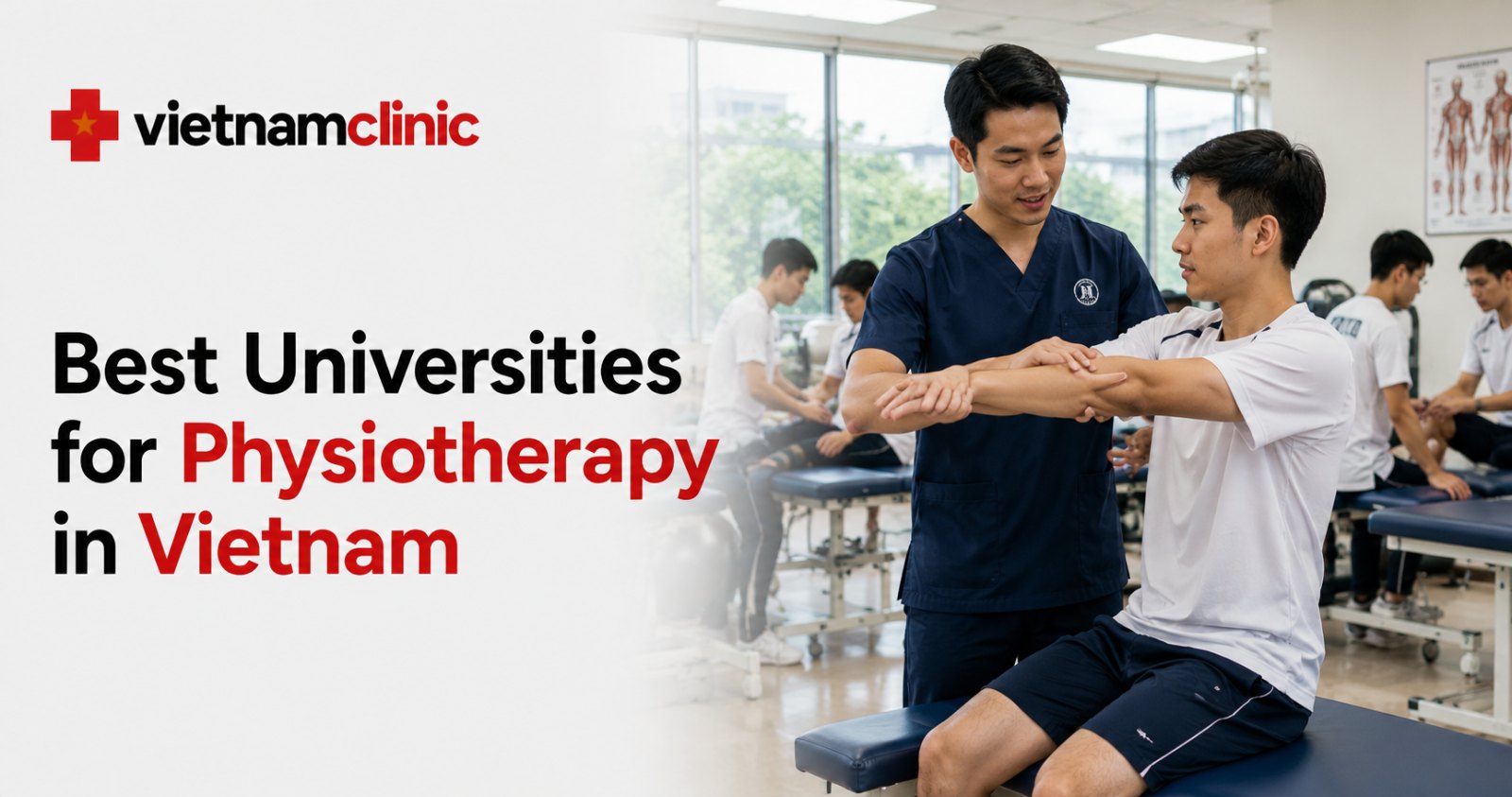
Physiotherapy education in Vietnam is usually found under the degree Rehabilitation Techniques, known in Vietnamese as Ky thuat Phuc hoi Chuc nang. The national programme code is 7720603, and physiotherapy or physical therapy is a major component of training at many universities.
That distinction is important for international students searching for the best physiotherapy schools in Vietnam. A university may not advertise a degree literally called Bachelor of Physiotherapy in English, even though its rehabilitation programme prepares graduates for physical therapy and rehabilitation roles.
There is no official national ranking of physiotherapy universities in Vietnam. The 12 institutions below were selected for factors such as established rehabilitation education, specialist health science training, clinical exposure, programme development and current 2026 undergraduate activity. The order is editorial rather than an official government ranking.
1. Hai Duong Medical Technical University
Location: Hai Duong
Hai Duong Medical Technical University deserves particular attention because of the depth of its history in rehabilitation education.
Its Faculty of Rehabilitation traces its origins to 1978, when the institution began training rehabilitation and physical therapy technicians. It introduced college-level physical therapy training in 2002 and started its first bachelor's-level Rehabilitation Techniques cohort in 2008.
The current undergraduate programme lasts four years and awards a Bachelor of Rehabilitation Techniques. What makes the programme particularly interesting is its differentiation between three areas:
- Physical therapy.
- Occupational therapy.
- Speech and language therapy.
The university states that it was the first institution in Vietnam to provide training across all three of these rehabilitation specialities.
For students specifically interested in rehabilitation rather than studying at a broader medical university, Hai Duong is one of the most specialised options in the country.
2. University of Medicine and Pharmacy at Ho Chi Minh City
Location: Ho Chi Minh City
The University of Medicine and Pharmacy at Ho Chi Minh City, or UMP HCMC, is one of Vietnam's major medical universities and offers a four-year undergraduate programme in Rehabilitation Techniques.
The university identifies physical therapy and occupational therapy as two areas within the programme. Students receive basic medical science education alongside specialist rehabilitation training and clinical practice.
UMP also offers postgraduate study in Rehabilitation Techniques, including a master's programme for the 2026 to 2028 cohort. That provides an academic pathway beyond the undergraduate degree for students who want to continue in rehabilitation education or research.
Its location is another advantage. Ho Chi Minh City has one of Vietnam's largest healthcare systems, giving students access to a wide range of hospitals and rehabilitation settings. You can explore the broader clinical environment through Vietnam Clinic's guide to hospitals in Ho Chi Minh City.
3. Hanoi Medical University
Location: Hanoi
Hanoi Medical University is one of Vietnam's most established medical schools and currently offers a Bachelor of Rehabilitation Techniques programme.
The programme lasts four years, is delivered in Vietnamese and leads to the national bachelor's qualification in Rehabilitation Techniques.
Its curriculum includes foundational medical sciences before progressing toward clinical and rehabilitation subjects. University course information includes areas such as neuroscience and the application of neurological examination to physical therapy and rehabilitation.
Hanoi Medical University admitted students to the programme again in 2026, with 70 places at its Hanoi campus as well as additional training at its Thanh Hoa branch.
The school's major strength is its position within Hanoi's extensive teaching and hospital network. Students considering the capital can also review hospitals in Hanoi to understand the wider healthcare environment.
4. Pham Ngoc Thach University of Medicine
Location: Ho Chi Minh City
Pham Ngoc Thach University of Medicine is another strong public option in Ho Chi Minh City.
Its 2026 undergraduate admissions include Rehabilitation Techniques under programme code 7720603, alongside medicine, nursing, pharmacy, medical laboratory technology and other health sciences.
The university has particularly close links with Ho Chi Minh City's healthcare system, which is relevant for a profession where clinical practice forms an essential part of training.
Students comparing Pham Ngoc Thach with UMP HCMC should look beyond university name recognition and examine the rehabilitation curriculum, clinical placements, admission score, tuition and future postgraduate options.
5. Da Nang University of Medical Technology and Pharmacy
Location: Da Nang
Da Nang University of Medical Technology and Pharmacy is a specialist public health sciences university under Vietnam's Ministry of Health.
Its Bachelor of Rehabilitation Techniques programme lasts four years. Official programme documentation states that the degree supplement can identify specialisation in physical therapy or speech therapy.
The university is particularly relevant for students who want to study in Central Vietnam rather than Hanoi or Ho Chi Minh City.
Its specialist medical technology focus also differentiates it from large multidisciplinary universities. Rehabilitation students study in an institution centred heavily on applied healthcare disciplines and clinical skills.
For an idea of the healthcare system surrounding the university, see Vietnam Clinic’s comparison of hospitals in Da Nang.
6. Thai Nguyen University of Medicine and Pharmacy
Location: Thai Nguyen
Thai Nguyen University of Medicine and Pharmacy offers a four-year Bachelor of Rehabilitation Techniques programme and continues to enrol students in the discipline.
Its official curriculum lists Vietnamese as the language of instruction and places the programme within the university's broader health sciences education system.
The programme combines theory with practical training and covers rehabilitation assessment and intervention for patients experiencing functional limitations.
Thai Nguyen is an important medical education centre for northern Vietnam outside Hanoi, which can appeal to students looking for a university embedded in a regional healthcare system rather than one of the country's two largest cities.
7. University of Public Health
Location: Hanoi
Hanoi's University of Public Health is best known internationally for public health education, but it also offers an undergraduate programme in Rehabilitation Techniques.
The programme remains part of its 2026 undergraduate offering alongside public health, nutrition, medical laboratory technology and other disciplines.
Its presence in this ranking reflects a different approach from traditional medical universities. Students study rehabilitation within an institution with a strong population health, prevention and community perspective.
That can be particularly relevant because modern rehabilitation extends beyond hospital treatment into disability prevention, community rehabilitation, long-term care and participation in everyday life.
8. Can Tho University of Medicine and Pharmacy
Location: Can Tho
Can Tho University of Medicine and Pharmacy is one of the most important health science universities in southern Vietnam and the Mekong Delta.
Its Rehabilitation Techniques programme is particularly notable because 2026 marks a new undergraduate intake in this field. The university announced 55 planned places for programme code 7720603.
Applicants can use several 2026 admission routes, including national high school examination results and V-SAT results, subject to the university's current requirements.
The programme was developed in response to increasing demand for rehabilitation professionals associated with chronic disease, stroke, musculoskeletal conditions, injuries, ageing and childhood developmental disorders in the Mekong Delta.
Because the programme is newer than those at institutions such as Hai Duong or UMP HCMC, prospective students should consider whether they value a newly developing programme within a major regional medical university or the longer rehabilitation training history of another institution.
9. Hong Bang International University
Location: Ho Chi Minh City
Hong Bang International University, or HIU, is a private university with a dedicated Faculty of Rehabilitation Techniques and a programme focused strongly on physical therapy and functional recovery.
For 2026, HIU publishes a 3.5-year, 120-credit bachelor's programme in Rehabilitation Techniques. Its curriculum emphasises clinical practice, functional assessment, movement rehabilitation and the use of rehabilitation equipment.
The university also reports a network of more than 25 affiliated hospitals for clinical experience and operates its own university hospital and clinical facilities.
HIU is additionally notable for offering postgraduate specialist education in Rehabilitation Techniques.
For students seeking a private university in Ho Chi Minh City with a clearly defined physiotherapy identity, it is one of the most visible alternatives to the city's major public medical universities.
10. Nguyen Tat Thanh University
Location: Ho Chi Minh City
Nguyen Tat Thanh University offers a four-year Rehabilitation Techniques programme with a strong physical therapy orientation.
The university explicitly describes graduates as Bachelor of Physical Therapy within its programme information and emphasises areas including functional anatomy, neuroscience, clinical assessment, exercise therapy and electrotherapy.
Students also complete practical training through hospitals in Ho Chi Minh City, supported by university laboratories and skills facilities.
For 2026 admissions, the university continues to offer multiple entry routes, including national high school examination results and academic-record-based selection subject to health science admission thresholds.
It is a useful option for students who want a private university where the link between the broader Rehabilitation Techniques degree and a physiotherapy career is clearly stated.
11. Tra Vinh University
Location: Tra Vinh
Tra Vinh University offers programme 7720603 in Rehabilitation Techniques through its health sciences education system.
The programme covers assessment, rehabilitation planning and practical techniques designed to restore or maximise physical function. Career pathways identified by the university include hospitals, rehabilitation centres, facilities supporting older people and people with disabilities, sports settings and rehabilitation equipment organisations.
Students can also progress to higher-level rehabilitation education after graduation.
Tra Vinh is especially relevant for students looking at universities in southern Vietnam outside Ho Chi Minh City and Can Tho.
12. Dong A University
Location: Da Nang
Dong A University is a private university in Da Nang that includes Rehabilitation Techniques within its health sciences portfolio for 2026.
Its current curriculum covers a wide range of rehabilitation topics, including:
- Physical therapy and therapeutic exercise.
- Musculoskeletal rehabilitation.
- Neurological rehabilitation.
- Cardiopulmonary rehabilitation.
- Paediatric rehabilitation.
- Occupational therapy.
- Speech therapy.
- Community-based rehabilitation.
- Assistive technology.
Dong A also places considerable emphasis on international employment and training pathways within its broader health science programmes.
Students comparing options in Da Nang should consider Dong A alongside the public Da Nang University of Medical Technology and Pharmacy, particularly in relation to tuition, clinical training and the structure of each programme.
Why Vietnam calls the degree Rehabilitation Techniques
International terminology can make university searches unnecessarily confusing.
In Vietnam, the recognised undergraduate field uses the code 7720603, Rehabilitation Techniques. Depending on the institution, the curriculum may then concentrate on one or more disciplines such as:
- Physical therapy.
- Occupational therapy.
- Speech and language therapy.
This is why searching only for a Bachelor of Physiotherapy can miss relevant Vietnamese universities.
A prospective student should read the detailed curriculum rather than assuming every programme with code 7720603 provides identical specialisation.
How we selected these 12 universities
This is not an official ranking and should not be read as a claim that university number one will be the best choice for every student.
The selection considered factors including:
- Current undergraduate rehabilitation training.
- History in physiotherapy and rehabilitation education.
- Clinical practice opportunities.
- Specialist health science environment.
- Breadth of rehabilitation disciplines.
- Postgraduate education where available.
- Current 2026 programme activity.
- Geographic importance within Vietnam's healthcare system.
Universities with a long record of rehabilitation education received particular attention, but newer programmes at major medical universities were also included where they expand meaningful training options.
How long does it take to study physiotherapy in Vietnam?
Most Rehabilitation Techniques bachelor's programmes in Vietnam take approximately four years.
Examples include Hanoi Medical University, UMP HCMC, Hai Duong Medical Technical University, Da Nang University of Medical Technology and Pharmacy, Thai Nguyen University of Medicine and Pharmacy and Nguyen Tat Thanh University.
Hong Bang International University currently publishes a shorter 3.5-year structure for its 2026 programme.
Students should verify the current curriculum because programme length, credit requirements and clinical practice arrangements can change.
What do physiotherapy students study?
The exact curriculum varies, but students generally begin with foundational health sciences before moving toward rehabilitation assessment and treatment.
Subjects can include:
- Anatomy.
- Physiology.
- Neuroscience.
- Musculoskeletal rehabilitation.
- Neurological rehabilitation.
- Therapeutic exercise.
- Physical modalities.
- Functional assessment.
- Rehabilitation equipment.
- Cardiopulmonary rehabilitation.
- Paediatric rehabilitation.
- Community rehabilitation.
Some programmes go much further into occupational therapy or speech therapy, while others have a stronger physical therapy emphasis.
This distinction should influence university choice if you already know which rehabilitation profession you want to pursue.
Clinical education matters as much as classroom teaching
Physiotherapy cannot be learned entirely from lectures.
Students need supervised experience assessing movement, planning rehabilitation and working with patients affected by neurological, musculoskeletal, respiratory and other conditions.
When comparing universities, ask:
- Which hospitals provide clinical placements?
- How early does practical training begin?
- How many clinical hours are included?
- Does the programme focus specifically on physical therapy or several rehabilitation disciplines?
- Who supervises clinical practice?
- Are university rehabilitation laboratories available?
Understanding how Vietnam's healthcare system works can also help international students understand the public and private clinical environments in which training may occur.
Can international students study physiotherapy in Vietnam?
Potentially, but language is the main obstacle.
Major programmes reviewed for this guide are primarily designed for Vietnamese students. Hanoi Medical University and Thai Nguyen University of Medicine and Pharmacy, for example, identify Vietnamese as the language of instruction for their rehabilitation bachelor's programmes.
Clinical training makes language especially important because students need to communicate with patients and healthcare teams.
International applicants should ask each university directly about:
- Eligibility for foreign students.
- Vietnamese-language requirements.
- Whether any modules are taught in English.
- Admissions requirements.
- Tuition for international students.
- Clinical placement language.
- Student visa documentation.
Do not assume that an English-language university website means the undergraduate physiotherapy programme is taught in English.
Will a Vietnamese physiotherapy degree be recognised abroad?
A Vietnamese bachelor's degree does not automatically provide professional registration in another country.
Physiotherapy is regulated differently around the world. Australia, the United Kingdom, the United States, Canada and European countries can have their own accreditation, credential assessment, language and registration requirements.
This is especially important because Vietnam's degree structure may combine physical therapy within the broader Rehabilitation Techniques qualification.
If your goal is to practise outside Vietnam, check the destination country's physiotherapy regulator before enrolling, not after graduation.
Ask whether the Vietnamese programme's curriculum and clinical hours can be evaluated for recognition and whether additional examinations or supervised practice will be required.
Choosing between Hanoi, Ho Chi Minh City and other regions
Location can shape the student experience as much as university reputation.
Hanoi offers major institutions including Hanoi Medical University and the University of Public Health, together with an extensive hospital network.
Ho Chi Minh City offers perhaps the broadest university choice, including UMP HCMC, Pham Ngoc Thach University of Medicine, Hong Bang International University and Nguyen Tat Thanh University.
Central Vietnam has specialist options in Da Nang, while Hai Duong and Thai Nguyen provide established public medical training environments in northern Vietnam. Can Tho and Tra Vinh extend the options into the Mekong Delta.
For a health profession requiring substantial practical training, the clinical environment surrounding the university deserves serious consideration.
Frequently Asked Questions
The answers below cover common questions about studying physiotherapy and rehabilitation in Vietnam. Admissions criteria, tuition and programme structures can change, so applicants should verify the 2026 requirements directly with each university.
What is the best university for physiotherapy in Vietnam?
There is no official national ranking. Hai Duong Medical Technical University is particularly notable for its long history in rehabilitation education and its training in physical therapy, occupational therapy and speech therapy. UMP Ho Chi Minh City and Hanoi Medical University are also major options.
What is a physiotherapy degree called in Vietnam?
The standard Vietnamese undergraduate programme is generally called Rehabilitation Techniques, with national programme code 7720603. Physical therapy may be the main focus or one specialisation within this broader rehabilitation degree.
How long does it take to study physiotherapy in Vietnam?
Most bachelor's programmes in Rehabilitation Techniques take four years. Some institutions use a different structure, such as Hong Bang International University's current 3.5-year programme.
Can foreigners study physiotherapy in Vietnam?
Some universities may admit international students, but most undergraduate rehabilitation programmes are primarily taught in Vietnamese. Foreign applicants should confirm language requirements, admissions criteria and clinical placement arrangements directly with the university.
Which universities offer physiotherapy in Ho Chi Minh City?
Options include the University of Medicine and Pharmacy at Ho Chi Minh City, Pham Ngoc Thach University of Medicine, Hong Bang International University and Nguyen Tat Thanh University.
Which universities offer physiotherapy in Hanoi?
Hanoi Medical University and the University of Public Health both offer undergraduate Rehabilitation Techniques programmes. Students should compare their curriculum, clinical training and admissions requirements.
Can I work abroad with a physiotherapy degree from Vietnam?
Possibly, but recognition is not automatic. Each destination country has its own professional registration requirements. Students intending to work abroad should check the relevant physiotherapy regulator before choosing a Vietnamese programme.
Conclusion
Students searching for physiotherapy schools in Vietnam should usually look for the official Rehabilitation Techniques programme, code 7720603, rather than expecting every university to advertise a standalone Bachelor of Physiotherapy.
Hai Duong Medical Technical University stands out for its long history and dedicated pathways in physical therapy, occupational therapy and speech therapy. UMP Ho Chi Minh City and Hanoi Medical University combine rehabilitation education with the resources of major medical universities, while Pham Ngoc Thach, Da Nang, Thai Nguyen and Can Tho provide strong regional options.
Private universities including Hong Bang, Nguyen Tat Thanh and Dong A add further choices, particularly for students comparing programme structure and practical training.
Before applying, compare the actual rehabilitation specialisation, clinical placements, teaching language, programme duration and professional recognition in the country where you eventually intend to work.
Sources
- Hai Duong Medical Technical University: Rehabilitation Techniques Program
- University of Medicine and Pharmacy at Ho Chi Minh City: Rehabilitation Techniques
- Hanoi Medical University: Bachelor of Rehabilitation Techniques
- Pham Ngoc Thach University of Medicine: 2026 Undergraduate Admissions
- Da Nang University of Medical Technology and Pharmacy: Rehabilitation Techniques Program
- Thai Nguyen University of Medicine and Pharmacy: Rehabilitation Techniques Curriculum

Writer
Tan Nguyen
Medical writer for Vietnam Clinic. MD, Vietnam National University Ho Chi Minh City.