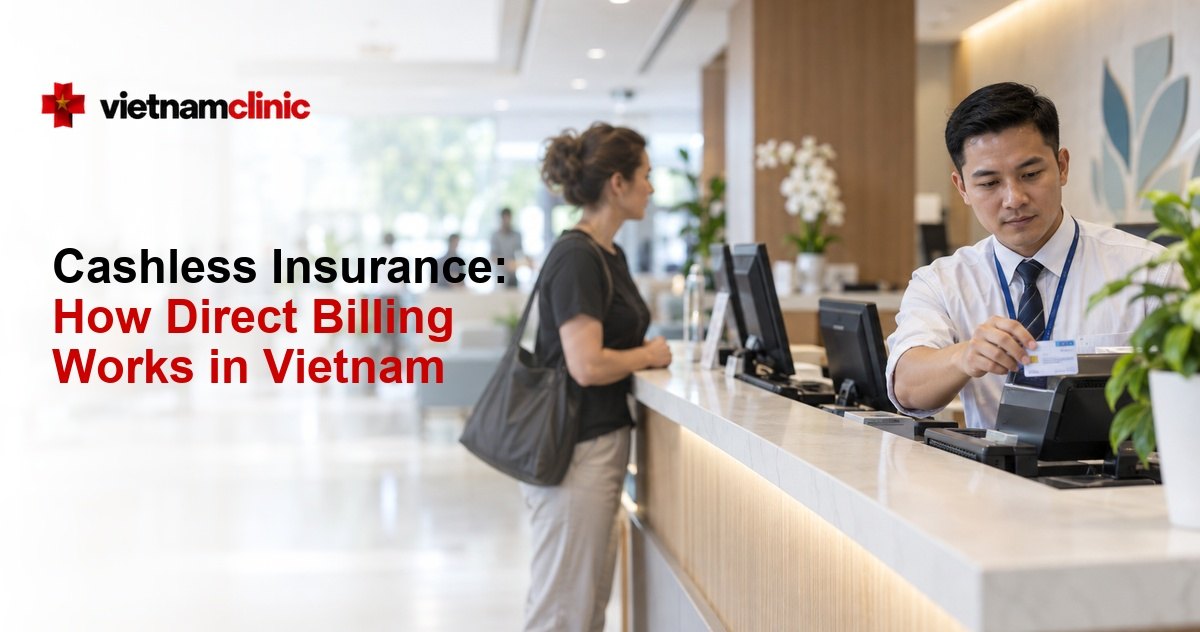
Cashless health insurance in Vietnam means an insurer can pay an eligible hospital or clinic directly for covered care. It does not mean treatment is free, that every provider accepts the card, or that the insurer has approved every item on the bill. The patient may still pay a deductible, co-payment, deposit, non-covered medicine, room upgrade or any amount above a benefit limit.
The service is commonly called direct billing, direct settlement or bảo lãnh viện phí. It works through an agreement between the insurer or assistance company and a medical provider. At registration, the provider verifies membership and sends medical and cost information for approval. If the request is accepted, the insurer issues or confirms a guarantee for the eligible amount; the patient settles the remainder.
What cashless health insurance actually guarantees
A membership card is evidence of enrolment, not an open promise to pay. The hospital must confirm that the policy is active, the provider and requested service are eligible, and any required authorization has been obtained. The insurer then applies the policy's limits, exclusions and patient contributions.
Liberty Vietnam's current guidance for treatment inside its network instructs members to present their insurance card and identity document before treatment. It also states that the patient pays excess and non-covered expenses. Pacific Cross Vietnam similarly explains that a member may need to complete a guarantee request, wait for confirmation and pay costs outside the policy even when treatment occurs at a linked provider.
“Cashless” is therefore a description of how an eligible bill is settled, not a separate medical benefit. If a policy excludes physiotherapy, using a direct-billing clinic does not create physiotherapy cover. If outpatient care has a yearly cap, the insurer will not pay beyond it simply because the provider belongs to the network.
The direct-billing process step by step
Before a routine visit, check the insurer's current provider directory rather than relying on an old hospital list or the facility's logo wall. Networks change, and one branch of a hospital group may participate while another does not. Direct billing can also be limited by department: a provider may accept it for inpatient care but not outpatient, dental or maternity services.
At reception, present the insurance card or electronic membership details, passport or accepted identity document and any referral required by the policy. The provider may request a credit card or deposit. This does not necessarily mean direct billing has failed; it protects the hospital against patient contributions and items the insurer later declines.
The clinic records the symptoms, diagnosis or provisional diagnosis, proposed services and expected cost. It sends the request to the insurer or assistance administrator. For a simple outpatient visit, confirmation may arrive during the appointment. For admission, surgery, expensive imaging or planned treatment, the process can require medical reports, an estimate and formal pre-authorization.
After receiving the insurer's response, the hospital identifies the guaranteed amount and the patient's share. The patient should review the estimate before treatment where practical. At discharge, the provider reconciles the actual services with the authorization. Additional items may require a revised guarantee; otherwise, the patient can be asked to pay them before leaving.
Pre-authorization and a guarantee of payment are different
Pre-authorization is the insurer's clinical and contractual review before a specified treatment. A guarantee of payment is the confirmation sent to the provider describing what the insurer expects to pay directly. In everyday practice the processes overlap, but patients should not treat a phone call saying treatment appears eligible as equivalent to a final financial guarantee.
Non-emergency admission and surgery usually require advance contact. Liberty's claim instructions state that pre-authorization is required for non-emergency inpatient treatment or surgery. The insurer may request the diagnosis, medical necessity, treatment plan, admission date and estimated cost. Starting planned treatment without approval can result in reimbursement-only handling, a reduced payment or a denial under the policy rules.
A guarantee can remain conditional. It may cover a standard room but not an upgrade, approve surgery but not an unrelated test, or apply only up to a stated sum. If the diagnosis changes during admission, the hospital should ask the insurer to revise the authorization. Patients should request a copy or clear explanation of the guaranteed and self-paid amounts.
Why a network hospital may still ask for money
The most common reason is a deductible or co-payment. A deductible is the amount the insured pays before the plan begins paying according to its terms. Co-payment is the percentage or fixed share retained by the patient. Both can apply even when the insurer settles its portion directly.
A provider may also collect a deposit while approval is pending. Pacific Cross states that participating facilities may apply their own deposit rule. In an emergency, treatment can begin before the insurer has enough information to confirm liability. The deposit is later reconciled with the approved patient share and the hospital's refund procedure.
Other common charges include administrative items, take-home products, meals for companions, premium rooms, non-prescribed tests, excluded conditions and amounts above customary or benefit limits. Ask for an itemised bill. A single label such as “hospital package” makes it difficult to distinguish covered clinical care from optional services.
A direct-billing refusal does not always mean the medical claim is permanently rejected. Pacific Cross explains that if a guarantee is refused, the member can pay the facility, collect the medical documents and invoices, and submit a reimbursement claim for consideration. The final answer depends on why the guarantee was refused and whether the treatment satisfies the contract.
Emergency treatment and direct billing
In a genuine emergency, obtain appropriate treatment first. Show insurance details as soon as reasonably possible and contact the insurer's emergency or assistance line. The hospital may request a deposit until coverage and identity are verified. Family members should record the policy number, admission time and contact person if the patient cannot manage the process.
Emergency status does not erase exclusions or limits, but policies often have special notification procedures. If the patient is admitted, the insurer may need a medical report before confirming ongoing treatment. Once stable, ask whether a transfer to a network facility is clinically appropriate and required. Never move a patient solely for billing convenience without the treating doctor's agreement.
Residents should keep the insurer's assistance number with their emergency contacts. The guide to Vietnamese public health insurance for foreigners is also useful for employees who may have both BHYT and private coverage; the two payment systems must be coordinated rather than assumed to combine automatically.
Treatment outside the direct-billing network
Outside the network, the usual route is reimbursement. The patient pays the provider and submits a claim form, itemised invoice, payment receipt, medical report, prescriptions, test results and any other required documents. Original invoices may be required above a threshold, and submission deadlines can apply.
Reimbursement gives patients a wider provider choice but creates cash-flow risk. A hospital bill can be substantial, and reimbursement may be lower than the amount paid because of deductibles, policy limits, reasonable-and-customary rules or currency conversion. Before planned treatment, request an estimate and ask whether the insurer can arrange a one-off direct settlement with that provider.
Do not choose a clinic solely because it displays several insurance logos. Confirm the exact branch, service and insurer arrangement. The guide to choosing a clinic in Vietnam covers licensing and clinical checks that should be considered separately from payment convenience.
How direct billing works with outpatient, inpatient and dental care
Outpatient direct billing can be fast when the consultation and tests fall within a clear outpatient benefit. However, some plans provide inpatient-only cover, impose a per-visit cap or exclude routine screening. The provider may separate the covered consultation from non-covered medicines or preventive tests.
Inpatient treatment usually involves more documentation because the financial exposure is larger. The insurer may review medical necessity, room entitlement, surgical fees and expected length of stay. Changes in treatment can trigger a revised estimate. At discharge, waiting for final confirmation may take time; patients should ask the hospital when the insurer received the final bill.
Dental and maternity networks are often narrower than general medical networks. A card accepted for outpatient medicine at a hospital may not provide cashless dental care at the same address. The article on whether health insurance in Vietnam covers dental treatment explains why preventive, restorative, accidental and cosmetic dental services must be checked separately.
Documents to carry and records to keep
Keep the physical or electronic insurance card, passport or accepted identity document, policy number and assistance contact available. For planned care, carry the referral, pre-authorization reference and recent reports. Foreign residents may also be asked for a valid visa or temporary-residence document under a provider's process.
Before signing discharge documents, review the itemised statement and patient contribution. Retain the medical report, prescriptions, laboratory and imaging results, invoice, receipt and explanation of benefits. These records help if an additional charge appears later or if the insurer and hospital disagree about the authorized amount.
For families, confirm that each dependent has an active card and correct date of birth. Do not assume a parent's membership number automatically proves a child's eligibility. Older residents should also check whether network access changes at renewal; health insurance for retirees in Vietnam discusses age and renewal constraints.
Questions to ask before relying on cashless access
Ask whether direct billing covers outpatient, inpatient, day surgery, dental and maternity care at each preferred facility. Ask whether pre-authorization is required, how long routine approval usually takes, what happens outside business hours and whether the hospital may collect a deposit.
Then ask which patient contributions apply: deductible, co-payment, room difference, excluded supplies and amounts over the annual or per-visit limit. Confirm whether pre-existing conditions, chronic medication and routine check-ups are treated differently. A broad provider network is less useful if the benefits needed most remain reimbursement-only or excluded.
Finally, ask how to proceed if the system is unavailable or the hospital cannot verify the card. Obtain the reimbursement deadline and required originals. Keep enough emergency funds or available credit to pay temporarily; even a well-designed direct-billing plan can require payment when authorization is delayed.
When comparing policies, look beyond the number of network facilities. Our guide to local, travel and international health insurance in Vietnam explains how geographic cover and benefit design change the value of a network. Reliable cashless cover comes from the combination of an active policy, an eligible service, a participating provider and timely authorization—not from the insurance card alone.
Frequently Asked Questions
Does direct billing mean I pay nothing at the hospital?
No. You may still pay a deductible, co-payment, deposit, excluded services, upgrades or costs above a policy limit.
Can a network hospital refuse cashless treatment?
Yes. Direct billing may be unavailable for a department, service or policy, or approval may be pending. You may need to pay and submit a reimbursement claim.
Is pre-authorization the same as a guarantee of payment?
Not exactly. Pre-authorization reviews the proposed treatment; a guarantee tells the provider what eligible amount the insurer expects to settle directly.
What should I show at a direct-billing hospital?
Usually the insurance card or electronic membership record and accepted identification. The provider may also request a referral, authorization reference, visa or residence document and a deposit method.
What happens if direct billing is unavailable in an emergency?
Seek care first, contact the insurer promptly, keep all medical and payment documents, and follow the emergency notification and reimbursement procedure in the policy.
Sources

Writer
Tan Nguyen
Medical writer for Vietnam Clinic. MD, Vietnam National University Ho Chi Minh City.