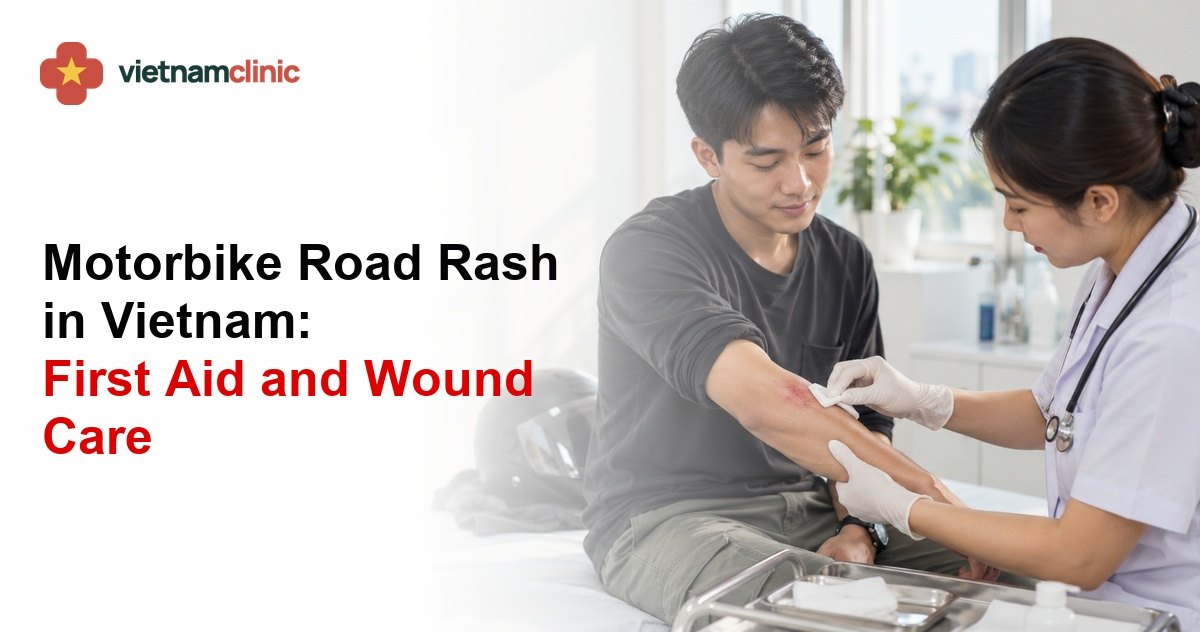
The motorbike is on its side, your clothes are torn and one knee is bleeding. The immediate temptation is to look only at the raw skin. After a crash in Vietnam, however, the most important decision comes before wound care: is this really just road rash, or is the abrasion distracting from a head, spine, chest, abdominal or limb injury?
Adrenaline can make a rider stand up and say they are fine while pain, dizziness or confusion becomes clearer minutes later. Treat the whole crash first and the skin second. Once serious injury and major bleeding are unlikely, thorough cleaning, an appropriate dressing and a tetanus check give a superficial abrasion the best chance to heal.
In the first minutes, read the crash as well as the wound
Move out of live traffic only when it is safe to do so. Do not drag someone who may have a neck or back injury unless remaining in place presents an immediate danger. Ask a bystander to warn approaching vehicles and call for help. Vietnam’s medical emergency number is 115; the guide to emergency numbers in Vietnam explains what information to give.
Check whether the injured person is awake, breathing normally and able to answer simple questions. Heavy bleeding needs firm, continuous pressure with sterile gauze or a clean folded cloth. Add material on top if blood soaks through rather than repeatedly lifting the first layer. Spurting blood, uncontrolled bleeding, pale clammy skin, collapse or breathing difficulty requires emergency care.
A rider should be assessed urgently after loss of consciousness, confusion, repeated vomiting, worsening headache, unequal pupils, seizure, weakness, numbness or unusual drowsiness. Severe neck, back, chest or abdominal pain, a deformed limb, inability to bear weight and pain that increases rather than settles also matter. A helmet reduces risk but does not rule out concussion, and a normal-looking abdomen does not exclude internal injury.
Do not ride away simply because the motorbike still runs. If head injury is possible, the person should not drink alcohol, drive or stay alone. Record what happened, including speed, impact direction, helmet strike and any period of memory loss; those details can help a clinician interpret symptoms that emerge later.
Decide whether the abrasion is suitable for home care
Road rash is a friction injury. Asphalt removes the upper layers of skin and often pushes dust, grit, paint or fabric into the exposed surface. A small superficial abrasion usually stings, oozes a little clear fluid and preserves normal movement and sensation. A deeper injury may expose yellow fat, have pale or black areas, bleed persistently or contain embedded particles.
Home care is reasonable only when the abrasion is limited, superficial, no longer bleeding significantly, and can be cleaned without force. Seek medical care for a large area, a wound across a joint, or an injury involving the face, eye, hand, genitals or foot. Exposed fat, tendon or bone, reduced sensation, limited movement and debris that will not rinse away need professional irrigation and, sometimes, debridement.
Gravel left in the skin can cause infection and permanent dark marks known as traumatic tattooing. Aggressive scrubbing is not the answer. If adequate cleaning is too painful or particles remain embedded, stop and let a clinician use pain control and proper instruments.
Cleaning road rash without damaging it again
Begin by washing your hands. If the wound is still bleeding lightly, apply pressure before cleaning. Once bleeding is controlled, place the abrasion under plenty of potable running water. Sterile saline is also suitable, but clean tap water is a reasonable option for superficial wounds according to current first-aid guidance.
Irrigation should continue until no obvious loose debris remains. Gently lift only material that comes away easily with clean gauze or first-aid tweezers. Do not dig for grit, pull out a deeply embedded object or scrub a broad raw surface until it bleeds. Clean the intact surrounding skin with mild soap, keeping vigorous rubbing away from the wound bed.
Pouring alcohol, hydrogen peroxide or concentrated iodine into the abrasion does not substitute for irrigation. Strong antiseptics can irritate viable tissue. The practical goal is a visibly clean wound, not a burning sensation that feels like proof of disinfection.
If clean water is not available at the roadside, cover the wound loosely with clean material and reach a place where it can be irrigated properly. A quick wipe with a tissue traps contamination rather than completing the job.
Cover the wound and let healing happen in a protected environment
After cleaning, use a sterile non-adherent dressing or another dressing recommended for superficial abrasions. Current first-aid guidance supports covering a clean abrasion with an occlusive dressing because a protected, appropriately moist environment promotes healing. Ordinary dry gauze placed directly on the raw surface can stick and tear new tissue away during removal.
Secure the dressing without restricting circulation. Fingers or toes beyond it should remain warm, normally coloured and free from increasing tingling or numbness. Follow the product instructions for changing it, and replace it sooner if it becomes soaked, dirty, loose or contaminated.
When a dressing sticks, moisten it with clean water or saline and wait. Pulling it off dry can restart bleeding. Wash your hands before and after every change, and inspect the wound in good light rather than opening it repeatedly throughout the day.
Avoid swimming pools, hot tubs, the sea and untreated fresh water while the surface remains open. Showering may be possible with suitable protection, but soaking exposes the wound to contamination and loosens dressings. Clothing should not rub across the injured area.
Tetanus depends on the wound and your vaccination history
Tetanus risk is not determined by whether the road or an object looked rusty. The bacteria can enter through broken skin, and an abrasion contaminated with soil or debris may count as a dirty wound. A clinician considers both the wound and the person’s immunisation record.
CDC guidance states that no tetanus vaccine is needed for any wound when the person completed the primary series and received the last tetanus-containing dose less than five years ago. For a dirty or major wound, a booster is recommended when the last dose was five or more years ago. For a clean minor wound, the usual threshold is ten years.
Anyone with an unknown, incomplete or absent vaccination history should be assessed. Some people with a dirty wound and inadequate immunity may also need tetanus immune globulin, including specific people with severe immune deficiency. Antibiotics do not prevent tetanus, so buying them without an indication is not a substitute for checking vaccination.
Bring any vaccine record you have. If it is stored on a phone or in another country’s system, a photograph or translated entry is more useful than guessing the year.
Watch the direction of change, not a single photograph
A fresh abrasion is expected to hurt and can have a narrow red edge. Early clear or pale-yellow fluid is not automatically pus. What matters over the next few days is the direction: pain, redness, warmth, swelling and drainage should gradually settle rather than expand.
Seek care if pain is increasing, redness spreads beyond the wound, the area becomes hotter or more swollen, or drainage turns thick, foul-smelling or pus-like. Fever, chills, red streaks travelling up a limb, swollen lymph nodes or feeling generally unwell require prompt assessment. Rapidly spreading discoloration, black tissue or pain far greater than the visible injury is urgent.
A wound can close over retained grit or infection. If it is not progressing, a clinician may need to reopen and irrigate it, remove dead tissue or decide whether culture and antibiotics are appropriate. Routine antibiotics are not necessary for every clean abrasion and should not be self-selected from a pharmacy.
Healing is a process, not a race to form a scab
A small graze may become much less painful within days, while a deep or broad abrasion can need weeks of dressings. Good progress means less pain and drainage, normal movement, healthy tissue and gradual closure. Forcing the surface to dry as quickly as possible is not the goal.
Eat normally, drink enough and avoid smoking because nicotine can impair tissue healing. Gentle movement can prevent stiffness around an uncomplicated wound, but suspected fracture, ligament damage or pain across a joint should be assessed before exercise. Use pain relief only when it is suitable for your health conditions and does not mask worsening pain after a significant collision.
Once the skin is fully closed, sun protection can reduce long-lasting colour change. Do not place silicone scar products on an open or infected wound. Seek advice if the scar becomes thick, persistently itchy or painful, or begins to restrict movement.
Finding the right level of care in Vietnam
A pharmacy can sell dressings and saline and may help with a minor wound, but it cannot rule out a fracture, concussion or internal injury. A clinic may manage a straightforward abrasion; a hospital emergency department is more appropriate when imaging, suturing, surgery, observation or treatment of several injuries might be needed.
The guides to what to do when sick or injured in Vietnam and medical care for visitors explain how to choose a starting point. In an emergency, choose timely capable care rather than delaying while searching for an ideal English-speaking provider.
Bring identification, insurance details when available, a medicine list, allergy information and the time of the crash. Keep photographs of the scene and wound if doing so is safe. Ask what dressing to use, when to change it, whether tetanus protection is needed, what symptoms require return, and when riding, work or swimming can resume.
People with diabetes, poor circulation, immune suppression or medicines that affect bleeding or healing should seek review sooner. The same applies when follow-up will be difficult because of travel.
Before getting back on the motorbike
Do not resume riding until attention, balance, movement and pain allow safe control of the bike. Replace a helmet that sustained an impact according to the manufacturer’s instructions, even if the shell looks intact. Have the motorbike checked after a meaningful collision.
For future journeys, a correctly fitted certified helmet protects the head, while gloves, closed footwear, long trousers and a motorcycle jacket protect skin. Thin everyday fabric can disappear quickly during a slide. Avoid riding after alcohol, sedating medication or severe fatigue, and slow down over sand, gravel, painted markings, metal covers and wet surfaces.
The visible abrasion is often the least complicated part of a motorbike crash. A good outcome begins by recognising what the skin injury might be hiding, then cleaning the wound thoroughly, covering it appropriately and watching how the whole person changes over time.
Frequently Asked Questions
Can a small road-rash wound be treated at home?
A limited superficial abrasion can usually be irrigated with potable running water and covered with a sterile non-adherent dressing. Seek care if it is large, deep, across a joint, contains embedded debris, affects movement or sensation, or follows a significant crash.
Should I pour alcohol or hydrogen peroxide on road rash?
No. Thorough irrigation with potable running water or saline is preferred for a superficial abrasion. Strong antiseptics can irritate viable tissue and do not compensate for dirt or grit left in the wound.
When is a tetanus booster needed after a motorbike fall?
It depends on wound type and vaccination history. CDC guidance recommends a booster for a dirty or major wound when a fully vaccinated person’s last tetanus-containing dose was five or more years ago; unknown or incomplete vaccination needs clinical assessment.
What are the warning signs of wound infection?
Increasing pain, spreading redness, warmth, swelling, pus or foul odour should be assessed. Fever, chills, red streaks, swollen lymph nodes, black tissue or feeling generally unwell require prompt care.
When can I swim after road rash?
Avoid pools, hot tubs, the sea and untreated fresh water while the wound remains open. Wait until the skin is fully closed and follow the treating clinician’s advice after a deep or infected abrasion.
Sources

Writer
Tan Nguyen
Medical writer for Vietnam Clinic. MD, Vietnam National University Ho Chi Minh City.