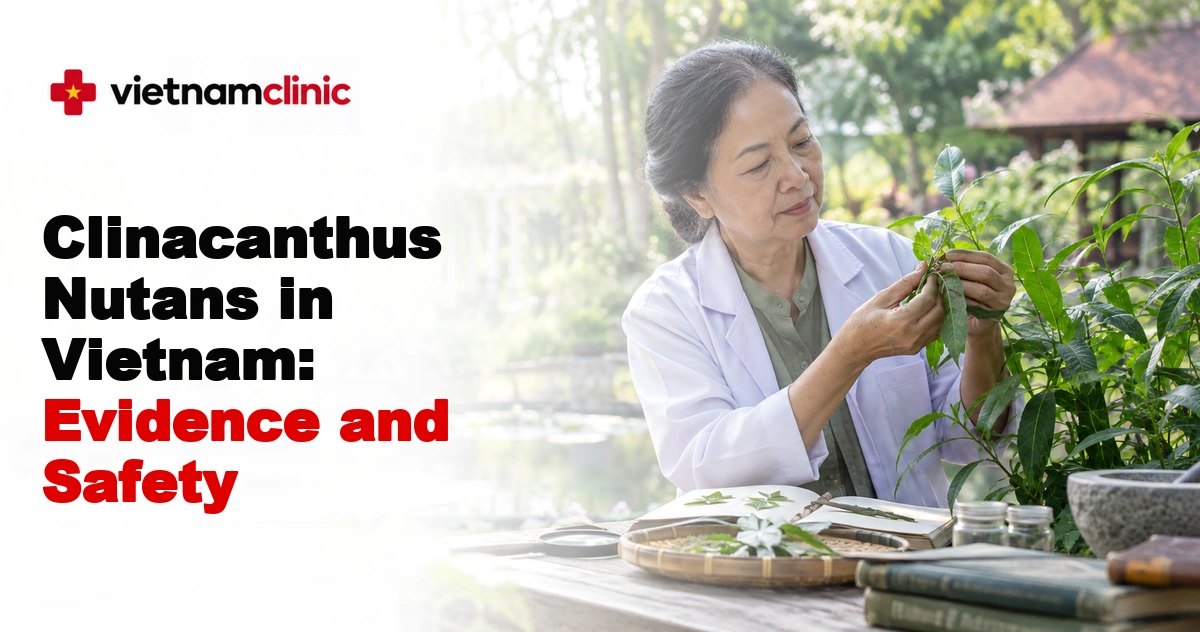
Clinacanthus nutans, commonly discussed in Vietnam as cây xương khỉ, is a medicinal plant used in Southeast Asia. Research has explored topical preparations for some herpes-related skin lesions, mouth rinses, and biological effects in laboratory models. These different lines of research should not be combined into a claim that the plant cures cancer or a wide range of chronic diseases.
The practical question is not simply whether the plant contains active chemicals. It is whether a particular preparation, used in a particular way, produces a worthwhile benefit in people and has an acceptable safety profile. For many promoted uses, that evidence remains insufficient.
Plant identity matters
Clinacanthus nutans belongs to the Acanthaceae family. Kew recognizes it as an accepted species native to parts of southern China and Southeast Asia. Regional common names vary, which can make identification and comparison of products difficult.
A scientific name on a label is more informative than a nickname alone, but does not guarantee correct identification or quality. A plant photograph is also not enough to establish that a collected leaf is suitable for medicinal use. Related plants can have different chemical compositions.
The part used matters too. Leaf, stem and root extracts are not automatically interchangeable. A study that tests a root fraction against cultured cells does not establish the benefit of drinking a tea made from leaves. Preserving these distinctions helps avoid misleading claims based on a shared plant name.
Traditional use and clinical evidence answer different questions
Traditional use can identify treatments worth studying and describe how communities have used a plant. It cannot by itself determine how much improvement was caused by the plant rather than natural recovery, another treatment or differences between patients.
This matters for conditions such as shingles, where skin lesions usually change over time even without a herbal cream. A person may notice healing after applying a preparation, but that observation does not reveal how the illness would have progressed without it.
Randomized controlled trials compare groups to help answer that question. The preparation, participants, comparison treatment, outcome and follow-up period all matter. Evidence about faster crusting of a rash is different from evidence about preventing nerve pain months later or eliminating a virus from the body.
What the older shingles trials found
A 1995 randomized placebo-controlled trial studied a topical Clinacanthus nutans formulation in 51 people with shingles. The researchers reported faster lesion crusting and healing, together with more rapid reduction in pain scores, in the extract group. No side effects were reported in that small trial.
A separate randomized trial of a Clinacanthus nutans cream was published in 1996. These studies provide a reason for further investigation of specific topical products. They do not establish that all commercial creams, homemade leaf pastes or oral preparations have the same effects.
Small studies also have limited ability to detect uncommon harms. Short-term skin improvement does not establish protection against eye involvement, serious infection or prolonged postherpetic neuralgia. The age of a study does not automatically invalidate it, but its findings need to be considered alongside current treatment standards and the exact product available.
Shingles still needs appropriate assessment
Shingles results from reactivation of varicella-zoster virus, the virus that causes chickenpox. It often produces pain and a blistering rash on one side of the body. Antiviral medicines can shorten or reduce the severity of illness, particularly when started promptly.
Do not delay medical evaluation while waiting to see whether leaves or a cream help. A rash near the eye or nose, visual symptoms, widespread lesions or illness in someone with a weakened immune system needs prompt assessment. Eye involvement can threaten vision.
A topical herbal preparation should not be presented as equivalent to an oral antiviral regimen or as a substitute for recommended vaccination. These interventions address different questions. The choice of antiviral, pain relief and follow-up depends on the person's condition rather than on a general preference for natural products.
Genital herpes is a separate clinical problem
Genital herpes is usually caused by herpes simplex virus, not the virus responsible for shingles. Similar-looking blisters do not mean that findings from one infection automatically apply to the other. Genital ulcers also have other causes that may require different testing and treatment.
Current CDC guidance uses oral antiviral medicines for appropriate first episodes, recurrences or suppressive treatment. Suppressive treatment can reduce recurrences and, in relevant circumstances, reduce transmission risk. Topical antiviral treatment provides little clinical benefit and is discouraged in that guidance.
Evidence about a herbal topical preparation does not establish prevention of sexual transmission, elimination of latent herpes or safety during pregnancy. A first genital outbreak, genital symptoms during pregnancy or severe symptoms requires clinical assessment. Do not place homemade plant preparations inside the vagina or on an unassessed genital ulcer.
Mouthwash research does not demonstrate cancer treatment
Clinacanthus nutans mouthwash has been investigated for oral mucositis associated with radiotherapy for head and neck cancer. Mucositis is inflammation and damage to the mouth lining that can make eating and drinking painful. A randomized trial of herbal mouthwashes was published in 2022.
The important distinction is the outcome being studied. Preventing or reducing treatment-related mouth soreness is supportive care; it is not evidence that the plant shrinks a tumour, prevents metastasis or improves cancer survival. A patient may receive supportive treatment while continuing radiotherapy.
People receiving cancer treatment should use the mouth-care plan recommended by their oncology team. A research mouthwash has a defined formulation and procedure; a homemade decoction is not an equivalent substitute. Inability to drink, fever or severe mouth pain needs clinical attention rather than simply increasing the strength of a rinse.
What cancer-cell studies actually show
Laboratory studies have exposed breast, cervical and other cancer cell lines to particular Clinacanthus nutans extracts. Some report reduced cell growth or increased apoptosis, a process of programmed cell death. A 2022 study, for example, examined selected extract fractions in MCF7 breast cancer cells.
These are experiments on cells, not treatment trials in people with breast cancer. A substance can damage cancer cells in a dish without reaching an effective concentration in a human tumour, and without being safe for other tissues. Digestion, absorption and metabolism can change what reaches the bloodstream.
Other work has included animal tumour models, including a 2025 study of triple-negative breast cancer. Such research can help identify mechanisms and future drug candidates. It still does not establish that patients should drink leaf juice or replace surgery, radiotherapy, chemotherapy or targeted treatment with the plant.
Extraction changes the substance being tested
Researchers have used water, methanol, dichloromethane, hexane and other solvents to separate different plant chemicals. A solvent fraction is a selected mixture, not simply a stronger version of ordinary tea. Different extracts can show different activity even when they come from the same species.
Solvents used in laboratory research are not instructions for home preparation. Do not try to reproduce a laboratory extract using industrial chemicals. A concentration reported in micrograms per millilitre in a cell experiment cannot be converted directly into a number of leaves to swallow.
The same caution applies to capsules advertised as concentrated. An extract ratio or a large milligram number alone does not show how much of a relevant compound is present, whether it is absorbed or whether the finished product has been tested in people.
Inflammation, joint pain and immune claims
Experimental studies have examined inflammatory pathways, including cytokine production and Toll-like receptor signalling. Researchers have reported changes in laboratory cell models after exposure to certain extracts. These findings help explain possible biological activity; they do not demonstrate treatment of every inflammatory disease.
An animal study compared a Clinacanthus nutans extract with diclofenac in an experimentally induced model involving bone and joint disease. That does not establish equivalent pain relief, cartilage protection or long-term safety in people with knee osteoarthritis.
Terms such as immune booster and anti-inflammatory are therefore too broad to serve as treatment instructions. Autoimmune disease, infection and joint degeneration have different mechanisms and require different care. Reducing a laboratory marker is not the same outcome as better walking, fewer flares or prevention of organ damage.
Diabetes, kidney disease and detox claims
Claims about lowering glucose, protecting kidneys or cleansing the body need human evidence for those specific outcomes. A laboratory antioxidant result cannot show that an oral product prevents kidney failure or safely replaces diabetes treatment.
People with diabetes should not reduce prescribed medicines because they start a herbal drink. Changes in glucose need to be interpreted with diet, illness and existing treatment in mind. People with kidney disease may be particularly vulnerable to uncertain ingredients or poorly characterized doses.
More frequent urination is not proof that toxins are being removed or kidney function is improving. Likewise, feeling more energetic does not establish that liver injury has resolved. These conditions require appropriate clinical measurements, not only subjective changes after starting a plant product.
Safety data have important limits
A preclinical study of an aqueous leaf extract included repeated dosing in rats over 90 days and reported reassuring results under its experimental conditions. That information is useful for research, but it cannot prove that every preparation is safe for lifelong human use.
Animal species, extract composition, dose and duration affect the interpretation. A high dose tolerated in one animal experiment is not a recommended human dose. Findings for a water extract cannot automatically establish the safety of a different concentrated fraction.
Human studies have not adequately established safety across pregnancy, breastfeeding, childhood and serious liver or kidney disease. Avoid self-prescribing medicinal quantities in these settings. Lack of documented harm is especially difficult to interpret when exposure numbers and adverse-event reporting are limited.
Possible medicine interactions
Researchers have tested Clinacanthus nutans leaf extracts against drug-metabolizing enzymes, including CYP3A4 and CYP2E1, in human liver microsomes. These are laboratory preparations used to investigate metabolism. Such work raises questions about interactions but does not by itself quantify what happens with a particular tea in a patient.
Do not interpret this uncertainty as a guarantee of compatibility with prescription medicines. The consequences of altered drug exposure can be important with cancer treatment, transplant medicines and other drugs that require carefully controlled levels.
Tell the treating clinician or pharmacist which plant preparation is being used and how often. Separating a supplement and a medicine by a few hours does not necessarily prevent interactions involving metabolism. During cancer treatment, even an apparently harmless addition should be checked against the actual regimen.
Quality, adverse reactions and situations needing care
Finished herbal products may differ in identity, concentration, contamination control and added ingredients. Homemade preparations also vary with the plant source, storage and preparation method. A label describing a product as standardized does not, by itself, guarantee consistent quality or clinical benefit.
Stop a new preparation and seek advice if a rash, persistent vomiting or other concerning symptoms develop. Breathing difficulty or swelling of the lips or tongue is an emergency. Jaundice, dark urine or markedly reduced urination requires prompt assessment; these signs should not be dismissed as a detox reaction.
Do not apply unsterile crushed leaves to eyes, deep wounds or severely damaged skin. Traditional associations with snakebite do not make this plant an antidote. A suspected venomous snakebite requires urgent medical treatment and, when indicated, appropriate antivenom; using plant remedies must not delay that care.
A realistic place for the evidence
Clinacanthus nutans has produced findings worth studying, particularly for defined topical uses and biological mechanisms. That is a narrower conclusion than calling it a proven cancer cure, a replacement for antivirals or a generally safe daily medicine.
For someone considering a product, the relevant comparison is the exact formulation and route used in human research for the same condition. If that evidence is missing, a confident sales claim does not fill the gap. Treatment decisions should preserve effective care while recognizing where this plant's benefits, doses and long-term risks remain uncertain.
Frequently Asked Questions
What should you know about plant identity matters?
Clinacanthus nutans belongs to the Acanthaceae family. Kew recognizes it as an accepted species native to parts of southern China and Southeast Asia.
What should you know about traditional use and clinical evidence answer different questions?
Traditional use can identify treatments worth studying and describe how communities have used a plant. It cannot by itself determine how much improvement was caused by the plant rather than natural recovery, another treatment or differences between patients.
What the older shingles trials found?
A 1995 randomized placebo-controlled trial studied a topical Clinacanthus nutans formulation in 51 people with shingles. The researchers reported faster lesion crusting and healing, together with more rapid reduction in pain scores, in the extract group.
What should you know about shingles still needs appropriate assessment?
Shingles results from reactivation of varicella-zoster virus, the virus that causes chickenpox. It often produces pain and a blistering rash on one side of the body.
What should you know about genital herpes is a separate clinical problem?
Genital herpes is usually caused by herpes simplex virus, not the virus responsible for shingles. Similar-looking blisters do not mean that findings from one infection automatically apply to the other.
Sources

Writer
Tan Nguyen
Medical writer for Vietnam Clinic. MD, Vietnam National University Ho Chi Minh City.