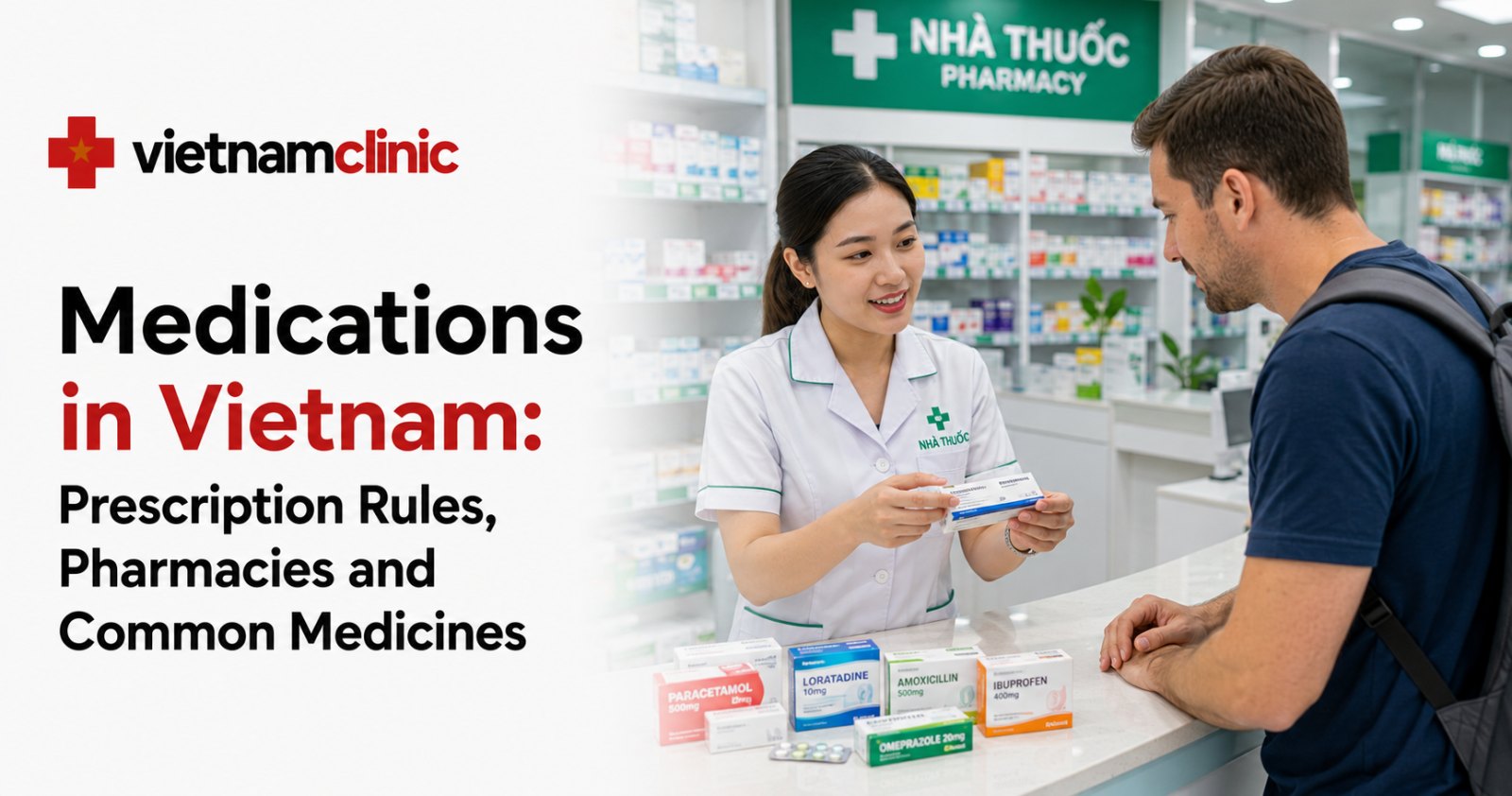
Buying medicine in Vietnam can feel surprisingly easy, particularly in large cities where pharmacies are common and many products are inexpensive. However, what a pharmacy is willing to sell and what Vietnamese pharmaceutical rules formally require are not always the same thing.
Vietnam distinguishes between over-the-counter medicines, prescription medicines and more tightly controlled narcotic or psychotropic medicines. The rules were updated significantly from July 2025, including new prescription requirements and clearer criteria for deciding which medicines qualify as non-prescription drugs.
For travelers and expats, the safest approach is to use reputable pharmacies, identify medicines by their active ingredient rather than brand name and avoid assuming that a medicine is legally over the counter simply because someone sells it without asking for a prescription.
Can you buy medicine easily in Vietnam?
Yes. Pharmacies are widespread in Vietnam, particularly in Hanoi, Ho Chi Minh City, Da Nang and other urban areas.
You can find:
- Independent neighborhood pharmacies.
- Large pharmacy chains.
- Pharmacies inside or close to hospitals.
- Pharmacies attached to private clinics.
- Online pharmacy services for eligible medicines.
Common non-prescription medicines are generally easy to obtain.
More specialised medicines may require a prescription, a hospital pharmacy or a larger pharmacy with broader stock.
Which medicines are available without a prescription?
Vietnam has a formal category of non-prescription medicines, also known as over-the-counter or OTC drugs.
Vietnam's amended Pharmaceutical Law defines an OTC medicine as one that can be supplied, sold and used without a prescription and that meets Ministry of Health classification requirements.
From July 1, 2025, the Ministry of Health introduced five core criteria that a medicine must satisfy to qualify as non-prescription.
Broadly, an OTC medicine should:
- Have a sufficiently wide safety margin.
- Be suitable for short-term conditions that people can reasonably self-treat.
- Have a low risk of abuse or misuse.
- Be simple to use without professional assistance.
- Not contain certain toxic medicinal ingredients.
This formal classification is more important than whether an individual pharmacy happens to sell the medicine without asking for paperwork.
Common over-the-counter medicines in Vietnam
Vietnamese Ministry of Health guidance on online OTC sales gives useful examples of medicines commonly considered non-prescription.
These include products containing substances such as:
- Paracetamol.
- Ibuprofen.
- Loratadine.
- Cetirizine.
- Antacids.
- Some anti-diarrheal medicines.
- Laxatives.
- Digestive products.
- Vitamins.
- Mineral supplements.
The exact formulation matters because two products with similar brand names may contain different active ingredients or doses.
Always read the packaging rather than buying solely by brand recognition.
Paracetamol is widely available
Paracetamol, also known as acetaminophen in some countries, is one of the most commonly available pain and fever medicines in Vietnam.
It can be sold under numerous brands as well as generic formulations.
Travelers may use it for short-term problems such as:
- Headache.
- Mild muscle pain.
- Fever.
- Minor aches.
Do not accidentally combine several cold or flu medicines that each contain paracetamol, because this can lead to excessive total dosing.
Check the active ingredients of combination products carefully.
Ibuprofen is another common option
Ibuprofen is also widely used for pain, fever and inflammation.
It belongs to the non-steroidal anti-inflammatory drug group, or NSAIDs.
It is not suitable for everyone. People with certain stomach, kidney, cardiovascular or medication-related risk factors may need to avoid it or seek professional advice.
Travelers with dengue-like symptoms should be particularly cautious about taking NSAIDs without medical guidance because bleeding risk can be relevant in suspected dengue.
Allergy medicines are easy to find
Antihistamines such as loratadine and cetirizine are among the common medicines referenced by Vietnam's Ministry of Health in connection with non-prescription pharmacy sales.
They may be used for symptoms related to:
- Allergic rhinitis.
- Itching.
- Hives.
- Other uncomplicated allergy symptoms.
Different antihistamines have different effects on alertness, so check whether a product may cause drowsiness before driving or riding a motorbike.
Stomach and diarrhea medicines are common pharmacy purchases
Travelers frequently visit pharmacies in Vietnam for digestive problems.
Depending on the situation, pharmacies may stock products such as:
- Oral rehydration salts.
- Antacids.
- Anti-diarrheal medicines.
- Laxatives.
- Digestive products.
Oral rehydration is particularly important when diarrhea causes significant fluid loss.
Medication that slows diarrhea is not appropriate in every situation, especially when there is bloody diarrhea, high fever or another sign of invasive infection.
For a broader guide, see Food Poisoning in Vietnam: Symptoms, Treatment and What Travelers Should Do.
Do antibiotics require a prescription in Vietnam?
Yes. Antibiotics should not be treated as ordinary over-the-counter medicines under Vietnam's formal pharmaceutical rules.
Vietnam's Ministry of Health has repeatedly emphasised that antibiotics should be used according to medical prescription requirements.
In practice, travelers and expats have historically reported being able to purchase antibiotics from some pharmacies without presenting a prescription. That reflects inconsistent retail practice rather than proof that antibiotics are officially OTC.
This distinction matters because inappropriate antibiotic use can:
- Cause side effects.
- Interact with other medicines.
- Fail to treat the actual illness.
- Contribute to antimicrobial resistance.
- Delay diagnosis of a more serious condition.
If you think you need an antibiotic, medical assessment is preferable to choosing one based solely on pharmacy availability.
Pharmacies may sell more than the law technically allows without a prescription
This is one of the most confusing aspects of medication in Vietnam.
A traveler may walk into one pharmacy and be asked for a prescription, then visit another and receive the same medicine without one.
Do not use that inconsistency as a legal classification system.
A pharmacy's decision to sell a product without paperwork does not automatically make that product a legally defined OTC medicine.
For prescription status, rely on the medicine's formal classification rather than anecdotal pharmacy practice.
Vietnam updated its prescription rules in 2025
Circular 26/2025/TT-BYT took effect on July 1, 2025 and regulates prescriptions for chemical medicines and biological products used in outpatient treatment.
Among other requirements, prescriptions may contain information such as:
- Patient identification information.
- Place of residence.
- Additional information for young children.
- The medicine name.
- Dose and instructions.
For single-active-ingredient medicines, prescriptions are generally written using the international non-proprietary name, helping reduce confusion between different commercial brands.
Hospitals were also required to move toward electronic prescribing under the updated rules.
Some chronic conditions can receive prescriptions for longer than 30 days
Vietnam's 2025 prescription reforms also allow longer outpatient prescription periods for a substantial list of chronic diseases and conditions.
Examples include certain cases involving:
- Diabetes.
- Hypertension.
- Parkinson's disease.
- Alzheimer's disease and dementia.
- Chronic hepatitis B.
- Some cancers.
- Other long-term diseases specified by the Ministry of Health.
This can be particularly relevant to expats who live in Vietnam rather than visiting for a short holiday.
Long-term residents may find it more practical to establish care with a local doctor rather than repeatedly importing large quantities of medication from abroad.
Can you buy prescription medicine online in Vietnam?
Vietnam introduced clearer legal rules for online pharmaceutical sales from July 2025.
The amended Pharmaceutical Law permits online sale of non-prescription medicines under the applicable regulatory framework.
Prescription medicines are much more restricted online, with limited exceptions under specific circumstances.
This means a website or app offering virtually any prescription medicine for immediate delivery without clinical involvement should not automatically be assumed to represent compliant pharmacy practice.
When buying medicine online, check that the seller is a legitimate pharmacy business rather than an anonymous marketplace seller.
Large pharmacy chains can be easier for foreigners
Large pharmacy chains can be useful for travelers because they often have:
- Computerised product databases.
- Consistent packaging.
- Wider stock.
- Clearer receipts.
- Multiple branches.
- Staff accustomed to identifying generic medicines.
Independent pharmacies can also provide good service, but the experience varies more between individual locations.
If the pharmacist does not recognise your foreign brand, show them the generic active ingredient and strength.
For example, instead of asking only for a specific foreign brand, provide information such as:
- Paracetamol 500 mg.
- Loratadine 10 mg.
- Omeprazole 20 mg.
That makes it easier to identify an equivalent Vietnamese product.
Brand names are not universal
One of the easiest mistakes for travelers is assuming that a familiar brand will have the same name in Vietnam.
Pharmaceutical brands differ between countries.
The same active ingredient can be sold under:
- Vietnamese brands.
- International brands.
- Generic labels.
- Manufacturer-specific names.
Before travelling, make a list showing:
- Brand name.
- Generic active ingredient.
- Strength.
- Normal dose.
This is particularly useful if you take daily medication.
Do not assume the same-looking box contains the same dose
Even when a medicine contains the correct active ingredient, the strength can differ.
For example, one country may commonly sell a product at one dose while Vietnamese pharmacies stock several strengths.
Always verify:
- Active ingredient.
- Milligrams per tablet or capsule.
- Number of doses per day.
- Immediate-release or extended-release formulation.
Taking the correct drug at the wrong strength can still be dangerous.
Controlled medicines follow much stricter rules
Narcotic and psychotropic medicines are not treated like ordinary prescription drugs.
This category can include some medications used for:
- Severe pain.
- Anxiety.
- Seizures.
- Insomnia.
- ADHD.
- Other neurological or psychiatric conditions.
Substances such as codeine, alprazolam and diazepam can fall within Vietnam's controlled-drug framework.
If you are bringing controlled medication into Vietnam, check the rules before departure rather than assuming a foreign prescription is sufficient.
For more detail, see What Medications Are Illegal in Vietnam? A Guide for Travelers and Expats.
Can tourists bring their own prescription medication?
Many ordinary prescription medicines can be brought into Vietnam for legitimate personal treatment, but documentation requirements become more important for controlled drugs.
A sensible travel medication file includes:
- Original packaging.
- Prescription copy.
- Doctor's letter where appropriate.
- Generic active ingredient.
- Dose.
- Quantity carried.
Vietnam Clinic's guide to Customs Rules for Prescription Medications in Vietnam covers the travel side in more detail.
What if you run out of medication while in Vietnam?
Start by identifying the active ingredient rather than the foreign brand.
A pharmacist may be able to locate a Vietnamese equivalent if it is legally available.
For prescription medicine, particularly medication used for chronic disease, mental health conditions or more complex treatment, seeing a doctor can be preferable.
The doctor can:
- Confirm the medicine is appropriate.
- Check the local equivalent.
- Issue a Vietnamese prescription where necessary.
- Arrange monitoring.
If you need help locating care, see How to Choose an English-Speaking Clinic in Vietnam.
Can you get sildenafil or Viagra in Vietnam?
Sildenafil products are available in Vietnam, but availability at pharmacies should not be confused with a guarantee that every product is genuine or appropriately supplied.
Counterfeit erectile dysfunction medicines are an international problem and may contain incorrect doses or undeclared substances.
Buy from legitimate pharmacies and avoid pills sold through bars, street sellers or anonymous social media accounts.
What about sleeping pills and anxiety medication?
Some medications used for sleep and anxiety are controlled psychotropic medicines in Vietnam.
This can include benzodiazepines such as:
- Alprazolam.
- Diazepam.
- Other controlled sedatives.
These are different from ordinary OTC antihistamines that may occasionally cause drowsiness.
Do not self-select a strong sedative simply because a pharmacy is willing to sell it.
Are steroids available in Vietnamese pharmacies?
The word "steroid" covers several completely different drug categories.
Corticosteroids used to treat inflammation are legitimate medicines but can have significant side effects when used incorrectly.
Anabolic-androgenic steroids used for performance enhancement involve different medical and regulatory concerns.
Do not assume that easy availability means long-term or unsupervised use is safe.
Be careful with combination cold and flu medicines
Vietnamese pharmacies sell many multi-ingredient products for respiratory symptoms.
These can combine substances for:
- Fever.
- Pain.
- Nasal congestion.
- Cough.
- Allergy symptoms.
The risk is accidentally taking two products containing the same ingredient.
Paracetamol is especially important because it appears in many combination cold medicines.
Read the full active ingredient list before combining products.
Pharmacy advice is useful, but it is not always a medical diagnosis
Pharmacists can help with straightforward medication questions and minor self-limiting symptoms.
However, a pharmacy counter is not a replacement for medical assessment when symptoms suggest something more serious.
Seek medical care rather than repeatedly trying different medicines if you have:
- Severe difficulty breathing.
- Chest pain.
- Neurological symptoms.
- Persistent high fever.
- Severe dehydration.
- Blood in vomit or stool.
- Significant abdominal pain.
- Rapid deterioration.
- Symptoms that are not improving as expected.
For urgent situations, see Medical Emergencies in Vietnam: Emergency Numbers and What to Do.
How to avoid counterfeit or poor-quality medication
The safest approach is to purchase medication through recognised pharmacies and healthcare facilities.
Avoid medicines sold through:
- Street vendors.
- Unverified social media accounts.
- Informal messaging groups.
- Sellers offering unusually cheap branded drugs.
- Unmarked or repackaged tablets without clear identification.
Check that packaging shows basic information such as:
- Medicine name.
- Active ingredient.
- Strength.
- Manufacturer.
- Expiry date.
- Batch information where applicable.
Do not take a tablet simply because someone tells you what it is.
A practical pharmacy checklist for foreigners
When buying medication in Vietnam:
- Know the active ingredient you need.
- Confirm the strength.
- Ask whether the medicine requires a prescription.
- Use a reputable pharmacy.
- Keep the medicine in labelled packaging.
- Check the expiry date.
- Avoid combining products with duplicate ingredients.
- Ask about drowsiness and other important side effects.
- Seek medical advice for persistent or severe symptoms.
- Treat controlled medicines differently from ordinary OTC drugs.
These simple checks prevent many of the problems travelers experience when navigating an unfamiliar pharmacy system.
Prescription medicine, OTC medicine and controlled medicine are different categories
Understanding these three categories makes medication use in Vietnam much easier.
Over-the-counter medicine
Formally classified as suitable for sale without a prescription.
Examples can include common painkillers, antihistamines and digestive medicines depending on the formulation.
Prescription medicine
A legitimate pharmaceutical product that requires professional prescribing under Vietnamese rules.
Antibiotics are an important example.
Controlled medicine
A medicine containing narcotic, psychotropic or precursor substances subject to additional controls.
These medicines can require much stricter prescribing, possession and import rules.
The fact that all three products may physically appear on pharmacy shelves does not make their legal status identical.
Frequently Asked Questions
The answers below provide general guidance about medications and pharmacies in Vietnam. The legal classification of individual medicines depends on the exact active ingredient and formulation, and medical decisions should be based on the patient's circumstances rather than pharmacy availability alone.
Can you buy medications over the counter in Vietnam?
Yes. Vietnam has an official category of non-prescription medicines that can be sold without a prescription. Common examples include some painkillers, antihistamines, antacids, anti-diarrheal products, laxatives, vitamins and minerals.
Can you buy antibiotics without a prescription in Vietnam?
Antibiotics should be prescribed under Vietnam's formal pharmaceutical rules. Some pharmacies may still sell them without requesting a prescription, but that does not make antibiotics legally classified as over-the-counter medicines.
Is paracetamol available in Vietnam?
Yes. Paracetamol is widely available in Vietnamese pharmacies and is commonly sold as a generic medicine and under multiple brand names.
Can I buy ibuprofen in Vietnam?
Ibuprofen is commonly available in Vietnam. As with any NSAID, it is not appropriate for everyone, and travelers with suspected dengue or certain medical conditions should seek professional advice before using it.
Can foreigners use pharmacies in Vietnam?
Yes. Travelers and expats can purchase medicines from Vietnamese pharmacies. Knowing the generic active ingredient and strength is useful because local brand names may differ from those in your home country.
Can you buy prescription medicine online in Vietnam?
Vietnam permits regulated online sale of non-prescription medicines. Online sale of prescription medicines is much more restricted and is only allowed in limited circumstances under current pharmaceutical rules.
Can I bring my own medication to Vietnam?
Many medicines can be brought for legitimate personal use, but controlled narcotic and psychotropic medicines can have additional documentation and quantity requirements. Keep medication in original packaging and carry appropriate prescriptions or medical letters.
Are sleeping pills available in Vietnam?
Some sleep medicines are available, but certain sedatives are controlled psychotropic drugs and should not be treated as ordinary over-the-counter medication. The exact rules depend on the active ingredient.
Conclusion
Medications are generally easy to access in Vietnam, and common OTC products such as paracetamol, ibuprofen, antihistamines, antacids and some digestive medicines are widely available.
Vietnam nevertheless has a formal prescription system. Antibiotics and many other medicines are prescription drugs even if individual pharmacies sometimes sell them without asking for one. Controlled narcotic and psychotropic medicines are subject to even stricter rules.
For travelers and expats, the best strategy is to know the active ingredient and dose of every medicine you use, buy from reputable pharmacies and seek medical advice when the medicine is prescription-only, controlled or being used for symptoms that are persistent or severe.
Sources

Writer
Tan Nguyen
Medical writer for Vietnam Clinic. MD, Vietnam National University Ho Chi Minh City.