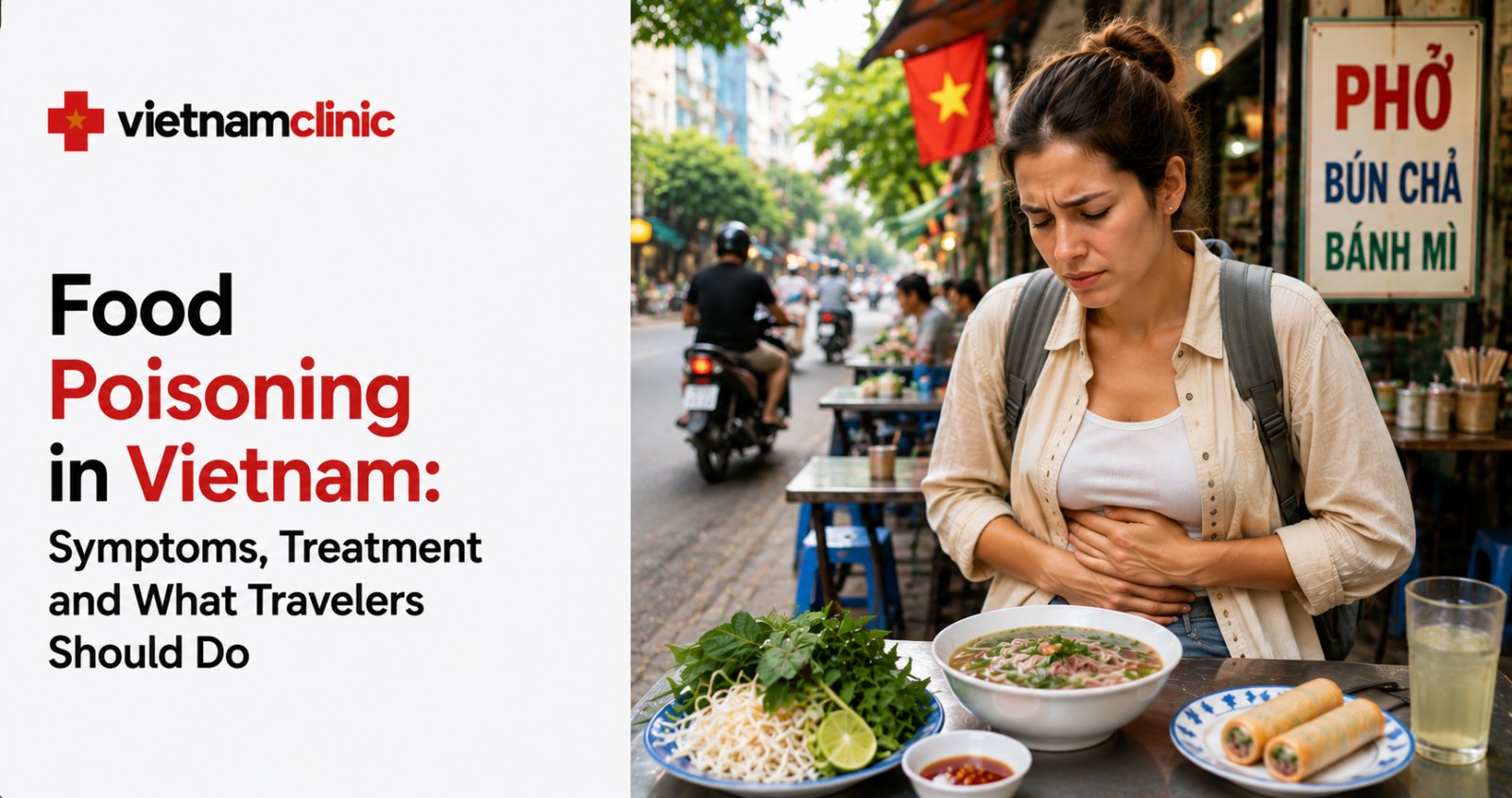
Food poisoning is one of the health problems travelers worry about most in Vietnam. Diarrhea, stomach cramps, nausea and vomiting can turn a normal holiday into a day spent close to the bathroom, but most short episodes improve without hospital treatment.
The term food poisoning in Vietnam can refer to several different illnesses. Contaminated food or water can transmit bacteria, viruses, parasites or toxins, and the time between eating and becoming sick varies considerably according to the cause.
For travelers, the most important priorities are usually replacing lost fluids, watching for signs of dehydration and knowing when symptoms have become severe enough to justify medical assessment.
The first few hours: what should you actually do?
If diarrhea or vomiting starts suddenly but you are otherwise alert and able to drink, the first priority is usually hydration.
Take small, frequent amounts of fluid rather than trying to drink a large volume at once, particularly if you feel nauseated.
Oral rehydration solution, commonly abbreviated to ORS, is especially useful because diarrhea and vomiting cause the body to lose both water and electrolytes.
WHO identifies oral rehydration salts as a key treatment for diarrheal illness because they replace the water and electrolytes lost through stool and vomiting.
During the first hours:
- Rest somewhere cool and comfortable.
- Take frequent small sips of safe fluids.
- Use properly prepared ORS when available.
- Avoid alcohol.
- Avoid strenuous exercise.
- Monitor how often you are urinating.
- Pay attention to whether symptoms are improving or becoming more severe.
If you cannot keep liquids down, home hydration becomes much less effective and medical assessment may be necessary.
What food poisoning usually feels like
Symptoms depend on the organism or toxin involved, so two people who describe having food poisoning may have quite different experiences.
Common symptoms include:
- Watery diarrhea.
- Abdominal cramps.
- Nausea.
- Vomiting.
- Loss of appetite.
- Fever.
- Weakness.
- Headache.
The CDC lists diarrhea, abdominal pain or cramps, nausea, vomiting and fever among the most common food poisoning symptoms.
Not every episode includes all of them. Some toxin-related illnesses cause dramatic vomiting within hours, while certain infections produce diarrhea that develops later and lasts several days.
How quickly can food poisoning start after eating?
The last meal you ate is not necessarily the one that made you sick.
Some foodborne toxins can cause symptoms within only a few hours. Other bacteria, viruses or parasites may have incubation periods lasting a day or considerably longer.
The CDC Yellow Book notes that toxin-mediated food poisoning can cause vomiting and diarrhea and often resolves spontaneously within approximately 12 to 24 hours.
Other forms of travelers' diarrhea may last several days.
This variation makes it difficult to identify the responsible restaurant simply by remembering where you ate most recently.
Travelers' diarrhea and food poisoning are not exactly the same thing
Travelers often use the terms interchangeably, but they are not identical.
Travelers' diarrhea is a broad clinical syndrome that can result from many intestinal infections acquired while travelling. Food poisoning more specifically refers to illness acquired through contaminated food or drink, including disease caused by toxins already present in food.
According to the CDC Yellow Book, bacteria are thought to cause approximately 75% to 90% of travelers' diarrhea cases, while viruses account for at least 10% to 25%. Protozoal infections are proportionally more important among people with longer-lasting symptoms.
For a traveler with a short episode, identifying the exact organism is often unnecessary unless the illness becomes severe or persistent.
Dehydration is often the main problem to watch
Frequent watery diarrhea and vomiting can remove substantial amounts of fluid and electrolytes from the body.
Signs suggesting dehydration include:
- Dry mouth.
- Strong thirst.
- Reduced urination.
- Dark urine.
- Weakness.
- Dizziness when standing.
- Increasing tiredness.
Severe dehydration can cause marked lethargy, poor drinking ability or altered consciousness and requires urgent medical attention.
Young children, older adults and people with significant medical conditions can become dehydrated more quickly.
The goal is not simply to stop diarrhea immediately. Maintaining hydration while the illness runs its course is often more important.
What should you drink?
Oral rehydration solution is usually the most useful option when diarrhea or vomiting is causing significant fluid loss.
Commercial ORS sachets contain a carefully balanced mixture of glucose and electrolytes and should be mixed according to the instructions using safe water.
Other fluids can contribute to hydration, but very sugary drinks are not equivalent to ORS and can sometimes worsen diarrhea when consumed in large amounts.
Suitable options may include:
- Properly prepared ORS.
- Bottled water from an intact sealed bottle.
- Soup or broth if tolerated.
- Other safe fluids that do not worsen nausea.
Avoid drinking untreated tap water in Vietnam. CDC travel guidance specifically advises travelers that tap water should not be considered safe to drink.
What can you eat while recovering?
You do not necessarily need to fast until the diarrhea disappears.
Once vomiting settles and you feel able to eat, start with foods that are relatively easy to tolerate.
Examples include:
- Rice.
- Plain noodles.
- Soup.
- Bananas.
- Toast or crackers.
- Potatoes.
- Other simple foods you tolerate comfortably.
Resume a more normal diet progressively as your appetite returns.
Very fatty meals, large amounts of alcohol and foods that clearly worsen nausea or diarrhea are sensible to avoid during the acute phase.
There is no need to force yourself to eat a large meal when you are nauseated. Fluids remain the priority when food intake is temporarily reduced.
Should you take antibiotics for food poisoning in Vietnam?
Not automatically.
Many cases of travelers' diarrhea and foodborne illness resolve without antibiotics. Viruses and toxin-mediated food poisoning will not improve because you take an antibacterial medicine.
The CDC Yellow Book recommends assessing travelers' diarrhea according to severity. Antibiotics can be appropriate for certain moderate or severe bacterial illnesses, but they are not necessary for every episode of loose stool.
There are several reasons to avoid taking random antibiotics from a pharmacy without an appropriate assessment:
- The illness may not be bacterial.
- The antibiotic may not target the organism involved.
- Side effects can occur.
- Antibiotic resistance is an important public health problem.
- Some diarrheal infections require a different approach.
If symptoms are severe enough that you think antibiotics may be needed, an assessment at a clinic is usually more sensible than selecting a medication yourself.
When diarrhea becomes more than an inconvenience
Most short episodes can be managed with hydration and rest, but there are warning signs that justify medical assessment.
The CDC recommends seeing a doctor for severe symptoms including:
- Bloody diarrhea.
- Diarrhea lasting more than three days.
- Fever above 102°F, approximately 39°C.
- Vomiting so frequently that you cannot keep liquids down.
- Signs of dehydration.
Other reasons to seek care include severe or worsening abdominal pain, confusion, fainting or rapid deterioration.
Pregnant travelers, very young children, older adults and people with significant immune suppression or chronic illness may need assessment earlier.
For non-emergency illness, Sick in Vietnam? What to Do and Where to Go explains the main options for obtaining medical care.
When should you go straight to a hospital?
A routine clinic may be enough for uncomplicated diarrhea, but some symptoms require more urgent evaluation.
Seek urgent medical care if someone has:
- Loss of consciousness.
- Severe confusion.
- Signs of shock.
- Serious difficulty breathing.
- Major gastrointestinal bleeding.
- Severe dehydration with inability to drink.
- Persistent vomiting with marked weakness.
- Another rapidly worsening condition.
If the situation appears life-threatening, do not spend time comparing outpatient clinics.
Vietnam Clinic's guide to medical emergencies in Vietnam explains emergency numbers and what international visitors should do when urgent help is required.
What if diarrhea lasts for two weeks?
Persistent diarrhea is a different clinical situation from a typical short episode of food poisoning.
The CDC defines persistent post-travel diarrhea as symptoms lasting 14 days or longer.
At that point, causes such as parasitic infections become relatively more important, and medical investigation may include stool testing or other diagnostic work depending on symptoms and travel history.
Do not continue treating two or three weeks of diarrhea as if it were an ordinary 24-hour stomach bug.
Tell the doctor:
- When symptoms started.
- Where you travelled.
- Whether you had blood in the stool.
- Whether you had fever.
- What medicines or antibiotics you already used.
- Whether anyone who travelled with you is also ill.
Street food is not the only possible source
Vietnam has an internationally recognised street-food culture, but it is overly simplistic to assume that every case of travelers' diarrhea comes from a street stall.
Illness can result from contaminated food or drink served in many environments.
Risk can be associated with:
- Inadequately cooked meat.
- Raw seafood.
- Contaminated vegetables.
- Unsafe water.
- Ice made from unsafe water.
- Food kept at unsafe temperatures.
- Poor hand hygiene during preparation.
- Cross-contamination between raw and cooked ingredients.
A busy street vendor cooking food thoroughly in front of you may sometimes present a different risk profile from a buffet where food has remained lukewarm for hours.
The type of food, temperature and handling matter more than simply whether a restaurant has walls and air conditioning.
Raw and undercooked food deserves extra caution
CDC guidance for Vietnam specifically advises caution with raw or undercooked meat and seafood, uncooked vegetables and fruit that cannot be peeled.
Vietnam also has particular dishes that may contain raw animal products.
The CDC warns against consuming dishes containing uncooked blood or meat from pigs, wild boar or other animals because of risks including infections such as Streptococcus suis and trichinellosis.
One example is tiet canh, a traditional dish prepared with raw blood.
Travelers unfamiliar with a dish should ask how it is prepared rather than assuming that all ingredients have been cooked.
Seafood can cause more than ordinary bacterial food poisoning
Vietnam's long coastline makes seafood a major part of the local diet.
Most seafood meals are uneventful, but raw or improperly stored seafood can transmit pathogens. Certain seafood can also contain toxins that are not necessarily destroyed by cooking.
Seek medical attention if a seafood-related illness is accompanied by unusual neurological symptoms, substantial weakness, breathing difficulty or rapid deterioration rather than assuming it is an ordinary stomach infection.
Is ice safe in Vietnam?
CDC destination guidance advises travelers that ice can be unsafe because it may be made from tap water.
In practice, many hotels, restaurants and established businesses use commercially produced ice, but travelers often cannot independently confirm the source.
If you are particularly concerned about gastrointestinal illness, choose drinks from sealed containers and avoid ice when you cannot establish that it was made from safe water.
The same caution applies to drinks made with untreated water.
Why one person gets sick and everyone else feels fine
A common reaction after becoming ill is: "We all ate the same meal, so it cannot have been the restaurant."
That conclusion is not reliable.
Exposure can vary because:
- One person ate a different ingredient.
- Contamination was unevenly distributed.
- The infectious dose differed.
- Individual susceptibility varies.
- Another meal may actually have caused the illness.
Incubation periods also differ significantly between pathogens.
Food poisoning therefore cannot usually be traced accurately from symptoms alone.
Pharmacies can help with simple supplies, but they are not emergency departments
Vietnam has a large number of community pharmacies, and they can be useful for products such as oral rehydration salts.
However, a pharmacy is not the right place to manage serious dehydration, gastrointestinal bleeding or severe systemic illness.
If you are unsure whether your symptoms need medical assessment, an appropriate clinic can evaluate hydration, abdominal symptoms and other warning signs more comprehensively.
International travelers who prefer care in English can use the guidance in How to Choose an English-Speaking Clinic in Vietnam.
Prevention is about reducing risk, not eating only packaged food
It is impossible to eliminate every gastrointestinal risk while travelling, and doing so would remove much of the enjoyment of Vietnam's food culture.
A more realistic strategy is to reduce unnecessary exposure.
Useful habits include:
- Choose food that is freshly cooked and served hot.
- Avoid obviously undercooked meat and seafood.
- Be cautious with food that has been sitting at room temperature.
- Drink safe water.
- Wash or sanitise your hands before eating.
- Choose fruit you can peel yourself when hygiene is uncertain.
- Avoid unpasteurised dairy products.
- Be particularly careful with raw animal products.
These precautions reduce risk but cannot guarantee that you will never develop travelers' diarrhea.
The CDC notes that travelers can become ill even when following conventional food-safety advice because hygiene and sanitation factors may occur before the food reaches the customer.
Food poisoning is only one common travel illness in Vietnam
Diarrhea is common among international travelers, but not every fever, nausea episode or feeling of weakness comes from contaminated food.
Dengue, respiratory infections, heat-related illness and several other health problems can initially produce nonspecific symptoms.
If the clinical picture does not fit a straightforward gastrointestinal illness, consider a medical assessment rather than continuing to assume you have food poisoning.
For a broader overview, see Most Common Illnesses in Vietnam.
A simple recovery plan for travelers
For uncomplicated symptoms, a practical approach is:
First 12 hours
Prioritise fluids and ORS, rest and monitor whether you can keep liquids down.
When vomiting improves
Introduce small amounts of simple food according to appetite and continue replacing fluids.
During the next day or two
Gradually return to your usual diet as symptoms improve. Avoid alcohol and strenuous exercise while dehydrated or weak.
If you are not improving
Reassess the situation rather than continuing indefinitely with self-treatment.
Seek medical advice for persistent diarrhea, bloody stool, high fever, inability to keep liquids down, dehydration or significant deterioration.
Frequently Asked Questions
The answers below cover common questions from travelers who develop food poisoning or travelers' diarrhea while in Vietnam. Individual treatment depends on the cause, severity and medical history, so persistent or severe illness should be professionally assessed.
What should I do if I get food poisoning in Vietnam?
For mild illness, prioritise hydration, use oral rehydration solution when needed, rest and gradually resume food as tolerated. Seek medical care if you develop bloody diarrhea, high fever, dehydration, persistent symptoms or vomiting that prevents you from keeping liquids down.
How long does food poisoning usually last?
Duration depends on the cause. Some toxin-mediated food poisoning can resolve within 12 to 24 hours, while infectious travelers' diarrhea can last several days. Diarrhea lasting 14 days or longer requires a different assessment for persistent causes.
Should I take antibiotics for food poisoning in Vietnam?
Not automatically. Many cases resolve without antibiotics, and viral or toxin-mediated illnesses will not benefit from antibacterial treatment. Antibiotics may be appropriate for selected moderate or severe bacterial diarrhea after medical assessment.
When should I see a doctor for food poisoning in Vietnam?
Seek medical advice for bloody diarrhea, diarrhea lasting more than three days, fever above approximately 39°C, repeated vomiting that prevents fluid intake, signs of dehydration or significant worsening.
What should I drink when I have diarrhea in Vietnam?
Oral rehydration solution is particularly useful because it replaces both fluid and electrolytes. Also use safe bottled or otherwise treated water. Take small frequent amounts if nausea makes drinking difficult.
Can street food cause food poisoning in Vietnam?
Yes, but street food is not the only possible source. Contamination can occur in restaurants, hotels, markets and homes. Risk depends on food handling, cooking temperature, water safety, storage and hygiene rather than simply whether food is sold on the street.
Is tap water safe to drink in Vietnam?
CDC travel guidance advises that tap water should not be considered safe to drink in Vietnam. Travelers should use safe bottled or treated water and be cautious about ice when its source is uncertain.
Conclusion
Food poisoning in Vietnam most commonly presents with some combination of diarrhea, stomach cramps, nausea, vomiting and fever. Many short episodes improve with rest and careful hydration, and oral rehydration solution is especially useful when fluid loss is significant.
The main mistake is treating every episode in the same way. Antibiotics are not automatically necessary, while severe dehydration, bloody diarrhea, high fever or repeated vomiting can justify medical assessment.
Most travelers recover without serious complications. Drink safe fluids, return to food gradually and pay more attention to the severity and duration of symptoms than to trying to identify exactly which meal caused the problem.
Sources

Writer
Tan Nguyen
Medical writer for Vietnam Clinic. MD, Vietnam National University Ho Chi Minh City.