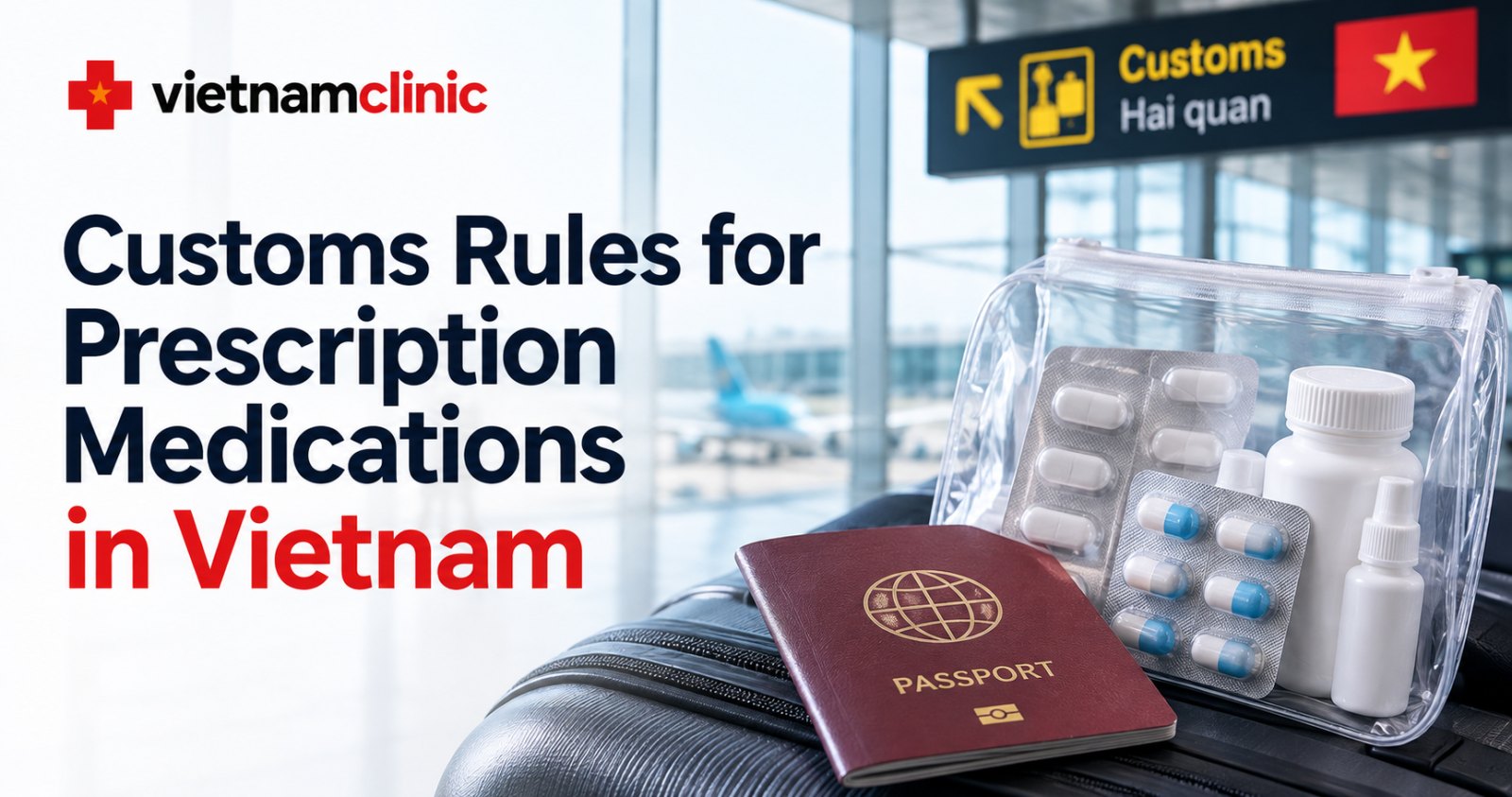
Travelling to Vietnam with prescription medication is usually possible, but the rules depend on what the medicine contains and how much you are carrying. The most important distinction is between ordinary prescription medicines and products Vietnam classifies as narcotic, psychotropic or precursor-containing medicines.
Controlled medicines are subject to particularly strict quantity limits. Current guidance from the Embassy of Vietnam in Australia states that travellers may bring up to 7 days of prescribed narcotic medication or 10 days of prescribed psychotropic medication or medication containing drug precursors for personal treatment without an import licence, based on the dosage stated in the accompanying prescription.
This guide explains the practical rules, documents to carry, customs declarations and what to do if your trip is longer than the amount of controlled medication normally permitted. Regulations and controlled-drug classifications can change, so travellers taking restricted medicines should confirm the current position with a Vietnamese embassy or Vietnamese customs before departure.
Can you bring prescription medication into Vietnam?
Yes, travellers can bring medication for their own medical treatment into Vietnam, subject to Vietnamese pharmaceutical and customs rules.
The rules become more restrictive when a medicine falls into a category subject to special control, particularly:
- Narcotic medicines.
- Psychotropic medicines.
- Medicines containing controlled drug precursors.
A medicine that is routinely prescribed in your home country is not automatically unrestricted in Vietnam. The active ingredient matters more than the brand name or the fact that you have a valid foreign prescription.
Before travelling, check the generic name and active ingredient of every prescription medicine you plan to carry.
The 7-day rule for narcotic medicines
Vietnamese embassy guidance states that a person entering Vietnam may bring narcotic medication for personal treatment without an import licence when the quantity does not exceed the amount required for 7 days of use, based on the dosage written on the prescription.
The medication must also not exceed the amount stated in that prescription.
This is particularly relevant to travellers using certain opioid-containing medicines and other drugs classified as narcotic medicines under Vietnamese rules.
Do not assume that because a medicine is legally prescribed elsewhere you can bring a full one-month or three-month supply into Vietnam.
If your medicine may contain a controlled narcotic substance, confirm its classification before travelling.
The 10-day rule for psychotropic medicines
The Embassy of Vietnam in Australia currently states that travellers may bring up to 10 days of prescribed psychotropic medication or medication containing drug precursors for their own treatment without an import licence.
Psychotropic medicines can include medicines affecting mood, behaviour, sleep or mental state. Depending on the active ingredient and Vietnamese classification, this can be relevant to some medicines used for:
- Anxiety.
- Insomnia.
- Attention disorders.
- Psychiatric conditions.
- Other neurological or mental health conditions.
However, these examples should not be used to decide whether a particular medication is controlled. Classification depends on the active ingredient and Vietnamese regulations.
If you are taking medication for a mental health condition and are unsure whether it is considered psychotropic under Vietnamese law, contact a Vietnamese embassy before departure rather than relying on general online lists.
Why some travel guidance says 7 days for both categories
Travellers may encounter apparently conflicting information online.
Current guidance published by the Embassy of Vietnam in Australia distinguishes between 7 days for narcotic medication and 10 days for psychotropic or precursor-containing medication.
UK government travel advice currently uses more cautious wording and tells British travellers that Vietnam restricts medicines classified as addictive or psychotropic, stating that travellers should not carry more than seven days of these prescribed medicines without obtaining further advice.
Because classifications and official guidance can differ in wording, the safest approach for anyone carrying a controlled medicine is to verify the specific active ingredient and planned quantity with a Vietnamese diplomatic mission or customs authority before travelling.
You need a prescription
Do not carry controlled prescription medication into Vietnam without documentation showing that it has been prescribed for you.
Vietnamese embassy guidance states that the prescription should contain at least:
- The patient's name.
- The patient's age.
- The medicine name.
- Strength or concentration.
- Quantity or number of treatment days.
- Dosage.
- The prescribing doctor's full name.
- The doctor's signature.
- The doctor's professional address, such as the hospital, clinic or medical centre.
The information on the prescription should correspond with the medication you are carrying.
A prescription showing only a commercial brand name may be less useful than documentation that also identifies the active ingredient.
Carry a doctor's letter
A doctor's letter is particularly useful when travelling with controlled medication.
UK government guidance recommends carrying a letter from your doctor explaining how much medication you require during the trip. It states that the letter can be in English and should include your name and age, medication name, quantity and dosage, together with the doctor's signature and address.
A practical letter can also identify:
- Your medical need for the medicine.
- The generic medication name.
- The active ingredient.
- Strength.
- Daily dose.
- Total quantity being carried.
- Expected duration of treatment.
The letter should match the medication and prescription you are carrying.
Keep medication in its original packaging
Keep prescription medicines in their original labelled containers whenever possible.
Vietnamese embassy guidance states that medicines should have labels showing information including:
- Medicine name.
- Active ingredient.
- Strength or concentration.
- Expiry date.
Loose tablets in an unlabelled plastic bag or pill organiser can make it much harder for customs officials to identify what you are carrying.
You can still use a pill organiser during your trip if convenient, but keeping the original packaging and supporting prescription available is sensible when crossing the border.
Should prescription medicines be in hand luggage?
UK government Vietnam travel guidance recommends carrying prescription medication in hand luggage together with a copy of the prescription.
This has practical advantages even beyond customs requirements. Checked luggage can be delayed or lost, while medicine that you need regularly may be difficult to replace immediately after arrival.
Consider keeping together:
- Medication.
- Prescription.
- Doctor's letter.
- Copies of relevant medical records.
- Contact details for your prescribing doctor.
Check airline security requirements separately, particularly if medication involves liquids, syringes, needles or other medical equipment.
Do controlled medicines need to be declared?
Vietnamese embassy guidance states that narcotic medicines, psychotropic medicines and medicines containing controlled precursors must be declared to customs.
The quantity should not exceed the amount prescribed and, under the standard personal-use allowance, should remain within the applicable 7-day or 10-day limit.
If you are carrying a medicine that may fall into one of these categories, declaring it is safer than attempting to decide at the airport that the rules probably do not apply.
Keep the medication and documentation easily accessible so that you can show them to customs officials if requested.
What if your medication is worth more than USD 100?
UK government travel advice for Vietnam says that people travelling from the UK on a full British citizen passport must declare prescription medication with a total import value greater than USD 100. This is a UK travel-advice threshold, not a general Vietnamese USD 100 rule. It is separate from the medicine limits in guidance from the Embassy of Vietnam in Australia.
The Embassy of Vietnam in Australia states that personal medicine which is not classified as narcotic, psychotropic or precursor-containing may be received no more than 3 times per year per individual or organisation, with a total customs value of no more than USD 200 per receipt. For medicine used by a person with a disease considered a critical illness, the guidance states that the total customs value must not exceed VND 10,000,000, about USD 400, per receipt, and that the medicine may be received no more than 4 times per year per individual.
These are different rules and categories. Controlled medicines remain subject to the separate limit of 7 days for narcotic medication and 10 days for psychotropic or precursor-containing medication, together with prescription and customs declaration requirements. Because application can depend on the medicine and the traveller’s circumstances, confirm the current position with Vietnamese customs or a Vietnamese embassy before departure.
What if you need more than 7 or 10 days of controlled medication?
This is one of the most important questions for travellers staying in Vietnam for several weeks or months.
The Embassy of Vietnam in Australia advises that travellers who need more than the standard 7-day narcotic or 10-day psychotropic or precursor-containing allowance can make a declaration to customs at their port of entry and provide:
- Their travel itinerary.
- Evidence demonstrating why the medication is necessary.
- Medical documentation from their doctor.
The embassy states that Vietnamese customs will decide whether the additional medication can be brought into the country.
This means a prescription by itself should not be interpreted as an automatic right to bring an unlimited supply.
If you need more than the normal allowance, contact the Vietnamese embassy or consulate before travelling. Do not arrive with several months of controlled medication based solely on advice from a social media group or travel forum.
Consider arranging medication in Vietnam for longer stays
The Vietnamese embassy also suggests contacting a hospital in Vietnam before travelling to determine whether the medication can be supplied locally.
This may be a practical solution for people staying for several months, but availability cannot be assumed.
A medicine available under one brand in your home country may:
- Have a different brand name in Vietnam.
- Require a local prescription.
- Be available only through certain hospitals or pharmacies.
- Have a different formulation or strength.
- Not be marketed in Vietnam at all.
Do not substitute one medication for another without appropriate medical advice.
If you expect to need continuing prescriptions after arriving, contact an appropriate medical provider before your existing supply runs out. How to Choose an English-Speaking Clinic in Vietnam explains what to check when arranging care in English.
What about ADHD, anxiety and sleeping medication?
These medicines deserve particular attention because some active ingredients may fall within Vietnam's controlled psychotropic categories.
Do not rely on the condition being treated to decide whether a medication is restricted. Two medicines used for the same condition can have completely different legal classifications.
Before travelling:
- Identify the active ingredient.
- Ask the prescribing doctor for a prescription and supporting letter.
- Check the Vietnamese classification of that ingredient.
- Confirm the permitted quantity with a Vietnamese embassy if there is any doubt.
- Declare the medicine where required.
This is especially important if you need more than a short supply during your stay.
What about opioid pain medication?
Certain opioid medicines may fall within Vietnam's narcotic medicine restrictions.
If you use prescription opioid medication for pain management, do not assume that carrying a normal monthly prescription is permitted.
Ask your doctor to document the medical need, active ingredient, strength, dosage and total quantity. Then confirm with a Vietnamese diplomatic mission whether the medicine is classified as narcotic and whether your planned quantity can enter Vietnam.
The standard published personal-use limit for narcotic medication is only 7 days unless customs permits otherwise.
What about ordinary prescription medicines?
Most travellers are not carrying narcotic or psychotropic medicines. Common prescriptions for conditions such as high blood pressure, thyroid disease, asthma or diabetes may fall outside these specially controlled categories.
Even then, carry the medicine clearly labelled together with your prescription, particularly when travelling with a substantial quantity.
Rules governing medicines sent or imported separately into Vietnam can differ from rules applying to medication physically carried by a traveller. Do not assume that a medicine you can legally bring in your luggage can simply be posted or couriered to Vietnam later under the same conditions.
If you expect to need regular medication during a long stay, discussing local availability with a doctor or hospital in Vietnam before travelling can prevent problems later.
Can you buy your prescription again in Vietnam?
Possibly, but availability varies substantially.
Some medicines widely prescribed internationally are readily available in Vietnam, while others may not be registered, may be available under different names or may be subject to stricter dispensing controls.
UK government guidance also warns that some medicines can be difficult to find in Vietnam and that counterfeit medicines can be a concern.
For regular or important treatment, use established hospitals, clinics and legitimate pharmacies rather than buying medication from an unknown seller or online source.
If you need help arranging a medical consultation after arrival, see What to Check Before a Medical Appointment in Vietnam.
A checklist before flying to Vietnam with medication
Before departure, check the following:
- Identify the generic name and active ingredient of every medicine.
- Confirm whether any medicine is narcotic, psychotropic or contains a controlled precursor in Vietnam.
- Check how many days of medication you are carrying.
- Obtain a current prescription.
- Ask your doctor for a signed medical letter when appropriate.
- Keep medicines in clearly labelled original packaging.
- Carry important medication and documentation in your hand luggage.
- Check whether customs declaration is required.
- Contact a Vietnamese embassy before travelling if the medication is controlled or the quantity exceeds the normal allowance.
- Check local availability if you will need additional medication during a long stay.
Availability, classifications and customs procedures can change, so confirm uncertain cases directly with Vietnamese authorities before departure.
Frequently Asked Questions
The answers below cover common practical questions about bringing prescription medicines into Vietnam. Individual medicines can be classified differently under Vietnamese law, so travellers carrying controlled substances should verify their specific medication before travelling.
Can I bring prescription medication into Vietnam?
Yes, medication for personal medical treatment can generally be brought into Vietnam, subject to customs and pharmaceutical rules. Controlled narcotic, psychotropic and precursor-containing medicines have stricter quantity and declaration requirements.
How much controlled medication can I bring into Vietnam?
Current Vietnamese embassy guidance states that the standard personal-use allowance without an import licence is up to 7 days of prescribed narcotic medication or 10 days of prescribed psychotropic or precursor-containing medication. The quantity must also be consistent with the dosage and amount stated in the prescription.
Do I need a doctor's letter to take medication to Vietnam?
A prescription is important, and a doctor's letter is strongly advisable for controlled or essential medication. The documentation should identify the patient, medicine, strength, dosage, quantity and prescribing doctor.
Do I have to declare prescription medication at Vietnam customs?
UK government travel advice for Vietnam says that people travelling from the UK on a full British citizen passport must declare prescription medication with a total import value above USD 100. This is a UK travel-advice threshold, not a general Vietnamese USD 100 rule. Embassy guidance for personal medicine outside narcotic, psychotropic and precursor-containing categories sets separate limits of up to USD 200 customs value per receipt and up to three times per year, with a different limit for critical-illness medicine.
Can I bring more than 10 days of psychotropic medication to Vietnam?
Do not assume that a foreign prescription automatically permits a larger quantity. Vietnamese embassy guidance advises travellers who require more than the standard allowance to declare the medication at the port of entry with their itinerary and evidence of medical necessity, with customs deciding whether the additional quantity can enter.
Should medication be kept in its original packaging?
Yes. Medicines should be clearly labelled with identifying information such as the medicine name, active ingredient, strength and expiry date. Keeping the original pharmacy packaging together with the prescription makes identification easier at customs.
Can I mail prescription medication to myself in Vietnam?
Do not assume that the rules for medication carried personally across the border also apply to medicines sent by post or courier. Separate import rules and value limits can apply, so check with Vietnamese authorities before arranging a shipment.
Conclusion
Travellers can bring prescription medicines into Vietnam for personal medical use, but controlled medications require particular care. Current Vietnamese embassy guidance allows a standard maximum of 7 days of narcotic medication and 10 days of psychotropic or precursor-containing medication, according to the prescribed dosage, without an import licence. These controlled medicines must be declared to customs.
Carry the original medication packaging, prescription and preferably a doctor's letter explaining the treatment. If you need more than the standard controlled-medicine allowance, contact a Vietnamese embassy before departure and be prepared to present your itinerary and medical evidence to customs. For prescription medicines, checking the exact active ingredient before travelling is much safer than relying on the brand name or advice from social media.
Sources

Writer
Tan Nguyen
Medical writer for Vietnam Clinic. MD, Vietnam National University Ho Chi Minh City.