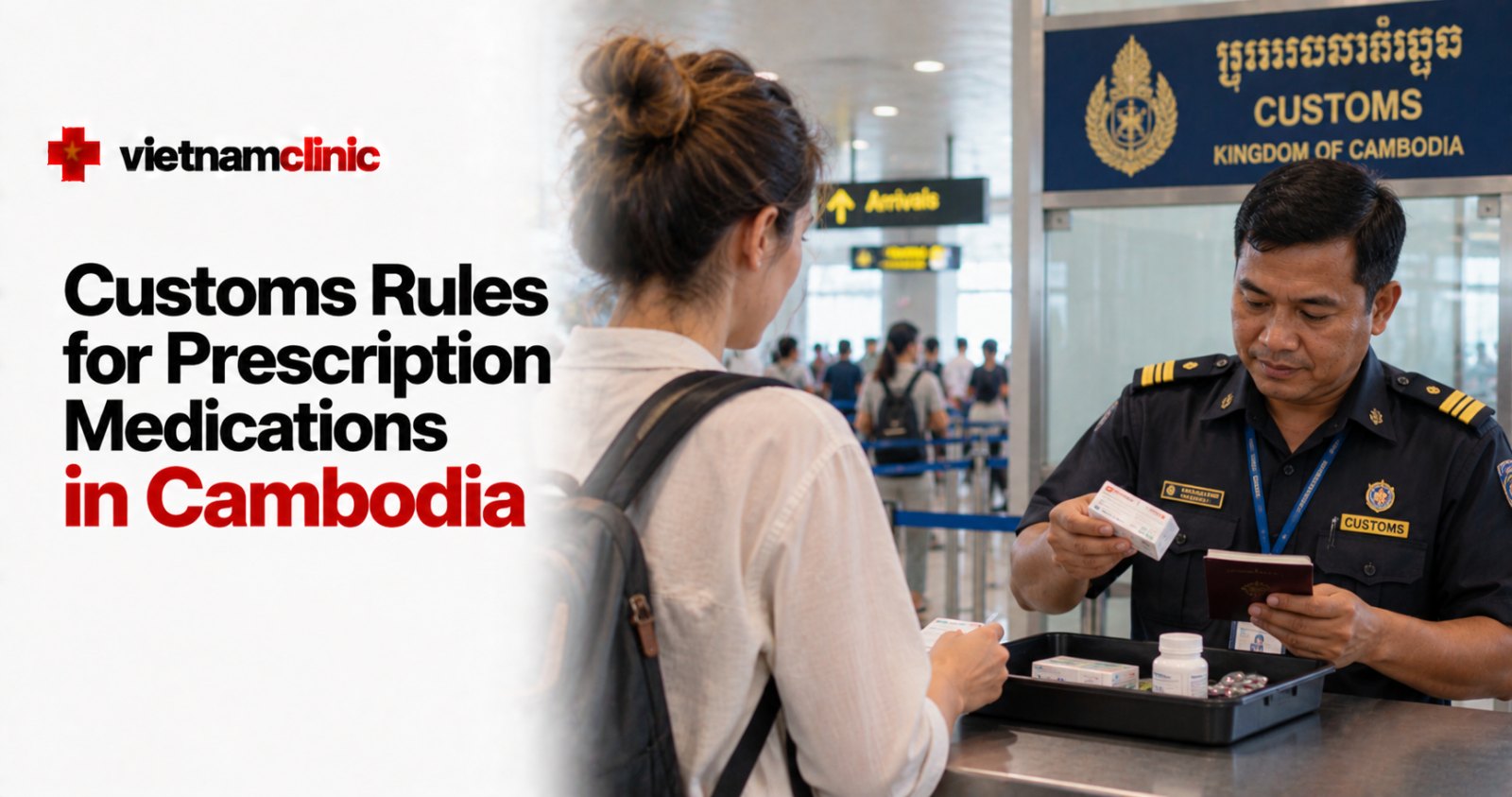
Travelers can bring many prescription medicines to Cambodia for personal medical use, but the rules become stricter when a medicine contains a narcotic or psychotropic substance. Cambodian regulations place a number of controlled pharmaceutical substances under Ministry of Health oversight, and some medicines require prior authorization.
For ordinary prescription medication, travelers should keep medicines in their original labeled packaging and carry a copy of the prescription. A doctor's letter describing the medical condition, generic drug name, dose and required quantity is also advisable, particularly when carrying injectable medicines, large quantities or drugs that could be considered controlled substances.
There is no simple published rule stating that every traveler may automatically bring a fixed 30-day or 90-day supply of every prescription medicine into Cambodia. The legal status depends on the active ingredient. If you take ADHD medication, strong opioid painkillers, benzodiazepines, sleeping medicines or another controlled drug, confirm the requirements with a Cambodian embassy or the Cambodian authorities before travelling.
Can you bring prescription medication into Cambodia?
In many cases, yes.
Travel guidance from the U.S. Department of State recommends that visitors to Cambodia carry prescription medicines in their original packaging together with the doctor's prescription and verify with a Cambodian embassy that the medicine is legal in the country.
The safest approach is to travel with medication that is clearly intended for your own treatment and to carry documentation explaining why you need it.
Useful documents include:
- The original pharmacy packaging
- A copy of the prescription
- A doctor's letter
- The generic name of the medicine
- The prescribed dose
- The amount required for the trip
Do not rely exclusively on a brand name because the same drug may be sold under a different name in Cambodia.
Do prescription medicines need to be declared at Cambodia customs?
Not every ordinary personal medicine necessarily requires a special customs permit, but restricted or controlled medicines can be subject to additional requirements.
Cambodia's customs rules classify medicines and pharmaceutical products among goods that can require authorization from the Ministry of Health when formally imported.
For a traveler carrying normal personal medication, the important question is whether the active ingredient is subject to narcotic, psychotropic or other restrictions.
If you are carrying a controlled medicine or are unsure about its classification, contact the Cambodian embassy or relevant Cambodian authority before departure and ask whether you need prior authorization or should declare it on arrival.
Keep prescription medicines in their original packaging
Travelers should avoid transferring prescription medicines into unmarked bags, pill boxes or loose containers when crossing an international border.
Original packaging helps customs officers identify:
- The medicine
- Active ingredient
- Strength
- Prescribing information
- Pharmacy or manufacturer
- Patient details when shown on the label
You can still use a pill organizer during your trip, but carrying the original packaging is useful when entering the country.
Should you carry a doctor's letter?
It is strongly advisable, particularly for medicines that may attract additional scrutiny.
A doctor's letter can state:
- Your name
- Your medical condition
- Generic name of the medicine
- Brand name if relevant
- Dose
- Form of medication
- Quantity required
- Expected duration of treatment
The U.S. Department of State also recommends that international travelers ask their doctor for a letter explaining their medical condition and listing prescription medicines by generic name.
A letter is particularly useful if you carry syringes, injectable medicines or several different prescription drugs.
Controlled medications in Cambodia
Cambodia applies additional controls to narcotic and psychotropic substances.
The Cambodian Ministry of Health's pharmaceutical legislation states that authorization from the Ministry is required for the importation of addictive drugs and drugs affecting the nervous system that fall under Cambodia's controlled-drug legislation.
UK government guidance for people travelling or living in Cambodia similarly states that a permit is required to bring medicines containing narcotic or psychotropic substances into the country.
This is important because a medicine can be legally prescribed in your home country while still being controlled in Cambodia.
Which prescription drugs may be controlled in Cambodia?
Cambodia's list of prohibited and restricted goods includes a range of narcotic and psychotropic substances.
Examples appearing in the official restricted-goods documentation include:
- Alprazolam
- Bromazepam
- Clonazepam
- Diazepam
- Fentanyl
- Lorazepam
- Methylphenidate
- Midazolam
- Nitrazepam
- Oxazepam
- Phenobarbital
- Temazepam
- Triazolam
This is not a complete list of every controlled medication in Cambodia.
If your prescription contains a psychoactive, stimulant, sedative or opioid substance, check the exact generic ingredient before travelling.
Can you bring benzodiazepines into Cambodia?
Benzodiazepines require particular care because several commonly prescribed medicines appear in Cambodia's restricted-goods documentation.
Examples include:
- Alprazolam
- Clonazepam
- Diazepam
- Lorazepam
- Oxazepam
- Temazepam
- Triazolam
Do not assume that having a prescription from another country automatically satisfies Cambodian import requirements.
If you need one of these medicines, contact a Cambodian embassy before travelling and ask whether a permit is required for the quantity you intend to carry.
Can you bring ADHD medication into Cambodia?
Travelers taking ADHD medication should verify the active ingredient carefully.
Methylphenidate appears in Cambodia's restricted-goods documentation, meaning travelers should not treat it like an unrestricted everyday medicine.
Other ADHD medicines can have different legal classifications.
Before travelling, provide the Cambodian embassy with:
- Generic drug name
- Dose
- Strength
- Quantity
- Length of stay
Ask specifically whether prior authorization is required.
Can you bring opioid painkillers into Cambodia?
Opioid medicines can fall under narcotic controls.
Cambodia's restricted-goods documentation includes substances such as fentanyl and pethidine, among other controlled drugs.
Anyone travelling with strong prescription opioids should confirm the rules in advance.
Carry the original packaging, prescription and medical letter, but remember that these documents do not necessarily replace a required Cambodian permit.
Can you bring sleeping pills into Cambodia?
It depends on the active ingredient.
Some medicines used for anxiety or sleep are psychotropic substances and appear in Cambodia's restricted-drug framework.
Examples include temazepam, triazolam, nitrazepam and several benzodiazepines.
Check the generic drug rather than assuming that all sleeping pills follow the same rule.
How much prescription medicine can you bring?
Cambodian sources reviewed for this guide do not provide a simple universal allowance such as "30 days" or "90 days" that applies to every prescription drug carried by every traveler.
That means you should be cautious with websites that state a fixed allowance without identifying an official Cambodian source.
For ordinary medication, carry a reasonable quantity for personal treatment during the trip.
For controlled medication, ask the Cambodian embassy or relevant authority specifically about:
- Maximum quantity
- Whether a permit is required
- Documents required
- Whether the medication must be declared
- How far in advance authorization should be requested
Can you bring more medication for a long stay?
A large supply may attract greater customs scrutiny because officials need to distinguish medicine intended for personal treatment from commercial importation.
If you are moving to Cambodia or staying for several months, it may be safer to confirm the arrangement before departure instead of travelling with a very large quantity without documentation.
Ask whether you can legally bring the full supply or whether treatment should be continued through a doctor and pharmacy in Cambodia.
Can you bring injectable medication into Cambodia?
Injectable medication may be possible to carry, but documentation becomes especially important.
Bring:
- Original medicine packaging
- Prescription
- Doctor's letter
- Syringes in original packaging where possible
- Documentation explaining the required administration schedule
Check airline security rules separately because airport security requirements for needles and liquids are different from Cambodian customs and pharmaceutical rules.
Can you bring insulin into Cambodia?
Travelers who need insulin should carry adequate supplies and medical documentation.
Keep insulin in its labeled pharmaceutical packaging and carry a prescription or doctor's letter.
Because insulin often requires temperature control, plan how it will be stored during flights and while travelling in Cambodia's hot climate.
Airline rules concerning cooling packs, liquids and needles should also be checked before departure.
What about refrigerated prescription medicines?
Some medicines, including certain injectable biologics, require refrigeration.
Travelers should confirm:
- Manufacturer storage requirements
- How long the medicine can remain outside refrigeration
- Airline rules for cold packs
- Availability of refrigeration at accommodation
- Backup arrangements during transport
Do not place temperature-sensitive medicine in checked luggage unless the manufacturer or treating professional has confirmed that the storage conditions are appropriate.
Should medication go in hand luggage or checked baggage?
Essential medication is generally better kept in carry-on luggage so that you still have access to it if checked baggage is delayed or lost.
Keep supporting medical documentation with the medication.
If airport security rules limit liquids, needles or cooling equipment, contact the airline before travelling.
Can you bring over-the-counter medication into Cambodia?
Many ordinary over-the-counter medicines present fewer problems than controlled prescription medicines, but legal status can still vary by active ingredient.
Do not assume that a medicine is unrestricted simply because it is sold without a prescription in your home country.
This is particularly important for products containing psychoactive substances or combinations that include controlled ingredients.
Can you bring medical cannabis into Cambodia?
Travelers should not assume that a medical cannabis prescription issued abroad authorizes possession or importation in Cambodia.
Cambodian customs documentation lists tetrahydrocannabinols (THC) among restricted substances subject to Ministry of Health controls.
A medical prescription from another country does not override Cambodian law.
Anyone considering travelling with a cannabis-derived prescription product should obtain specific confirmation from Cambodian authorities before departure rather than bringing it without authorization.
Is CBD treated the same as prescription medicine?
CBD products create additional complexity because composition varies and some products can contain measurable THC.
Do not assume that a CBD oil, gummy or medical cannabis product is legal to import simply because it is legally purchased elsewhere.
If the product contains cannabinoids, obtain specific advice from Cambodian authorities before travelling.
What happens if your medication is restricted?
Do not simply pack it and hope that customs will accept a foreign prescription.
Instead:
- Identify the generic active ingredient.
- Contact the Cambodian embassy serving your country.
- Explain that the medicine is prescribed for personal treatment.
- Provide the dose and quantity.
- Ask whether the drug is controlled in Cambodia.
- Ask whether a permit is required.
- Obtain written confirmation where possible.
If the medicine cannot legally be imported, discuss alternatives with your doctor before travelling.
How to check if your medicine is legal in Cambodia
Start with the generic drug name, not the brand.
For example, asking about "Valium" is less precise than asking about diazepam.
Provide authorities with:
- Generic name
- Brand name
- Strength
- Dosage form
- Daily dose
- Total quantity
- Length of stay
The U.S. Department of State specifically advises travelers to check with the Royal Embassy of Cambodia to ensure that their medication is legal in Cambodia.
Who should you contact before travelling?
The most appropriate contact can depend on your country of residence.
Possible sources include:
- Cambodian embassy or consulate
- Cambodia Ministry of Health
- General Department of Customs and Excise of Cambodia
The General Department of Customs and Excise currently lists its public contact office at 6-8 Preah Norodom Boulevard, Phnom Penh and publishes the contact email info@customs.gov.kh.
For controlled medicines, ask specifically about personal carriage by a traveler rather than general commercial pharmaceutical importation.
Do not rely only on a pharmacy in Cambodia
Some medicines may be easier to purchase in Cambodia than in your home country, but availability does not prove that buying them without proper medical supervision is safe or lawful.
The U.S. Department of State warns travelers to exercise caution when purchasing medicines in Cambodia because counterfeit or incorrectly formulated products can occur.
If you need a replacement prescription, using a legitimate medical provider and established pharmacy is safer than purchasing medicine from an unknown seller.
What if you lose your medicine in Cambodia?
If essential medication is lost or stolen:
- Contact your travel insurer if appropriate.
- Contact a reputable clinic or hospital.
- Show your existing prescription and medical documentation.
- Give the doctor the generic drug name and dose.
- Ask whether the same medicine or an appropriate alternative is legally available in Cambodia.
Do not substitute a medicine yourself simply because the packaging looks similar.
Different countries can use different brand names, concentrations and formulations.
Can you mail prescription medicine to Cambodia?
Mailing or couriering medicine into Cambodia is not necessarily subject to the same practical process as carrying your own medication as a traveler.
Cambodian pharmaceutical law requires Ministry of Health authorization for pharmaceutical importation, and customs procedures apply to imported goods.
Controlled substances create additional restrictions.
Do not assume you can simply have a relative mail prescription medicine to your hotel or apartment if you run out.
Check the import rules before arranging an international shipment.
What documents should you carry?
A practical medication travel file can include:
- Original prescription
- Doctor's letter
- Medicine in original packaging
- Copy of passport identification page
- Generic medicine names
- Details of any required permit
- Contact information for your doctor
Keep digital copies as a backup, but carrying paper copies can be useful at immigration, customs or a medical facility.
Checklist before travelling to Cambodia with medication
Before departure:
- List every prescription medicine you take.
- Identify the generic active ingredient of each medicine.
- Check whether any are narcotic or psychotropic substances.
- Contact the Cambodian embassy if a medicine may be controlled.
- Apply for any required permit before travelling.
- Keep all medication in original packaging.
- Carry your prescription.
- Obtain a doctor's letter if appropriate.
- Carry only an amount consistent with personal medical use unless authorities approve otherwise.
- Keep essential medicines in your hand luggage.
- Check airline restrictions for needles, liquids or refrigerated medication.
- Keep copies of relevant documents.
Frequently Asked Questions
Can I bring prescription medication into Cambodia?
Many prescription medicines can be carried for personal treatment, but requirements depend on the active ingredient. Keep medicines in their original packaging with your prescription and confirm that they are legal in Cambodia.
Do I need a prescription to bring medication into Cambodia?
Official travel guidance recommends carrying your prescription with the medication. A doctor's letter explaining the condition, generic medicine name and dose is also advisable.
Do I need a permit for controlled drugs in Cambodia?
Potentially, yes. Medicines containing narcotic or psychotropic substances can require prior authorization. Confirm the exact requirement with a Cambodian embassy before travelling.
Can I bring diazepam or alprazolam into Cambodia?
Both diazepam and alprazolam appear in Cambodia's restricted-goods documentation. Travelers prescribed these medicines should confirm authorization requirements before departure.
Can I bring methylphenidate into Cambodia?
Methylphenidate appears in Cambodia's restricted-goods documentation. Travelers taking it for ADHD or another condition should check whether a permit is required before entering Cambodia.
How much prescription medication can I bring to Cambodia?
The official sources reviewed do not provide one universal 30-day or 90-day allowance covering every medication. Carry a reasonable personal supply and obtain specific guidance for controlled drugs or larger quantities.
Should prescription medicine stay in its original packaging?
Yes. Original labeled packaging, together with the prescription and medical documentation, makes the medicine easier to identify at customs.
Can I bring medical cannabis to Cambodia?
Do not assume that a medical cannabis prescription from another country permits importation. THC appears in Cambodia's restricted-goods documentation, so travelers should obtain specific advice from Cambodian authorities before carrying cannabis-derived medication.
Conclusion
Travelers can bring many prescription medications into Cambodia, but there is an important distinction between ordinary medicines and drugs containing controlled narcotic or psychotropic substances.
For routine prescription medication, keep the drug in its original packaging and carry your prescription. A doctor's letter listing the generic medicine, dose and medical need is also useful, especially when travelling with injectable medicines or a significant supply.
Controlled medicines require much greater care. Cambodian customs documentation lists substances including methylphenidate, fentanyl, diazepam, clonazepam, lorazepam, alprazolam and several other psychotropic or narcotic medicines among restricted goods, while UK government guidance states that a permit is required to bring narcotic or psychotropic medicines into Cambodia.
There is no reliable one-size-fits-all personal allowance that should be applied to every prescription drug. If your medicine is controlled, contact a Cambodian embassy before travelling, provide the exact generic ingredient and quantity, and obtain any required authorization before entering the country.
Sources
- General Department of Customs and Excise of Cambodia - List of Prohibited and Restricted Goods
- Cambodia Ministry of Health - Law on Amendment of the Law on Pharmaceutical Management
- UK Government - Living in Cambodia: Medicine
- U.S. Department of State - Cambodia Travel Information and Prescription Medication Guidance

Writer
Tan Nguyen
Medical writer for Vietnam Clinic. MD, Vietnam National University Ho Chi Minh City.