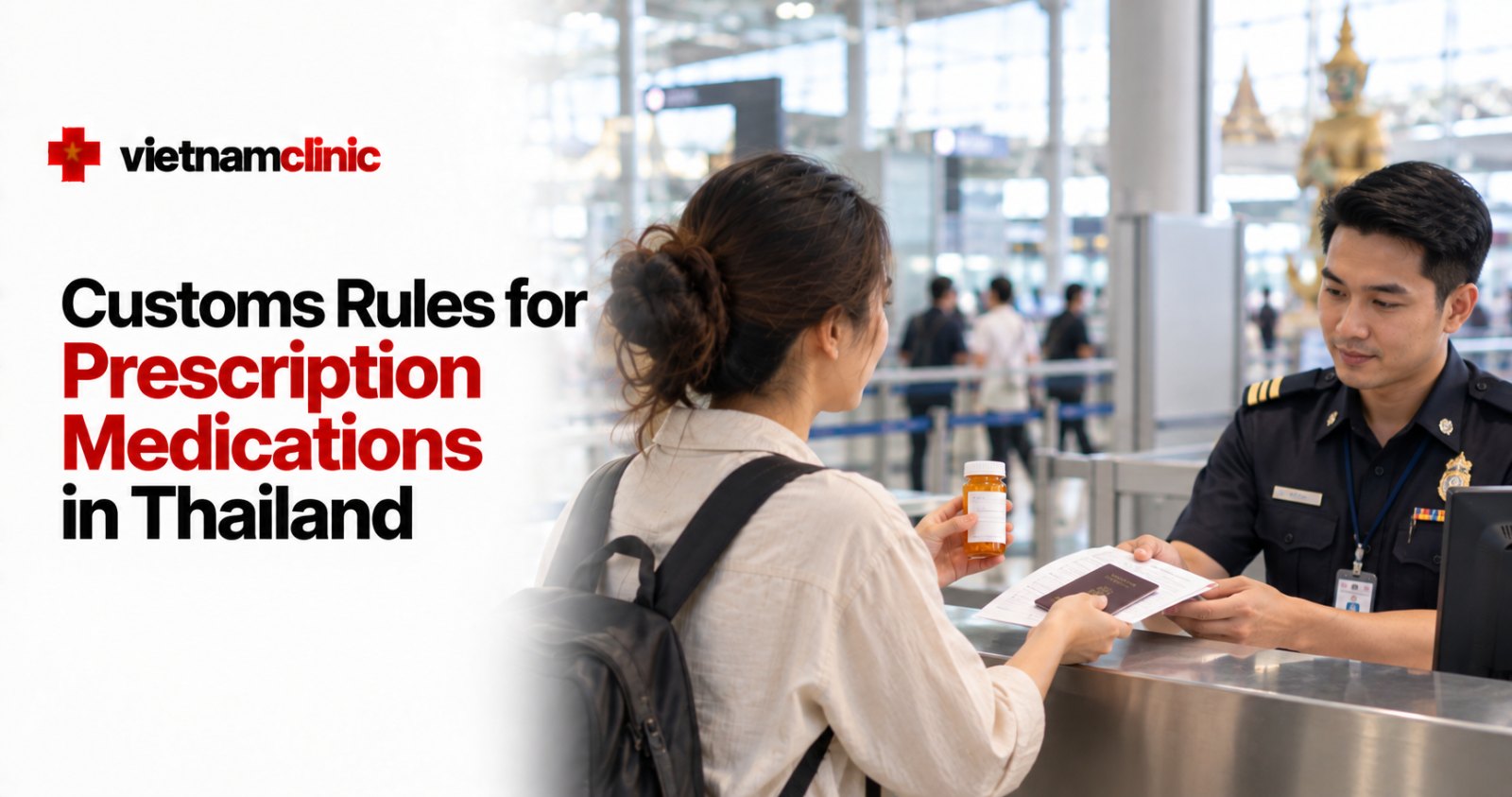
Thailand allows many travellers to carry prescription medicine for their own treatment, but the rules are not identical for every product. The active ingredient, Thai legal schedule, amount carried and supporting documents determine whether the medicine can enter as personal belongings or needs advance permission.
This guide explains the current Thai Food and Drug Administration, or Thai FDA, process for ordinary prescription medicines, psychotropic substances and narcotic medicines. Check the rules again shortly before travel because classifications and procedures can change.
Start with the active ingredient
Do not rely only on a brand name. A medicine sold under a familiar name in Vietnam or another country may have a different name in Thailand, while the same active ingredient may be controlled under Thai law.
Before booking or packing, write down:
- the generic or active ingredient
- the strength and dosage form
- your prescribed daily dose
- the total quantity you plan to carry
- your arrival and departure dates
Use the Thai FDA Permit for Traveller portal to check the ingredient. If the result is unclear, contact the Thai FDA Narcotics Control Division before travel rather than assuming that a prescription from abroad is sufficient.
Ordinary prescription medicines
Thai FDA guidance says a traveller may carry a finished modern medicine for personal use in an amount needed for no more than 30 days. It should remain in its original container and travel with the doctor's prescription.
The personal-use exception applies to medicine carried by the traveller. Thai FDA's FAQ says medicines cannot simply be ordered or sent into Thailand by post under this exception. If you need medicine after arrival, ask a licensed healthcare professional or pharmacy whether an equivalent product is lawfully available in Thailand.
Pack medicines in their pharmacy-labelled containers. Loose tablets in an unlabelled pill box are harder to identify at inspection. Keep the prescription and medical letter in your cabin baggage with the medicine, while following airline rules for liquids, needles and medical devices.
Psychotropic medicines
Thailand places additional controls on psychotropic substances. Under current Thai FDA guidance, travellers under treatment may carry a permitted Schedule II, III or IV psychotropic medicine for up to 30 days of prescribed use without obtaining the longer-supply permit, provided they carry a certificate or prescription from the treating physician.
A prescribed supply of 31 to 90 days requires a Thai FDA permit obtained before travel. Thai FDA instructs applicants to submit the online request at least 15 days before arrival or departure. Schedule I psychotropic substances are prohibited from import for personal treatment.
Commonly prescribed medicines can fall within controlled schedules, so do not guess from the type of condition being treated. Search the exact ingredient on the official portal. Rules for a sleep medicine, anxiety medicine or stimulant may differ even when all were legally prescribed at home.
Narcotic medicines
Current Thai FDA guidance permits certain medicines containing Schedule II or III narcotic drugs for personal treatment, up to a 90-day prescribed supply, but requires a permit in advance. Apply online at least 15 days before travel. Thai FDA states that complete applications are generally processed in about three working days, but this is not a reason to apply late. Missing documents or questions about an ingredient can add time.
Other narcotic schedules are prohibited except where a specific Thai rule allows them. The official guidance identifies Schedule I and V narcotic medicines as prohibited for travellers under the current framework, apart from the permitted categories described by Thai FDA. Confirm the latest classification for the ingredient on the official portal.
Documents to prepare
The medical prescription or certificate should clearly connect the traveller, condition and medicine. Thai FDA permit guidance asks for information including:
- the patient's name and address
- the medical condition being treated
- the medicine name, strength and instructions for use
- the reason it was prescribed
- the dosage and total quantity
- the prescriber's name, address and professional licence number
Permit applications also require travel information and a passport copy. Enter the exact port and travel dates requested by the form. Carry the permit, prescription or certificate and medicine together throughout the trip. A digital backup is useful, but it should not replace the documents required for inspection.
If the original paperwork is not in English or Thai, ask the Thai authority whether a certified translation is needed. Do not alter pharmacy labels or transfer medicine into a different manufacturer's package.
What to do at customs
Thai FDA guidance instructs travellers carrying permitted narcotic medicines or controlled psychotropic medicines that require a permit to present the medicines and documents at the Customs Department Red Channel on entry. Keep everything accessible for inspection rather than placing it deep inside checked baggage.
For other medicines carried as personal belongings within the applicable 30-day limit, the current guidance says travellers do not need to use the Red Channel when the medicine is accompanied by the required prescription or medical certificate. If an officer asks about the medicine, answer accurately and show the documentation. When uncertain, declaring and asking is safer than concealing an item.
Airline security rules are separate from Thai medicine law. Check the airline and departure airport requirements for liquid medicine, refrigerated products, syringes or injectable devices.
If you need more than the permitted amount
Do not divide a large supply between bags or fellow travellers to avoid the limit. For a permitted psychotropic medicine needed for 31 to 90 days, or a permitted narcotic medicine, follow the Thai FDA permit route.
For an ordinary medicine needed beyond the traveller allowance, discuss continuity of care before departure. Thai FDA advises checking whether the medicine is available in Thailand. A doctor in Thailand may need to assess you and prescribe a locally available equivalent. Product availability, fees and English-language support can change, so confirm directly with the hospital or clinic. Our guide to choosing a clinic in Vietnam explains practical checks that also help when comparing care abroad.
Travel insurance may cover an unexpected consultation but does not override customs or prescribing law. Review exclusions, pre-authorisation rules and coverage for pre-existing conditions. The distinction between short-trip and longer-term cover is explained in travel insurance versus health insurance in Vietnam.
A practical pre-travel checklist
- List each medicine by active ingredient, strength and total quantity.
- Check every ingredient on the Thai FDA Permit for Traveller portal.
- Confirm whether the amount is within the personal-use limit or needs a permit.
- If required, apply at least 15 days before travel and wait for approval.
- Obtain a clear prescription or medical certificate with the required details.
- Keep medicine in its original labelled container.
- Carry the medicine, documents and permit together.
- Use the Red Channel when Thai FDA guidance requires declaration.
- Recheck official rules shortly before departure.
Before you travel
Most problems are easier to prevent when you identify the active ingredient early and match it to the Thai category. Check each medicine individually, prepare the paperwork and use the official permit process where required.
If you cannot confirm the classification, contact Thai FDA before departure. Do not stop an essential medicine abruptly or substitute it without advice from the clinician responsible for your care.
Frequently Asked Questions
Can I bring prescription medicine into Thailand?
Usually, a traveller can carry a personal supply of an ordinary finished medicine for up to 30 days. Keep it in the original labelled container and carry the prescription or a medical document from the prescriber.
Do I need a Thai FDA permit for controlled medication?
It depends on the active ingredient, its Thai legal schedule and the quantity. Thai FDA guidance requires advance permission for permitted narcotic medicines and for a 31 to 90-day supply of permitted psychotropic medicines.
How early should I apply for a permit?
Thai FDA says travellers who need a permit should apply online at least 15 days before arrival or departure. Do not travel until you have the required approval and supporting documents.
Can I post my prescription medicine to Thailand?
Thai FDA distinguishes medicines carried by a traveller from medicines ordered or shipped into the country. Its current FAQ says bringing or ordering medicines by post is not allowed under the personal traveller exception.
Sources
- Thai Food and Drug Administration: Passenger belongings related to health products
- Thai Food and Drug Administration: Frequently asked questions
- Thai Food and Drug Administration: Guidance for travellers carrying narcotic and psychotropic medicines
- Thai FDA Narcotics Control Division: Permit for Traveller portal

Writer
Tan Nguyen
Medical writer for Vietnam Clinic. MD, Vietnam National University Ho Chi Minh City.