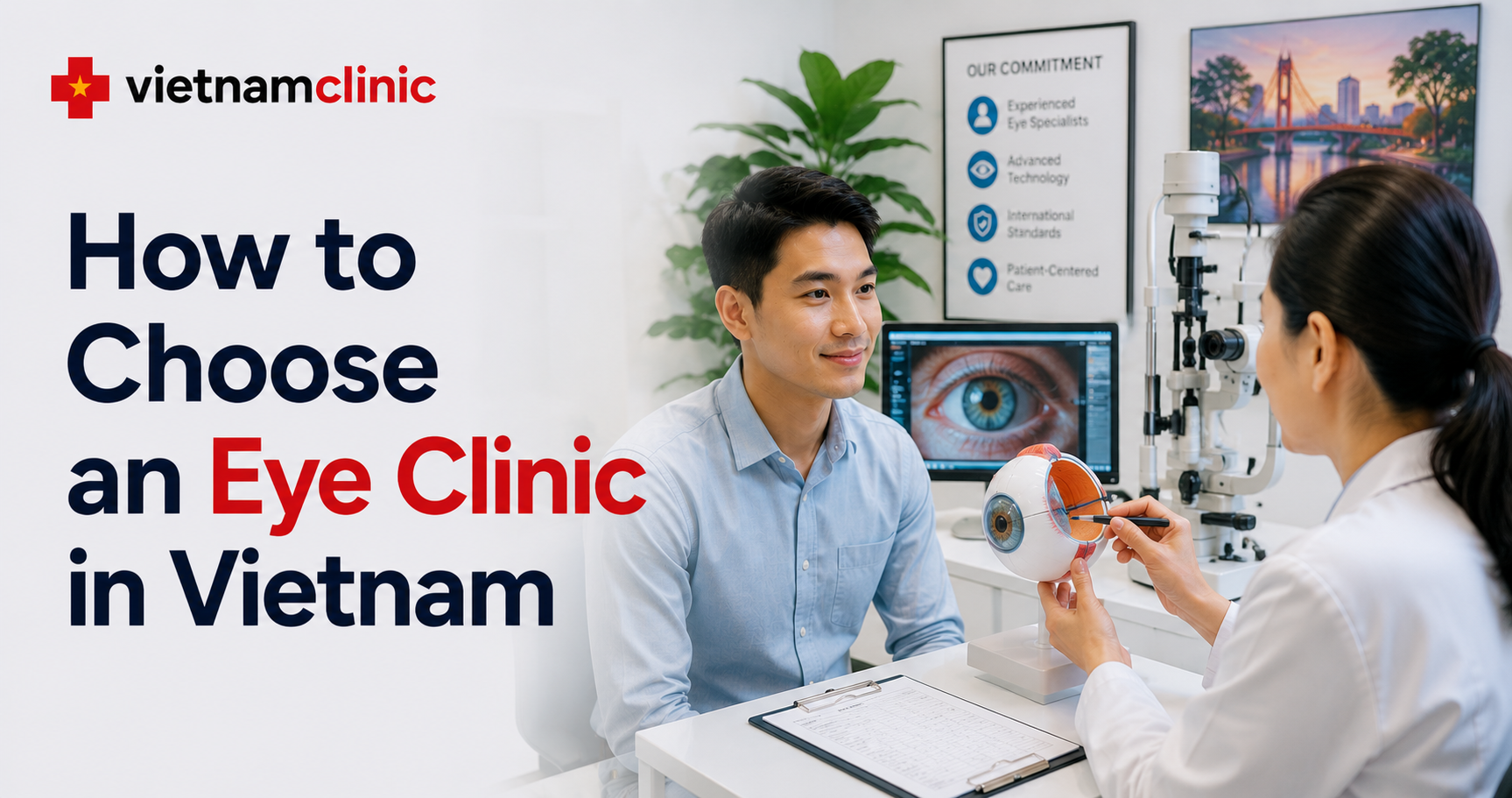
Choosing an eye clinic in Vietnam can mean anything from finding somewhere for a routine vision assessment to selecting a specialist for cataract surgery, glaucoma, retinal disease or laser vision correction. The right type of facility depends on the problem, the expertise required and whether you may need diagnostic tests, surgery or ongoing follow-up.
International residents and travellers also have practical considerations such as English-language communication, insurance, medical records and what happens after they leave Vietnam. Rather than choosing a clinic from advertising or price alone, it is useful to compare the facility, the individual ophthalmologist and the specific service you need.
Start with the type of eye care you need
Not every eye appointment requires the same type of provider. Before comparing clinics, identify whether you need routine vision care, assessment of a medical problem or specialist treatment.
Routine eye examinations
If your main concern is checking your vision or updating glasses or contact lenses, a routine eye examination may be sufficient. However, reduced vision is not always caused by a refractive error, so unexplained or significant changes should be medically assessed rather than assumed to require stronger glasses.
People with diabetes, glaucoma risk factors, previous eye disease, previous eye surgery or other medical conditions may also need examinations that go beyond a basic vision test.
Medical ophthalmology
An ophthalmologist is a medical doctor specialising in eye disease and treatment. An ophthalmology clinic is the appropriate setting when you need assessment or management of conditions such as:
- Cataracts
- Glaucoma
- Retinal disease
- Diabetic retinopathy
- Corneal disease
- Uveitis and other eye inflammation
- Persistent eye pain or redness
- Eye injuries
- Significant or unexplained vision changes
Some ophthalmologists focus on particular areas such as the retina, cornea, glaucoma, paediatric ophthalmology or oculoplastic surgery. If you already know your diagnosis, look for a clinician whose published qualifications and practice are relevant to that condition.
Refractive surgery
If you are considering LASIK or another form of laser vision correction, choose a facility that performs a complete preoperative assessment rather than focusing only on the advertised procedure.
Eligibility depends on factors including your prescription, corneal measurements, eye health and medical history. Different procedures are appropriate for different patients, and not everyone is a suitable candidate for refractive surgery.
Cataract surgery
Cataract treatment requires more than comparing the headline surgical fee. Ask who will perform the operation, which intraocular lens options are available, what diagnostic measurements are performed before surgery, what the quote includes and how postoperative reviews are arranged.
Check that the facility is authorised to provide medical care
Medical clinics and hospitals in Vietnam operate within a licensing framework. Vietnam's Ministry of Health states that healthcare facilities must satisfy the applicable conditions for an operating licence under the country's regulations on medical examination and treatment.
This is particularly important when an eye procedure is marketed through a general beauty, wellness or commercial business rather than an identifiable medical facility.
Ask the provider for its full registered name and confirm that the procedure will take place in an appropriately licensed healthcare facility. For surgery or invasive treatment, also ask whether the facility is authorised to perform that particular type of procedure.
A professional website, attractive premises or a large social media following should not be treated as substitutes for medical licensing.
Check the individual ophthalmologist
Choosing an eye clinic should also involve checking the doctor who will actually assess or treat you.
Ask for the ophthalmologist's:
- Full name
- Medical qualifications
- Ophthalmology specialist training
- Relevant subspecialty training
- Experience with the condition or procedure you need
- Languages spoken during consultations
If you are considering surgery, ask whether the ophthalmologist you meet during the consultation will also perform the procedure. Large eye centres may have several doctors with different areas of expertise.
Published doctor profiles can be useful for verification. For example, FV Hospital in Ho Chi Minh City publishes individual ophthalmologist profiles showing qualifications, areas of interest and languages spoken. This establishes information the hospital currently publishes about its own medical staff, not an independent assessment of their quality.
Look for the right ophthalmology service, not simply a large clinic
Eye care contains several subspecialties. A facility that is suitable for laser vision correction may not necessarily be the most appropriate place for a complex retinal condition, paediatric eye problem or corneal disease.
Depending on your needs, ask whether the clinic provides:
- General ophthalmology
- Cataract assessment and surgery
- Glaucoma diagnosis and monitoring
- Medical and surgical retina care
- Corneal services
- Refractive surgery
- Paediatric ophthalmology
- Strabismus assessment
- Oculoplastic or eyelid surgery
- Diabetic eye screening
- Emergency ophthalmology
FV Hospital, for example, currently publishes ophthalmology services covering areas including cataracts, glaucoma, retinal disease, refractive surgery and other medical eye conditions. Vinmec also operates ophthalmology services within its hospital network. These examples show the range of services available in Vietnam but are not rankings or recommendations.
Ask what diagnostic equipment is available
Modern eye assessment can require much more than reading letters from a chart. The tests you need depend on your symptoms and diagnosis.
An ophthalmology clinic may use equipment for:
- Slit-lamp examination
- Eye pressure measurement
- Retinal imaging
- Optical coherence tomography, commonly called OCT
- Corneal topography or tomography
- Visual field testing
- Biometry before cataract surgery
- Dilated retinal examination
You do not need to choose a clinic because it advertises the largest number of machines. What matters is whether the necessary investigations are available and whether an appropriately trained clinician interprets the results in the context of your examination.
If the clinic sends patients elsewhere for a particular scan or test, ask how results are transferred and who reviews them.
Confirm English-language communication
Major private and international hospitals in Hanoi and Ho Chi Minh City often publish information in English, and individual doctors may list English among their working languages. However, an English-language website does not guarantee that every ophthalmologist, nurse or administrative employee can communicate fluently in English.
Before booking, ask:
- Can the ophthalmologist conduct the consultation in English?
- Are consent documents available in English?
- Can test results and prescriptions be explained in English?
- Is English assistance available on the day of surgery?
- Who can you contact in English if you have a problem afterwards?
Clear communication becomes particularly important when discussing surgery, possible complications or choices between different procedures or intraocular lenses.
See How to Choose an English-Speaking Clinic in Vietnam for a broader checklist on language support and clinic selection.
Ask for a complete price estimate
Eye care costs in Vietnam vary substantially by provider and by the complexity of the examination or procedure. A routine consultation, retinal investigation, cataract operation and laser vision correction are not directly comparable services.
Before treatment, ask for an itemised estimate covering any relevant components, such as:
- Initial ophthalmology consultation
- Diagnostic scans or tests
- Medication
- Surgical fee
- Intraocular lens, if applicable
- Anaesthesia
- Facility charges
- Postoperative medication
- Follow-up examinations
- Additional treatment if a complication occurs
For refractive or cataract surgery, confirm whether an advertised price applies to one eye or both eyes.
Do not assume that the lowest advertised surgical price represents the final amount. The type of procedure, technology, lens or additional testing can change the total substantially.
Check your insurance before treatment
Whether international health insurance covers eye care depends on both the policy and the reason for treatment.
Medical treatment for eye disease may be covered under some policies, while routine vision examinations, glasses, contact lenses and elective refractive surgery may be excluded or covered only through an additional optical benefit.
Before your appointment, ask your insurer:
- Is the consultation covered?
- Are diagnostic eye tests covered?
- Is pre-authorisation required for surgery?
- Does the insurer have a direct billing arrangement with the clinic?
- Is there a deductible or co-payment?
- Are glasses, lenses or elective refractive procedures excluded?
Ask the clinic whether it can provide the invoice, medical report and other documentation required for reimbursement.
Prepare previous eye records
Medical history can be particularly useful when monitoring changes over time.
If available, bring:
- Previous eye examination reports
- Your current glasses prescription
- Previous OCT, retinal or visual field results
- Details of previous laser treatment or eye surgery
- Information about implanted intraocular lenses
- A list of current medications
- Details of diabetes, hypertension or other relevant medical conditions
If you wear contact lenses and are being evaluated for refractive surgery, ask the clinic in advance whether you need to stop wearing them before diagnostic measurements.
For general preparation advice, see What to Check Before a Medical Appointment in Vietnam.
Pay particular attention to follow-up after eye surgery
Follow-up is an important part of cataract surgery, refractive surgery and many other ophthalmic procedures.
This requires extra planning if you are visiting Vietnam temporarily. Before scheduling treatment, ask:
- How many postoperative checks are normally required?
- When will those appointments occur?
- How long should you remain in Vietnam?
- What symptoms require an earlier assessment?
- Who can you contact outside normal opening hours?
- Can your records be sent to an ophthalmologist in another country?
Do not schedule elective eye surgery immediately before an international flight or departure without discussing the timing with the treating ophthalmologist. Your individual recovery requirements depend on the procedure and your medical situation.
Know when an eye problem needs urgent assessment
Some eye symptoms should not wait for a routine appointment.
Seek urgent medical or ophthalmological assessment for symptoms such as:
- Sudden loss or major reduction of vision
- A sudden increase in new floaters
- New flashes of light
- A dark curtain or shadow moving across the field of vision
- Significant eye trauma
- Chemical exposure to the eye
- Severe eye pain, particularly with reduced vision
- Sudden vision changes after eye surgery
NHS and specialist eye hospital guidance identifies sudden new flashes or floaters, particularly when associated with a dark curtain, blurred vision or eye pain, as symptoms requiring urgent assessment because retinal problems can threaten sight.
If you have sudden severe vision loss, significant eye trauma or another potentially sight-threatening problem in Vietnam, seek immediate local medical care rather than waiting for a routine clinic appointment.
Questions to ask before choosing an eye clinic
A short checklist can make comparisons easier:
- Is this an appropriately licensed medical facility?
- Which ophthalmologist will examine or treat me?
- What are that doctor's qualifications and relevant specialist interests?
- Does the clinic regularly manage my particular eye condition?
- Can the consultation and consent process take place in English?
- Which diagnostic tests are likely to be required?
- What is included in the quoted price?
- Does the clinic work with my insurer?
- What follow-up is required after treatment?
- How are urgent postoperative problems handled?
Choosing between eye clinics in Vietnam
There is no single eye clinic that is appropriate for every patient or every condition. For a routine examination, convenience and language support may be major factors. For glaucoma, retinal disease, corneal problems or surgery, the relevant ophthalmologist's expertise, diagnostic facilities and follow-up arrangements become more important.
Hanoi and Ho Chi Minh City have the broadest concentration of specialist and hospital-based ophthalmology services, while eye care is also available in Da Nang and other major Vietnamese cities. Services, individual doctors, fees, insurance arrangements and language support can change, so verify them directly before attending.
The practical next step is to identify the type of eye care you need, shortlist facilities that provide that specific service, and compare the ophthalmologist, diagnostic capabilities, communication, total cost and follow-up plan before making a decision.
Frequently Asked Questions
The questions below address common practical concerns for international residents and travellers looking for eye care in Vietnam.
How do I choose a good eye clinic in Vietnam?
Start by checking that the facility provides the specific ophthalmology service you need and that an appropriately trained ophthalmologist will examine or treat you. Compare qualifications, diagnostic facilities, English support, total costs and follow-up arrangements rather than relying only on advertising or price.
Can I find an English-speaking ophthalmologist in Vietnam?
Yes. Some private and international hospitals, particularly in Hanoi and Ho Chi Minh City, publish profiles of ophthalmologists who speak English. Confirm directly that the individual doctor conducting your consultation can communicate in English.
Should I go to an eye clinic or an optician for vision problems?
A routine glasses or contact lens check may be handled by an optical provider, but unexplained vision loss, eye pain, eye disease, injury or significant changes should be medically assessed. An ophthalmologist is a medical doctor specialising in eye conditions and treatment.
What should I check before having LASIK in Vietnam?
Confirm the surgeon's ophthalmology and refractive surgery experience, the exact procedure being proposed, the preoperative testing, total cost and follow-up plan. A complete assessment is necessary because not every patient is suitable for laser vision correction.
Does international health insurance cover eye treatment in Vietnam?
Coverage depends on the policy and the reason for treatment. Medical eye disease may be covered, while routine vision care, glasses, contact lenses and elective refractive surgery are often subject to separate limits or exclusions.
When should I seek urgent eye care in Vietnam?
Seek urgent medical assessment for sudden vision loss, new flashes or a sudden increase in floaters, a dark curtain or shadow in your vision, severe eye pain, significant eye trauma or sudden problems after eye surgery. These symptoms can sometimes indicate conditions that threaten vision and should not wait for a routine appointment.
Sources
- Vietnam Ministry of Health: Conditions for Licensing Private Medical Clinics
- FV Hospital: Ophthalmology and Refractive Surgery
- FV Hospital: Comprehensive Vision Care
- FV Hospital: Ophthalmology Experts
- NHS: Floaters and Flashes in the Eyes
- Moorfields Eye Hospital: Flashes and Floaters Diagnosis and Treatment

Writer
Tan Nguyen
Medical writer for Vietnam Clinic. MD, Vietnam National University Ho Chi Minh City.