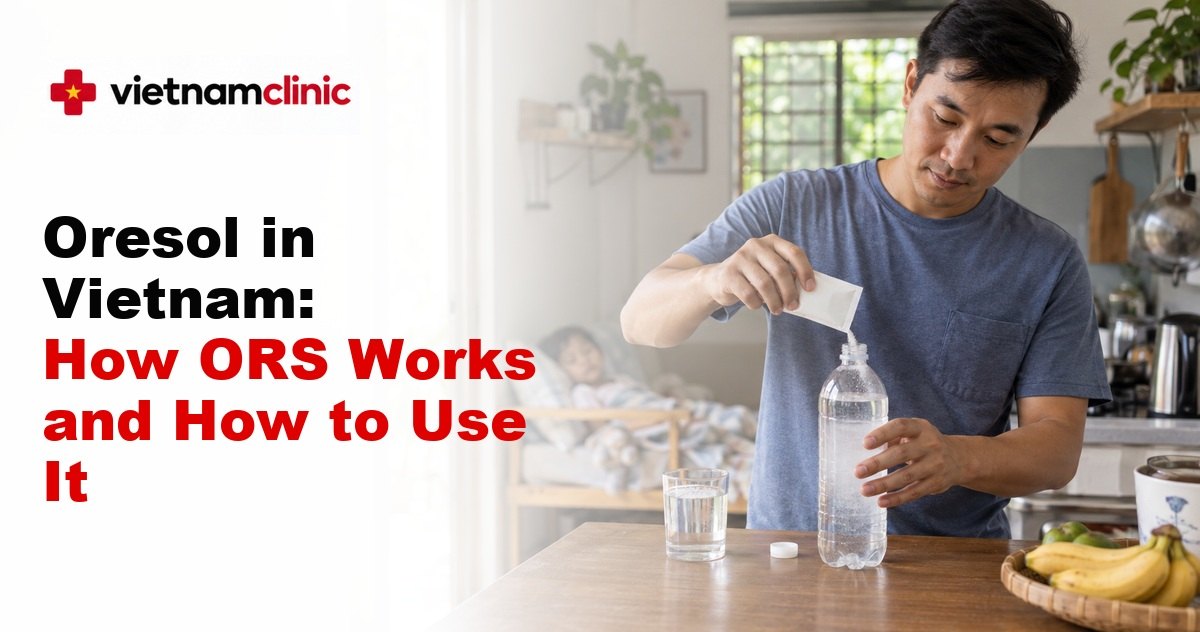
Oresol is a familiar name in Vietnam for oral rehydration salts, or ORS. When prepared correctly, the solution replaces water and electrolytes lost through diarrhoea and vomiting. It can prevent dehydration from becoming dangerous and is a central part of treatment for many diarrhoeal illnesses.
ORS does not work by stopping bowel movements or killing an infection. Its main purpose is to help the intestine absorb fluid despite ongoing losses. The amount of water used to prepare a packet is therefore a safety requirement, not a suggestion that can be changed to improve the taste.
How oral rehydration works
The intestine can absorb sodium together with glucose through a transport process that often remains functional during infectious diarrhoea. Water follows this absorption. A carefully balanced mixture of glucose and salts takes advantage of that process to restore fluid more effectively than simply replacing a large loss with plain water.
The WHO reduced-osmolarity formulation contains sodium and glucose at 75 millimoles per litre each, with a total osmolarity of 245 milliosmoles per litre. It also contains potassium, chloride and citrate. These figures describe a standardized formulation; they are not instructions to measure individual chemicals at home.
Commercial preparations can differ. The packet label determines the water volume required for that product. A smaller packet is not necessarily a weaker medicine, and a stronger-tasting solution is not more effective.
When ORS is useful
ORS is commonly used during acute watery diarrhoea, including gastroenteritis, to replace continuing losses. It can also help when vomiting contributes to dehydration, provided the person can swallow and retain enough fluid. Starting rehydration early is particularly important for babies and young children, who can deteriorate quickly.
For cholera, fluid replacement is the most important treatment. Profuse watery diarrhoea can cause severe dehydration within a short time. ORS should be started promptly if the person can drink, while urgent medical care is arranged when losses are substantial.
An ORS packet is not a universal answer to every cause of vomiting. Severe abdominal pain, a swollen abdomen, green vomit, blood in vomit or altered consciousness requires assessment for another serious problem. Rehydration must not become a reason to delay diagnosis.
Recognizing dehydration
Thirst, a dry mouth, darker urine and urinating less often can be early clues. Adults may feel tired or light-headed, especially when standing. Children may have fewer wet nappies, fewer tears, a dry mouth or unusual irritability. No single sign reliably grades dehydration on its own.
More concerning features include unusual sleepiness, confusion, sunken eyes, rapid breathing, a fast heartbeat, cold or mottled skin and very little urine. A person who cannot drink, is difficult to wake or appears shocked needs emergency care.
Infants, older adults and people with significant chronic illness deserve a lower threshold for assessment. Do not wait for all the signs on a checklist. A noticeable deterioration while diarrhoea or vomiting continues is enough to seek help.
Read the exact packet before mixing
Check that the product is intended for oral rehydration and that the sachet is intact and in date. Find the specified water volume before opening it. Some packets are designed for 200 millilitres, others for a litre, and other sizes exist.
For example, a packet labelled for 200 millilitres must be mixed with that amount; a packet labelled for one litre needs one litre. Do not assume that every product called Oresol has the same instructions. Use a clean measuring container with reliable markings rather than estimating the size of a drinking glass.
Empty the whole sachet into the measured water and mix until dissolved. Do not divide the dry powder by eye to make a smaller portion. You may not distribute the ingredients accurately, and the remaining powder can be exposed to moisture or contamination.
Use safe water and nothing extra
Use safe drinking water. When boiling is needed to make water safe, boil it first and allow it to cool before adding the powder. Follow the product's specific instructions for infants and local water conditions.
Do not mix ORS into milk, juice, soup, soft drinks or another electrolyte drink. Do not add sugar, honey or extra salt. These additions alter the intended balance and can interfere with rehydration. A child disliking the taste is a reason to try a slower method of giving it or seek advice, not to make it sweeter.
Do not boil the prepared solution, because water loss can change its concentration. Ready-to-drink products should be used according to their own label; they usually should not be diluted or combined with powder. Keep them distinct from sachets that require mixing.
Why a mixing error can be dangerous
Too little water produces excessive concentrations of salts and glucose. This can worsen electrolyte disturbances, including dangerously high sodium. Vietnam's National Children's Hospital has warned about serious illness associated with incorrectly concentrated Oresol.
Too much water also changes the balance and may fail to replace electrolytes adequately. Neither error should be corrected by guessing after someone has already begun drinking the mixture. If you discover a preparation mistake, stop using that batch and make a new one correctly.
If a child has consumed a substantially concentrated mixture, obtain urgent medical advice, especially with unusual thirst, agitation, drowsiness, vomiting or seizures. Do not attempt to rapidly correct a suspected sodium disturbance with large volumes of plain water at home. The amount taken and the child's condition guide medical assessment.
Give small amounts frequently
A person who feels nauseated may tolerate small, frequent sips better than a large glass at once. For a child, a clean spoon or oral syringe can help give controlled amounts. Allow the child time to swallow; do not force fluid into the mouth.
If vomiting occurs, pause briefly and restart more slowly with smaller amounts. A single vomit does not automatically mean oral rehydration has failed, because some fluid may already have been absorbed. However, persistent vomiting that prevents adequate intake needs medical care.
Never give drinks by mouth to someone who is unconscious, cannot swallow safely or is having a seizure. These situations require emergency assistance. A tube or intravenous fluid may be needed in a clinical setting when ordinary drinking is not sufficient or safe.
The drinking amount is different from the mixing volume
The water volume on the sachet tells you how to prepare the solution. It does not mean everyone must drink exactly one packet, nor that a child should finish the entire batch immediately. The amount needed depends on body size, existing dehydration and continuing losses.
Clinical protocols distinguish replacing an existing fluid deficit from replacing each new loose stool or vomit. For example, NICE guidance for young children with clinical dehydration uses a weight-based rehydration plan over several hours, with reassessment. That is a clinical plan, not a reason to calculate a large home dose without evaluating the child.
Follow the age-specific product instructions and the clinician's advice. Keep offering replacement fluid while losses continue, but seek reassessment if intake cannot keep pace. Improvement in thirst, alertness and urine output is more useful than simply counting empty sachets.
Continue appropriate feeding
Breastfeeding should continue during diarrhoeal illness and oral rehydration. ORS supplies fluid and electrolytes; it does not provide the complete nutrition of breast milk, formula or food. Do not replace all feeds with ORS for an extended period.
For children without dehydration who tolerate feeding, usual age-appropriate food and milk can generally continue. During treatment of established dehydration, follow the rehydration plan, then resume normal feeding as advised. Formula should normally be prepared at its usual strength, not diluted to treat diarrhoea.
Adults can return to their usual diet as appetite and tolerance allow. Prolonged fasting or a severely restricted diet is generally unnecessary. Large amounts of very sweet drinks may aggravate diarrhoea. Some people temporarily tolerate lactose poorly after gastroenteritis, but that does not mean every child needs a special formula.
Storage and hygiene
Wash hands before preparing ORS and use a clean container and utensil. Keep the prepared solution covered, and avoid repeatedly contaminating the main batch with a used spoon. Note when it was mixed so that an old preparation is not mistaken for a fresh one.
Follow the product's storage and discard instructions. Many ORS recommendations limit prepared solution to 24 hours, but some products specify discarding after one hour at room temperature unless refrigerated. The shorter limit on the actual product takes priority.
Do not keep yesterday's leftover solution for another day, top it up with new powder or add water to compensate for evaporation. Make a fresh batch when needed. Refrigeration may improve taste for some people, but it does not make a prepared solution safe indefinitely.
ORS, sports drinks and homemade mixtures
Sports drinks and energy drinks are not interchangeable with ORS for clinically important diarrhoeal dehydration. Their sugar and electrolyte balance is different. Very sweet beverages can increase water movement into the bowel and worsen diarrhoea when consumed in large amounts.
For mild illness in a healthy adult, usual fluids may help maintain hydration. With substantial diarrhoeal losses, or in children at risk, a correctly prepared ORS formulation is the more appropriate replacement. Plain water alone does not replace all the salts being lost.
When packaged ORS is unavailable, public-health services may provide an emergency sugar-and-salt recipe. Such recipes require accurate measurements and safe water and are not identical to a complete commercial formulation. Do not improvise a concentration from memory. Seek an authoritative local instruction while arranging access to ORS or medical care.
Medicines and other diarrhoea treatments
ORS remains useful even if another treatment is prescribed because antibiotics and symptom-relief medicines do not replace lost fluid. Many episodes of acute watery diarrhoea do not need antibiotics. Bloody stool, persistent symptoms or severe illness may change the investigation and treatment plan.
Antidiarrhoeal medicines are not appropriate for every patient, particularly young children or people with bloody diarrhoea and fever. Do not give a child an adult medicine simply because ORS has not stopped the stools; stopping stools is not its job.
Zinc may be prescribed alongside ORS for childhood diarrhoea under current guidance. WHO updated its paediatric recommendations in 2024, including zinc dosing, so old online dose schedules should not be copied automatically. Probiotics are not substitutes for rehydration, and their role should not be assumed from advertising.
Conditions requiring an individualized plan
People with kidney disease, heart failure, fluid restrictions or prescribed sodium or potassium limits should obtain advice about fluid and electrolyte replacement. Their need to replace losses must be balanced against the risk of excess fluid or particular electrolytes.
Diabetes is not a reason to remove glucose from an ORS recipe: glucose has a specific role in absorption. It is a reason to discuss appropriate use and monitor illness carefully. Persistent vomiting or marked glucose abnormalities can require urgent assessment beyond rehydration alone.
Severely malnourished children need specialized assessment and fluid management. Do not modify ordinary ORS at home to imitate a specialist formula. Pregnancy with significant vomiting or reduced intake also warrants assessment; ORS may help replace losses but does not treat every cause of prolonged vomiting.
When oral treatment is not enough
Severe dehydration or shock may require intravenous fluid and close monitoring. Once a person can drink safely, ORS often remains part of replacing continuing losses. Needing hospital fluids does not mean ORS is ineffective; it means the severity or circumstances require additional treatment.
Seek prompt review for blood in stool, high or persistent fever, worsening abdominal pain, ongoing vomiting or diarrhoea that is not improving. Babies with poor feeding or fewer wet nappies should be assessed early. If someone becomes confused, collapses or cannot drink, seek emergency help. Correctly prepared Oresol is valuable, but recognizing deterioration is just as important as mixing the packet correctly.
Frequently Asked Questions
How oral rehydration works?
The intestine can absorb sodium together with glucose through a transport process that often remains functional during infectious diarrhoea. Water follows this absorption.
When ORS is useful?
ORS is commonly used during acute watery diarrhoea, including gastroenteritis, to replace continuing losses. It can also help when vomiting contributes to dehydration, provided the person can swallow and retain enough fluid.
What should you know about recognizing dehydration?
Thirst, a dry mouth, darker urine and urinating less often can be early clues. Adults may feel tired or light-headed, especially when standing.
What should you know about read the exact packet before mixing?
Check that the product is intended for oral rehydration and that the sachet is intact and in date. Find the specified water volume before opening it.
What should you know about use safe water and nothing extra?
Use safe drinking water. When boiling is needed to make water safe, boil it first and allow it to cool before adding the powder.
Sources

Writer
Tan Nguyen
Medical writer for Vietnam Clinic. MD, Vietnam National University Ho Chi Minh City.