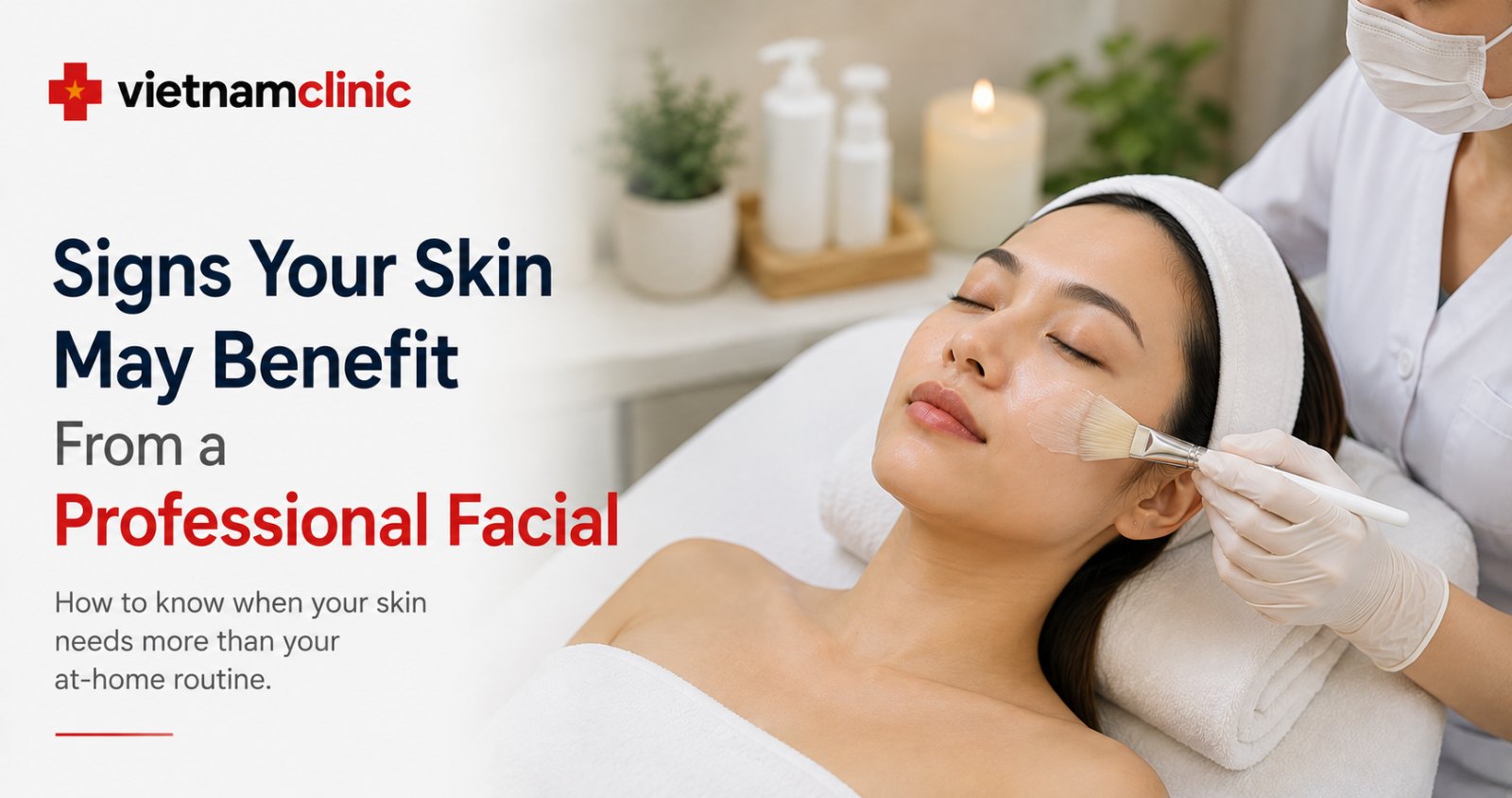
Professional facials are widely available at spas, beauty clinics and dermatology centres across Vietnam. Depending on the treatment, a facial may include cleansing, exfoliation, extraction, hydration, masks or technologies such as LED light therapy.
A facial can improve the temporary appearance and feel of the skin, but it is not a substitute for medical treatment. Persistent acne, rosacea, unexplained rashes, changing skin lesions and other skin diseases should be assessed by an appropriately qualified healthcare professional.
Here are 10 signs that a professional facial may be worth considering, along with situations where professional dermatology care may be more appropriate.
1. Your skin feels persistently dry or dehydrated
Skin that regularly feels tight, rough or uncomfortable may benefit from a facial focused on gentle cleansing and hydration.
Professional treatments may use moisturising masks, humectants or hydrating serums to temporarily improve skin softness and moisture. Cleveland Clinic notes that facials may help hydrate and plump the skin, while the American Academy of Dermatology recommends regular moisturising and gentle skin care for persistent dryness.
A facial is not necessarily the solution if dryness is severe, painful or accompanied by cracking, inflammation or persistent itching. These symptoms may indicate eczema, contact dermatitis or another condition requiring medical assessment.
2. Your complexion looks dull
A buildup of dead surface skin cells can make the skin appear rougher or less bright. Gentle exfoliation is therefore a common part of professional facial treatments.
Depending on the provider and your skin type, this may involve mild mechanical exfoliation, an exfoliating product or another superficial treatment.
More aggressive exfoliation is not automatically better. Excessive treatment can damage the skin barrier and lead to irritation, redness or increased sensitivity.
If you have sensitive skin, rosacea or active inflammation, tell the provider before any exfoliating treatment begins.
3. Your pores frequently feel congested
Blackheads and clogged pores are common reasons people book facials. Some professional treatments include manual extraction or techniques designed to cleanse the skin surface and remove material from congested pores.
Certain non-surgical facial procedures also combine exfoliation and suction. Cleveland Clinic describes dermalinfusion, for example, as a treatment that exfoliates the skin, cleans pores and applies a hydrating serum.
Extractions should be performed carefully. Repeated squeezing or aggressive manipulation can irritate the skin and potentially contribute to inflammation or scarring.
4. Your normal skincare routine no longer seems effective
Sometimes a skincare routine becomes unnecessarily complicated or poorly matched to the skin's current condition. Dryness, oiliness, sensitivity and breakouts can all be made worse by combinations of products that irritate the skin.
A professional facial appointment may provide an opportunity to review how the skin responds to cleansing, exfoliation and hydration. However, be cautious about assuming that an extensive collection of products is necessary simply because they are recommended during a treatment.
For persistent skin problems, a dermatologist is better placed to assess whether a medical condition is involved and recommend evidence-based treatment.
5. Your skin feels rough or uneven
Superficial exfoliation can temporarily make rough skin feel smoother by removing some dead cells from the outermost layer of the skin.
Procedures offered under the broad term "facial" vary substantially, however. A traditional spa facial is different from dermaplaning, chemical peeling, microdermabrasion or laser resurfacing.
More intensive procedures carry additional risks and may require a medical professional or appropriately trained practitioner. Cleveland Clinic notes that dermaplaning, for example, can carry risks including infection, scarring and changes in skin pigmentation.
Ask exactly which procedure is being proposed rather than booking based only on the word "facial."
6. Your skin becomes oily quickly
Excess surface oil can make the skin feel greasy and contribute to clogged pores in some people. A facial involving gentle cleansing may temporarily improve how the skin feels.
Trying to remove all oil from the skin is not a useful goal. Harsh cleansing and repeated scrubbing can irritate the skin and may make an existing acne or sensitivity problem harder to manage.
The American Academy of Dermatology recommends gentle cleansing for acne-prone skin and warns against habits that repeatedly irritate or scrub the skin.
If oiliness is accompanied by persistent inflammatory acne, painful lesions or scarring, consider a dermatologist rather than relying on repeated facials.
7. You have occasional blackheads or minor breakouts
A professional facial may help with mild congestion and superficial blackheads, particularly when careful extraction is part of the treatment.
However, a facial should not be presented as a cure for acne. Acne is a medical skin condition with several potential treatments, and the American Academy of Dermatology recommends professional assessment when breakouts persist despite skincare efforts.
See a dermatologist if you have:
- Frequent inflammatory acne
- Painful nodules or cysts
- Acne that is leaving scars
- Significant pigmentation after breakouts
- Acne that is affecting your wellbeing
- Breakouts that continue despite appropriate skincare
The aim should be to avoid turning a manageable acne problem into irritated or scarred skin through repeated aggressive extractions.
8. Your skin looks temporarily tired before an event
Some people book hydrating or gentle exfoliating facials before weddings, photographs, business events or holidays because these treatments may temporarily make the skin feel smoother or appear more hydrated.
If you are trying a new treatment, avoid scheduling an aggressive procedure immediately before an important event. Even relatively routine facial treatments can cause temporary redness, irritation or breakouts in some people.
Ask the provider about expected downtime and avoid experimenting with strong acids, resurfacing procedures or unfamiliar products at the last minute.
9. Your skin has been exposed to a different climate
Moving to or travelling through Vietnam can expose the skin to changes in humidity, heat, air conditioning, pollution, sun exposure and skincare habits.
Someone arriving from a colder or drier climate may notice increased oiliness, sweating or congestion. Others may experience dehydration from air conditioning or irritation from frequent cleansing and sunscreen use.
A gentle facial may help with temporary dryness or congestion, but adapting your daily routine is usually more important than relying on repeated professional treatments. Regular sunscreen, gentle cleansing and an appropriate moisturiser remain fundamental parts of skin care.
10. You want professional guidance before trying stronger treatments
A consultation can be particularly useful if you are considering treatments beyond a basic facial, such as chemical peels, dermaplaning, LED therapy, laser treatment or other energy-based procedures.
These treatments have different evidence, risks and suitability criteria. Cleveland Clinic notes, for example, that LED light therapy is generally non-invasive but is not appropriate for everyone and recommends discussing suitability with a healthcare provider.
If a treatment is intended to address acne scars, pigmentation, rosacea, prominent blood vessels or significant signs of sun damage, a dermatologist-led assessment may be more appropriate than starting with a general spa treatment.
When a facial may not be the right choice
Some symptoms should prompt medical evaluation rather than a cosmetic facial.
Consider seeing a dermatologist or other qualified healthcare professional if you have:
- Severe or persistent acne
- A painful or rapidly worsening rash
- Persistent facial redness or suspected rosacea
- Open wounds or active skin infection
- Unexplained swelling
- A changing mole or skin lesion
- Significant pigmentation that has appeared unexpectedly
- Severe itching, burning or pain
Rosacea deserves particular caution. The American Academy of Dermatology notes that rosacea-prone skin can be extremely sensitive, and products or techniques that irritate the skin can worsen symptoms.
What type of facial should you choose?
There is no single treatment called a professional facial. Providers may use the term for very different procedures.
Common options include:
Basic cleansing facial
Usually focuses on cleansing, light exfoliation, hydration and sometimes extraction. This may be appropriate for someone seeking general skin maintenance rather than treatment of a medical condition.
Hydrating facial
Designed primarily to improve temporary dryness and make the skin feel softer. These treatments commonly use moisturising masks or serums.
Extraction facial
Focuses more heavily on clogged pores and blackheads. Ask how extractions are performed and avoid aggressive squeezing that causes significant pain or skin damage.
Dermaplaning
A blade is used to remove superficial dead skin cells and fine facial hair. It is more technique-dependent than a simple facial and carries risks including infection, scarring and pigmentation changes.
LED facial
Uses specific wavelengths of visible light. Different devices are promoted for concerns including acne and signs of ageing, although effectiveness depends on the device, condition and treatment protocol.
More intensive resurfacing treatments
Chemical peels, microdermabrasion, laser resurfacing and other procedures should not be grouped automatically with routine spa facials. Their potential effects and risks are different, and practitioner qualifications become increasingly important as treatment intensity increases.
Choosing a facial clinic in Vietnam
Vietnam has a large beauty and aesthetic treatment market, particularly in Ho Chi Minh City, Hanoi and Da Nang. Options range from hotel spas and independent beauty centres to dermatologist-led aesthetic clinics and hospitals.
Before booking, ask:
- What exactly does the facial include?
- Which products or devices will be used?
- Who performs the treatment?
- What training does that person have?
- Are extractions included?
- Is the treatment suitable for sensitive or acne-prone skin?
- Is there expected redness or downtime?
- What should you avoid before and after treatment?
- What happens if you develop significant irritation?
For a simple cosmetic facial, the relevant practitioner may not be a doctor. However, treatments involving prescription medicines, significant skin resurfacing, medical devices or management of a diagnosed skin disease may require different qualifications and medical oversight.
Do not choose a facial only by price
Facial prices in Vietnam vary according to location, facility, products, devices and treatment complexity. Promotional packages are common, particularly in the beauty sector.
Before agreeing to a package, clarify whether the advertised price applies to a single treatment or requires purchasing multiple sessions. Also ask whether additional procedures or products will be recommended during the appointment.
A more expensive facial is not automatically better, and a low price is not automatically unsafe. The useful comparison is whether the treatment is appropriate for your skin, what it actually includes and who performs it.
What to do before your appointment
Tell the provider about important skin conditions and treatments, including:
- Active acne
- Rosacea
- Eczema or dermatitis
- Cold sores
- Recent sunburn
- Recent chemical peels or laser treatments
- Prescription acne medication
- Retinoids or strong exfoliating products
- Known allergies or previous reactions to skincare products
Do not hide active irritation simply because you have already paid for the appointment. Postponing or modifying a treatment can be safer than applying additional products to already inflamed skin.
A professional facial should have a clear purpose
A facial can be a reasonable part of a skincare routine when the goal is realistic. Hydration, superficial exfoliation, temporary improvement in skin texture and careful management of mild congestion are different goals from treating acne, rosacea, scars or other medical conditions.
If your skin is generally healthy but feels dry, congested, rough or dull, a well-chosen professional facial may be worth considering. If the concern is persistent, painful, worsening or difficult to identify, start with a dermatologist or other appropriately qualified healthcare professional instead.
In Vietnam, compare the actual treatment, practitioner, products and aftercare rather than choosing a clinic based only on photographs, promotions or package prices.
Frequently Asked Questions
The questions below cover common concerns about professional facial treatments and choosing an appropriate provider.
How do I know if I need a professional facial?
A facial may be worth considering if your skin feels persistently dry, dull, rough or mildly congested and you want professional cleansing, exfoliation or hydration. Persistent acne, redness, pain or other unexplained symptoms are better assessed by a dermatologist.
Can a facial help with acne?
Some facials may temporarily help with superficial congestion or blackheads, but they do not replace medical acne treatment. Persistent inflammatory acne, painful lesions or scarring should be assessed by a qualified healthcare professional.
How often should I get a facial?
There is no medically required schedule for routine cosmetic facials. How often you choose one should depend on your skin, the type and intensity of treatment, your skincare routine and professional advice rather than a fixed monthly rule.
Can sensitive skin have a professional facial?
Potentially, but the treatment should be adapted carefully. Tell the provider about sensitivity, rosacea, eczema, allergies and previous reactions, and avoid aggressive exfoliation or unfamiliar active ingredients without appropriate assessment.
Should I choose a spa or a dermatology clinic for a facial?
A straightforward cleansing or hydrating facial may be offered in a spa or beauty clinic. If you have persistent acne, rosacea, pigmentation, a skin disease or are considering stronger resurfacing or device-based treatment, a dermatology or medically supervised setting may be more appropriate.
Can I have a facial immediately before an important event?
A familiar gentle treatment may be reasonable, but trying a new or intensive facial immediately before an event can cause unexpected redness, irritation or breakouts. Ask about expected downtime and consider leaving enough time for the skin to settle.
Sources

Writer
Tan Nguyen
Medical writer for Vietnam Clinic. MD, Vietnam National University Ho Chi Minh City.