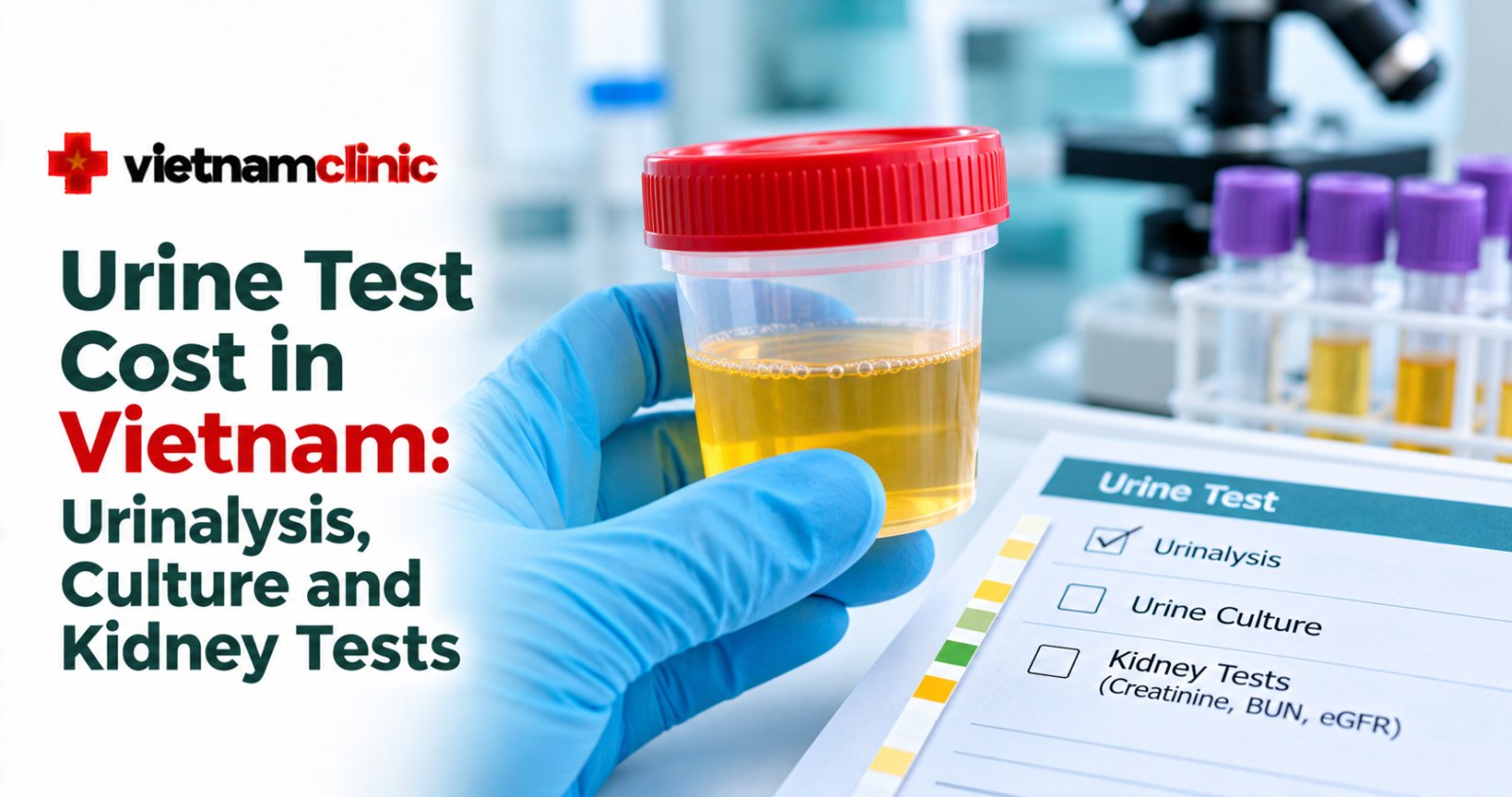
A urine test in Vietnam can be one of the cheapest laboratory tests available. Basic urinalysis costs only a few tens of thousands of đồng at some private laboratories, while more specialised tests such as urine culture, albumin-to-creatinine ratio or STI PCR can cost several hundred thousand đồng or more.
The important point is that "urine test" can mean several very different things. A routine urinalysis checks characteristics such as blood, protein, glucose, white blood cells and other markers. A urine culture looks for bacteria. Kidney monitoring may involve microalbumin or albumin-to-creatinine ratio, while sexual-health testing may use urine for PCR detection of specific infections.
Current published prices put routine urinalysis at around 35,000 to 59,000 VND at DIAG and MEDLATEC, making it one of the least expensive diagnostic tests in Vietnam.
How much does a urine test cost in Vietnam?
Current published prices give a useful starting point:
| Urine test | Published price example |
|---|---|
| Routine automated urinalysis at DIAG | 35,000 VND |
| Routine urinalysis at MEDLATEC | 59,000 VND |
| Manual urine sediment examination at MEDLATEC | 59,000 VND |
| Urine sediment at DIAG | 63,000 VND |
| Urine protein at DIAG | 46,000 VND |
| Urine creatinine at DIAG | 46,000 VND |
| Urine microalbumin at DIAG | 70,000 VND |
| Urine albumin/creatinine ratio at DIAG | 116,000 VND |
| UACR at Vinmec Phu Quoc / Duong Dong | 550,000 VND |
| Quantitative urine protein at Vinmec Central Park | 210,000 VND |
| UTI panel with urine sediment, culture and antibiotic susceptibility at DIAG | 690,000 VND |
These are provider-published prices, not national averages. Consultation, sample collection, home visits and additional laboratory testing may be charged separately.
For a broader comparison of laboratory prices, see Blood Test Cost in Vietnam.
How much is a basic urinalysis in Vietnam?
Routine urinalysis is very inexpensive.
DIAG currently publishes automated urinalysis at 35,000 VND.
MEDLATEC lists routine urinalysis at 59,000 VND in several current health-check packages.
MEDLATEC also lists a manual urine sediment examination at another 59,000 VND when that additional microscopic assessment is performed.
A basic test therefore does not usually require a large health-check package unless you also want blood tests, imaging or a medical consultation.
What does a routine urine test check?
A standard urinalysis can assess several physical, chemical and microscopic features of urine.
Depending on the analyser and laboratory, these may include:
- Blood
- Protein
- Glucose
- Ketones
- Nitrite
- Leukocyte esterase
- pH
- Specific gravity
- Bilirubin
- Urobilinogen
A microscopic or sediment examination can additionally identify elements such as:
- Red blood cells
- White blood cells
- Epithelial cells
- Crystals
- Casts
- Bacteria or other microorganisms
The result can point toward a possible urinary infection, kidney problem, diabetes or another condition, but urinalysis alone does not establish every diagnosis.
How much does urine sediment testing cost?
DIAG currently publishes urine sediment at 63,000 VND.
MEDLATEC lists a manual urine sediment examination at 59,000 VND.
Vinmec Smart City publishes microscopic examination of urine sediment at 270,000 VND in its current international service tariff.
The large difference shows why hospital pricing should not be assumed to match independent laboratory pricing.
Urine sediment may be ordered when a routine dipstick or automated urinalysis shows blood, white cells, protein or another abnormality that needs closer examination.
How much does a urine culture cost?
A urine culture is more expensive than basic urinalysis because the laboratory attempts to grow and identify bacteria or other organisms present in the sample.
DIAG currently publishes a urinary tract infection testing package at 690,000 VND. The package includes:
- Urine sediment examination
- Bacterial urine culture
- Antibiotic susceptibility testing
That is a more clinically useful package when bacterial urinary tract infection is suspected than repeatedly ordering basic urinalysis alone.
The culture can identify the organism, while susceptibility testing helps determine which antibiotics are likely to work against it.
Urinalysis versus urine culture
These tests answer different questions.
| Urinalysis | Urine culture |
|---|---|
| Looks for chemical and cellular abnormalities | Attempts to grow and identify bacteria |
| Very inexpensive | More expensive |
| Results usually available quickly | Usually takes longer |
| Can suggest infection | Helps confirm bacterial infection |
| Does not identify antibiotic sensitivity | Can include antibiotic susceptibility testing |
A positive leukocyte or nitrite result on urinalysis can support suspicion of a UTI, but culture can provide much more specific information when the diagnosis is uncertain, symptoms persist or antibiotic resistance is a concern.
When is a urine culture useful?
A clinician may consider culture when someone has symptoms such as:
- Burning during urination
- Frequent urination
- Urgent need to urinate
- Lower abdominal discomfort
- Blood in the urine
- Fever with urinary symptoms
- Recurrent urinary infections
Culture is particularly useful in complicated infections, recurrent UTIs, pregnancy or cases where initial treatment has failed.
Severe fever, flank pain, vomiting or marked illness can suggest infection beyond the bladder and should prompt medical assessment rather than relying on a self-ordered urine test.
How much does a kidney urine test cost?
Kidney evaluation can involve several urine measurements rather than one generic test.
DIAG currently publishes:
| Kidney-related urine test | Price |
|---|---|
| Urine protein | 46,000 VND |
| Urine creatinine | 46,000 VND |
| Microalbumin | 70,000 VND |
| Microalbumin/creatinine ratio | 116,000 VND |
| Urine electrolytes, Na/K/Cl | 90,000 VND |
These can be useful in different clinical situations and should not be treated as interchangeable.
What is a urine albumin-to-creatinine ratio?
The urine albumin-to-creatinine ratio, commonly abbreviated UACR or ACR, looks for relatively small amounts of albumin leaking into the urine while correcting for urine concentration using creatinine.
It is widely used in kidney-risk assessment, particularly in people with diabetes, hypertension or known kidney disease.
Current prices vary substantially by provider:
- DIAG microalbumin/creatinine ratio: 116,000 VND
- Vinmec Duong Dong UACR: 550,000 VND
- Vinmec Phu Quoc UACR: 550,000 VND
A higher hospital price does not necessarily mean a different biological marker is being measured, so compare the exact test and package inclusions.
How much does a urine protein test cost?
DIAG publishes quantitative urine protein at 46,000 VND.
Vinmec Central Park publishes quantitative urine protein at 210,000 VND.
Protein in the urine can occur for many reasons, ranging from temporary changes after exercise or illness to kidney disease.
A one-off abnormal result may therefore need repeat testing or more specific tests such as UACR, depending on the clinical situation.
Can exercise affect urine test results?
Yes, depending on what is being measured.
Intense exercise can temporarily affect markers such as urine protein and other laboratory values.
DIAG specifically advises avoiding intense exercise for at least 24 hours before its urine urea test.
If a kidney-related urine result is unexpectedly abnormal, tell the doctor about recent strenuous exercise, dehydration, fever or other factors that could influence interpretation.
How much does a urine creatinine test cost?
DIAG currently publishes urine creatinine at 46,000 VND.
Vinmec Phu Quoc and Duong Dong publish quantitative urine creatinine at 187,000 VND.
Urine creatinine is often used together with another marker rather than interpreted alone. For example, albumin and creatinine are combined to calculate UACR, while timed urine collections can be used in more specialised kidney assessment.
What about a 24-hour urine test?
Some conditions require collecting all urine over a 24-hour period rather than providing one sample.
DIAG currently publishes 24-hour urinary urea testing at 58,000 VND.
The collection procedure is important. DIAG instructs patients to discard the first urine at the beginning of the collection period, record the time and then collect all urine for the following 24 hours.
Missing part of the collection can make the result inaccurate.
A 24-hour urine test is therefore very different from a normal midstream sample collected at a clinic.
Do you need to fast for a urine test?
Usually not for a basic urinalysis.
Fasting requirements depend more on other tests being performed at the same time.
If you are having urine testing as part of a medical check-up that also includes glucose or lipid testing, the provider may ask you to fast because of the blood tests rather than the urinalysis itself.
Always follow the instructions for the complete set of tests you have booked.
How should you collect a urine sample?
For many routine and infection-related tests, the laboratory may request a clean-catch midstream urine sample.
That generally means:
- Clean the genital area according to the instructions provided.
- Begin urinating into the toilet.
- Collect the middle portion of the stream in the sterile container.
- Finish urinating into the toilet.
- Close the container without touching the inside.
The aim is to reduce contamination from skin and genital bacteria.
For cultures, correct collection is particularly important because contamination can lead to misleading results.
Can menstruation affect a urine test?
Yes.
Menstrual blood can contaminate a urine specimen and make blood or cellular results difficult to interpret.
If you are menstruating, tell the laboratory or clinician before collecting the sample.
Depending on why the test is being performed, they may advise proceeding with careful collection or repeating the test later.
Urine pregnancy tests are different
A pregnancy urine test measures human chorionic gonadotropin, or hCG, rather than the markers assessed in standard urinalysis.
It should not be confused with a routine urine examination.
Home pregnancy tests are widely available from pharmacies, while clinics and laboratories can perform pregnancy testing when confirmation or medical assessment is needed.
If the main question is pregnancy rather than urinary health, the appropriate test and timing are different.
Can STD tests use urine samples?
Yes, some sexually transmitted infections can be tested using urine, particularly with nucleic acid amplification or PCR methods.
Chlamydia and gonorrhea are common examples.
However, a routine urinalysis does not test for chlamydia, gonorrhea, HIV or syphilis.
A person requesting "a urine test for STDs" should make sure the laboratory understands that they need targeted STI testing rather than ordinary urinalysis.
For current STI prices, see STD Testing Cost in Vietnam.
Can a urine test detect diabetes?
Routine urinalysis can detect glucose or ketones in urine, but it is not the main test used to diagnose diabetes.
Blood glucose and HbA1c are generally more useful for diagnosing and monitoring diabetes.
Urine testing can still provide additional information, particularly when ketones or kidney complications are being assessed.
Can a urine test detect kidney disease?
It can provide important clues, but no single urine test diagnoses every type of kidney disease.
Kidney assessment commonly combines:
- Urinalysis
- UACR or urine protein measurements
- Blood creatinine
- Estimated glomerular filtration rate, or eGFR
- Blood pressure
- Imaging when appropriate
DIAG publishes both urine and blood kidney markers within its nephrology services, which illustrates how the tests are commonly interpreted together rather than in isolation.
Urine tests in Ho Chi Minh City
Ho Chi Minh City has extensive access to routine urinalysis, cultures and kidney testing through private laboratories and hospitals.
DIAG currently provides some of the clearest published prices, including:
- Urinalysis: 35,000 VND
- Urine sediment: 63,000 VND
- Urine protein: 46,000 VND
- Urine creatinine: 46,000 VND
- Microalbumin: 70,000 VND
- UACR: 116,000 VND
- UTI panel with culture and susceptibility: 690,000 VND
A person who only needs basic screening can therefore avoid paying for a larger hospital package.
Urine tests in Hanoi
MEDLATEC currently publishes routine urinalysis at 59,000 VND and manual urine sediment examination at another 59,000 VND within several active health-check programmes.
The network also provides home sample collection in many areas, although specimen requirements differ depending on the test.
If you are arranging several preventive tests at once, see Medical Check-Ups in Vietnam for broader package information.
Urine tests in Da Nang
Routine urine testing is also widely available through hospitals and laboratories in Da Nang.
Simple urinalysis does not require highly specialised equipment, so there is generally no need to travel to Hanoi or Ho Chi Minh City for basic testing.
For recurrent infections, abnormal kidney markers or more complicated symptoms, a hospital or clinic with urology or nephrology services may be more useful than a laboratory-only visit.
How quickly do urine test results come back?
Routine urinalysis and sediment testing can often be reported the same day.
DIAG currently gives a result time of roughly a few hours for several urine chemistry tests.
Urine culture takes longer because organisms need time to grow before they can be identified and tested against antibiotics.
If the result is time-sensitive, ask whether you are booking:
- Routine urinalysis
- Microscopy
- Culture
- PCR
- A specialised kidney test
The turnaround can differ considerably.
What if blood is found in the urine?
Blood on a urine test has many possible causes.
It can occur with:
- Urinary infection
- Kidney stones
- Menstrual contamination
- Recent strenuous exercise
- Kidney disease
- Urinary tract disorders
Visible blood in the urine or repeated microscopic blood should not simply be ignored because there was no pain.
A clinician may repeat the urine test or recommend imaging, culture or specialist assessment depending on age, symptoms and risk factors.
What if protein is found in the urine?
Protein can be temporary or persistent.
A clinician may repeat the sample and use a more specific test such as UACR or protein-to-creatinine ratio if kidney disease is a concern.
Vinmec Phu Quoc currently publishes a urine protein-to-creatinine ratio at 150,000 VND, while DIAG offers microalbumin/creatinine ratio at 116,000 VND.
The exact follow-up depends on the amount of protein and the patient's wider health history.
What should you ask before booking?
Ask the laboratory:
- Is this a basic urinalysis or urine culture?
- Is urine sediment included?
- If infection is suspected, is antibiotic susceptibility testing included?
- Is this a kidney test such as UACR rather than standard urinalysis?
- How should I collect the sample?
- Should I use a first-morning sample?
- How quickly will the result be available?
- Is consultation included in the price?
This prevents a common mistake: booking the cheapest "urine test" when the clinical question actually requires culture, PCR or kidney-specific analysis.
What to remember
Urine test cost in Vietnam is very low for routine testing. DIAG currently publishes automated urinalysis at 35,000 VND, while MEDLATEC lists routine urinalysis at 59,000 VND.
More specialised urine tests cost more. DIAG lists microalbumin at 70,000 VND, albumin-to-creatinine ratio at 116,000 VND and a UTI package with urine sediment, culture and antibiotic susceptibility at 690,000 VND. Vinmec publishes UACR at around 550,000 VND at selected facilities.
The key is to choose the right urine test for the question. Basic urinalysis is useful for general screening, culture is more appropriate when bacterial infection is suspected, and albumin or protein ratios are used when kidney damage is being investigated.
Frequently Asked Questions
How much does a urine test cost in Vietnam?
Routine urinalysis can be very inexpensive. DIAG currently publishes automated urinalysis at 35,000 VND, while MEDLATEC lists routine urinalysis at 59,000 VND.
How much does a urine culture cost in Vietnam?
DIAG currently publishes a urinary tract infection package at 690,000 VND that includes urine sediment, bacterial culture and antibiotic susceptibility testing. Standalone culture prices can differ by provider.
How much does a kidney urine test cost in Vietnam?
Prices depend on the marker. DIAG currently publishes urine protein at 46,000 VND, microalbumin at 70,000 VND and microalbumin-to-creatinine ratio at 116,000 VND. Selected Vinmec facilities list UACR at 550,000 VND.
Do I need to fast for a urine test?
Basic urinalysis usually does not require fasting. You may be asked to fast if the urine test is being performed alongside blood glucose, cholesterol or other blood tests.
Can a routine urine test detect an STD?
No. Standard urinalysis does not test for infections such as chlamydia, gonorrhea, HIV or syphilis. Chlamydia and gonorrhea can be tested using targeted urine PCR or other nucleic acid tests.
Where can I get a urine test in Vietnam?
Urinalysis, urine culture and kidney-related urine testing are widely available through private laboratories and hospitals in Hanoi, Ho Chi Minh City, Da Nang and other Vietnamese cities. DIAG and MEDLATEC publish several current urine-test prices.
Sources

Writer
Tan Nguyen
Medical writer
Medical writer for Vietnam Clinic. MD, Vietnam National University Ho Chi Minh City.
View profile