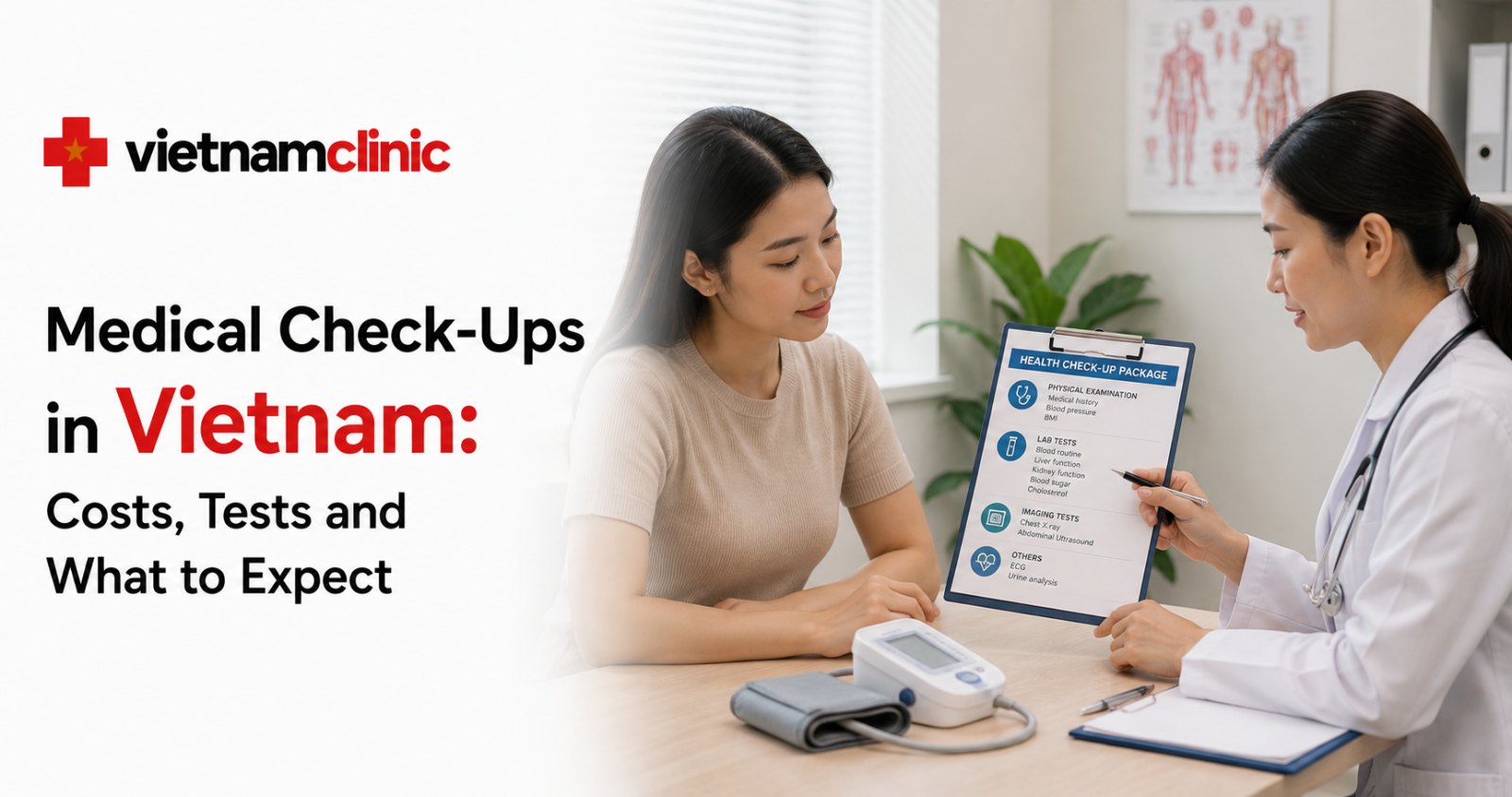
Medical check-ups are widely available in Vietnam, from relatively inexpensive basic health screenings to premium packages involving CT scans, MRI, endoscopy and more extensive cancer screening.
For foreigners, one of the main attractions is price. A straightforward private health screening can cost only a few million Vietnamese dong, while comprehensive programs at international hospitals can reach VND 30 million to VND 50 million or more.
The most expensive package is not automatically the most useful. A good medical check-up should be based on your age, sex, medical history, family history, symptoms and established screening recommendations rather than simply performing as many tests and scans as possible.
How much does a medical check-up cost in Vietnam?
Current published private-sector prices illustrate the range clearly.
CarePlus currently lists general health screening packages for men starting around VND 2.3 million, with progressively broader packages at approximately VND 3.7 million, VND 4.4 million, VND 5.7 million, VND 7.2 million and VND 8.5 million before any temporary discounts.
Vinmec's current international-patient health screening packages are positioned at a higher price level:
| Example package | Current published price |
|---|---|
| CarePlus men's standard screening | VND 2.3 million |
| CarePlus men's Standard Plus | VND 3.7 million |
| CarePlus men's Advanced | VND 4.4 million |
| Vinmec Standard General Health Checkup | VND 6.8 million |
| Vinmec Advanced General Health Checkup | VND 10 million |
| Vinmec Comprehensive General Health Checkup | VND 30 million |
| Vinmec Premium General Health Checkup | VND 50 million |
These are current provider examples, not official average prices for Vietnam.
Prices depend heavily on what is included, and promotional discounts can temporarily reduce advertised costs.
A useful budget is often VND 2 million to VND 10 million
For many healthy adults who want a preventive check-up rather than an intensive diagnostic investigation, this is the most relevant part of the market.
Within roughly VND 2 million to VND 10 million, private providers may combine a doctor examination with selected laboratory testing, imaging and age-appropriate screening.
The package can become much more expensive when it includes procedures such as:
- CT scanning.
- MRI.
- Gastroscopy.
- Colonoscopy.
- Extensive cancer-marker panels.
- Specialist consultations.
- Cardiac imaging.
- Advanced neurological screening.
Before paying for an expensive package, ask what each additional test is intended to detect and whether it is appropriate for your risk profile.
What does a basic medical check-up usually include?
There is no universal package, but common components include:
- General medical consultation.
- Height and weight.
- Body mass index.
- Blood pressure.
- Medical and family history.
- Complete blood count.
- Blood glucose.
- Liver function tests.
- Kidney function tests.
- Lipid profile.
- Urinalysis.
- Chest imaging in some packages.
- Abdominal ultrasound in some packages.
More comprehensive packages can add specialist examinations, cancer screening and advanced imaging.
The first step should still be a doctor, not a laboratory menu
One advantage of a structured medical check-up is that testing can be placed in clinical context.
A doctor may ask about:
- Existing conditions.
- Medications.
- Smoking.
- Alcohol intake.
- Exercise.
- Sleep.
- Weight changes.
- Family history of cardiovascular disease or cancer.
- Previous abnormal test results.
That information can determine whether you need more than a standard package.
For example, someone with a strong family history of premature cardiovascular disease may benefit from a different screening approach from a healthy 25-year-old with no risk factors.
Complete blood count
A complete blood count, often abbreviated CBC, is one of the most commonly included laboratory tests.
It measures components such as:
- Red blood cells.
- Hemoglobin.
- White blood cells.
- Platelets.
Abnormal results can be associated with conditions such as anemia, infection and various blood disorders, but a CBC is not a stand-alone diagnosis.
Slightly abnormal laboratory values often require interpretation alongside symptoms and other tests.
Blood glucose and diabetes screening
Health screening packages frequently include fasting glucose or another assessment related to diabetes risk.
This is particularly relevant for people with risk factors such as:
- Overweight or obesity.
- Family history of diabetes.
- Previous high glucose results.
- High blood pressure.
- Abnormal cholesterol.
More targeted diabetes screening may include additional tests depending on the clinician's assessment.
CarePlus, for example, currently sells a separate diabetes screening package in addition to its general medical check-ups.
Cholesterol and cardiovascular risk
A lipid profile commonly includes measurements such as:
- Total cholesterol.
- LDL cholesterol.
- HDL cholesterol.
- Triglycerides.
These numbers are more useful when interpreted as part of overall cardiovascular risk rather than judged individually.
Age, blood pressure, smoking, diabetes and family history can all influence the significance of a cholesterol result.
Some higher-level Vietnam screening packages add electrocardiography, cardiac ultrasound or CT-based cardiovascular assessment.
Those tests are not necessarily necessary for every asymptomatic adult.
Liver and kidney tests are commonly included
Vietnamese health screening packages often include blood tests related to liver and kidney function.
Examples can include:
- AST.
- ALT.
- Creatinine.
- Urea.
- Other chemistry tests depending on the package.
These can identify abnormalities that deserve further evaluation, particularly in people using long-term medications or living with conditions such as hypertension or diabetes.
An isolated abnormal liver enzyme does not automatically mean serious liver disease, so results should be reviewed by a clinician rather than interpreted from the laboratory's reference range alone.
Abdominal ultrasound is common in Vietnam check-up packages
Abdominal ultrasound is included in many mid-range and comprehensive health screening programs.
It can examine structures including the:
- Liver.
- Gallbladder.
- Kidneys.
- Spleen.
- Bladder.
- Other abdominal organs depending on the examination.
Ultrasound is non-invasive and does not use ionising radiation.
It can detect certain structural abnormalities, although it cannot rule out every abdominal disease.
Chest X-ray, CT or neither?
Some health screening packages include a chest X-ray, while more expensive programs may offer low-dose CT or other chest CT examinations.
These tests should not be treated as interchangeable.
CT provides substantially more anatomical detail but also involves more radiation than a standard chest X-ray.
Vinmec's current Advanced General Health Checkup, for example, allows patients to select from options including low-dose chest CT, a more comprehensive chest CT or a standard PA chest X-ray within the package.
Whether a CT scan is justified depends on factors such as age, smoking history and clinical risk.
More screening is not always better screening
Premium check-up packages can contain a striking number of tests.
That can feel reassuring, but indiscriminate testing has disadvantages.
These can include:
- False-positive results.
- Incidental findings.
- Unnecessary follow-up scans.
- Additional invasive procedures.
- Anxiety.
- Extra cost.
A scan can detect an abnormality that would never have caused illness, while a normal scan cannot guarantee that you are free of every disease.
Ask the doctor which components are appropriate for you rather than assuming that the longest checklist offers the best preventive medicine.
What about cancer screening?
Cancer screening should ideally be matched to age, sex and individual risk.
Vietnamese private hospitals commonly offer screening for cancers such as:
- Colorectal cancer.
- Breast cancer.
- Cervical cancer.
- Liver cancer.
- Prostate cancer.
- Lung cancer.
Vinmec's current Standard check-up includes selected cancer screening, while its more expensive packages progressively add broader cancer assessment and advanced diagnostic options.
CarePlus separately sells breast, cervical and broader cancer-screening packages.
Cancer screening is useful when the chosen test has a reasonable evidence base for the patient's circumstances. Ordering every available tumor marker is not the same thing as evidence-based cancer screening.
Tumor markers need careful interpretation
Some comprehensive packages advertise blood tests commonly described as tumor markers.
These tests can be useful in particular clinical circumstances, but many are not suitable as simple universal cancer-screening tests for healthy people.
Results can be abnormal for non-cancer reasons, while some cancers occur despite normal markers.
If a package contains multiple tumor markers, ask the physician what decision will actually be made based on each result.
Whole-body MRI is available, but it is not a routine requirement
Premium health screening programs in Vietnam increasingly offer advanced imaging.
Vinmec's current Premium General Health Checkup includes whole-body MRI as one possible advanced modality within its package structure.
CarePlus also advertises whole-body MRI services separately.
Whole-body imaging may appeal to people who want extremely extensive screening, but it can reveal incidental findings that require additional investigation.
It should not be viewed as a replacement for evidence-based screening such as appropriate blood pressure checks, cervical screening or colorectal cancer screening.
Men and women may receive different packages
Health screening providers commonly vary packages according to sex and age because some preventive tests are different.
Women's packages may include options such as:
- Gynecological examination.
- Cervical cancer screening.
- Breast ultrasound.
- Mammography depending on age and risk.
Men's packages may include prostate-related assessment in selected age groups or higher-tier programs.
Neither approach should be applied automatically without considering the patient's individual circumstances.
Should you fast before a medical check-up?
Possibly.
Many health-screening packages request fasting because blood tests or abdominal imaging may be affected by recent food intake.
The facility may ask you to avoid food for several hours before the appointment while still allowing plain water.
However, fasting requirements vary according to the tests being performed.
Do not invent your own fasting period. Ask the hospital or clinic when booking.
People with diabetes, pregnancy or medical conditions affected by fasting should obtain individual instructions.
Can you drink water before the check-up?
Often plain water is allowed and may even help with blood collection or certain ultrasound examinations, but the exact instructions depend on the package.
Some abdominal or pelvic ultrasound examinations may require particular preparation, including a full bladder.
The clinic should provide written preparation instructions before your appointment.
Coffee, tea, milk, juice and sweetened beverages should not automatically be treated as equivalent to water when fasting has been requested.
Should you stop your medication?
Do not stop regular prescription medication simply because you have a health check unless the healthcare provider specifically instructs you to do so.
Bring a list of your medicines, including:
- Prescription drugs.
- Vitamins.
- Supplements.
- Hormones.
- Over-the-counter medicines.
Some medicines can influence laboratory results, which makes accurate medication history important.
For more information about obtaining and using medication locally, see Medications in Vietnam: Prescription Rules, Pharmacies and Common Medicines.
What should you bring to the appointment?
Useful items include:
- Passport or identification.
- Previous medical records.
- Previous blood-test results.
- Imaging reports.
- List of medications and supplements.
- Vaccination information where relevant.
- Family medical history if known.
- Insurance information.
If you have previous abnormal tests, bring them even if they were performed outside Vietnam. Comparing trends can be more informative than looking at one isolated result.
How long does a medical check-up take?
A simple screening may be completed within a few hours.
A larger package involving multiple specialists and imaging can take much of the day.
Procedures such as endoscopy can add more time because preparation, sedation and recovery may be involved.
Ask when booking whether:
- All tests are performed on one day.
- Results are available the same day.
- A second doctor consultation is included.
- Any results will arrive later by email or app.
International patients with limited time in Vietnam should confirm this before scheduling flights or onward travel.
Do you receive the results in English?
International hospitals and clinics often provide English-language communication, but this should not be assumed at every healthcare facility.
Ask whether you will receive:
- Laboratory results in English.
- Imaging reports in English.
- A doctor's written summary.
- Digital copies of scans.
This is especially important if you expect to show the results to a doctor in another country later.
Vietnam Clinic's guide to How to Choose an English-Speaking Clinic in Vietnam explains what foreigners should check before booking care.
Hanoi, Ho Chi Minh City or Da Nang: where should you go?
All three cities have private hospitals and clinics offering general health screening.
Ho Chi Minh City
Ho Chi Minh City has the largest private healthcare market and extensive options ranging from outpatient clinics to international hospitals and highly comprehensive screening programs.
Hanoi
Hanoi also offers major private and public hospitals with broad diagnostic services and specialist screening.
Da Nang
Da Nang has fewer providers than the two largest cities but still offers private hospitals and health screening suitable for many expats and travelers.
For broader provider information, see Vietnam Clinic's directories of hospitals in Ho Chi Minh City, hospitals in Hanoi and hospitals in Da Nang.
Medical check-up vs work permit health check
These are not the same thing.
A general medical check-up is designed around preventive health screening and may be customised according to age and risk.
A work permit health check is performed to satisfy employment or immigration-related requirements and follows a more administrative format.
CarePlus currently lists separate work permit health-check packages from approximately VND 2 million for men and VND 2.2 million for women, illustrating that providers treat these as distinct services from their standard preventive screening packages.
If your employer requires a health certificate, tell the clinic specifically that the examination is for a Vietnamese work permit rather than booking a general wellness package.
Is health insurance likely to cover a check-up?
It depends on the policy.
Some premium health insurance plans include annual preventive health screening as a benefit, while other policies cover treatment of illness but exclude routine check-ups.
Employer health plans may also include annual examinations.
Check:
- Annual preventive-care allowance.
- Whether the provider is in-network.
- Whether pre-authorisation is required.
- Whether laboratory and imaging costs are included.
For broader coverage information, see Health Insurance for Foreigners in Vietnam: Costs, Coverage and Options.
How often should you have a medical check-up?
There is no single ideal annual test package for every healthy person.
The appropriate schedule depends on factors including:
- Age.
- Sex.
- Existing medical conditions.
- Family history.
- Previous results.
- Smoking and alcohol use.
- Cardiovascular risk.
- Cancer-screening recommendations.
Some measurements, such as blood pressure, may reasonably be checked periodically, while other tests are only appropriate at particular ages or intervals.
Ask a doctor to recommend a schedule rather than automatically repeating a large commercial package every year.
What if the check-up finds something abnormal?
An abnormal result does not necessarily mean you have a serious disease.
The next step may involve:
- Repeating the test.
- Comparing previous results.
- A specialist consultation.
- More targeted blood tests.
- Imaging.
- Biopsy or another procedure in selected cases.
This follow-up process is one reason it can be useful to choose a provider where you would also be comfortable receiving further care.
A cheap screening package becomes less convenient if every abnormality requires transferring records to another hospital.
When a health check is not the right appointment
A preventive check-up is intended primarily for people who are well or who want structured risk assessment.
If you already have concerning symptoms, book a clinical consultation instead of relying on a generic screening package.
Examples include:
- Chest pain.
- Significant shortness of breath.
- Unexplained bleeding.
- Severe abdominal pain.
- Neurological symptoms.
- Persistent fever.
- Rapid unexplained weight loss.
These symptoms may require targeted diagnostic evaluation rather than routine screening.
If you become acutely ill while in Vietnam, see Sick in Vietnam? What to Do and Where to Get Medical Care.
How to choose the right medical check-up package
A useful approach is to start with your risk profile rather than the price list.
Ask yourself:
- How old am I?
- Do I have existing medical conditions?
- What diseases run in my family?
- When was my last blood pressure, glucose or cholesterol check?
- Am I due for any established cancer screening?
- Do I smoke?
- Am I taking long-term medication?
- Have I had previous abnormal results?
- Do I actually need advanced imaging?
- Will a doctor review the results with me afterward?
Then compare packages based on what they include.
A practical price guide for foreigners
For planning purposes, current private-sector pricing suggests three broad levels.
Basic to standard screening: around VND 2 million to VND 7 million
Suitable for many healthy adults wanting basic clinical examination and laboratory screening.
Advanced screening: around VND 7 million to VND 15 million
Can add broader imaging, specialist assessment or more extensive cancer and cardiovascular screening.
Comprehensive or premium screening: VND 30 million to VND 50 million or more
Can include endoscopy, advanced CT or MRI and extensive screening programs.
These ranges are not official national tariffs. They reflect the current private market and can change according to hospital, city, promotions and individual tests.
Frequently Asked Questions
The answers below cover common questions about medical check-ups in Vietnam. The most appropriate tests depend on age, medical history and individual risk, so a package should not substitute for personalised medical assessment when one is needed.
How much does a medical check-up cost in Vietnam?
Current private-sector packages range widely. Basic general health screening can start around VND 2 million to VND 3 million, while comprehensive international-hospital packages can cost VND 30 million to VND 50 million or more.
What tests are included in a medical check-up in Vietnam?
Common packages may include a doctor consultation, blood pressure, complete blood count, glucose, cholesterol, liver and kidney tests, urinalysis and sometimes abdominal ultrasound or chest imaging. More expensive packages can add cancer screening, CT, MRI or endoscopy.
Do I need to fast before a health check in Vietnam?
Many packages require fasting because certain blood tests and imaging may be affected by food. The exact instructions vary, so confirm the fasting period and whether plain water is allowed with the clinic before your appointment.
How long does a medical check-up take in Vietnam?
A basic check-up may take a few hours. More comprehensive packages involving multiple specialists, imaging or endoscopy can take most of the day and may require later follow-up for some results.
Can foreigners get medical check-ups in Vietnam?
Yes. Private hospitals and clinics routinely provide health screening to foreigners, particularly in Ho Chi Minh City, Hanoi and Da Nang. International providers may also offer English-language results and support.
Is a work permit health check the same as a general medical check-up?
No. A work permit health examination is designed to meet administrative requirements for employment, while a general health check-up focuses on preventive screening. Tell the provider which type of examination you need.
Are comprehensive health check-ups worth it?
They can be useful for selected people, but more tests are not automatically better. Extensive imaging and laboratory panels can produce false positives or incidental findings. Screening should ideally be matched to age, medical history and individual risk.
Does health insurance cover medical check-ups in Vietnam?
Some private and employer insurance plans include annual preventive screening, while others exclude routine check-ups. Check the preventive-care allowance, provider network and pre-authorisation requirements in your policy.
Conclusion
Medical check-ups in Vietnam can be relatively affordable, particularly for foreigners accustomed to private healthcare prices in Western countries.
Current private clinic packages start at around VND 2 million to VND 3 million, while international-hospital screening can range from around VND 6.8 million for a standard package to VND 50 million for premium programs involving much more extensive diagnostics.
For most healthy adults, the best check-up is not necessarily the package containing the most blood tests and scans. Start with a medical consultation, choose screening appropriate to your age and risk factors, and make sure a doctor will interpret the results rather than simply handing you a folder of numbers.
Sources

Writer
Tan Nguyen
Medical writer for Vietnam Clinic. MD, Vietnam National University Ho Chi Minh City.