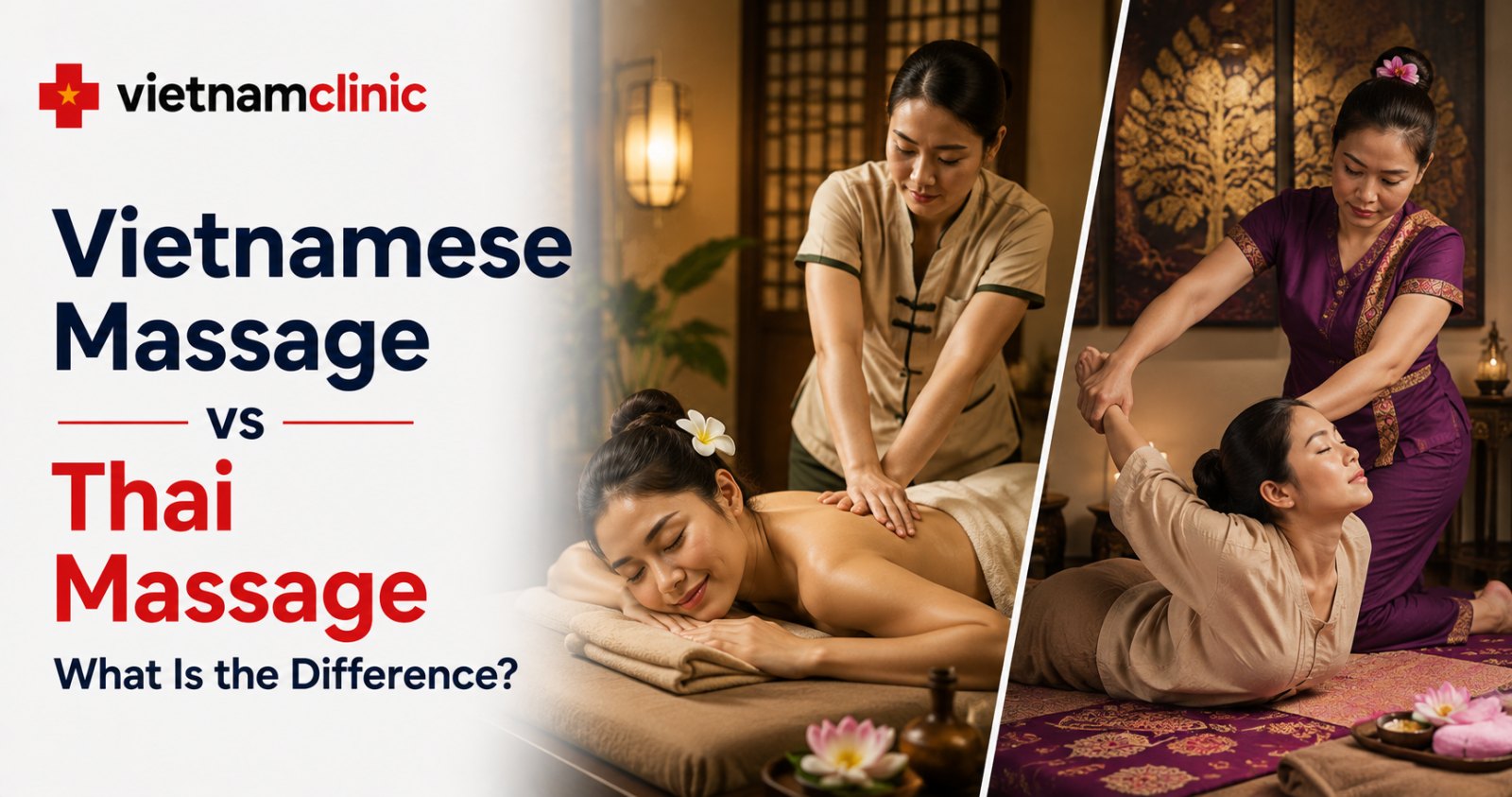
Vietnamese massage and Thai massage are both widely available in Southeast Asia, but they are not the same experience. Traditional Thai massage is a clearly defined system with a strong emphasis on assisted stretching and body manipulation, while the term Vietnamese massage can describe a broader range of local massage styles offered by spas and wellness centres in Vietnam.
For travellers choosing between them, the most noticeable differences are usually how much stretching is involved, whether oil is used, how much clothing you keep on and how active the treatment feels.
This guide compares Vietnamese massage vs Thai massage in practical terms so you know what to expect before booking.
Vietnamese massage vs Thai massage at a glance
The simplest distinction is that traditional Thai massage generally involves more assisted movement and stretching, while many Vietnamese massage treatments place greater emphasis on direct pressure, kneading and relaxation.
Typical differences include:
| Feature | Vietnamese massage | Traditional Thai massage |
|---|---|---|
| Main focus | Muscle relaxation, pressure and kneading | Compression, manipulation and assisted stretching |
| Stretching | Usually limited to moderate | Often a major part of the session |
| Oil | Frequently used in spa-style treatments | Traditionally little or no oil |
| Clothing | Depends on treatment | Usually performed while clothed |
| Treatment surface | Usually massage table | Traditionally a mat or firm surface |
| Intensity | Can range from gentle to strong | Often physically active and firm |
| Therapist movement | Mostly massage techniques | Hands, thumbs, elbows, knees and body positioning may be used |
| Overall feel | Often closer to a relaxing body massage | Often described as a combination of massage and assisted stretching |
These are general patterns rather than fixed rules. Spa menus use massage names inconsistently, particularly outside formal traditional medicine settings. Always read the treatment description or ask what the therapist will actually do.
What is Vietnamese massage?
There is no single internationally standardised treatment represented by the English phrase "Vietnamese massage". In Vietnam, the term can be used for treatments influenced by local massage traditions, acupressure, conventional spa massage and other forms of Asian bodywork.
A typical Vietnamese body massage may involve:
- Palm and finger pressure
- Kneading of muscles
- Circular movements
- Pressure along areas of muscular tension
- Some use of elbows or forearms
- Gentle joint movement
- Limited stretching
- Oil or balm, depending on the treatment
Some spas offer a dry traditional-style massage, while others describe an oil-based full-body treatment as Vietnamese massage. This variation means the treatment description is usually more useful than the name alone.
Treatments may also incorporate local wellness practices such as herbal compresses, warming balms or foot treatments, although these are not universal features of Vietnamese massage.
What is traditional Thai massage?
Traditional Thai massage, known as Nuad Thai, has a much more clearly documented traditional framework.
UNESCO added Nuad Thai to the Representative List of the Intangible Cultural Heritage of Humanity in 2019. UNESCO describes it as part of traditional Thai healthcare and explains that practitioners use bodily manipulation to work with the body's structure and traditional concepts of energy pathways known as sen.
A traditional Thai massage typically involves:
- Rhythmic compression
- Pressure with hands and thumbs
- Use of elbows, forearms, knees or feet in some techniques
- Joint mobilisation
- Assisted stretching
- Movement of the body into different positions
Sessions are traditionally performed on a mat or firm surface while the client wears loose clothing.
Unlike a conventional oil massage, the therapist may move your arms and legs repeatedly during the session. This is why Thai massage is sometimes compared informally with passive or assisted yoga, although it remains a distinct massage tradition.
The biggest difference: stretching
Stretching is probably the clearest difference when comparing Vietnamese massage vs Thai massage.
Traditional Thai massage commonly includes significant assisted stretching. A therapist may move your legs, rotate your hips, stretch your shoulders or position your body in ways that involve several muscle groups at once.
A Vietnamese spa massage may include some stretches, but they are generally less central to the treatment. More time may instead be spent directly manipulating muscles with the hands, fingers, palms, forearms or elbows.
If you enjoy mobility work and a physically active treatment, Thai massage may feel more distinctive.
If you primarily want muscle work without extensive stretching, a Vietnamese massage or conventional oil massage may be more comfortable. Travellers can compare highly rated providers in our guides to the best massage places in Ho Chi Minh City and the best massage places in Hanoi.
Which massage uses more pressure?
Both can be strong.
The idea that Thai massage is always stronger than Vietnamese massage is too simplistic. Intensity depends heavily on the therapist, treatment style and what you request.
Thai massage can feel intense because pressure is combined with stretching and joint movement. Vietnamese massage can also involve strong pressure, particularly when elbows or concentrated acupressure techniques are used.
When booking, it is more useful to ask for:
- Light pressure
- Medium pressure
- Firm pressure
Tell the therapist during the session if pressure becomes painful. More pressure is not automatically more therapeutic.
Does Vietnamese massage use oil?
Often, but not always.
Many Vietnamese spas offer massage treatments using oil, balm or lotion. This allows longer gliding movements over the back, legs and shoulders and usually creates a more conventional relaxation massage experience.
However, some treatments marketed as traditional Vietnamese massage are performed largely without oil.
If oil matters to you, check before booking. This is especially important if you have sensitive skin or allergies to fragrances, essential oils or herbal ingredients.
Does Thai massage use oil?
Traditional Nuad Thai is normally performed without massage oil and while the client is clothed.
However, spas in both Thailand and Vietnam also offer products labelled "Thai oil massage". That is a different spa treatment combining elements of Thai massage with oil-based techniques.
If you specifically want traditional Thai massage, look for descriptions such as:
- Traditional Thai massage
- Nuad Thai
- Thai traditional massage
Then confirm whether the treatment is dry and performed in loose clothing.
What do you wear during each massage?
For traditional Thai massage, clients usually remain clothed. Spas often provide loose trousers and a top that allow the therapist to move the body comfortably.
For oil-based Vietnamese massage, clients normally remove some clothing and are covered with towels or sheets, similar to other full-body oil massages.
Dry Vietnamese massage may be performed partly or fully clothed depending on the establishment.
Professional providers should explain clothing and draping arrangements before treatment. You can also ask which areas of the body will be treated and request that an area be avoided.
Which one is more relaxing?
If your definition of relaxing is lying relatively still while a therapist works directly on your muscles, Vietnamese oil massage may feel more relaxing.
Traditional Thai massage can certainly leave people feeling relaxed afterwards, but the session itself is often more active. You may be moved repeatedly between positions and experience substantial stretching.
Your preference matters more than the label.
Choose a Vietnamese or oil-based massage if you prefer:
- A quieter, more passive session
- Long massage strokes
- Oil or balm
- Less stretching
- Direct muscle work
Consider traditional Thai massage if you prefer:
- Assisted stretching
- Joint movement
- Firm compression
- A dry massage
- Remaining clothed
- A more active treatment
Which is better for tight muscles?
Neither style is automatically better for everyone.
Massage can temporarily help some people with muscle tension, soreness or relaxation, but the evidence varies depending on the condition and type of massage. The US National Center for Complementary and Integrative Health notes that massage has been studied for several pain conditions, but benefits may be short term and research quality varies.
If your goal is general muscle relaxation, either style may be reasonable depending on your preferences.
If you have persistent pain, weakness, numbness, significant swelling or an injury, a massage should not replace appropriate medical assessment.
Is Thai massage more physically demanding?
Usually, yes.
Traditional Thai massage commonly involves larger ranges of movement than a typical Vietnamese spa massage. The therapist may flex and extend your limbs, rotate joints or use body weight to apply pressure.
This can feel very comfortable for some people and too intense for others.
Tell the practitioner beforehand if you have limited mobility or any history of:
- Back problems
- Neck problems
- Joint injuries
- Recent surgery
- Osteoporosis
- Fractures
- Significant cardiovascular disease
- Pregnancy
The treatment can then be modified or avoided when appropriate.
Are massages safe?
Massage therapy is generally considered low risk when performed appropriately by a trained practitioner, but it is not completely risk-free.
The US National Center for Complementary and Integrative Health notes that rare serious adverse events have included nerve injury, fractures and blood clots. Some reported cases involved vigorous massage or people who already had factors increasing their risk of injury.
Extra caution may be appropriate if you have a recent injury, significant osteoporosis, a bleeding disorder, take anticoagulant medication or have another medical condition that could make strong pressure or stretching unsafe.
If you are uncertain whether massage is appropriate because of a health condition, ask a qualified healthcare professional rather than relying on the spa to diagnose the problem.
If you are visiting central Vietnam, our guide to the best massage places in Da Nang offers another useful shortlist.\n\n## What should you ask before booking a massage in Vietnam?
Massage menus in Vietnam can contain several similar terms, and the same treatment name may mean different things at different spas.
Before booking, ask:
- Is the massage performed with oil or without oil?
- Do I remain clothed?
- Does it include assisted stretching?
- How strong is the pressure?
- How long is the treatment?
- Is the treatment full body?
- Can I request a male or female therapist?
- Can specific areas be avoided?
- Are herbal balms or essential oils used?
- What is the complete price?
You should also be able to stop the treatment or ask the therapist to change pressure at any point.
Vietnamese massage, Thai massage or Swedish massage?
Travellers in Vietnam may also see Swedish massage on spa menus.
The three treatments usually differ in broad style:
Vietnamese massage
Often combines direct muscle pressure, kneading and local spa techniques. Oil use varies considerably.
Thai massage
Traditionally dry and clothed, with substantial compression, movement and assisted stretching.
Swedish massage
Typically uses oil or lotion with long gliding strokes and kneading. It usually involves considerably less assisted stretching than Thai massage.
Spa menus sometimes blend these techniques, so names should be treated as descriptions rather than guarantees of a standardised protocol.
Which massage should you choose in Vietnam?
Choose according to the experience you want rather than assuming one national style is inherently better.
If you want a relaxing oil treatment with direct work on tired muscles, a Vietnamese-style body massage may be a good starting point. If you want stronger compression, extensive stretching and a more active session while remaining clothed, traditional Thai massage is likely to be closer to what you are looking for.
The most important practical step is to ask the spa what the treatment actually includes. Vietnamese massage in particular can vary considerably between establishments, while traditional Nuad Thai has a more clearly defined heritage and treatment framework.
If you have an injury, severe pain or a medical condition that could make massage unsafe, seek appropriate medical advice before booking a vigorous treatment.
Frequently Asked Questions
What is the main difference between Vietnamese massage and Thai massage?
Thai massage generally places much more emphasis on assisted stretching, compression and body movement. Vietnamese massage varies more between providers but commonly focuses on direct muscle pressure, kneading and relaxation, sometimes using oil.
Is Vietnamese massage similar to Thai massage?
There can be overlap in pressure techniques and the use of hands, elbows or forearms, but the overall experience is usually different. Traditional Thai massage generally involves more stretching and joint movement.
Does Vietnamese massage use oil?
Many Vietnamese spa massages use oil or balm, but not all of them do. Because the term Vietnamese massage is used for different treatment styles, confirm whether the session is oil-based before booking.
Do you keep your clothes on for Thai massage?
Traditional Thai massage is usually performed while wearing loose clothing and without oil. Some spas also offer Thai oil massage, which is a different treatment and may require different clothing and draping.
Which is stronger, Vietnamese massage or Thai massage?
Either can be strong depending on the therapist and requested pressure. Thai massage may feel more intense because firm compression is often combined with assisted stretching and joint movement.
Is Thai massage safe if I have back or joint problems?
It depends on the condition and the techniques used. Vigorous massage and stretching may not be appropriate for some injuries or medical conditions, so discuss significant back, joint or bone problems with a healthcare professional and tell the practitioner before treatment.
Sources

Writer
Tan Nguyen
Medical writer for Vietnam Clinic. MD, Vietnam National University Ho Chi Minh City.