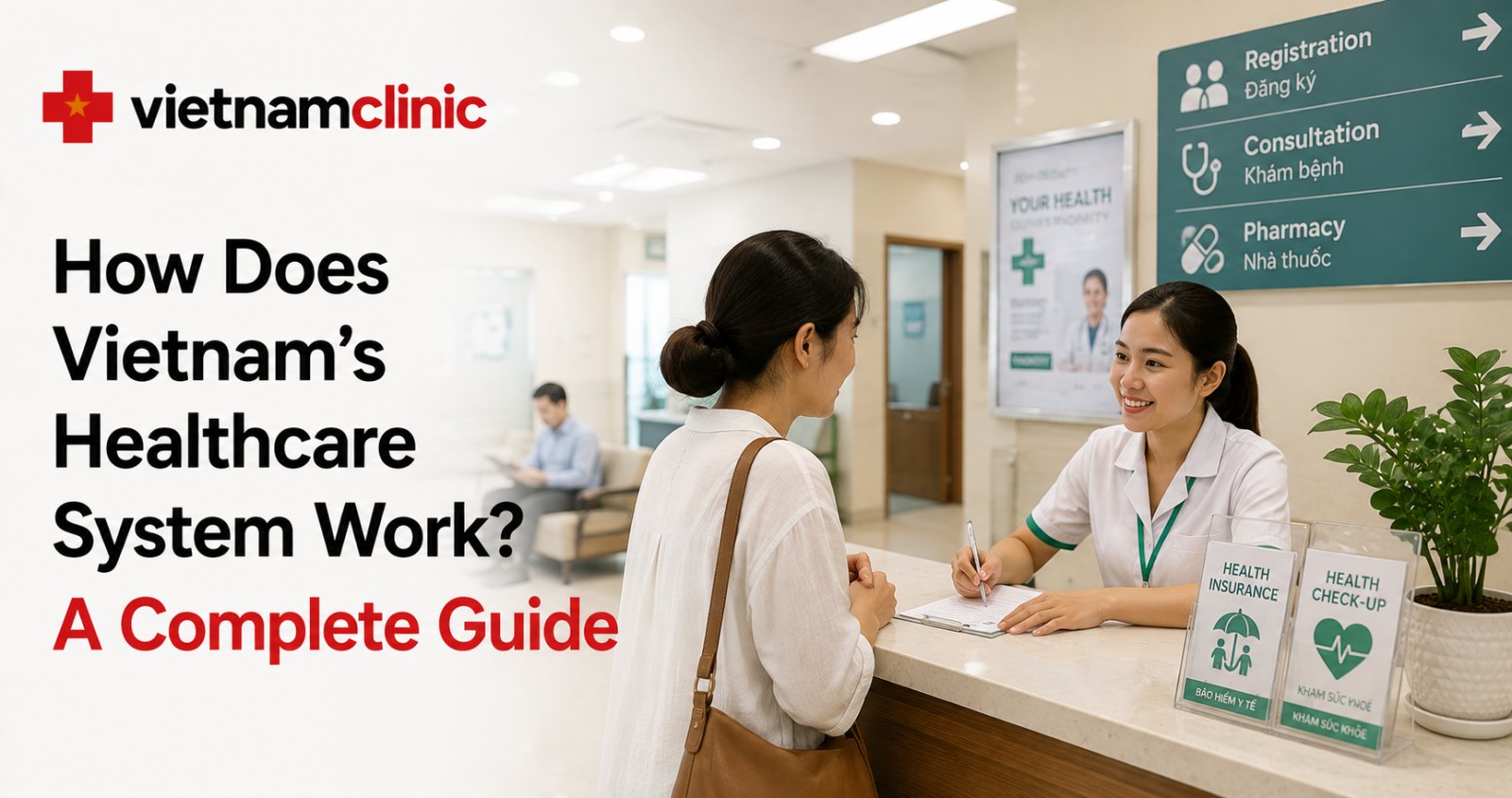
Vietnam's healthcare system combines public providers, social health insurance, private clinics and hospitals, and community health services. There is no single route that every patient must follow. The practical path depends on the service needed, where it is available, whether statutory or private insurance applies, and what the provider currently offers.
The way facilities are administered is also changing. Viet Nam's two-tier local-government model took effect on 1 July 2025, as Vietnam Social Security reported. The Ministry of Health issued guidance on reorganising parts of the health network. A facility may keep its location and patients while its name, supervising authority, service area or referral arrangements change. Check the current facility page and insurance information before travelling, especially when a page still uses an older district-level name.
How is the healthcare network organized?
The system includes commune and ward health stations, area health centres, general and specialist hospitals, private practices, diagnostic services and pharmacies. These are useful descriptions of provider roles, but they do not form one fixed ladder that every patient must climb.
Commune and ward health stations
Commune and ward health stations are part of the grassroots network. Their work includes preventive and public-health services and may include first-contact consultations, vaccination, maternal and child health, and follow-up for some ongoing conditions. The exact staffing, hours, medicines, tests and treatment available vary by station. Contact the station or local health authority to confirm what it can provide and whether an appointment or insurance registration is needed.
The Ministry of Health's guidance for the two-tier local-government model says existing commune and ward stations should generally be maintained and transferred to the new commune-level authority, with at least one station for each new commune or ward. It also directs provincial health departments to support stations with staff, clinical guidance, medicines and equipment. This describes the transition framework; it does not guarantee the same service list at every location. Read the WHO–Ministry of Health review of Viet Nam's commune health system alongside the Government's guidance on reorganising health facilities.
Area health centres and former district facilities
Before the local-government transition, many areas had district health centres and district general hospitals. The Ministry's guidance generally retains existing district hospitals and reorganises them as regional general hospitals serving residents across several communes or wards. It also guides provinces to reorganise district health centres as regional health centres under the provincial Department of Health; some may be merged or otherwise changed after local review.
These changes affect administration and service areas, not necessarily the building or the care people can receive there. A regional hospital may offer outpatient and inpatient services, diagnostics, emergency care or common procedures, but its current scope depends on that hospital. Health centres may support public-health work and local stations. Check the current name, address, department and service list instead of assuming that every former district facility has the same role.
Provincial, city, central and specialist hospitals
Provincial and city hospitals provide hospital-based outpatient, inpatient and specialist services, with capacity that varies by facility. Central and national hospitals, as well as designated specialist hospitals, provide some services that may not be available locally and can receive referred or complex cases. A hospital's name or old administrative category alone does not establish its current technical level or whether a particular service is offered there.
For planned care, contact the exact department to ask whether it provides the service, how patients are registered, whether a referral is needed for your insurance route, and what records to bring. A hospital may offer some specialties on site but refer other services elsewhere.
Private hospitals, clinics and diagnostic providers
Private providers range from single-specialty practices and outpatient clinics to general hospitals and diagnostic centres. The service list, opening hours, languages offered, insurance networks, payment methods and appointment process differ by provider. Some facilities market to international patients, but that does not mean every clinician or department is available in English or that an insurer will cover every visit.
Private care is not automatically more suitable, and public care is not automatically less capable. Compare the specific service, clinician, location, current appointment options, written cost information and payment route that matter for your situation. For a starting list, see general medical clinics in Vietnam; the comparison is not a substitute for checking a provider directly.
Clinical service levels are not the old administrative map
Current health-insurance rules align with three professional and technical service levels: initial, basic and specialized care. These describe the service level of a registered facility. They are not interchangeable with the old labels of commune, district, province and central, and the same administrative label does not tell you every service a facility provides.
The 2024 amended Health Insurance Law took effect on 1 July 2025. Vietnam Social Security explains that the law removed some administrative-boundary limits: a participant may receive covered care at a registered primary-care facility nationwide under the benefit rules, and transfer between facilities is no longer based only on the old administrative ladder. The law also allows direct access to specialized care for certain listed conditions or services without a referral document. These are statutory health-insurance rules, not a promise that every facility offers every treatment or that every bill is fully paid. The exact entitlement depends on the person's insurance status, the facility's registration and technical level, the service, and current implementing rules. See Vietnam Social Security's explanation of the amended law and the official text of Law 51/2024/QH15.
If you use statutory health insurance, check the facility listed for your initial registration, the current facility level, and whether a referral or pre-approval is needed for the planned service. Ask the provider or Vietnam Social Security how the current rule applies to your case before a non-urgent, higher-cost visit. Do not infer coverage solely from a hospital's former district, provincial or central name.
How public and private care differ in practice
Public and private facilities both provide care in Viet Nam. Foreign residents and travellers can seek care at public or private providers; you do not have to use a facility branded as international simply because you are not Vietnamese. Before going, ask the facility how to register a foreign patient, which identification it accepts, what payment it requires, and whether it can provide the service you need.
Practical arrangements can differ: a provider may require in-person registration, accept online appointments, request a referral, or have separate processes for insured and self-paying patients. Communication support also varies by facility, clinician, department and appointment time. Ask who will conduct the consultation and whether an interpreter or English-language records are available; do not assume that a hospital or clinic's English website guarantees English support for every visit. For a focused checklist, read how to choose an English-speaking clinic in Vietnam.
Vietnam's social health insurance system is designed for eligible participants, but coverage is not the same as free care for every patient or service. WHO reported in December 2025 that social health insurance covered about 95% of the population. That national figure does not determine an individual's eligibility, benefit level, provider choice or out-of-pocket amount. Co-payments, non-covered services and expenses outside the policy can remain. See WHO's December 2025 update on universal health coverage.
Some foreign employees working for a Vietnam-based employer must participate in compulsory social and health insurance when they sign a labour contract for a full 12 months or longer, according to Vietnam Social Security's current employee guidance. Eligibility depends on the applicable rules and the person's circumstances. Ask the employer and Vietnam Social Security to confirm your status; do not assume that a tourist, retiree, remote worker or other foreign resident is automatically covered by statutory health insurance. Employer, private and travel policies are separate contracts with their own scope and exclusions.
Finding care in Ho Chi Minh City, Hanoi and Da Nang
Ho Chi Minh City and Hanoi have central and specialist hospitals alongside city hospitals, private hospitals, clinics and diagnostic providers. Da Nang serves as a major care centre for central Viet Nam and also has public and private providers. The Government's national health-network plan for 2021–2030 includes facilities and services that serve across provincial and regional areas, but a plan does not confirm a service's current opening, appointment availability or suitability for an individual patient.
Use the city pages as directories to identify facilities, then verify the current service and patient arrangements with the provider: Ho Chi Minh City hospitals, Hanoi hospitals, and Da Nang hospitals. A listing is a starting point, not an endorsement or guarantee of capacity. If you live outside a major city or need ongoing specialist care, identify a nearby provider for routine needs and ask the treating team whether another location is needed for a particular service.
Referrals, registration and reimbursement
A referral may have different meanings in a provider's own booking process, statutory health insurance and a private insurance contract. A clinic may accept a direct appointment while an insurer separately requires prior authorisation or a referral. Conversely, a patient's health-insurance benefits may depend on the registered facility and route specified by current rules even when the hospital will accept a self-paying patient.
Before planned care, ask three separate questions: whether the provider will book you directly; whether statutory insurance requires a particular registration, referral or transfer; and whether your private insurer requires a referral or pre-authorisation. Save the answer, the provider's estimate and any approval. If the provider says a referral is needed, ask who must issue it and what documents to bring. If you have a health-insurance card, confirm how the facility will process that card before tests or treatment begin.
Appointments and public-hospital logistics
Booking and registration vary between facilities. Some providers offer online booking or telephone appointments; others direct patients to an in-person registration desk. A large or specialist hospital may have separate queues, forms or payment steps for different departments. Check the current provider instructions before you travel and allow time for registration; do not rely on an old address, opening time or administrative name.
For a non-urgent visit, confirm:
- The exact facility, entrance, department and appointment time.
- Whether you need an appointment, referral, health-insurance card or prior authorisation.
- Which identification the provider accepts and whether it needs copies of earlier reports.
- Who will see you and what language or interpreter support is available.
- The consultation price and whether diagnostic tests or medicines are separate charges.
- Whether the provider can issue the records, receipts or itemised bill required by your insurer.
- How and when results and follow-up arrangements will be provided.
Bring identification accepted by the facility, any relevant health-insurance or private-insurance details, previous reports you choose to share, and a list of current medicines and known allergies. Keep copies of prescriptions and reports. What to check before a medical appointment in Vietnam has a fuller preparation checklist.
What healthcare can cost
There is no single price for healthcare in Vietnam. The amount depends on the facility, service, clinician, location, insurance route and what is needed during the visit. A consultation price alone may not include diagnostic tests, medicines, supplies, procedures, facility fees or follow-up.
A hospital or clinic bill may separate charges for:
- Consultation or specialist fees.
- Laboratory tests and pathology.
- Imaging or other diagnostic procedures.
- Medicines, medical supplies and equipment.
- Procedures, surgery, anaesthesia and associated services.
- Emergency, inpatient, room or accommodation charges.
- Follow-up visits, reports or additional treatment.
For planned treatment, request an itemised estimate and ask which items are provisional, which are excluded, what could change the total, whether a deposit is required, and how payment is handled. If you have statutory health insurance, ask which parts the facility will submit and what copayment or non-covered amount may remain. If you use private insurance, confirm network status, approval and direct-billing terms with both the provider and insurer. An estimate is not a guaranteed final bill; for an emergency, seek urgent care rather than delaying treatment to compare prices.
Private insurance and paying a bill
Private health insurance does not follow one universal rule. Policies differ in provider networks, outpatient and inpatient benefits, geographical scope, deductibles, copayments, annual or per-condition limits, exclusions, waiting periods and reimbursement documents. Some plans arrange direct billing with selected facilities for eligible services; others require the patient to pay first and submit a claim. A card or provider logo alone does not guarantee cashless treatment.
Before a planned visit, check whether your exact policy and facility are in network, whether the specific department or service is eligible, whether written pre-authorisation or referral is required, and what you must pay yourself. Ask how to proceed outside the network or during an emergency. If you pay first and claim later, ask the insurer which forms, invoices and medical records it needs, whether originals or translations are required, the submission deadline, and how reimbursement is paid. Keep written approvals, itemised bills, receipts, prescriptions and reports. For a broader comparison checklist, see how to choose health insurance in Vietnam.
Pharmacies and medicines
Pharmacies are common in cities and towns, from independent outlets to national chains. They can dispense medicines and other products under local rules, but buying a product at a pharmacy is not a substitute for assessment when symptoms are severe, persistent or unexplained. Product names and brands can differ from those used elsewhere; the generic name and strength of a prescribed medicine can help avoid confusion. Follow the label and instructions given by the treating professional, and ask a qualified clinician or pharmacist when you are unsure about a medicine.
If you bring medicines into Viet Nam, check the current customs requirements before travelling, especially for controlled or psychotropic medicines. Rules may depend on the medicine, quantity, documentation and length of stay. See customs rules for prescription medications in Vietnam and verify current requirements with the relevant authorities; do not rely on a pharmacy or an old travel account for import permission.
Strengths, challenges and differences in access
Viet Nam has expanded social health insurance, maintains a nationwide grassroots network and has public hospitals, specialist services and private providers. WHO and the Ministry of Health's 2025 review of the commune health system describes it as a key part of current reform and examines service delivery, financing and governance. WHO's country overview also identifies the need to improve hospitals' integration with primary care and address system-level issues such as cost escalation and monitoring. These are system-wide observations, not a judgment about every facility.
Access and service availability differ by location and specialty. A service available at one city hospital may not be offered at a local station or another hospital, and language, appointment and payment arrangements are not uniform. Major urban centres offer a wider mix of providers, while people outside them may need to plan how to reach a particular specialty. Ask providers about the service itself rather than relying on a general label such as public, private, international or central.
Planning routine and chronic care
If you live in Viet Nam, identify a nearby provider for routine visits and find out how to contact it, book appointments, pay and obtain records. If you need recurring follow-up or a specialist, ask whether the same facility can provide it, how referrals or insurance registration work, and how prescriptions and results will be managed when you travel. Availability and continuity depend on the provider and policy; confirm the details for your care.
Keep copies of your current prescriptions, prior reports, insurance information and a medicine list in a place you can access. If changing cities or providers, ask the clinician for the records or summary you need to continue care. For a visitor, check before travel what your policy requires, how to contact its assistance service, and whether you must arrange approval before planned treatment. These steps help you prepare; they do not replace advice from the clinician responsible for your care.
What to do in an emergency
Vietnam's ambulance and medical emergency number is 115. For a serious or rapidly worsening emergency, seek urgent local medical care and do not wait for a routine appointment, insurer response or online comparison. UK government guidance says emergency calls are handled in Vietnamese; if someone who can help communicate is immediately available, ask them to assist without delaying care. Confirmed emergency arrangements and language support vary by provider. For non-emergency care, contact the exact facility first and follow its current registration instructions.
The practical next step is to identify a nearby routine-care option, understand which insurance route applies to you, and know where to seek urgent help. Use the hospital and clinic pages linked above to build a shortlist, then confirm services, access and costs directly with the provider.
Frequently Asked Questions
Does Vietnam have public healthcare?
Yes. Viet Nam's public network includes commune and ward health stations; regional health centres and regional general hospitals reorganised from many former district facilities; provincial and city hospitals; and central and specialist hospitals. Under the two-tier local-government reorganisation, facility names, supervision and service areas may change, so confirm each provider's current status and services. Private clinics and hospitals also operate alongside the public network.
Is healthcare free in Vietnam?
Healthcare is not universally free at the point of use. Social health insurance pays eligible costs for insured patients according to applicable rules, but co-payments and other out-of-pocket expenses can still occur.
Can foreigners use hospitals in Vietnam?
Yes. Foreign residents and travellers can contact public and private hospitals. Ask the specific facility about registration, available services, payment and insurance requirements. English-language support and insurance arrangements vary by provider, department and visit; fees also vary by facility and service, so confirm them directly. For practical checks, see [how to choose an English-speaking clinic in Vietnam](https://vietnamclinic.com/blog/how-to-choose-english-speaking-clinic-vietnam) and [how to choose health insurance in Vietnam](https://vietnamclinic.com/blog/how-to-choose-health-insurance-vietnam).
Do foreigners get Vietnamese health insurance?
Some foreign employees working in Vietnam under qualifying employment contracts are included in compulsory health insurance. Tourists and many other foreign residents are not automatically covered and commonly use travel, employer or private health insurance.
Which Vietnamese cities have the most healthcare options?
Ho Chi Minh City and Hanoi have the broadest concentration of major hospitals and specialist services. Da Nang is an important healthcare centre for central Vietnam and also has a substantial mix of public and private providers.
What is the emergency medical number in Vietnam?
The medical emergency and ambulance number in Vietnam is 115. For potentially life-threatening symptoms, seek urgent medical care rather than waiting for a routine appointment.
Sources
- World Health Organization: Hospitals in Viet Nam
- World Bank: Bringing Quality Healthcare Services Closer to Disadvantaged Communities in Vietnam
- World Bank: Trends and Differentials in Household Out-of-Pocket Health Spending in Viet Nam
- Government of Viet Nam: Master Plan on Healthcare Network
- UK Government: Vietnam Health Advice
- Government of Viet Nam: Official Dispatch 92/CĐ-TTg on implementing the two-tier local government model from 1 July 2025
- Government of Viet Nam, Ministry of Health: Guidance on reorganising health facilities under the two-tier local-government model

Writer
Tan Nguyen
Medical writer
Medical writer for Vietnam Clinic. MD, Vietnam National University Ho Chi Minh City.
View profile
Medical review
John Maitland
Medical reviewer
Medical reviewer for Vietnam Clinic. MD, University of Pennsylvania.
View profile