Allergy testing is available in Vietnam through allergy and clinical immunology services, hospitals and diagnostic laboratories. Depending on the symptoms and suspected trigger, a doctor may recommend a skin prick test, specific IgE blood testing, patch testing or a supervised challenge test.
The right test depends on what type of allergy is being investigated. A large blood panel is not automatically more useful than a carefully selected skin test, and a positive laboratory result does not by itself prove that a particular food, medicine or environmental substance is causing symptoms.
Costs also vary considerably. Published 2026 Vietnamese hospital tariffs show skin prick testing from about 500,000 VND for some respiratory allergen testing, while broader skin panels and specific IgE blood profiles can cost from around 1 million VND to several million VND.
How much does allergy testing cost in Vietnam?
There is no single national allergy-testing price. Hospitals charge differently according to the method, number of allergens and laboratory platform used.
Current published examples give a useful indication of the range.
| Allergy test | Published price example |
|---|---|
| Respiratory allergen skin prick test at Vinmec Times City | 500,000 VND |
| Skin prick test for up to 10 respiratory or food allergens at Vinmec Times City | 1,000,000 VND |
| Skin prick test for more than 10 respiratory or food allergens at Vinmec Times City | 2,000,000 VND |
| RIDA allergy screening panel at Vinmec Nha Trang | 1,540,000 VND |
| 60-allergen blood panel at MEDLATEC | 1,660,000 VND in a published package |
| House dust mite allergy profile at Vinmec Grand Park | 2,100,000 VND |
| Milk allergy profile at Vinmec Grand Park | 2,100,000 VND |
| Individual specific IgE tests at some Vinmec hospitals | Around 700,000 to 1,100,000 VND each |
These are published examples rather than fixed national prices. Consultation charges may be separate, and prices vary between Vinmec hospitals and other providers.
For comparison with other laboratory services, see Blood test cost in Vietnam.
What is a skin prick test?
A skin prick test looks for an immediate allergic response to selected substances.
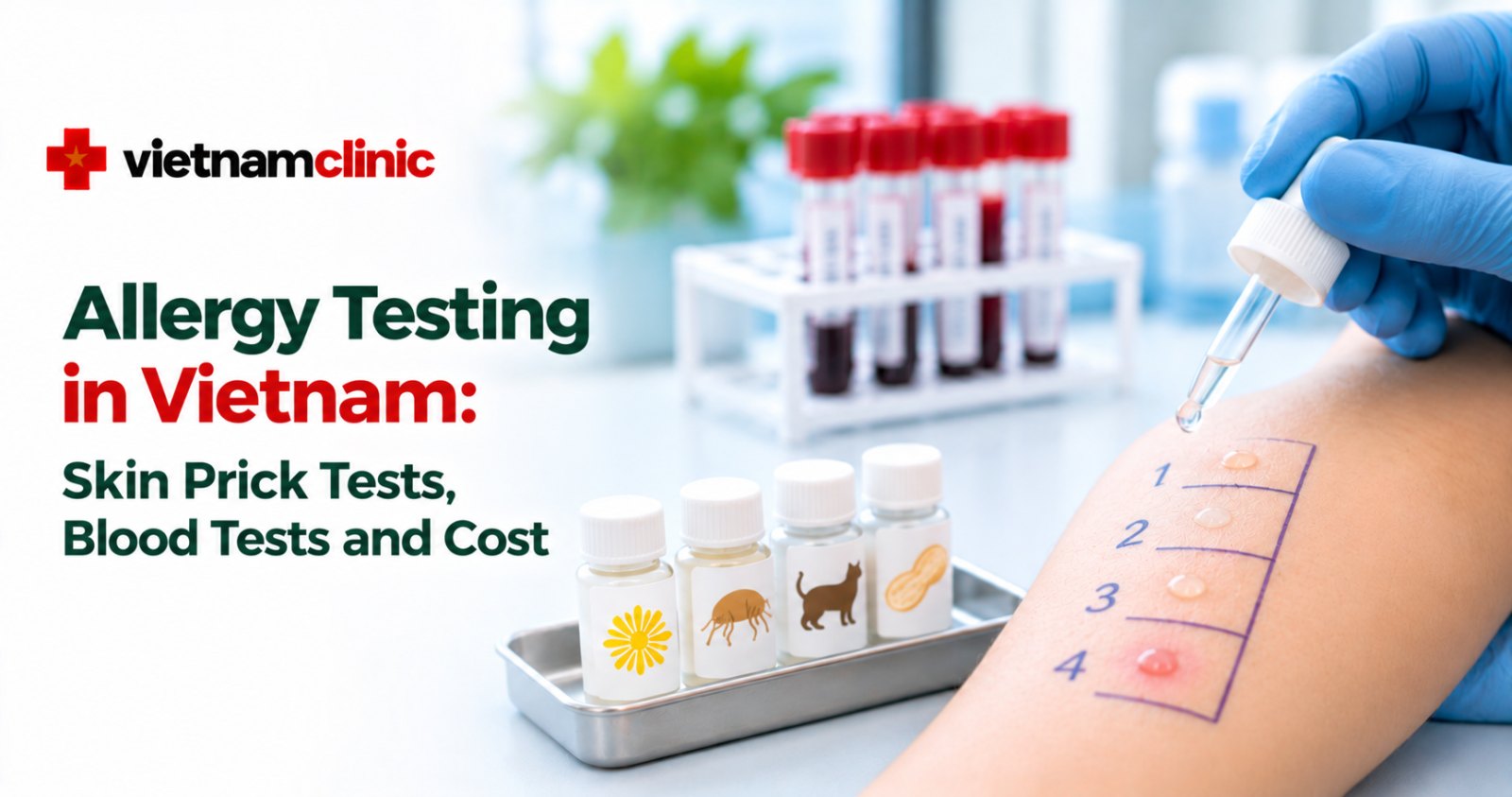
A small amount of allergen extract is placed on the skin, usually on the forearm or back, and the skin is lightly pricked through the drop. The test is then observed for a local reaction such as a raised, itchy wheal.
Skin prick testing can be used for suspected allergies to substances such as:
- House dust mites
- Pollens
- Animal allergens
- Moulds
- Selected foods
The test is usually interpreted together with positive and negative controls so that the clinician can judge whether the skin reacted normally.
A positive result means that sensitisation may be present. It does not automatically mean that exposure to that allergen explains the patient's symptoms.
How much does a skin prick test cost in Vietnam?
Vinmec Times City publishes several 2026 skin prick test prices.
| Skin prick test | Published price |
|---|---|
| Specific respiratory allergen prick test | 500,000 VND |
| Respiratory or food allergens, up to 10 | 1,000,000 VND |
| Respiratory or food allergens, more than 10 | 2,000,000 VND |
Vinmec Smart City also lists skin prick testing for up to 10 respiratory or food allergens at 1,000,000 VND.
The total appointment can cost more if a specialist consultation is required before testing.
What is a specific IgE blood test?
A specific IgE blood test measures immunoglobulin E antibodies directed against a particular allergen or group of allergens.
Unlike skin prick testing, it requires a blood sample rather than placing allergen extracts on the skin.
Specific IgE testing can be useful when the clinical history suggests an immediate-type allergy and the clinician wants laboratory evidence of sensitisation.
Vietnamese laboratories offer both individual allergen tests and broader panels.
Examples found in published hospital tariffs include tests for:
- Dust mites
- Milk proteins
- Egg proteins
- Peanut and soybean
- Shrimp
- Selected antibiotics
- Insect venom
- Pollens and moulds
The useful test is the one that matches the clinical history. Testing dozens of unrelated allergens can produce results that are difficult to interpret and may identify sensitisation that has no practical clinical relevance.
How much do allergy blood tests cost?
Prices depend heavily on whether one allergen or an entire panel is tested.
Vinmec Hai Phong publishes individual specific IgE tests for several allergens at approximately 700,000 to 1,100,000 VND each. Its published profiles include:
| Blood allergy test | Published price |
|---|---|
| Specific IgE to milk component | 740,000 VND |
| Specific IgE to egg component | 740,000 VND |
| Specific IgE to dust mite d1 or d2 | 950,000 VND |
| Specific IgE to dust mite d201 | 1,100,000 VND |
| House dust mite profile | 3,000,000 VND |
| Milk allergy profile | 2,800,000 VND |
| Egg allergy profile | 3,000,000 VND |
Prices differ between Vinmec locations. Vinmec Grand Park, for example, publishes its house dust mite, milk and egg profiles at 2,100,000 VND each.
This is why the exact hospital and test code should be confirmed before comparing prices.
What about large allergy panels?
Large blood panels test multiple allergens from one blood sample.
MEDLATEC's 2026 laboratory catalogue includes a 60-allergen panel, and one current MEDLATEC package lists that panel at 1,660,000 VND.
Vinmec hospitals also publish RIDA allergy screening panels. Vinmec Nha Trang currently lists RIDA Allergy Screen Panel 1 and Panel 4 at 1,540,000 VND each.
A large panel can appear attractive because it provides many results at once, but more testing is not always better.
An allergist usually gets the most useful information by starting with the symptoms, timing and suspected exposure, then selecting tests that can answer a specific question.
Total IgE is different from specific IgE
A total IgE result and a specific IgE allergy test are not interchangeable.
Total IgE measures the overall amount of IgE in the blood. It may be elevated in people with allergic conditions, but it can also be influenced by other factors and does not identify the allergen responsible for symptoms.
Specific IgE measures antibodies directed against a defined allergen, such as house dust mite, milk or egg.
MEDLATEC currently lists total IgE at 212,000 VND within one published health package. That relatively low price should not be confused with the cost of a comprehensive allergy panel.
Skin prick test or blood test: which is better?
There is no universal winner.
The American Academy of Allergy, Asthma & Immunology notes that skin testing, interpreted together with the medical history and examination, is a rapid and cost-effective way to investigate many allergies. Blood testing is useful in other situations and can be chosen when skin testing is unsuitable.
| Skin prick testing | Specific IgE blood testing |
|---|---|
| Result usually available during the visit | Requires laboratory processing |
| Tests the skin response directly | Uses a blood sample |
| Can test several allergens at once | Can test individual allergens or panels |
| Some medicines can affect skin responses | Less affected by medicines that suppress skin reactions |
| Requires suitable skin for testing | Can be useful when skin testing is difficult |
The clinician should decide which method fits the suspected allergy rather than ordering both automatically.
What is a patch test?
Patch testing investigates delayed contact allergy, which is different from the immediate IgE-mediated reactions evaluated by a typical skin prick test.
It may be considered when a clinician suspects allergic contact dermatitis caused by substances such as metals, preservatives, fragrances or ingredients in topical products.
Vinmec Can Tho publishes patch testing for drugs or cosmetics at approximately 825,000 VND in part of its service tariff, with other listed patch-test services at 1.1 million VND.
Patch testing normally requires the test materials to remain on the skin for an extended period before interpretation, so it is not an instant test like a skin prick test.
For people with persistent eczema-type symptoms, Atopic dermatitis in Vietnam explains another common cause of chronic inflamed or itchy skin.
What is an allergy challenge test?
A challenge test involves controlled exposure to a suspected allergen under medical supervision.
For suspected food allergy, an oral food challenge may be used when the history and other tests do not provide a sufficiently clear answer.
This should not be attempted at home because a significant allergic reaction can occur.
Vinmec Times City publishes a milk challenge test at 2,000,000 VND in its 2026 tariff.
Challenge testing is generally more resource-intensive than a blood test because the patient must be observed while increasing amounts of the suspected allergen are administered according to a medical protocol.
Drug allergy testing in Vietnam
Drug allergy requires particular care because the testing method varies by medicine and by the type of previous reaction.
Vietnamese hospitals publish services including:
- Skin prick tests for some drugs or vaccines
- Intradermal testing
- Patch testing for selected delayed reactions
- Specific IgE tests for selected medicines
Vinmec Hai Phong, for example, publishes specific IgE testing for penicillin G, penicillin V, amoxicillin and cefaclor at around 700,000 VND per allergen.
Tam Anh General Hospital notes that suspected local anaesthetic allergy may be assessed with skin prick and intradermal testing under controlled medical conditions.
Drug allergy evaluation should be based on the exact medicine, timing and symptoms of the previous reaction. A generic allergy panel cannot reliably answer every drug-allergy question.
Where can you get allergy testing in Vietnam?
Several types of providers offer allergy testing.
Allergy and clinical immunology services
Specialist allergy services are useful when symptoms are recurrent, severe or difficult to interpret.
Vinmec Times City in Hanoi operates a Center for Allergy and Clinical Immunology and publishes skin prick testing among its services.
Tam Anh General Hospital also publishes information from its allergy and clinical immunology services on skin testing, specific IgE testing and challenge procedures.
Diagnostic laboratories
Large laboratory networks such as MEDLATEC offer blood-based allergy testing and multi-allergen panels.
Blood testing may be particularly convenient when a doctor has already identified the allergens that need investigation.
If you are unfamiliar with the difference between private hospitals, laboratories and other healthcare facilities, see How hospitals work in Vietnam.
Allergy testing in Hanoi
Hanoi has several hospital and laboratory options.
Vinmec Times City has specialist allergy and clinical immunology services and publishes skin prick tests for respiratory and food allergens. MEDLATEC also operates a large diagnostic laboratory network in Hanoi and offers allergy blood testing.
Ask whether the appointment should begin with an allergist consultation or whether an existing referral can be used to book laboratory testing directly.
Allergy testing in Ho Chi Minh City
Ho Chi Minh City has allergy testing through large hospitals, specialist services and diagnostic laboratories.
Vinmec Grand Park publishes several specific IgE allergy profiles, while Tam Anh Hospital Ho Chi Minh City provides allergy and clinical immunology services and describes skin prick and blood testing among its diagnostic methods.
Availability varies by location, so confirm the exact allergen and test before travelling to the hospital.
Can foreigners get allergy tests in Vietnam?
Yes. International residents and travellers can use private hospitals and laboratories and pay directly for testing.
English-language support is more likely at international hospitals, but it varies between departments and individual staff members.
When booking, it is useful to say whether you need:
- A specialist allergy consultation
- Skin prick testing
- A specific IgE blood test
- A broad allergy panel
- Drug allergy assessment
- Patch testing
This prevents an appointment being booked with a service that does not perform the required test.
Do you need a referral?
Policies vary by facility.
Some laboratories can perform requested blood tests directly, but consulting a doctor first can avoid unnecessary panels and improve interpretation.
This is particularly important for suspected food or drug allergies because a laboratory result does not replace the clinical history.
How should you prepare for allergy testing?
Preparation depends on the test.
For skin testing, tell the clinic about all prescription and non-prescription medicines you take. Some medicines can interfere with the skin response, so the clinic may give specific instructions before the test.
Do not stop prescribed medication without checking with the clinician who is arranging the assessment.
Blood-based specific IgE testing generally does not rely on the same skin response, so preparation can differ.
Ask the hospital for its instructions when booking rather than applying preparation rules from another clinic.
How are allergy test results interpreted?
A positive test does not necessarily mean that an allergen causes clinically important symptoms.
The result has to be interpreted alongside questions such as:
- What symptoms occurred?
- How soon after exposure did they begin?
- Has the reaction happened repeatedly?
- How much exposure was required?
- Does avoiding the suspected trigger prevent symptoms?
This is particularly important with food testing. Detectable specific IgE can indicate sensitisation without proving that eating the food will cause a clinically significant reaction.
Do not remove multiple foods from the diet solely because a broad panel contains positive results without discussing their significance with an appropriate clinician.
Be cautious with IgG food intolerance tests
IgG testing should not be confused with established specific IgE testing for immediate allergy.
The American Academy of Allergy, Asthma & Immunology advises against using food-specific IgG tests to diagnose food allergy or food intolerance. IgG responses can reflect exposure to foods rather than disease.
If a provider markets a very large food intolerance panel, ask exactly which antibody is being measured and what clinical guideline supports its use.
What if you have a severe allergic reaction?
Testing is not the priority during an acute severe reaction.
Difficulty breathing, swelling of the tongue or throat, collapse, severe dizziness or a rapidly progressing systemic reaction can indicate anaphylaxis and requires immediate emergency medical care.
Do not travel across a city for an outpatient allergy test while a severe reaction is occurring. Go to an appropriate emergency department or call local emergency services.
Does insurance cover allergy testing?
Coverage depends on the insurer, medical indication and facility.
International private insurance may cover medically necessary specialist assessment and diagnostic testing but exclude broad screening panels requested without a clinical indication.
Before a planned assessment, ask:
- Whether an allergy specialist is covered
- Whether laboratory tests need pre-authorisation
- Whether skin testing is covered
- Whether the hospital offers direct billing
- Whether you will need an itemised invoice for reimbursement
Keep the doctor's referral or clinical notes if you intend to submit a claim.
What should you ask before booking?
Before attending a clinic or laboratory, confirm:
- Which allergy test is being recommended?
- How many allergens are included?
- Is the specialist consultation charged separately?
- What is the full current price?
- Do any medicines need to be adjusted before skin testing?
- How long will results take?
- Will a doctor interpret the results with you?
- Is English-language support available if needed?
The cheapest panel is not necessarily the most useful. A targeted assessment based on the clinical history often provides clearer information than testing a very large number of unrelated allergens.
What to remember
Allergy testing is widely available in Vietnam, with skin prick testing and specific IgE blood tests among the main methods used for immediate allergic reactions.
Current published private-hospital prices range from about 500,000 VND for some skin prick testing to several million VND for larger skin or blood allergy profiles. Broad blood panels can cost around 1.5 million to several million VND depending on the laboratory and allergens included.
Before booking, identify what question you are trying to answer. A specialist consultation can help determine whether skin testing, targeted specific IgE testing, patch testing or a supervised challenge is actually appropriate. Confirm current prices and test availability directly with the provider because hospital tariffs and laboratory panels can change.
Frequently Asked Questions
How much does an allergy test cost in Vietnam?
Costs vary by method and number of allergens. Current published examples range from around 500,000 VND for some skin prick tests to 1 to 2 million VND for broader skin testing, while specific IgE blood profiles can cost several million VND.
How much does a skin prick test cost in Vietnam?
Vinmec Times City currently lists respiratory allergen skin prick testing at 500,000 VND, testing for up to 10 respiratory or food allergens at 1 million VND, and testing for more than 10 allergens at 2 million VND.
How much does an allergy blood test cost in Vietnam?
The price depends on whether a single specific IgE or a larger panel is ordered. Published examples include individual specific IgE tests around 700,000 to 1.1 million VND and multi-allergen screening panels around 1.5 million VND or more.
Which is better, a skin prick test or a blood allergy test?
Neither test is best for every situation. Skin prick testing is rapid and useful for many immediate allergies, while specific IgE blood testing can be preferable when skin testing is unsuitable. The result should always be interpreted alongside the patient's symptoms and exposure history.
Can foreigners get allergy testing in Vietnam?
Yes. Private hospitals, specialist allergy services and diagnostic laboratories accept foreign residents and travellers. Confirm the exact test, price and English-language support with the provider before attending.
Are food IgG tests reliable for diagnosing food allergy?
Major allergy organisations such as the AAAAI do not recommend food-specific IgG testing to diagnose food allergy or intolerance. Established allergy assessment relies on the clinical history together with appropriate methods such as skin prick testing, specific IgE testing or supervised challenge when indicated.
Sources

Writer
Tan Nguyen
Medical writer
Medical writer for Vietnam Clinic. MD, Vietnam National University Ho Chi Minh City.
View profile
Medical review
John Maitland
Medical reviewer
Medical reviewer for Vietnam Clinic. MD, University of Pennsylvania.
View profile