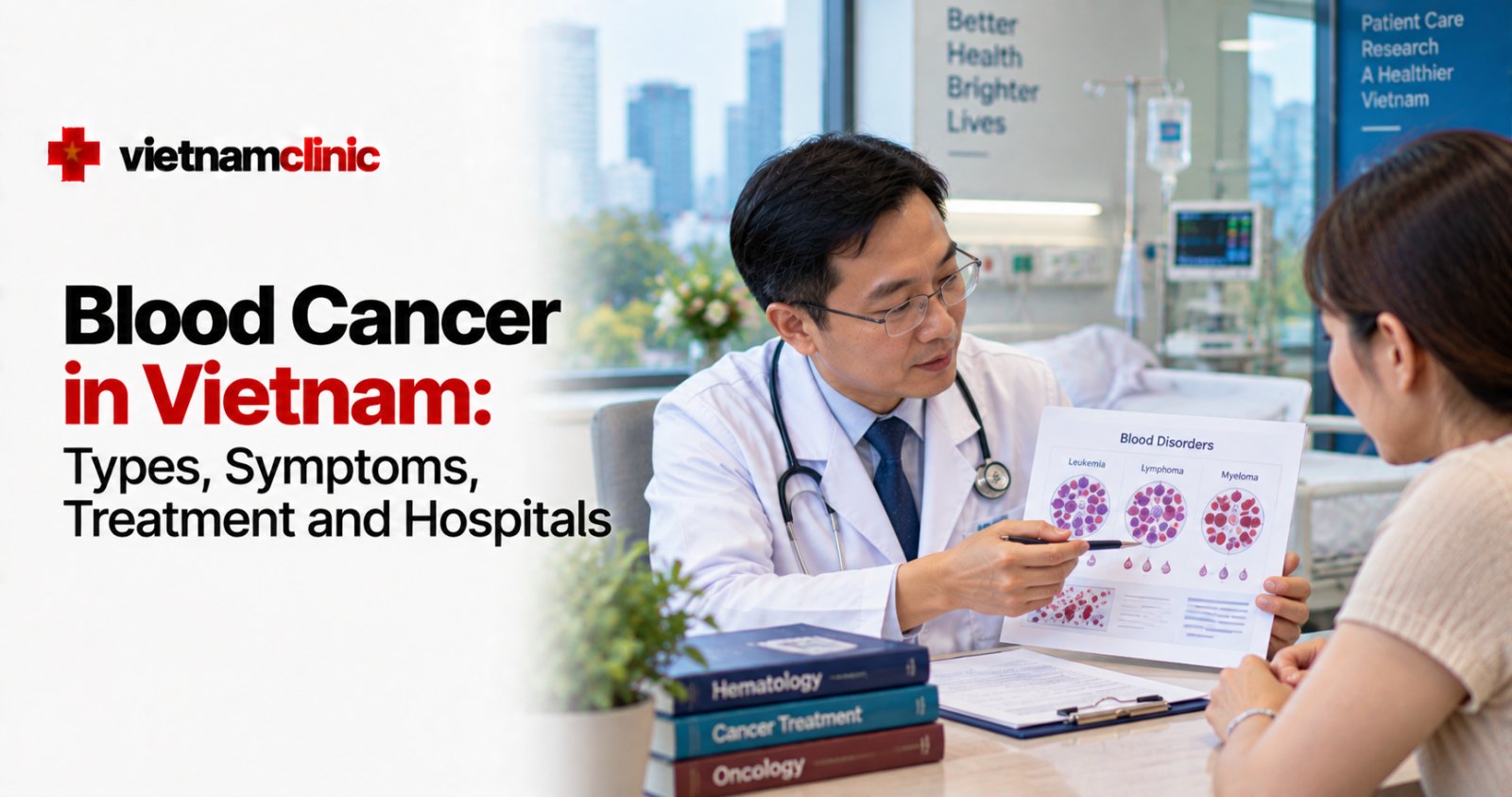
Blood cancer in Vietnam is diagnosed and treated through specialist hematology and oncology services in major cities including Hanoi and Ho Chi Minh City. The term blood cancer covers several different diseases, most commonly leukemia, lymphoma and multiple myeloma, and treatment depends heavily on the exact diagnosis, subtype, age and overall health of the patient.
Vietnam has specialist institutions dedicated to blood diseases, including the National Institute of Hematology and Blood Transfusion in Hanoi and the Ho Chi Minh City Hospital of Hematology and Blood Transfusion. Private hospital groups also provide hematology and oncology services, while some advanced treatments such as hematopoietic stem cell transplantation are available at specialized centers.
Anyone with persistent symptoms such as unexplained fatigue, repeated infections, unusual bruising or bleeding, swollen lymph nodes or unexplained weight loss should seek medical assessment. These symptoms have many possible causes and do not automatically mean blood cancer.
What is blood cancer?
Blood cancer is a broad term for cancers affecting blood cells, bone marrow or the lymphatic system.
The three major groups are:
- Leukemia
- Lymphoma
- Multiple myeloma
These are not a single disease. Each group contains several subtypes that behave differently and require different treatment approaches.
In Vietnamese, blood cancer is commonly called ung thư máu, while leukemia may also be described as bệnh bạch cầu or leukemia.
Main types of blood cancer in Vietnam
Leukemia
Leukemia affects blood-forming tissues, particularly bone marrow.
Major categories include:
- Acute lymphoblastic leukemia (ALL)
- Acute myeloid leukemia (AML)
- Chronic lymphocytic leukemia (CLL)
- Chronic myeloid leukemia (CML)
Acute leukemia can progress quickly and usually requires prompt specialist treatment.
Vietnamese medical sources describe acute leukemia as involving abnormal proliferation of immature blood cells in the bone marrow, which can interfere with normal production of red blood cells, platelets and healthy white blood cells.
Lymphoma
Lymphoma develops in cells of the lymphatic system.
The two broad groups are:
- Hodgkin lymphoma
- Non-Hodgkin lymphoma
There are many subtypes within these categories, and treatment varies substantially depending on the pathology.
Multiple myeloma
Multiple myeloma affects plasma cells, a type of white blood cell produced in the bone marrow.
It can affect multiple parts of the body and may cause problems involving:
- Bones
- Kidneys
- Blood cell production
- Calcium levels
- Immune function
Specialist hematology assessment is required to diagnose and classify the disease accurately.
How common is cancer in Vietnam?
Cancer represents a major health burden in Vietnam.
According to GLOBOCAN 2022, the International Agency for Research on Cancer estimated approximately 180,480 new cancer cases and 120,184 cancer deaths in Vietnam in 2022.
These figures cover all cancers rather than blood cancers alone. Breast, liver, lung, colorectal and stomach cancers represented the most frequently diagnosed cancers overall.
Blood cancers account for a smaller proportion of the national cancer burden but remain an important area of specialist care.
For a broader overview of oncology services, see Cancer Treatment in Vietnam: Hospitals, Costs and What to Expect.
What are the symptoms of blood cancer?
Symptoms depend on the disease and its stage.
Possible signs include:
- Persistent fatigue
- Weakness
- Pale skin
- Repeated infections
- Fever without a clear explanation
- Easy bruising
- Unusual bleeding
- Nosebleeds
- Tiny red or purple spots on the skin
- Swollen lymph nodes
- Bone or joint pain
- Night sweats
- Unexplained weight loss
- Reduced appetite
- Abdominal fullness
These symptoms are not specific to blood cancer.
For example, fatigue or abnormal blood counts can also result from infection, nutritional deficiencies, medication or many other medical conditions.
A doctor needs to interpret symptoms together with blood tests and other investigations.
When should you see a doctor?
Arrange medical assessment if symptoms are persistent, unexplained or worsening.
More urgent evaluation may be appropriate if you develop:
- Heavy or unexplained bleeding
- Severe weakness
- Shortness of breath
- High fever with significant illness
- Signs of serious infection
- Neurological symptoms
Patients already receiving chemotherapy or other blood cancer treatment should follow the emergency instructions given by their hematology team, particularly if they develop fever or signs of infection.
How is blood cancer diagnosed in Vietnam?
Diagnosis normally begins with a medical history, examination and blood testing.
Depending on the suspected disease, investigations can include:
- Complete blood count
- Peripheral blood smear
- Bone marrow aspiration
- Bone marrow biopsy
- Flow cytometry
- Immunophenotyping
- Cytogenetic testing
- Molecular tests
- Lymph node biopsy
- CT scans
- PET/CT
- Kidney and liver function tests
- Protein studies for suspected multiple myeloma
Not every patient requires every test.
Modern blood cancer treatment increasingly depends on identifying the specific biological and molecular characteristics of the cancer rather than simply identifying it as leukemia or lymphoma.
What does an abnormal blood count mean?
An abnormal complete blood count can be one of the first reasons a doctor suspects a hematological disorder.
Possible findings include:
- Low red blood cells or anemia
- Low platelets
- Very high or very low white blood cell counts
- Abnormal immature cells
However, abnormal blood counts occur in many non-cancerous conditions as well.
A blood test alone usually cannot establish the exact diagnosis of blood cancer.
Further hematology testing may be necessary.
Blood cancer treatment in Vietnam
Treatment depends on the precise type and subtype of cancer.
Options available in Vietnam can include:
- Chemotherapy
- Targeted therapy
- Immunotherapy
- Corticosteroids
- Radiotherapy for selected lymphomas
- Blood and platelet transfusions
- Antibiotic and infection management
- Hematopoietic stem cell transplantation
- Supportive care
Some patients require only one treatment modality, while others receive several treatments in sequence or combination.
Treatment decisions should be made by a hematology or oncology team based on the diagnosis rather than by choosing a treatment independently.
Chemotherapy for blood cancer in Vietnam
Chemotherapy remains an important treatment for many leukemias and lymphomas.
Patients with acute leukemia can require intensive treatment and prolonged hospital admission because chemotherapy can temporarily suppress normal bone marrow function.
During this period, patients may need:
- Blood transfusions
- Platelet transfusions
- Antibiotics
- Antifungal medication
- Infection monitoring
- Isolation precautions
The exact treatment schedule differs greatly between diseases.
Targeted therapy
Targeted medicines act on specific biological abnormalities in cancer cells.
They have changed the treatment of several blood cancers, particularly some forms of leukemia and lymphoma.
Whether targeted therapy is appropriate depends on laboratory and molecular testing.
The presence of a particular mutation or biological marker can influence the drugs a hematologist recommends.
Immunotherapy for blood cancer
Immunotherapy uses or modifies the immune system to attack malignant cells.
Different forms of immunotherapy are used internationally for lymphoma, leukemia and multiple myeloma.
Availability in Vietnam depends on the specific drug, hospital, diagnosis and clinical situation.
Patients should ask the treating hematologist which therapies are actually available for their subtype rather than assuming every treatment used internationally is routinely accessible locally.
CAR-T therapy in Vietnam
Vietnam has also begun developing CAR-T cell therapy capabilities.
Vinmec reported what the President of the Vietnam Society of Hematology and Blood Transfusion described as Vietnam's first successfully treated leukemia case using CAR-T cell therapy. The patient was a child with acute lymphoblastic leukemia who had not responded adequately to conventional treatment.
CAR-T is an advanced form of cellular immunotherapy and is not a standard treatment for every patient with blood cancer.
Eligibility depends on the disease, previous treatments, clinical status and availability at specialized centers.
Stem cell transplant for blood cancer in Vietnam
Hematopoietic stem cell transplantation is established in several specialist centers in Vietnam.
The National Institute of Hematology and Blood Transfusion in Hanoi performs both autologous and allogeneic hematopoietic stem cell transplantation.
According to the Institute, transplantation may be used for malignant blood disorders including:
- Acute myeloid leukemia
- Acute lymphoblastic leukemia
- Chronic myeloid leukemia
- Hodgkin lymphoma
- Non-Hodgkin lymphoma
- Multiple myeloma
- Myelodysplastic syndromes
The appropriate transplant type depends on the disease.
Autologous stem cell transplant
In an autologous transplant, the patient's own stem cells are collected and later returned after intensive treatment.
This approach can be used for diseases including multiple myeloma and some lymphomas.
Allogeneic stem cell transplant
An allogeneic transplant uses stem cells from another person.
This may be a matched relative, unrelated donor or another donor strategy depending on the transplant program.
Allogeneic transplantation can be used for selected leukemias and other serious hematological diseases.
Stem cell transplantation is an intensive treatment with potentially serious complications and requires specialist assessment.
Where is blood cancer treated in Vietnam?
Patients should look for a hospital with a dedicated hematology or hematologic oncology service rather than simply choosing a general clinic.
Major options include specialist public institutions and private hospitals.
National Institute of Hematology and Blood Transfusion in Hanoi
The National Institute of Hematology and Blood Transfusion (NIHBT) is one of Vietnam's principal specialist institutions for hematological diseases.
Its services include diagnosis and treatment of blood disorders and hematopoietic stem cell transplantation.
The Institute lists its main address as 5 Pham Van Bach Street, Cau Giay, Hanoi.
For complex leukemia, lymphoma, multiple myeloma or transplant assessment, a national hematology center can be an important referral option.
Ho Chi Minh City Hospital of Hematology and Blood Transfusion
The Ho Chi Minh City Hospital of Hematology and Blood Transfusion is a specialist public hospital for blood diseases in southern Vietnam.
Vietnam's Ministry of Health hospital database identifies it as a public hospital in Ho Chi Minh City, and the hospital's current official website lists its main treatment facility at 1 Tran Huu Nghiep, Tan Nhut, Ho Chi Minh City.
The institution provides specialist hematology services and has experience with stem cell transplantation.
Vinmec
Vinmec provides oncology and hematology-related services at selected hospitals.
Its oncology program describes multidisciplinary cancer diagnosis and treatment using laboratory testing, imaging, pathology and molecular biology.
Vinmec has also reported performing stem cell transplantation and developing cellular therapies for selected blood cancers.
Patients should confirm which specific Vinmec hospital treats their particular hematological cancer because services differ between facilities.
Blood cancer treatment in Hanoi
Hanoi has some of Vietnam's most specialized hematology services.
The National Institute of Hematology and Blood Transfusion is particularly relevant for patients who need:
- Complex leukemia assessment
- Lymphoma treatment
- Multiple myeloma care
- Specialized laboratory testing
- Stem cell transplant evaluation
Other large public and private hospitals in Hanoi also provide oncology and hematology care.
Patients coming from abroad should contact the hospital before travelling and ask what documentation is required for an appointment.
Blood cancer treatment in Ho Chi Minh City
Ho Chi Minh City also has advanced hematology services.
The Hospital of Hematology and Blood Transfusion is a specialist institution serving patients with blood diseases and is particularly relevant for complicated hematological cancers.
Large general hospitals and private hospital groups may also diagnose or treat certain blood cancers.
For highly specialized treatment, patients should confirm whether the hospital has a dedicated hematology team and whether the required diagnostic and treatment technology is available at that specific facility.
Can foreigners receive blood cancer treatment in Vietnam?
Yes. Foreigners can seek cancer care in Vietnam.
However, blood cancer treatment can be complex and may last for months, so international patients should plan carefully.
Before travelling, ask the hospital about:
- Whether it treats the exact diagnosis
- Availability of a hematologist
- Pathology review
- Required laboratory testing
- Whether previous biopsy material can be reviewed
- Estimated treatment schedule
- Estimated costs
- Admission procedures
- Language support
- Payment requirements
- Insurance arrangements
Do not assume that every hospital has a dedicated international department or English-speaking hematology team.
What medical records should you bring?
Patients transferring treatment to Vietnam should bring as much of their previous medical record as possible.
Useful documentation includes:
- Pathology report
- Bone marrow report
- Flow cytometry results
- Cytogenetic results
- Molecular testing
- CT or PET/CT images
- Blood test history
- Previous chemotherapy protocols
- Medication list
- Transplant records
- Details of previous complications
Whenever possible, bring original reports and digital imaging files rather than only a short summary.
The Vietnamese hematology team may still repeat some tests before starting treatment.
Can blood cancer be cured?
Some blood cancers can be cured, while others are treated as long-term diseases.
The prognosis varies enormously according to:
- Exact cancer type
- Molecular subtype
- Patient age
- Overall health
- Stage or disease burden
- Response to initial treatment
- Availability of targeted treatment
- Eligibility for stem cell transplantation
It is therefore misleading to give one cure rate for all forms of blood cancer.
A child with acute lymphoblastic leukemia, an adult with acute myeloid leukemia and an older patient with multiple myeloma have very different diseases and treatment expectations.
Is blood cancer treatment improving in Vietnam?
Vietnamese hematology centers continue to expand advanced treatment capabilities.
The National Institute of Hematology and Blood Transfusion has established stem cell transplantation programs, while more hospitals are developing transplantation capacity.
In August 2026, the Institute reported supporting Phu Tho General Hospital in successfully performing its first autologous stem cell transplant for a patient with high-risk multiple myeloma.
Vinmec has also reported progress in cellular immunotherapy, including CAR-T treatment for selected leukemia patients.
These developments do not mean every advanced therapy is available everywhere in Vietnam. Highly specialized treatments remain concentrated in selected institutions.
How much does blood cancer treatment cost in Vietnam?
There is no single price for blood cancer treatment.
Costs depend on:
- Diagnosis
- Type of chemotherapy
- Number of treatment cycles
- Length of hospital admission
- Targeted medicines
- Immunotherapy
- Blood transfusions
- Infection treatment
- Diagnostic testing
- Stem cell transplantation
- Private versus public hospital
- Insurance status
Treatment of a chronic leukemia controlled with outpatient medication can have a completely different cost structure from intensive treatment for acute leukemia or a stem cell transplant.
Patients should request an individualized estimate from the treating hospital after the diagnosis and treatment plan have been established.
If you are comparing how medical care is financed locally, see How Does Vietnam's Healthcare System Work? A Complete Guide.
Does health insurance cover blood cancer treatment in Vietnam?
Coverage depends entirely on the insurance policy.
Important questions include:
- Is cancer treatment included?
- Is the cancer considered a pre-existing condition?
- What is the annual medical limit?
- Are chemotherapy drugs covered?
- Are targeted medicines covered?
- Is stem cell transplantation covered?
- Are outpatient medicines included?
- Does the policy cover private hospitals?
- Is preauthorization required?
International patients should obtain written confirmation from the insurer before beginning expensive planned treatment whenever possible.
Can someone travel to Vietnam specifically for blood cancer treatment?
It is possible, but the decision requires more planning than most forms of medical tourism.
Blood cancer treatment can involve prolonged periods of immune suppression, frequent blood tests, hospital admissions and urgent management of complications.
Patients should consider:
- Continuity of care
- Access to emergency hematology services
- Availability of blood products
- Accommodation near the hospital
- Infection risks
- Visa duration
- Insurance
- Follow-up after returning home
A patient undergoing intensive leukemia treatment or stem cell transplantation may need to remain close to the treating hospital for an extended period.
For a broader overview of treatment as an international patient, see A Tourist's Guide to Medical Care in Vietnam.
What should you ask a hematologist in Vietnam?
Useful questions include:
- What exact type and subtype of blood cancer do I have?
- Do my pathology or bone marrow samples need to be reviewed again?
- Are molecular or genetic tests needed?
- What treatment do you recommend and why?
- Is treatment intended to cure the disease or control it?
- Will I need to remain in hospital?
- What are the main treatment risks?
- Could I require a stem cell transplant?
- Is a suitable donor search necessary?
- Which treatments are available at this hospital?
- What happens if the disease does not respond?
- What is the estimated cost of the complete treatment plan?
Frequently Asked Questions
What are the main types of blood cancer in Vietnam?
The main groups are leukemia, lymphoma and multiple myeloma. Each includes different subtypes with different diagnostic tests, treatments and prognoses.
Can blood cancer be treated in Vietnam?
Yes. Specialist hospitals in Vietnam diagnose and treat blood cancers using therapies that can include chemotherapy, targeted therapy, immunotherapy and hematopoietic stem cell transplantation depending on the diagnosis.
Where is blood cancer treated in Hanoi?
The National Institute of Hematology and Blood Transfusion in Hanoi is one of Vietnam's main specialist institutions for blood diseases and hematopoietic stem cell transplantation.
Where is blood cancer treated in Ho Chi Minh City?
The Ho Chi Minh City Hospital of Hematology and Blood Transfusion is a specialist public hospital providing diagnosis and treatment for hematological diseases.
Is stem cell transplantation available in Vietnam?
Yes. Specialist centers including the National Institute of Hematology and Blood Transfusion perform autologous and allogeneic hematopoietic stem cell transplantation for selected blood diseases.
Is CAR-T therapy available in Vietnam?
Vietnam has begun developing CAR-T treatment capabilities. Vinmec has reported successful CAR-T treatment for selected leukemia patients, but access remains specialized and eligibility must be assessed individually.
Can foreigners get blood cancer treatment in Vietnam?
Yes. Foreigners can seek hematology and oncology care in Vietnam. They should contact the hospital in advance to confirm that the facility treats their exact diagnosis and to ask about records, costs, language support and follow-up.
How much does blood cancer treatment cost in Vietnam?
Costs vary widely according to the diagnosis and treatment required. Chemotherapy, targeted drugs, hospitalization, transfusions and stem cell transplantation have very different cost structures, so patients need an individualized quotation.
Conclusion
Blood cancer in Vietnam can be diagnosed and treated through specialized hematology services, particularly in Hanoi and Ho Chi Minh City. Leukemia, lymphoma and multiple myeloma are different diseases, so treatment and prognosis depend on the precise subtype rather than the general label of blood cancer.
Vietnam has established capabilities in chemotherapy, targeted treatment, blood transfusion support and hematopoietic stem cell transplantation. Advanced cellular treatments are also beginning to develop, with Vinmec reporting successful CAR-T treatment in selected leukemia cases.
For patients with a suspected or confirmed blood cancer, the most important step is to obtain an accurate hematological diagnosis and treatment plan at a specialist center. International patients should also confirm costs, insurance coverage, language support and how follow-up will be managed before travelling for treatment.
For broader information about oncology care in the country, see Cancer Treatment in Vietnam: Hospitals, Costs and What to Expect.
Sources
- International Agency for Research on Cancer - GLOBOCAN 2022 Vietnam Fact Sheet
- National Institute of Hematology and Blood Transfusion - Hematopoietic Stem Cell Transplantation
- Ho Chi Minh City Hospital of Hematology and Blood Transfusion
- Vietnam Ministry of Health - Ho Chi Minh City Hospital of Hematology and Blood Transfusion
- Vinmec - First Leukemia Case Treated With CAR-T Cell Therapy in Vietnam

Writer
Tan Nguyen
Medical writer for Vietnam Clinic. MD, Vietnam National University Ho Chi Minh City.