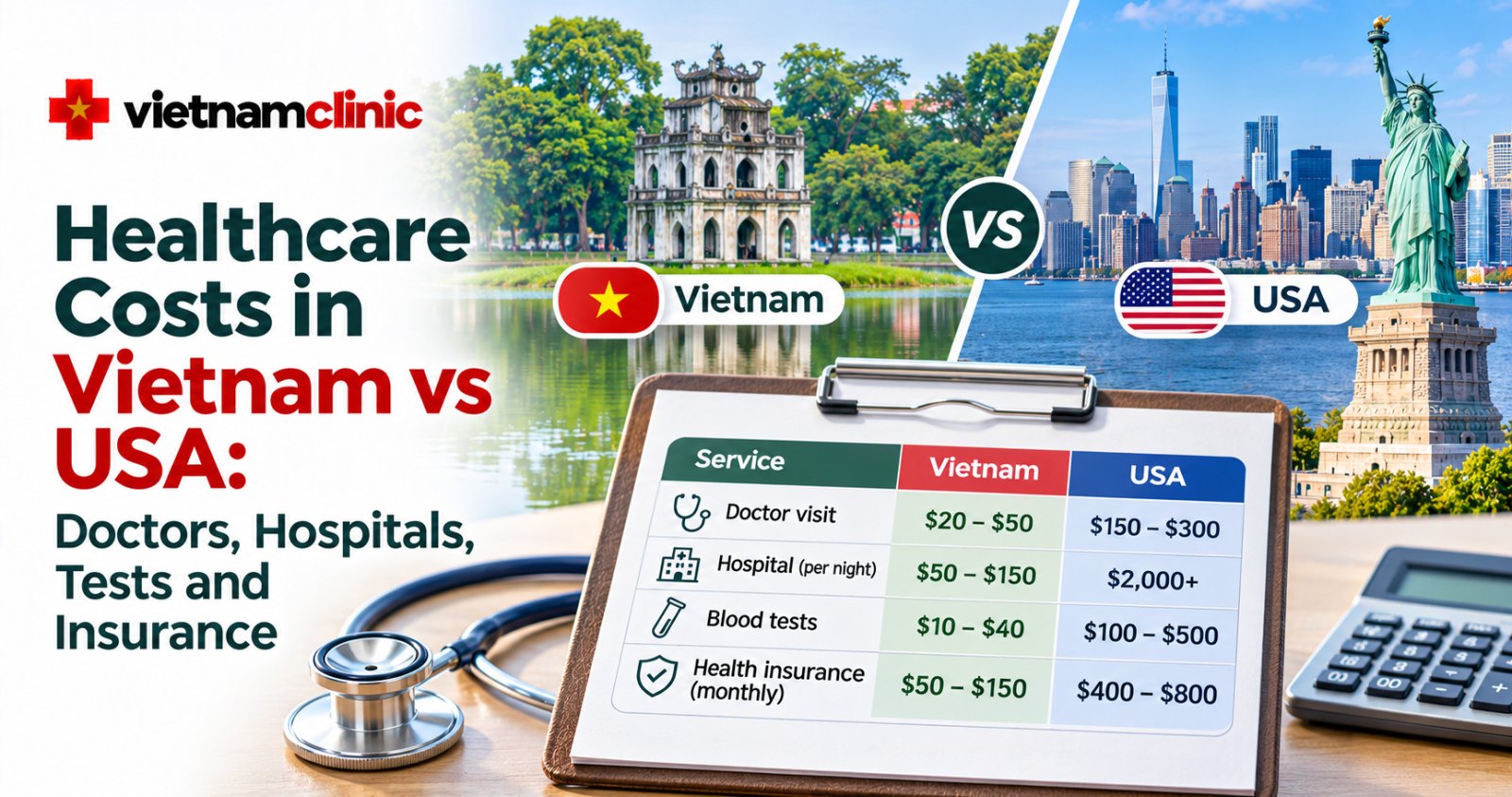
Few differences between Vietnam and the United States are as immediately noticeable as the price of healthcare.
A private doctor consultation in Vietnam can cost a few hundred thousand đồng. An MRI at a major international hospital may cost a few million. Even private maternity packages at internationally oriented hospitals can be priced at levels that would look unusual in the United States.
That does not mean every Vietnamese patient experiences healthcare as cheap. Income levels are much lower, and Vietnamese households pay a relatively large share of healthcare costs directly out of pocket. The two systems also finance care very differently, so comparing a hospital price in Vietnam with an American insurance copay can be misleading.
Still, the overall difference is enormous. The latest internationally comparable World Bank and WHO data put health spending per person in 2023 at about US$197 in Vietnam versus US$13,473 in the United States. In nominal dollar terms, the US figure was roughly 68 times higher.
Vietnam vs USA healthcare costs at a glance
| Measure or service | Vietnam | United States |
|---|---|---|
| Health expenditure per person, 2023 | US$197 | US$13,473 |
| Out-of-pocket spending per person, 2023 | US$77 | US$1,472 |
| Out-of-pocket share of health spending | 39.2% in Vietnam in 2023 | About 11% of US health spending in 2024 |
| Private doctor consultation | Common published examples around 300,000 to 1.2 million VND | Average outpatient evaluation and management claim was about US$125 in 2021 |
| Private brain MRI | Around 3.6 to 3.8 million VND at selected Vinmec hospitals | US MRI prices vary greatly; an older claims benchmark put lower-back MRI at US$861 on average |
| Emergency care | Consultation fees can begin around 1.8 million VND at selected private facilities before tests and treatment | Average US emergency department visit was US$2,453 in 2021 claims data |
| Pregnancy and childbirth | Private international-hospital packages can start around 39 million VND for vaginal delivery | Pregnancy, delivery and postpartum care averaged US$20,416 for employer-insured women in recent US claims data |
These figures are illustrative benchmarks, not perfectly matched national prices. Vietnamese figures often come from published private-provider tariffs, while American figures commonly come from insurance claims. The year, included services and payment method can differ.
Why healthcare is so much cheaper in Vietnam
The difference is not explained by one factor.
Healthcare prices are influenced by:
- Wages for medical and support staff
- Hospital operating costs
- Property and construction costs
- Administrative expenses
- Insurance structures
- Pharmaceutical and device pricing
- Government reimbursement
- Market competition
The United States is unusual even compared with other wealthy countries. Peterson-KFF research consistently finds that the US spends much more per person largely because prices paid to hospitals and healthcare professionals are higher, not simply because Americans use dramatically more healthcare.
Vietnam operates in a very different cost environment.
A modern private hospital in Ho Chi Minh City can therefore use advanced imaging equipment and internationally recognised medical technology while charging much less than an American hospital for many services.
How much does a doctor visit cost in Vietnam vs USA?
Private consultation prices in Vietnam vary according to hospital, specialist, appointment status and whether the patient uses an international service.
Vinmec Smart City currently publishes examples such as:
- Consultation under 30 minutes: 300,000 VND
- General consultation: 440,000 VND
- Doctor consultation with appointment: 690,000 VND
- Primary doctor consultation with appointment: 800,000 VND
- Specialist or consultant appointment: 1.2 million VND
- Out-of-hours specialist consultation: up to 1.5 to 1.8 million VND
These are already at the more expensive private end of Vietnamese healthcare.
In the United States, determining the cost of a doctor visit is less straightforward because the price depends on insurance network, negotiated rates, billing code, facility fees and deductible status.
Peterson-KFF found that the average evaluation and management cost for an outpatient physician visit was approximately US$125 in 2021.
A patient's actual out-of-pocket payment may be much lower if insurance covers most of it, or much higher when deductibles and additional services are involved.
A US medical bill and a Vietnam medical bill are not the same thing
This is one of the most important points when comparing prices.
In Vietnam, especially when using private care as a foreigner, you may simply receive a published cash price and pay it directly.
In the US, a medical service can have several relevant prices:
- Gross hospital charge
- Discounted cash price
- Insurer-negotiated price
- Medicare or Medicaid reimbursement
- Patient deductible
- Coinsurance
- Copayment
Two American patients having the same procedure at the same hospital can therefore face very different financial consequences.
US hospitals are required by federal price-transparency rules to publish standard charges, including discounted cash prices and negotiated insurer rates, but CMS explicitly warns that these figures do not necessarily equal the final amount an individual patient will owe.
MRI cost in Vietnam vs USA
MRI provides a good example of the difference.
Vinmec Central Park currently publishes a brain MRI at 3.75 million VND for selected examinations.
Vinmec Smart City lists several MRI procedures around 3.08 to 4.29 million VND, depending on the body area and technique.
For more Vietnamese examples, see MRI Scan Cost in Vietnam.
US imaging prices are much more variable.
Peterson-KFF previously found an average employer-plan price of US$861 for an outpatient lower-back MRI in 2018, with metropolitan averages ranging approximately from US$400 to US$1,100. Earlier international comparisons also found US MRI prices far above those of other countries.
Those US figures are older and should not be presented as a current quotation. Their value is in demonstrating how large geographic and insurer-related price variation can be.
Emergency room costs show an even bigger contrast
Emergency care is one area where the United States can become particularly expensive.
Peterson-KFF analysis found that an average US emergency department visit cost approximately US$2,453 in 2021.
Part of the reason is the use of facility fees in addition to professional charges and testing.
In Vietnam, emergency treatment at a private international hospital is more expensive than an ordinary clinic visit, but consultation charges can still begin at levels that look modest by US standards.
Vinmec Duong Dong, for example, publishes an accident and emergency GP consultation fee of 1.8 million VND.
That is only the consultation. Imaging, medication, procedures, hospitalisation and emergency treatment are additional, so it should not be compared directly with the total US emergency-visit figure.
The useful takeaway is that the starting price of private emergency care in Vietnam is generally much lower, although a major trauma or prolonged intensive-care admission can still become expensive.
Childbirth cost in Vietnam vs USA
Childbirth produces one of the clearest comparisons.
Hanoi French Hospital currently publishes private maternity packages starting around:
- 39.3 million VND for a single vaginal delivery package focused on labour and delivery
- 58.2 million VND for a single caesarean delivery package
- 39.8 million VND for a vaginal-delivery package beginning from week 32 and including prenatal services
- 58.8 million VND for a caesarean package beginning from week 32
These are prices at an international private hospital, not the cheapest maternity options in Vietnam.
In the United States, KFF's analysis of employer-sponsored insurance claims from 2021 to 2023 found that pregnancy, childbirth and postpartum care generated an average of US$20,416 in healthcare spending, including approximately US$2,743 paid out of pocket by the patient.
The average differed sharply by type of delivery. Women with vaginal deliveries generated approximately US$15,712 in additional healthcare spending, while those with caesarean deliveries averaged about US$28,998.
The comparison is not exact because the Vietnamese hospital packages and the US insurance-claims analysis include different periods and services. But the scale of the price difference is difficult to miss.
Blood tests are particularly inexpensive in Vietnam
Routine laboratory testing can feel almost surprisingly cheap to someone accustomed to American medical billing.
Vietnamese laboratory networks currently publish examples such as:
- Total cholesterol: around 37,000 to 45,000 VND
- TSH: around 155,000 VND at MEDLATEC
- Routine urinalysis: around 35,000 to 59,000 VND
- HIV Ag/Ab test: around 223,000 VND at MEDLATEC
Laboratory prices in the US vary by insurer, laboratory and whether testing occurs through a hospital or independent facility.
This is an important difference for people who want regular monitoring. Routine blood work in Vietnam can often be purchased directly without committing to a large hospital package.
Preventive health checks are more commonly sold as packages in Vietnam
Private Vietnamese hospitals frequently sell bundled health-check programmes.
A package may combine:
- Doctor consultation
- Complete blood count
- Glucose
- Cholesterol
- Liver and kidney tests
- Urinalysis
- ECG
- Chest imaging
- Ultrasound
- Cancer screening depending on age and package
This creates a different consumer experience from the US system, where preventive services may be covered by insurance but additional diagnostic tests can generate separate bills.
If you are comparing Vietnamese packages specifically, see Medical Check-Ups in Vietnam.
Why the US spends so much more per person
The scale becomes clearer when looking at national expenditure.
World Bank data based on the WHO Global Health Expenditure Database show that in 2023:
- Vietnam spent approximately US$197 per person on healthcare
- The United States spent approximately US$13,473 per person
That is roughly a 68-fold difference in nominal US dollars.
However, this does not mean an identical basket of healthcare services literally costs 68 times more in America.
National expenditure includes everything from hospital treatment and prescription medicines to public programmes and administration, and the two economies have very different wage and price levels.
Purchasing-power-adjusted comparisons narrow the gap considerably.
The latest US healthcare spending is even higher
CMS reports that US healthcare spending reached US$5.3 trillion in 2024, equivalent to US$15,474 per person and 18% of GDP.
That is among the highest healthcare spending levels in the world.
CMS reports that 2024 spending included approximately:
- US$1.63 trillion on hospitals
- US$1.11 trillion on physician and clinical services
- US$467 billion on prescription drugs
High spending does not necessarily mean every American patient personally pays these amounts. Much of it is financed by employers, private insurers, Medicare, Medicaid and government programmes.
Vietnam has lower prices but higher direct-payment exposure
Vietnam's healthcare costs are much lower in absolute terms, but Vietnamese households fund a larger proportion directly themselves.
World Bank and WHO data put out-of-pocket spending at 39.2% of total Vietnamese health expenditure in 2023.
The comparable US share was much smaller. CMS reports that out-of-pocket payments represented about 11% of US national health expenditure in 2024.
This creates an important paradox.
An MRI may be dramatically cheaper in Vietnam, yet a Vietnamese household may have to pay a larger share of its healthcare bill directly relative to its income.
Out-of-pocket spending per person is still much higher in the USA
Despite Vietnam's larger out-of-pocket percentage, the dollar amount spent directly by an average person remains much lower.
World Bank data for 2023 show approximately:
- Vietnam: US$77 per person in out-of-pocket health expenditure
- United States: US$1,472 per person
The US figure was roughly 19 times higher in nominal dollars.
Again, income differences matter enormously when interpreting affordability.
Health insurance works very differently
Vietnam has a national social health insurance system alongside private and international insurance.
Foreign residents often use:
- International health insurance
- Employer insurance
- Vietnamese private insurance
- Direct self-payment
The US system is more heavily organised around multiple payers, including:
- Employer-sponsored private insurance
- Medicare
- Medicaid
- Affordable Care Act marketplace plans
- Other public programmes
- Self-pay care
This makes American sticker prices particularly difficult to interpret without knowing the insurance situation.
For foreigners considering coverage in Vietnam, see Health Insurance for Foreigners in Vietnam.
US insurance itself is expensive
Medical service prices are only part of the American cost story.
Employer-sponsored family insurance premiums have historically reached many thousands of dollars per year, with the employer usually paying a substantial part of the premium.
Employees can then still face deductibles, copayments and coinsurance when they actually use healthcare.
As a result, saying an American with insurance pays only a US$30 copay for an appointment misses the cost of the insurance financing that sits behind that visit.
Does cheaper healthcare mean lower quality?
Not automatically.
Vietnam has private hospitals using modern MRI and CT equipment, internationally trained doctors and sophisticated surgical services.
At the same time, healthcare quality is not uniform across the country.
Differences can exist between:
- Major cities and rural areas
- Public and private hospitals
- Large tertiary hospitals and small clinics
- Different specialties
- Different individual providers
The United States similarly has enormous variation in quality between hospitals and regions despite much higher prices.
Price should therefore not be used as a direct proxy for medical quality in either country.
Why international hospitals in Vietnam cost more
Foreign patients often use hospitals such as Vinmec, Hanoi French Hospital and other internationally oriented private facilities.
These hospitals can charge substantially more than Vietnamese public hospitals because they may provide:
- English-language support
- Shorter waiting times
- Private rooms
- International insurance billing
- More administrative support
- Higher-end facilities
Even at these premium Vietnamese providers, many published prices remain much lower than American hospital prices.
Is Vietnam a good place to self-pay for healthcare?
For routine outpatient services, diagnostics and elective treatment, Vietnam can be attractive to someone comfortable paying cash.
Transparent provider tariffs make it possible to estimate many costs in advance.
Examples include:
- Doctor consultations
- Blood tests
- MRI and X-ray
- Dental treatment
- Health checks
- Dermatology
- Selected elective procedures
The equation changes with severe illness.
Cancer treatment, prolonged intensive care, major surgery or repeated hospital admissions can still generate substantial bills. Health insurance remains valuable even in a country where routine medical prices are comparatively low.
Vietnam vs USA for medical tourism
The price gap helps explain why Americans sometimes travel abroad for dental, cosmetic and other elective procedures.
Vietnam can offer especially large savings for services with a high labour component, such as:
- Dentistry
- Cosmetic dentistry
- Health screening
- Selected aesthetic procedures
- Some elective surgery
But the cheapest quote should not be the only consideration.
For major treatment, patients should also compare:
- Doctor credentials
- Hospital accreditation
- Implant or device brand
- Follow-up requirements
- Complication management
- Travel costs
- Insurance exclusions
- What happens after returning to the USA
Follow-up can erase part of the saving
A procedure performed in Vietnam may cost much less initially, but follow-up can become complicated if treatment requires several visits.
Dental implants are a good example. Implant placement may take place during one trip, while the final restoration is completed months later after healing.
Likewise, a complication after surgery may require care in the United States, where the patient's US insurer may not automatically cover problems resulting from planned treatment abroad.
The total episode cost, not the first quotation, is what matters.
Which country is cheaper for healthcare?
For most directly purchased medical services, Vietnam is dramatically cheaper than the United States.
The difference is visible in consultations, diagnostic imaging, laboratory testing, dentistry and private maternity care.
But affordability is a different question from price.
US incomes are much higher, insurance pays a large share of many medical bills, and public programmes cover major groups of patients. Vietnamese prices are lower, yet households historically pay a much larger proportion of health expenditure directly out of pocket.
What to remember
Healthcare in Vietnam and the United States operates on completely different price scales.
The latest matched international data show US$197 in health expenditure per person in Vietnam versus US$13,473 in the United States in 2023. The US therefore spent roughly 68 times more per person in nominal dollar terms.
Individual services show the same general pattern. Private Vietnamese consultations can cost several hundred thousand đồng, brain MRI prices at Vinmec are around 3.6 to 3.8 million VND for selected examinations, and international-hospital maternity packages can begin around 39 million VND. American hospital and insurance claims frequently run into hundreds or thousands of dollars for comparable categories of care.
The comparison needs context, however. Vietnam's lower prices exist alongside lower incomes and a relatively high out-of-pocket share of health spending. Meanwhile, US prices are complicated by negotiated insurance rates, deductibles and facility fees.
For a foreign resident or traveller paying directly, Vietnam can nevertheless make routine healthcare feel remarkably inexpensive compared with the United States.
Frequently Asked Questions
Is healthcare cheaper in Vietnam than in the USA?
Yes. Direct prices for doctor consultations, laboratory tests, imaging, dental care and many private hospital services are generally much lower in Vietnam. National health expenditure per person was about US$197 in Vietnam versus US$13,473 in the United States in 2023.
How much does a doctor visit cost in Vietnam compared with the USA?
Current private Vietnamese hospital tariffs include consultations from roughly 300,000 VND to over 1 million VND depending on the doctor and appointment type. A Peterson-KFF analysis found average US outpatient evaluation and management costs of around US$125 in 2021, although US prices and patient payments vary greatly by insurance.
How much does an MRI cost in Vietnam compared with the USA?
Selected 2026 Vinmec tariffs put many MRI examinations around 3 to 4 million VND. US MRI prices vary substantially by facility and insurer. An older employer-insurance claims benchmark found an average of US$861 for a lower-back MRI in 2018.
How much does childbirth cost in Vietnam compared with the USA?
Hanoi French Hospital currently publishes single-pregnancy delivery packages from about 39.3 million VND for vaginal delivery and 58.2 million VND for caesarean delivery. Recent KFF analysis found pregnancy, delivery and postpartum healthcare spending averaged US$20,416 for women with employer-sponsored insurance in the United States.
Why is healthcare more expensive in the United States?
Research comparing the US with other countries consistently identifies higher prices paid for hospital and physician services as a major driver. Administrative structures, wages, insurance arrangements and pharmaceutical and medical-service prices also contribute.
Do you need health insurance in Vietnam if healthcare is cheap?
Insurance can still be important. Routine outpatient care may be inexpensive, but serious illness, major surgery, cancer treatment, intensive care or prolonged hospitalisation can produce substantial bills. Foreign residents should consider coverage for high-cost events rather than judging insurance only by routine consultation prices.
Sources
- World Bank and WHO: Current health expenditure per capita
- CMS: National Health Expenditure Fact Sheet
- CMS: Hospital Price Transparency
- Peterson-KFF Health System Tracker: Healthcare prices and utilization in the United States
- KFF: Health costs associated with pregnancy, childbirth and postpartum care
- Hanoi French Hospital: Maternity package prices
- Vinmec Central Park Hospital: 2026 service prices

Writer
Tan Nguyen
Medical writer
Medical writer for Vietnam Clinic. MD, Vietnam National University Ho Chi Minh City.
View profile