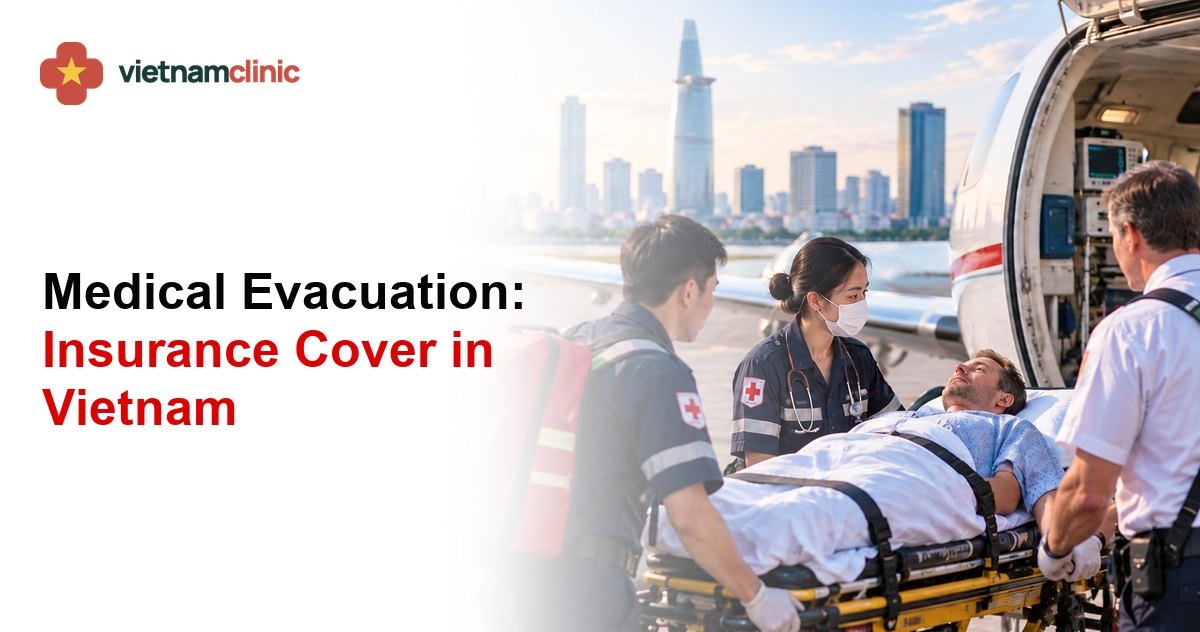
Medical evacuation insurance can be important for foreigners living or travelling in Vietnam, especially when they spend time far from major referral hospitals or want access to treatment outside the country. It is not a private ambulance subscription or a promise to fly a patient home on request. A covered evacuation normally occurs only when the insurer's medical team agrees that necessary treatment is unavailable locally and authorizes the destination and transport.
Vietnam has capable hospitals in its largest cities, but access to specialist care, intensive care and complex surgery varies by location. The practical risk is not that every illness requires an aircraft. It is that a severe injury or time-sensitive condition may first occur on an island, in a mountain province or at a facility unable to provide the required level of care. The insurance value lies in coordination and payment when a medically supervised transfer becomes necessary.
Medical evacuation, local ambulance and repatriation are different
A local ambulance transports a patient within the local care system, such as from home to a nearby emergency department. Medical evacuation moves a patient to the nearest or another suitable medical centre when appropriate care is not available at the current location. Depending on distance and condition, transport can involve a ground ambulance, scheduled flight with medical escort, helicopter or air ambulance.
Medical repatriation usually means transporting a patient to their home country for treatment or returning them after stabilization, if the policy provides it. It is not automatically included whenever evacuation is covered. Repatriation of mortal remains is a separate benefit again, with its own limits and procedures. Policyholders should identify all three terms rather than assuming “evacuation” covers every return journey.
Liberty Vietnam's group MediCare wording defines emergency medical evacuation as medically necessary transport and en-route care for an insured person with a serious condition to the nearest hospital within Vietnam where appropriate care is available, with the decision made by treating clinicians together with the insurer's medical advisers. Liberty's travel wording similarly gives the insurer authority to decide whether evacuation is warranted, the destination and the transport method. Those examples show why the patient cannot simply book an air ambulance and expect reimbursement.
Who is most likely to need evacuation cover?
People based in Hanoi or Ho Chi Minh City with a strong hospital network may have less need for international evacuation for many conditions, but they can still benefit if their preferred specialist care is outside Vietnam or the policy covers repatriation. The decision should reflect the hospitals realistically accessible to the resident, not a general judgement about the whole country.
The case is stronger for people living on islands, in remote industrial areas or far from tertiary hospitals. It is also stronger for frequent domestic travellers, adventure-sport participants, offshore workers, people with children, and those whose medical history could require specialized intervention. However, a known medical condition may be excluded or restricted, so higher need does not itself guarantee coverage.
Short-term visitors need to distinguish travel insurance from resident medical insurance. A travel plan may cover evacuation during an eligible trip but exclude events in the traveller's usual country of residence. A resident health policy may cover evacuation from Vietnam under different geographic and medical criteria. Buying a travel policy designed for trips leaving Vietnam does not necessarily protect a foreign resident inside Vietnam.
Travellers should verify evacuation cover before departure because medical providers can require payment or proof of insurance, while embassies and national health systems do not ordinarily arrange or fund a private medical transfer. The relevant policy and assistance service must be confirmed in advance.
How an evacuation decision is made
The first medical facility stabilizes the patient and identifies what care is needed. The treating doctor or family contacts the insurer's 24-hour assistance service. The insurer requests clinical notes, test results, vital signs, current treatment and the reason a transfer is proposed. Its medical team then discusses the case with the treating clinicians.
The central question is usually whether appropriate treatment is available safely and within a clinically acceptable time at the current facility or elsewhere nearby. The insurer can choose transfer to a suitable hospital within Vietnam rather than Singapore, Thailand or the home country. “Best hospital” is not normally the contractual test; medical suitability, safety, availability and cost-effectiveness can all influence the destination.
If evacuation is approved, the assistance company coordinates receiving-hospital acceptance, bed availability, transport, medical crew, ground transfers and travel documents. Complex transfers may require immigration clearance, fit-to-fly information, oxygen approval and space for equipment. Organizing this independently creates both medical and financial risk.
Contact the assistance provider before arranging transport whenever possible. Many wordings require the insurer or its provider to authorize and organize the evacuation. In a rapidly developing emergency, seek immediate local care first, then have a family member or hospital contact the assistance line as soon as possible.
What evacuation insurance may pay for
A well-defined benefit can cover the medically necessary transport, medical escort or crew, care during transit, communications and ground ambulance connections. Some policies also cover a companion, the return of dependent children, a compassionate visit, accommodation or a return journey after treatment. These are separate benefits and should be checked individually.
Coverage can be stated as “as incurred” or “fully covered,” but those labels remain subject to medical necessity, eligibility, exclusions and the insurer's control of arrangements. They do not authorize unlimited personal choice. If a standard commercial flight with an escort is medically safe, a policy may not pay for a dedicated air ambulance.
Treatment at the destination is another issue. An evacuation benefit may pay transport while hospital treatment draws from the normal inpatient limit. If the geographical area excludes the destination country, treatment there may not be covered even if the transfer itself is approved under a limited clause. Ask how the transport benefit and medical-treatment limit interact.
Residents comparing broader health plans can use the guide to local, travel and international insurance in Vietnam to understand why geographic scope matters. A large annual medical limit is useful, but it does not replace a clear evacuation benefit and assistance service.
Common exclusions and reasons an evacuation is not approved
An insurer may decline evacuation when adequate care exists locally, the patient's condition does not meet the policy's seriousness threshold, or the requested destination is based on preference rather than necessity. It may also decline a transfer that the treating and assistance doctors consider unsafe. Stabilization can take priority over immediate travel.
Pre-existing conditions, non-disclosure and waiting periods can affect eligibility. A policy may cover an unrelated accident but exclude complications of a condition listed on the schedule. The exact wording matters; medical evacuation does not override the underlying medical exclusion.
Other exclusions can involve travel against medical advice, alcohol or drug-related incidents, excluded sports, war or civil disturbance, self-harm, pregnancy beyond specified limits and elective treatment. Rescue from a mountain, sea or remote trail can also be different from medical transport after the patient reaches a suitable pickup point. Search-and-rescue cover should be checked separately.
Evacuation for convenience is normally excluded. A patient cannot require transfer merely because they prefer a hospital closer to family or one with more comfortable rooms. Medical repatriation may permit a home-country destination under some plans, but only when the written benefit and medical approval support it.
Why destination and transport limits matter
“Nearest appropriate facility” may mean a hospital in Da Nang, Hanoi or Ho Chi Minh City rather than another country. This can be entirely reasonable if the necessary specialty and bed are available. People who specifically want access to Bangkok, Singapore or their home country need a policy whose area and repatriation wording support that choice.
Some plans cover evacuation only within Vietnam. Others cover the geographic region, worldwide excluding specified countries, or worldwide including the United States. A resident should verify whether the home country lies within the area of cover and whether medical repatriation is optional or automatic.
The receiving hospital must accept the patient. During high demand, the first-choice facility may lack an intensive-care bed. The assistance team can select another suitable provider. Transfer timing can also depend on weather, airport operations and clinical stability; insurance cannot remove these operational limits.
For day-to-day provider decisions before an emergency, the guide to choosing a clinic in Vietnam helps residents examine services and credentials. Knowing the nearest capable hospital and a likely referral centre makes an emergency plan more practical.
What to check before buying a policy
Read the definition of emergency or serious medical condition. Some contracts require an urgent threat to life or long-term health. Then identify who decides whether evacuation is necessary, what “appropriate facility” means and whether the benefit is limited to Vietnam.
Check separate entries for local ambulance, evacuation, medical repatriation, return after treatment, mortal remains, companion travel and return of children. Note monetary limits, deductibles and whether these costs reduce the annual medical limit. Confirm that the assistance line operates 24 hours and that the insurer arranges payment directly.
Review exclusions against actual activities. A motorbike rider should verify licence, helmet and vehicle rules. Divers, trekkers and offshore workers should check sport, altitude, depth, occupational and rescue restrictions. Someone with a chronic illness should obtain a written underwriting decision rather than relying on a generic evacuation benefit.
Ask for an example involving the place where you live. Would an eligible patient in Phu Quoc be moved to Ho Chi Minh City? Under what circumstances would a transfer abroad be considered? The answer is illustrative rather than binding, but it reveals whether the seller understands the wording.
Preparing for an emergency in Vietnam
Save the assistance number on every family member's phone and carry the policy number. Tell a trusted contact where the documents are stored. Keep a concise medical summary with diagnoses, allergies, medication, blood group if known, passport details and emergency contacts.
In an emergency, call local services and reach a capable facility. Then contact the insurer. Do not spend hours seeking authorization while delaying stabilization. When possible, give the assistance team the hospital's direct contact, treating doctor's name, diagnosis, current condition and proposed next step.
Keep records of calls, reference numbers and medical documents. Do not sign a private air-ambulance contract unless you understand who will pay. If the insurer declines, request the policy clause and medical reason in writing, then use the appeal process if the facts or wording appear inconsistent.
Direct billing at the hospital is related but separate. An insurance card does not itself authorize a transfer or every hospital charge; the assistance service must approve the evacuation under the relevant benefit.
Is evacuation insurance necessary for every expatriate?
There is no universal answer. A healthy person living near a tertiary hospital, with substantial savings and no preference for overseas treatment, may accept the risk. A family on a remote island, an offshore worker or a person who wants access to a specific regional system has a different exposure.
Evaluate the maximum financial and practical consequence, not just the probability. A medically staffed transfer can be difficult to arrange quickly and can create a bill far beyond an ordinary domestic ambulance. The assistance company's coordination can be as important as reimbursement.
Do not buy duplicate benefits without checking coordination. Employer insurance, a personal international plan and a credit-card travel policy may all mention evacuation but apply to different locations, trip lengths and causes. Identify which policy is primary and which assistance number should be called first.
Foreign workers who also have statutory cover should understand that Vietnamese public health insurance follows its own referral and payment rules; it should not be assumed to fund an international air ambulance. Evacuation cover is most valuable when its destination, medical threshold, authorization procedure and geographic scope match the real places and risks in a person's life.
Frequently Asked Questions
Does medical evacuation always mean flying home?
No. It usually means transport to the nearest suitable medical facility. Returning to a home country is medical repatriation and requires a separate or specifically stated benefit.
Can I choose Singapore or Thailand as the destination?
Only if the policy and medical decision allow it. The insurer can select a suitable hospital within Vietnam when appropriate care is available there.
Can I arrange an air ambulance myself and claim later?
This is risky. Many policies require the insurer or assistance provider to authorize and organize the evacuation. Contact them as early as possible after immediate stabilization.
Does evacuation cover include treatment at the destination?
Not necessarily. Transport and medical treatment can use separate benefits and limits. Check whether the destination is inside the policy's treatment area.
Is search and rescue included with medical evacuation?
Not automatically. Rescue from mountains, water or remote terrain may be a separate benefit with activity and location restrictions.
Sources

Writer
Tan Nguyen
Medical writer for Vietnam Clinic. MD, Vietnam National University Ho Chi Minh City.