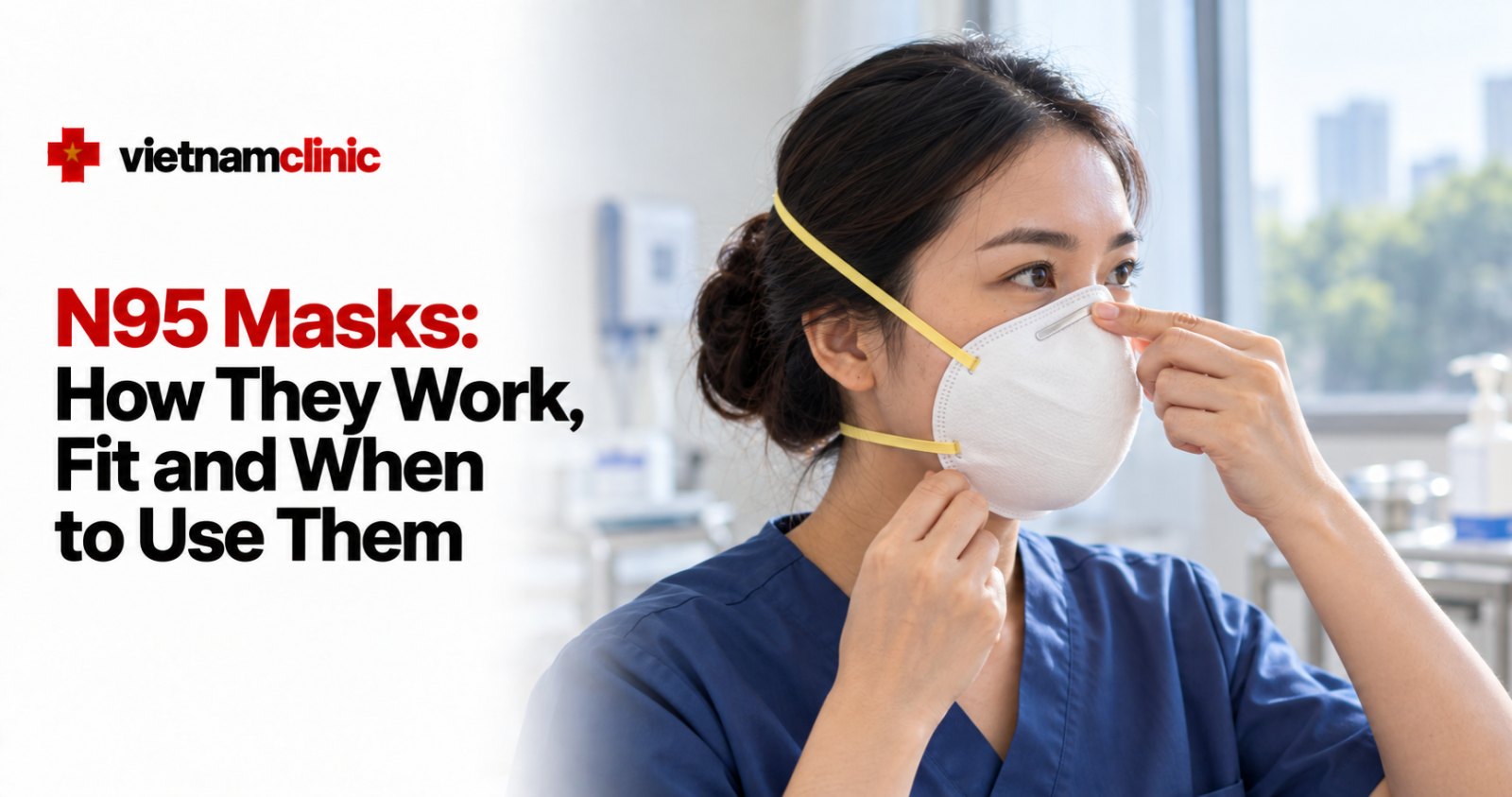
An N95 is a particulate-filtering respirator designed to fit closely to the face. In Vietnam, N95 masks can be useful in several situations, including periods of high PM2.5 pollution, dusty environments and some settings where exposure to respiratory infections is a concern. When the respirator is genuine, appropriate for the hazard and worn correctly, it can reduce the amount of airborne particles the wearer breathes.
For people living in or travelling around Vietnam, the important questions are not only how an N95 works, but also when it is worth wearing one, how to get a good seal and where to buy a genuine respirator. This can be particularly relevant during periods of poor air quality in Hanoi or in other heavily polluted urban environments. An N95 does not supply oxygen and does not protect against all gases or vapours, so reducing exposure remains important even when wearing a good respirator.
What the N95 rating means
N95 is a classification used in the United States NIOSH approval system. Under specified testing conditions, the filter removes at least 95 percent of the test particles. The "N" category means the respirator is not resistant to oil. Approval applies to a particular respirator design and configuration, not to any product that simply prints "N95" or "95" on its packaging.
The rating does not mean you have a guaranteed 95 percent reduction in infection or pollution exposure. Real-world protection depends on fit, time worn, particle concentration, breathing pattern and other factors. A high-quality filter is useful only when inhaled air passes through it rather than leaking around the nose, cheeks or chin.
When should you use an N95 mask in Vietnam?
There is no need to wear an N95 continuously simply because you are in Vietnam. Its usefulness depends on the situation and the type of exposure.
Situations where a well-fitting particulate respirator may be useful include:
- Days with high levels of PM2.5 or other fine-particle pollution
- Heavy traffic exposure during poor air-quality periods
- Dusty construction or work environments
- Smoke containing fine particles
- Crowded or poorly ventilated settings when reducing exposure to respiratory infections is important
- Specific workplaces where respiratory protection is required
Air pollution varies considerably by location, season and day. Hanoi can experience periods of elevated PM2.5, so checking current air-quality information can be more useful than automatically wearing a respirator every day.
An N95 does not protect against every pollutant. Traffic emissions and smoke can contain gases as well as particles, and an N95 is not a general-purpose chemical respirator.
Where to buy N95 masks in Vietnam
N95 and other particulate respirators are widely sold in Vietnam through pharmacies, medical-supply retailers, occupational-safety suppliers and online marketplaces. Availability varies considerably between cities and individual stores.
In Hanoi and Ho Chi Minh City, specialist medical or occupational-safety suppliers may offer a broader range of respirators than a small neighbourhood pharmacy. In Da Nang and other cities, availability may be more limited but particulate respirators can still be found through pharmacies, safety-equipment businesses and online retailers.
The main issue is not simply finding a product labelled N95. Check that the manufacturer, model and claimed certification can be verified. Marketplace listings can contain genuine products as well as products with unclear or misleading certification.
For an N95 claiming NIOSH approval, compare the manufacturer, model and approval information with the official NIOSH Certified Equipment List. If you need a respirator for occupational or medically important exposure, verification matters more than choosing the cheapest listing.
How much do N95 masks cost in Vietnam?
Prices vary according to manufacturer, model, seller and whether respirators are sold individually or in multipacks. Imported NIOSH-approved products may cost more than locally available masks or respirators certified under other standards.
Because retail prices and availability can change quickly, it is better to compare the exact model and certification rather than relying on a general national N95 price. An unusually low price for a product claiming to be an imported certified respirator is a reason to verify the model carefully.
Keep the original packaging when possible. It can contain the model, approval and lot information needed to check authenticity.
N95 masks for air pollution in Vietnam
Fine-particle pollution is one of the most relevant reasons to consider an N95 in Vietnam. A properly fitting particulate respirator can reduce inhalation of airborne particles, including PM2.5.
However, wearing a respirator should not replace reducing exposure. During periods of particularly poor air quality, consider limiting prolonged outdoor activity near heavy traffic, spending more time in cleaner indoor environments and using appropriate indoor air filtration where available.
This is particularly relevant in cities that experience significant seasonal or episodic air pollution. If you live in the capital, see our guide to air quality in Hanoi for more information about PM2.5, health risks and practical ways to reduce exposure.
N95 masks for traffic pollution
Motorbike and road traffic can expose people to a mixture of particulate and gaseous pollutants. An N95 can filter particles when it fits properly, but it does not remove every component of traffic pollution.
This distinction matters in cities such as Hanoi and Ho Chi Minh City. Wearing an N95 while riding through heavy traffic may reduce particulate exposure, but it should not be interpreted as complete protection from vehicle emissions.
Fit can also be affected by movement, helmets, glasses and sweat. Make sure other equipment does not push the respirator away from the face.
Respirators, surgical masks and cloth coverings
A surgical mask is generally loose-fitting and provides a barrier against droplets and splashes while helping reduce the release of respiratory particles. It does not provide the same reliable facial seal as a properly fitted respirator.
Cloth coverings vary widely in materials and fit. A face shield protects a different area and is not a substitute for respiratory filtration.
A surgical N95 combines respirator requirements with additional features for medical use, including fluid resistance. An ordinary N95 is not automatically suitable for every clinical procedure involving splashes. In hospitals and workplaces, follow the protective-equipment requirements for the specific task.
N95, KN95 and FFP2 masks in Vietnam
Vietnamese shops and online marketplaces may sell N95, KN95, FFP2 and other particulate respirators.
These labels refer to different certification systems. They are often discussed together because they describe respirators intended to filter airborne particles, but their regulatory and testing requirements are not identical.
A KN95 label does not constitute NIOSH approval, and an FFP2 respirator should be assessed according to its own conformity requirements.
Do not assume that a higher number, thicker material or additional layers automatically means better protection. Product authenticity, appropriate certification and facial fit matter more.
How to check whether an N95 is genuine
For an N95 claiming NIOSH approval, compare the manufacturer, model and approval information with the NIOSH Certified Equipment List. An approval number commonly has the form TC-84A followed by identifying digits.
The details should correspond to the actual respirator model, not merely another product made by the same company.
Counterfeit or misrepresented products can use copied approval numbers, incorrect markings or unsupported claims. A certificate image displayed by an online seller is not sufficient by itself.
If the product cannot be matched to official approval information, do not rely on it for an important hazardous exposure.
Find a model that seals comfortably
Respirators come in different shapes and sizes. A model that seals well on one person may leak on another.
The respirator should:
- Cover the nose and mouth
- Sit securely under the chin
- Have no obvious gaps around the edges
- Remain stable when you speak
- Stay in position when you move your head
If there is a mouldable nosepiece, shape it according to the manufacturer's instructions. Glasses, helmets and other equipment should not push the respirator away from the face.
Fogging of glasses can suggest leakage, but it is not a validated pass-or-fail test.
How to put an N95 on correctly
Clean your hands and inspect the respirator before use. Check for tears, distorted shape, damaged nose foam or stretched straps.
Place the respirator on your face according to the manufacturer's instructions, position the straps and adjust the nosepiece if present. Keep hair, jewellery and clothing away from the sealing surface.
Perform a user seal check every time you put it on. The exact procedure depends on the model and should be described in its instructions.
If you detect a leak, readjust the respirator and check again. A user seal check is useful each time the respirator is worn, but it is not the same as a formal fit test.
Fit testing and facial hair
A fit test evaluates whether a particular make, model, style and size provides an adequate fit for an individual. Workplace respiratory-protection programmes may require formal fit testing, medical evaluation and training.
Passing a fit test for one N95 does not prove that another model will fit.
Facial hair crossing the sealing surface can allow contaminated air to enter. Even short stubble may interfere with the seal. Tightening the straps cannot reliably compensate for hair beneath the sealing surface.
N95 masks and respiratory infections
A well-fitting respirator can reduce exposure to infectious respiratory particles, particularly in crowded or poorly ventilated indoor environments.
It is still only one layer of protection. Cleaner indoor air, ventilation, reducing close exposure when ill and relevant vaccination can address risks that a respirator alone cannot eliminate.
Wear the respirator over both your nose and mouth throughout the exposure. Pulling it down to speak or leaving the nose uncovered allows air to bypass the intended filtration route.
If caring for someone with a specific airborne infection, follow the relevant medical or workplace guidance rather than relying only on a general mask guide.
Fine pollution, smoke and hazardous gases
An N95 can reduce inhalation of fine particles in smoke or dusty air when it fits correctly. However, smoke and traffic emissions can also contain gases.
An N95 does not protect against carbon monoxide and is not a general-purpose chemical respirator.
Do not enter a fire, confined space or unknown chemical atmosphere simply because you are wearing an N95. These environments may require specialised respiratory equipment and trained responders.
Exhalation valves
Some respirators contain an exhalation valve. This can reduce exhalation resistance or moisture accumulation.
The respirator may still provide its intended inward particulate protection when correctly fitted, but outward filtration depends on the design. An unfiltered valve can allow some exhaled air to bypass the filter.
Where protecting other people or maintaining a sterile environment is important, a non-valved respirator is generally the simpler option unless the facility specifies otherwise.
Can you reuse an N95?
There is no single safe number of days that applies to every N95 and every type of exposure.
Follow the manufacturer's instructions and any workplace or clinical protocol. Replace a respirator when it becomes:
- Wet
- Dirty
- Damaged
- Difficult to breathe through
- Deformed
- Unable to maintain a secure seal
Repeated removal can stretch the straps or contaminate the respirator.
Do not wash a disposable filtering facepiece, spray it with alcohol, boil it or microwave it. Unvalidated household disinfection can damage the filter or structure even when the damage is not visible.
Using an N95 in Vietnam's hot and humid weather
Heat and humidity can make prolonged respirator use uncomfortable, particularly outdoors.
Choose a model that fits securely without excessive pressure and take breaks in cleaner air when appropriate. Replace the respirator if it becomes wet with sweat.
Do not loosen the respirator during exposure simply to improve comfort, because doing so can compromise the seal. If one model is consistently uncomfortable, another size or design may provide a better fit.
Children and people with health conditions
Adult respirators often do not fit children properly. A product marketed for children does not automatically have NIOSH approval or provide a dependable seal.
Never place a mask or respirator on a child under two years old or on someone who cannot remove it safely without assistance.
People with significant heart or lung disease should seek professional advice if breathing through a respirator is difficult. If wearing one causes concerning breathlessness, chest pain, dizziness or distress, move to safer air and seek appropriate medical help.
An N95 is protective equipment. It is not treatment for asthma, an acute respiratory problem or another medical condition.
A practical N95 checklist in Vietnam
Before relying on an N95:
- Identify the reason you need respiratory protection.
- Check that an N95 is appropriate for that type of exposure.
- Buy from a credible pharmacy, medical supplier or safety-equipment retailer.
- Verify NIOSH approval if the product claims to be an N95.
- Check that the respirator fits your face.
- Perform a seal check every time you put it on.
- Replace it when damaged, wet, dirty or unable to seal.
- Remember that an N95 filters particles but does not protect against every gas or chemical.
- Reduce the underlying exposure whenever possible.
For people in Vietnam, an N95 can be particularly useful during episodes of high PM2.5 pollution, dusty conditions and situations where respiratory-particle exposure is a concern. The most important factors are choosing a genuine respirator, obtaining a good facial seal and using it for the right type of hazard.
Frequently Asked Questions
What does N95 mean?
N95 is a US NIOSH filter classification. Under specified test conditions, an approved respirator filters at least 95% of the test particles and is not resistant to oil. The rating does not guarantee the same reduction in real-world exposure if the respirator leaks around the face.
How can I tell whether an N95 fits correctly?
It should cover the nose and mouth, sit securely under the chin and remain stable when you speak or move. Perform the manufacturer’s user seal check every time you put it on. A workplace fit test is a separate, formal assessment of a specific model and size.
Can an N95 be reused?
There is no universal number of safe reuses. Follow the manufacturer’s instructions and any workplace protocol. Replace it if it becomes wet, dirty, damaged, difficult to breathe through or no longer seals securely. Do not wash or spray a disposable N95 with alcohol.
Does an N95 protect against pollution and smoke?
A well-fitting N95 can reduce exposure to fine particles in polluted or smoky air, but it does not protect against carbon monoxide, supply oxygen or filter every gas and vapour. Reducing exposure and using cleaner indoor air remain important.
Sources

Writer
Tan Nguyen
Medical writer for Vietnam Clinic. MD, Vietnam National University Ho Chi Minh City.