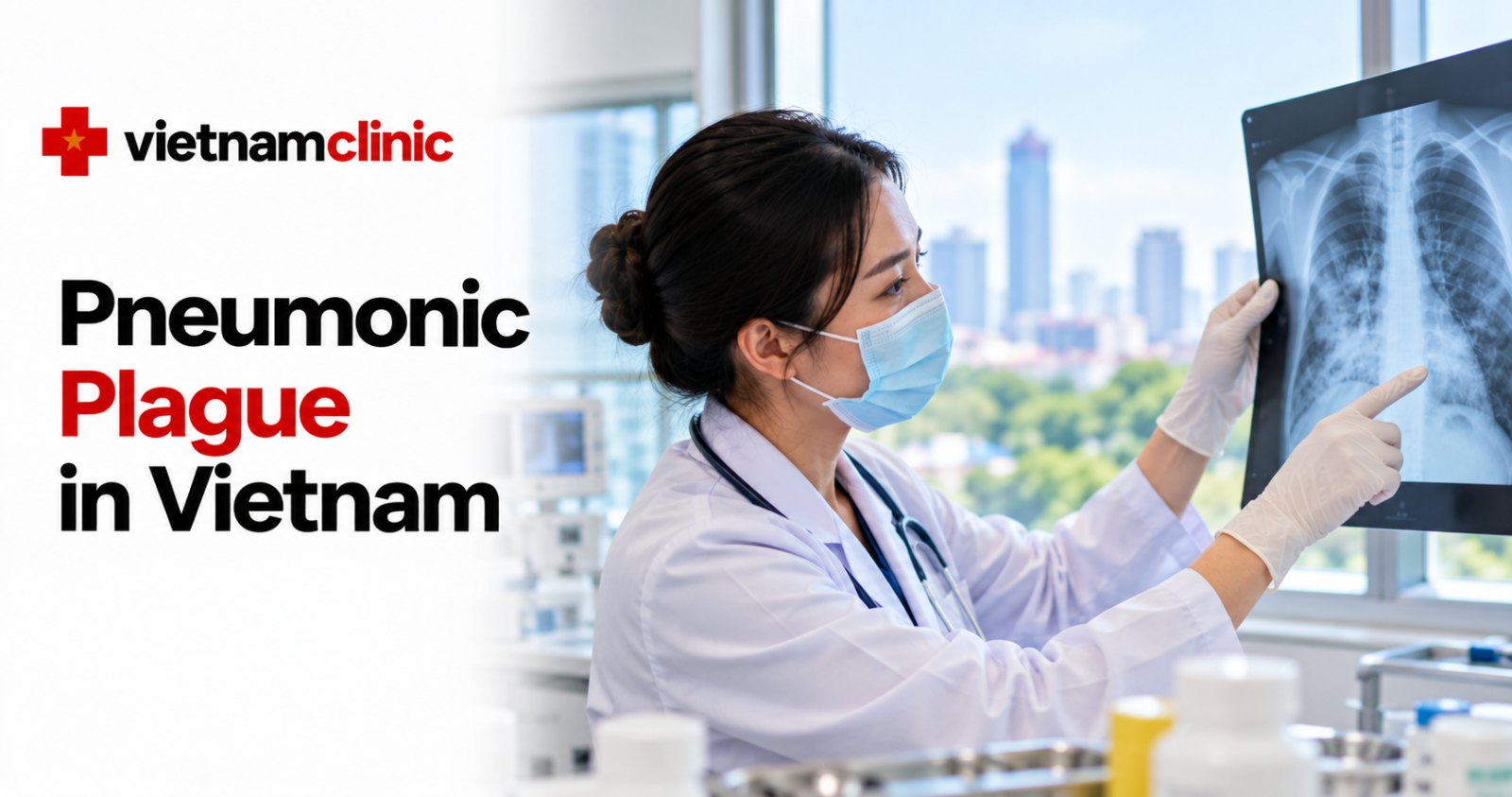
Pneumonic plague is the lung form of plague caused by the bacterium Yersinia pestis. It is rare, but it is the most rapidly progressive form of plague and can be transmitted from person to person through infectious respiratory particles during close contact.
For people living in or travelling through Vietnam, the key point is perspective: pneumonic plague is not currently considered a common travel-health threat in Vietnam. Recent World Health Organization reporting for 2019 to 2025 identifies the largest burden of reported human plague in countries such as the Democratic Republic of the Congo and Madagascar, not Vietnam.
However, plague has historical relevance in Vietnam, and severe unexplained fever with rapidly worsening respiratory symptoms always deserves urgent medical assessment regardless of the suspected cause.
What is pneumonic plague?
Plague is an infectious disease caused by Yersinia pestis, a bacterium maintained in animal reservoirs, particularly small mammals and their fleas.
There are three major clinical forms:
| Form | Main feature | Person-to-person spread |
|---|---|---|
| Bubonic plague | Painful swollen lymph nodes called buboes | Rare |
| Septicaemic plague | Infection spreads through the bloodstream | Not the usual route |
| Pneumonic plague | Infection involves the lungs | Yes, through respiratory particles during close contact |
Pneumonic plague can occur after inhaling infectious respiratory particles or when another form of plague spreads to the lungs.
The World Health Organization describes it as the most virulent form of plague.
How serious is pneumonic plague?
Very serious if untreated.
WHO states that untreated pneumonic plague can become fatal extremely quickly, sometimes within 18 to 24 hours after symptoms begin.
The disease is nevertheless treatable with antibiotics when recognised early.
This creates an unusual combination: pneumonic plague is potentially devastating but can have a much better outcome when diagnosis and treatment begin promptly.
What are the symptoms?
Symptoms can progress rapidly.
Typical features can include:
- Sudden fever
- Chills
- Severe weakness
- Headache
- Shortness of breath
- Cough
- Chest discomfort
- Rapid deterioration
- Sputum that may contain blood
WHO notes that the respiratory symptoms of pneumonic plague can begin quickly after infection, and the incubation period can be as short as approximately 24 hours in some cases.
These symptoms are not specific to plague. Pneumonia caused by other bacteria or viruses is vastly more common, and several other infections can produce fever, cough and breathing difficulty.
That is why diagnosis depends on exposure history and laboratory testing rather than symptoms alone.
Pneumonic plague vs ordinary pneumonia
The name can cause confusion because pneumonic plague is a type of severe bacterial pneumonia, but it is not the same as the much more common forms of community-acquired pneumonia.
| Feature | Pneumonic plague | More common pneumonia |
|---|---|---|
| Cause | Yersinia pestis | Many bacteria, viruses and other pathogens |
| Frequency | Very rare globally | Common |
| Person-to-person epidemic potential | Significant during close exposure | Depends on the pathogen |
| Progression | Can be extremely rapid | Variable |
| Diagnosis | Requires specific microbiological testing | Depends on suspected cause |
| Treatment urgency | Immediate | Also potentially urgent, depending on severity |
A patient with severe pneumonia should not try to identify the organism from symptoms alone.
Is pneumonic plague present in Vietnam today?
There is no indication from current major international surveillance that Vietnam is experiencing ongoing widespread human plague transmission.
WHO's latest global summary covering 2019 to 2025 reports that most human plague cases were recorded in the Democratic Republic of the Congo and Madagascar.
Vietnam does not appear among the countries carrying the major recent reported burden in that global summary.
Similarly, the current CDC travel-health page for Vietnam does not list plague among the principal infectious disease concerns for ordinary travellers. It instead highlights risks such as dengue, Japanese encephalitis and malaria in selected areas.
This does not prove that Yersinia pestis can never occur in Vietnam, but it does mean that routine travellers should not treat pneumonic plague as a major everyday risk.
For a broader overview of infections travellers and residents are more likely to encounter, see Most Common Illnesses in Vietnam.
Vietnam has a historical connection with plague
Vietnam has an important historical connection with plague research through Alexandre Yersin.
Yersin identified the bacterium responsible for plague in Hong Kong in 1894. The organism was later named Yersinia pestis in recognition of his work.
Yersin subsequently spent much of his life in Vietnam and played an important role in infectious-disease research and the development of Pasteur institutions in the region.
This historical link is sometimes confused with present-day risk. The fact that Vietnam has a major place in plague history does not mean modern Vietnam is experiencing a current plague epidemic.
How does pneumonic plague spread?
Pneumonic plague can spread when a person inhales infectious respiratory particles produced by someone with pneumonic infection.
Transmission generally requires close exposure rather than casual contact at a distance.
Plague can also enter the human population through other routes:
- Bites from infected fleas
- Direct contact with infected animal tissues or body fluids
- Exposure to infected animals
A person can initially develop bubonic plague after a flea bite and later develop secondary pneumonic plague if the bacteria spread to the lungs.
How is this different from bubonic plague?
Bubonic plague is the most common clinical form worldwide.
It usually follows the bite of an infected flea and characteristically causes one or more painful, swollen lymph nodes known as buboes.
Bubonic plague does not normally spread directly between people.
However, if infection progresses to the lungs, secondary pneumonic plague can develop. At that point respiratory transmission becomes possible.
Can tourists catch pneumonic plague in Vietnam?
For ordinary travellers, the risk appears extremely low based on current surveillance.
There is no routine recommendation for tourists to Vietnam to take antibiotics or receive a plague vaccine.
WHO also does not recommend routine plague vaccination for the general population. Vaccination is reserved for very specific high-risk groups where appropriate.
Travellers should focus much more strongly on established Vietnamese health risks such as mosquito-borne disease, food and water safety, traffic injuries and rabies exposure.
For practical preparation, see Vaccinations for Vietnam and Dengue in Vietnam.
When would plague become a realistic possibility?
Doctors would be more likely to consider plague when severe symptoms occur alongside a relevant exposure history.
Examples include:
- Close contact with a confirmed pneumonic plague patient
- Travel to an area experiencing an active plague outbreak
- Contact with infected rodents or other mammals
- Flea exposure in a recognised plague focus
- Sudden severe pneumonia after a compatible epidemiological exposure
Without such an exposure, many other causes of pneumonia are substantially more likely.
How quickly do symptoms appear?
Plague overall commonly has an incubation period of about 1 to 7 days, but pneumonic plague can develop faster.
WHO notes that symptoms of the pneumonic form may begin in less than 24 hours after infection in some circumstances.
The rapid progression is one reason suspected pneumonic plague is treated as a medical and public-health emergency.
How is pneumonic plague diagnosed?
Diagnosis cannot be confirmed from symptoms alone.
WHO recommends laboratory identification of Yersinia pestis. Samples can include:
- Sputum
- Blood
- Material from a swollen lymph node when buboes are present
Laboratory methods may include culture, molecular techniques and validated rapid diagnostic tests depending on the setting.
Because untreated pneumonic plague can progress quickly, treatment may need to begin before final laboratory confirmation when clinical suspicion is high.
Treatment
Pneumonic plague is treated with antibiotics.
WHO guidance includes several effective antimicrobial options, and modern plague treatment can be highly successful when started promptly.
The key issue is timing.
A patient with suspected pneumonic plague should not wait at home for symptoms to improve or attempt to treat the infection using leftover antibiotics.
Hospital evaluation is necessary because severe respiratory infection may require oxygen, intravenous treatment, monitoring or other supportive care.
Why self-treatment with antibiotics is a bad idea
Antibiotics are widely available in many parts of Vietnam, and people may be tempted to start treatment themselves when they develop fever and cough.
That can create several problems:
- The drug may not be appropriate
- The dose may be wrong
- Severe illness can deteriorate while professional assessment is delayed
- Other dangerous diagnoses may be missed
- Unnecessary antibiotic use contributes to antimicrobial resistance
If you are unfamiliar with local antibiotic rules, Can You Buy Antibiotics Without a Prescription in Vietnam? explains the practical and safety issues.
Would a person with pneumonic plague need isolation?
Yes. Suspected pneumonic plague requires infection-control precautions because respiratory transmission is possible.
WHO recommends appropriate personal protective equipment for healthcare workers and measures to reduce transmission from confirmed or suspected cases.
Close contacts may require assessment and, in some situations, preventive antibiotics.
These decisions should be managed by public-health and infectious-disease teams rather than by patients themselves.
What should close contacts do?
A person who has had genuine close contact with a confirmed pneumonic plague case should seek medical or public-health advice immediately, even if they currently feel well.
WHO guidance includes antibiotic prophylaxis for healthcare workers and other people with relevant direct exposure.
This is very different from taking antibiotics 'just in case' after ordinary travel in Vietnam.
Without a confirmed exposure or public-health recommendation, prophylactic antibiotics are not appropriate for routine travellers.
When should you seek emergency care?
Severe respiratory symptoms should be treated as an emergency regardless of whether plague is suspected.
Seek urgent medical care for symptoms such as:
- Severe shortness of breath
- Rapidly worsening breathing
- Coughing up blood
- Confusion
- Fainting
- Bluish lips or skin
- Severe weakness
- Persistent high fever with rapid deterioration
If you are in Vietnam and need urgent help, see Emergency Numbers in Vietnam.
What other illnesses are more likely in Vietnam?
For most residents and travellers, a fever or respiratory illness in Vietnam is far more likely to have another cause.
Depending on symptoms and exposure, doctors may consider conditions such as:
- Influenza
- COVID-19
- Common bacterial pneumonia
- Dengue
- Other respiratory infections
- Tuberculosis in relevant situations
- Other regional infectious diseases
Exposure history is critical. A clinician may ask about travel, animal contact, insect bites, sick contacts and how quickly symptoms developed.
Should travellers avoid rodents in Vietnam?
Avoiding contact with wild or dead animals is sensible general health advice, but there is no reason for ordinary travellers in Vietnam to behave as though a plague outbreak is occurring.
Do not handle sick or dead rodents with bare hands. In areas where public-health authorities identify plague activity, flea control and avoidance of animal carcasses become particularly important.
WHO notes that flea control should precede rodent-control measures during plague outbreaks because killing rodents first can cause infected fleas to seek new hosts.
Is there a plague vaccine?
WHO does not recommend routine plague vaccination for travellers or the general public.
Vaccination may be considered only for specific groups at particularly high occupational risk, such as certain laboratory workers or healthcare personnel with sustained exposure.
A tourist travelling to Vietnam does not normally need a plague vaccine.
Plague should not be confused with common travel infections
The historical reputation of plague can make any mention of the disease alarming.
But modern risk assessment should be based on current epidemiology.
| Health issue | Relevance to typical Vietnam travel |
|---|---|
| Dengue | Important and widespread risk |
| Rabies | Relevant after mammal bites or scratches |
| Japanese encephalitis | Relevant to some longer or rural trips |
| Malaria | Localised risk in selected rural areas |
| Food and water illness | Common practical concern |
| Pneumonic plague | Very rare and not a routine travel threat |
That difference in probability matters when interpreting symptoms.
What if you become severely ill while travelling in Vietnam?
Do not spend hours trying to determine the exact infectious disease from internet symptom lists.
If the illness is severe, seek medical assessment first.
For people unfamiliar with Vietnamese healthcare, Sick in Vietnam? What to Do and Where to Go explains the difference between clinics, hospitals and emergency care.
Bring information about:
- Recent travel
- Animal exposure
- Flea or insect exposure
- Sick contacts
- Medications already taken
- When symptoms began
Those details can be diagnostically useful.
What to remember
Pneumonic plague is a rare but extremely serious infection caused by Yersinia pestis.
It can spread between people through respiratory particles during close contact and may progress rapidly if untreated. Early antibiotic treatment is effective and can be lifesaving.
For Vietnam specifically, current international surveillance does not suggest that pneumonic plague is a routine or significant travel-health threat. Recent global human plague activity has been concentrated elsewhere, particularly in parts of Africa.
That said, severe pneumonia with rapid deterioration is always a medical emergency. The appropriate response is urgent professional evaluation, not waiting to determine whether the illness matches a rare diagnosis.
Frequently Asked Questions
The questions below cover common searches about pneumonic plague and Vietnam.
Is there pneumonic plague in Vietnam?
Vietnam has historical links with plague, but current major international surveillance does not identify Vietnam as a country with a significant recent burden of reported human plague. Pneumonic plague is not considered a routine travel-health risk for ordinary visitors to Vietnam.
Can pneumonic plague spread from person to person?
Yes. Unlike ordinary bubonic plague, pneumonic plague can spread through infectious respiratory particles during close contact with an infected person.
What are the symptoms of pneumonic plague?
Symptoms can include sudden fever, chills, severe weakness, shortness of breath, cough, chest symptoms and sometimes blood-stained sputum. The illness can deteriorate rapidly.
Is pneumonic plague fatal?
Untreated pneumonic plague can be rapidly fatal. However, antibiotics are effective when treatment begins early, which is why suspected cases require urgent medical assessment.
Do I need a plague vaccine to travel to Vietnam?
No routine plague vaccination is recommended for ordinary travellers to Vietnam. WHO limits vaccination considerations to specific high-risk groups.
Should I worry about plague if I develop a cough in Vietnam?
For most travellers, common respiratory infections are far more likely. Plague becomes more relevant when severe rapidly progressive pneumonia occurs together with a specific exposure, such as close contact with a confirmed case or travel to an active plague outbreak area.
Sources

Writer
Tan Nguyen
Medical writer for Vietnam Clinic. MD, Vietnam National University Ho Chi Minh City.