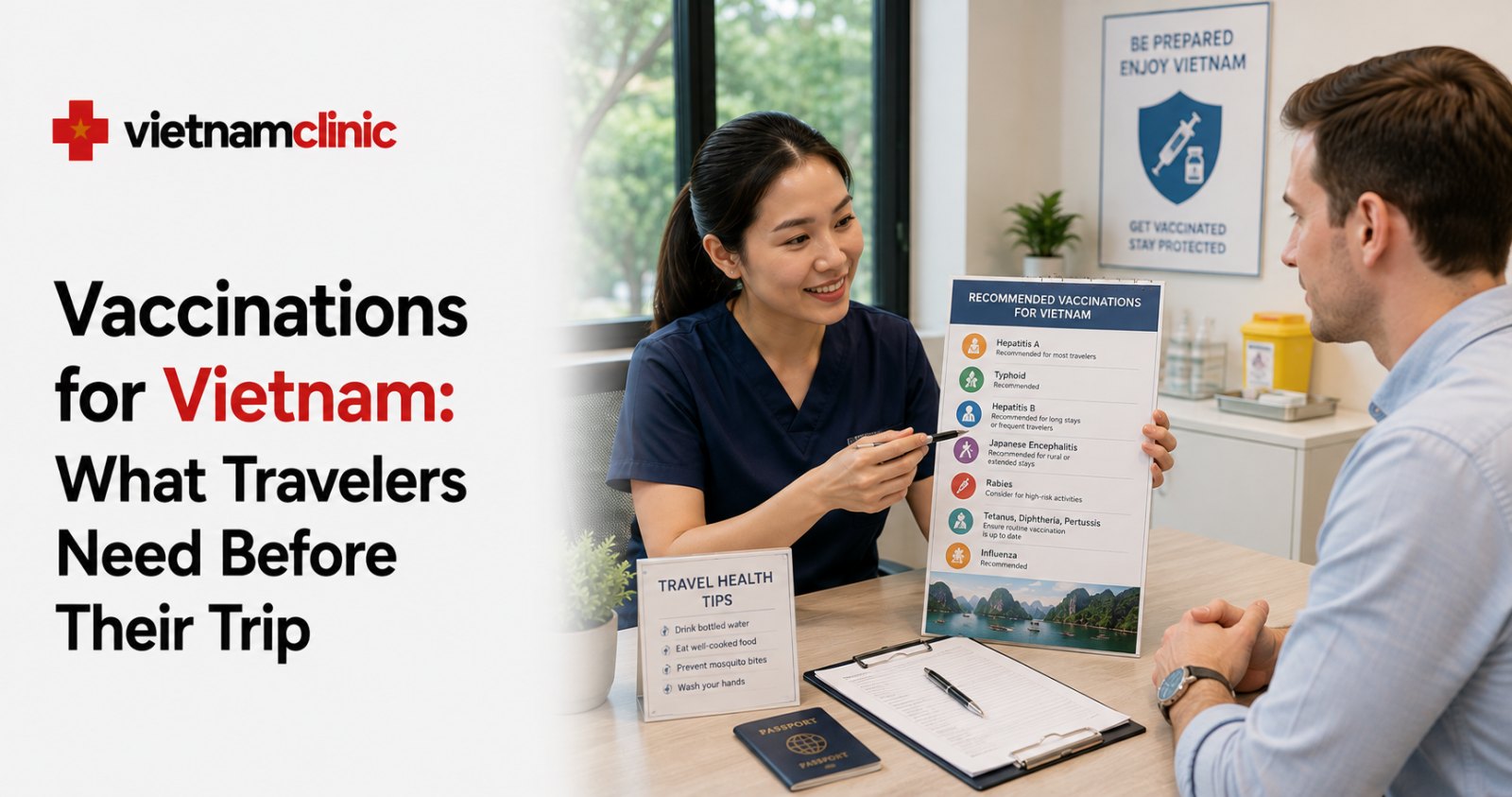
You do not need every travel vaccine simply because you are going to Vietnam. The right vaccination plan depends on your age, previous vaccinations, how long you will stay and whether your trip involves cities, rural areas, animals or extended travel.
Current CDC guidance recommends that travelers to Vietnam review their routine vaccinations and identifies hepatitis A, hepatitis B and typhoid as particularly relevant. Japanese encephalitis and rabies vaccination are more selective and depend strongly on the itinerary.
For most travelers, the useful distinction is between vaccines that are broadly recommended, vaccines worth considering only in higher-risk situations and vaccines that are not routinely required for Vietnam at all.
Which vaccinations should you check before Vietnam?
A useful starting point is:
| Vaccine | Typical recommendation for Vietnam |
|---|---|
| Routine vaccines | Make sure they are up to date |
| Hepatitis A | Recommended for unvaccinated travelers aged 1+ |
| Hepatitis B | Recommended for unvaccinated travelers of all ages |
| Typhoid | Recommended for most travelers |
| Japanese encephalitis | Recommended or considered for selected itineraries |
| Rabies | Consider according to animal exposure and access to treatment |
| COVID-19 | CDC advises eligible travelers to stay up to date |
| Yellow fever | Not recommended and not currently required for Vietnam |
| Chikungunya | Generally not recommended routinely |
This table is only a starting point. A one-week holiday in central Ho Chi Minh City is very different from spending three months cycling through rural Vietnam.
Do I need vaccines to travel to Vietnam?
You do not currently need a universal package of compulsory travel vaccinations simply to visit Vietnam.
However, recommended vaccination is different from an entry requirement.
A vaccine can be medically advisable even when Vietnamese immigration does not require a certificate at the border.
Current CDC guidance recommends that travelers review several vaccines before Vietnam, particularly routine immunisation, hepatitis A, hepatitis B and typhoid.
UK government travel advice also notes that travelers may be asked to complete health declarations in some circumstances and that these may include vaccination information. Entry procedures can change, so check current rules shortly before departure.
Start with the vaccines you may already have
Travel vaccination planning should not begin with exotic diseases. It should begin with your normal vaccination record.
CDC advises travelers to Vietnam to be up to date with routine vaccines, including where appropriate:
- Measles, mumps and rubella.
- Tetanus, diphtheria and pertussis.
- Polio.
- Influenza.
- Varicella.
- Other age-appropriate routine vaccinations.
Many adults already have protection against several of these diseases from childhood immunisation programmes.
Instead of automatically repeating vaccines, check your records and discuss uncertain vaccination history with a healthcare professional.
Hepatitis A is one of the highest-priority travel vaccines
CDC recommends hepatitis A vaccination for unvaccinated travelers aged one year and older visiting Vietnam.
Hepatitis A spreads mainly through contaminated food and water and through close contact with an infected person.
That makes it particularly relevant to travel because you cannot control every stage of food preparation, even when eating in reputable restaurants.
Infants aged 6 to 11 months travelling to Vietnam may also receive a travel dose under CDC guidance, although that dose does not replace the standard childhood series later.
Food hygiene still matters after vaccination because hepatitis A is only one possible cause of gastrointestinal illness.
Travelers concerned about stomach problems can also read Food Poisoning in Vietnam: Symptoms, Treatment and What Travelers Should Do.
Hepatitis B matters for more than adventurous travel
CDC currently recommends hepatitis B vaccination for unvaccinated travelers of all ages going to Vietnam.
Hepatitis B can spread through blood and certain body fluids.
Possible exposure during travel can occur through situations such as:
- Sexual contact.
- Medical treatment.
- Dental procedures.
- Tattoos.
- Piercings.
- Exposure to contaminated needles or instruments.
Many travelers will already have been vaccinated during childhood or adolescence.
Long-term residents and expats should pay particular attention because living in a country for months or years naturally increases the chance of eventually needing medical or dental treatment.
Typhoid is recommended for most travelers
CDC recommends typhoid vaccination for most travelers to Vietnam.
It is particularly relevant for people who:
- Visit smaller cities.
- Spend time in rural areas.
- Stay with friends or relatives.
- Travel extensively outside major tourist infrastructure.
Typhoid spreads through contaminated food and water.
Vaccination is useful but not completely protective, so safe food and water habits still matter.
A vaccinated traveler should not interpret the vaccine as permission to ignore questionable drinking water or obviously unsafe food handling.
Japanese encephalitis depends more on your itinerary than your passport
Japanese encephalitis vaccination is not automatically recommended for every tourist visiting Vietnam.
CDC recommends it for travelers who:
- Move to an area where Japanese encephalitis occurs.
- Spend around a month or longer in areas with risk.
- Frequently travel to areas where the disease occurs.
It can also be considered for shorter trips involving greater exposure, such as:
- Rural travel.
- Hiking.
- Camping.
- Long periods outdoors.
- Accommodation without screens or air conditioning.
- An uncertain itinerary involving rural areas.
CDC does not generally recommend it for short trips restricted mainly to urban areas.
This means a short holiday in Hanoi and Ho Chi Minh City may lead to a different recommendation from a six-week motorbike trip through rural Vietnam.
Rabies vaccination is worth thinking about before remote or long-term travel
Rabies remains present in Vietnam.
CDC states that dogs infected with rabies are sometimes found in the country, while WHO reports continuing human rabies deaths in Vietnam.
Pre-exposure vaccination is not necessary for every visitor, but it becomes more relevant when:
- You work with animals.
- You volunteer with animal rescue organisations.
- You expect frequent contact with dogs or other mammals.
- You spend substantial time in remote areas.
- Access to prompt post-exposure treatment may be difficult.
- You are staying in Vietnam long term.
Even someone vaccinated before travel still needs medical assessment after a potentially risky animal bite or scratch.
For detailed guidance, see Rabies in Vietnam: Risk, Vaccination and What to Do After a Bite.
Measles should not be overlooked just because it is familiar
Measles is often ignored in travel planning because it is not perceived as a tropical disease.
However, international measles activity has increased in recent years, and CDC advises international travelers to be fully vaccinated according to its measles recommendations.
Check your MMR status before Vietnam, particularly if:
- Your vaccination history is unclear.
- You received incomplete childhood vaccination.
- You are travelling with an infant.
- You come from a country where vaccination schedules changed over time.
Routine vaccination can be just as important as travel-specific vaccines.
Is yellow fever vaccination required for Vietnam?
Under current CDC guidance, yellow fever vaccination is not recommended for Vietnam and is not currently required for entry.
That does not mean yellow fever rules are irrelevant to every itinerary.
If your journey includes countries in Africa or South America where yellow fever vaccination certificates can be required, check the rules for the full itinerary rather than Vietnam alone.
Transit arrangements can also matter depending on the countries involved.
What about COVID-19 vaccination?
CDC currently recommends that eligible travelers stay up to date with COVID-19 vaccination.
This should be separated from border policy.
A medical recommendation to remain vaccinated does not necessarily mean Vietnam requires proof of vaccination for routine entry.
Because health declarations and border procedures can change, check official Vietnamese or airline information before departure rather than relying on requirements from previous years.
Dengue is a major Vietnam travel risk, but vaccination is not the main solution for most visitors
Dengue occurs in Vietnam and CDC currently identifies it as a year-round risk.
For most travelers, mosquito-bite prevention remains the practical priority.
Useful measures include:
- Effective insect repellent.
- Long trousers and sleeves when practical.
- Air-conditioned or screened accommodation.
- Bed nets where rooms are exposed to mosquitoes.
This illustrates an important point: vaccines cannot prevent every significant travel infection in Vietnam.
Mosquito precautions remain useful even when you have completed all recommended travel vaccinations.
Malaria prevention is not a vaccination question
Travelers sometimes search for a malaria vaccine when preparing for Vietnam.
For ordinary travelers, malaria prevention usually involves mosquito avoidance and, for selected destinations, prescription antimalarial medication, rather than a travel vaccination.
CDC recommends preventive medicine for travelers visiting certain areas of Vietnam.
Risk is concentrated more in specific rural areas and does not apply equally to every major tourist city.
Tell a travel health professional the actual provinces and activities on your itinerary rather than asking simply whether Vietnam has malaria.
A two-week city holiday needs a different plan from a three-month backpacking trip
The easiest way to understand vaccination recommendations is to divide travelers by itinerary.
Short urban holiday
Someone spending ten days in Hanoi, Da Nang and Ho Chi Minh City may mainly need to review:
- Routine vaccinations.
- Hepatitis A.
- Hepatitis B.
- Typhoid.
Japanese encephalitis and pre-exposure rabies vaccination may be less compelling for many travelers in this category.
Backpacking around Vietnam
A traveler spending several weeks crossing the country, staying in smaller towns and spending time outdoors may have stronger reasons to discuss:
- Typhoid.
- Japanese encephalitis.
- Rabies.
- Malaria prevention for particular regions.
Rural or adventure travel
Camping, hiking, cycling and extensive rural travel can increase exposure to mosquitoes and animals and may make Japanese encephalitis or rabies vaccination more relevant.
Long-term expat stay
Someone moving to Vietnam for six months, a year or longer should think beyond the needs of an ordinary tourist.
Longer exposure increases the likelihood of rural trips, medical procedures, animal encounters and mosquito bites.
What vaccines do children need before Vietnam?
Children should first be up to date with routine childhood immunisation according to their home country's schedule.
Travel-specific recommendations can differ according to age.
For example, CDC advises that infants aged 6 to 11 months travelling internationally may receive an early MMR dose, and infants in that age group travelling to Vietnam can also receive an early hepatitis A dose under travel guidance.
These early travel doses do not necessarily replace the standard doses given later in childhood.
Parents should therefore arrange a travel health consultation rather than adapting an adult vaccine checklist themselves.
Pregnancy can change the vaccination plan
Pregnant travelers should discuss Vietnam travel with a healthcare professional before receiving travel vaccines or medicines.
Some vaccines can be used during pregnancy when clinically appropriate, while live vaccines are generally handled differently.
The itinerary also matters because mosquito-borne diseases and access to medical care can influence travel planning during pregnancy.
Do not assume that being pregnant means either receiving every vaccine or avoiding every vaccine. The recommendation depends on the individual vaccine and risk of exposure.
How early should you get vaccinated before Vietnam?
CDC advises travelers to see a healthcare professional at least one month before travel where possible.
That provides time to:
- Review existing vaccination records.
- Complete vaccines requiring several doses.
- Allow immunity to develop.
- Discuss malaria prevention.
- Review regular medications.
If your trip is closer than one month away, do not assume it is too late.
Some vaccines can still provide useful protection when given closer to departure, and healthcare professionals may be able to adapt schedules depending on the vaccine.
What if you are leaving next week?
Book a travel health consultation anyway.
A late appointment can still be useful for:
- Hepatitis A vaccination.
- Reviewing routine vaccinations.
- Discussing typhoid.
- Assessing rabies or Japanese encephalitis risk.
- Prescribing malaria medication if necessary.
- Reviewing medications and travel health supplies.
Tell the clinician the exact departure date and itinerary.
Do not abandon all preventive preparation simply because you did not start months in advance.
Can you get vaccinated after arriving in Vietnam?
Yes, vaccines are available in Vietnam through hospitals and vaccination providers, particularly in major cities.
However, travel vaccination ideally takes place before exposure begins.
Receiving a Japanese encephalitis or hepatitis vaccine after spending weeks in the relevant environment defeats part of the purpose of pre-travel protection.
Long-term residents may reasonably obtain routine boosters and later vaccinations locally.
If you need non-emergency healthcare after arrival, How to Choose an English-Speaking Clinic in Vietnam explains what international patients should check when selecting a provider.
Do you need to carry vaccination certificates?
For an ordinary Vietnam holiday, travelers are not routinely walking around with certificates for hepatitis A, hepatitis B or typhoid.
It is still useful to keep a digital vaccination record, especially if you:
- Travel through several countries.
- Have received rabies pre-exposure vaccination.
- Need an unusual travel vaccine.
- Are travelling long term.
- May need to continue a vaccine series abroad.
UK government guidance currently notes that travelers to or through Vietnam may in some circumstances be asked to complete health declarations that can include vaccination information.
Check current entry procedures near your departure date because administrative requirements can change faster than medical recommendations.
Vaccines do not replace travel insurance
Even a perfectly vaccinated traveler can still experience:
- Food poisoning.
- Dengue.
- Road accidents.
- Appendicitis.
- Broken bones.
- Heat illness.
- Other medical emergencies.
Vaccination protects against selected infections, not the financial cost of healthcare abroad.
Travelers should therefore consider suitable medical and evacuation coverage. See Travel Insurance for Vietnam: 7 Best Options and What Travelers Should Know for the main options and coverage issues.
It is also worth saving Vietnam's medical emergency numbers before travelling.
The easiest vaccine checklist to take to your travel clinic
Bring your vaccination history and discuss these questions:
- Are my routine vaccinations current?
- Have I completed hepatitis A vaccination?
- Have I completed hepatitis B vaccination?
- Should I receive typhoid vaccination?
- Does my itinerary justify Japanese encephalitis vaccination?
- Should I consider rabies pre-exposure vaccination?
- Do I need malaria prevention for any of my destinations?
- Are there special recommendations because of my age or medical history?
- Do any of my regular medications require travel documentation?
- Have Vietnam's entry health requirements changed?
This produces a much more useful consultation than asking for every vaccine available for Southeast Asia.
Frequently Asked Questions
The answers below cover common questions about vaccinations for Vietnam. Individual recommendations can differ according to age, health, pregnancy, previous vaccinations and itinerary, so a healthcare professional should assess unusual or higher-risk situations.
What vaccinations do I need for Vietnam?
Travelers should make sure routine vaccinations are current. CDC recommends hepatitis A for unvaccinated travelers aged one year and older, hepatitis B for unvaccinated travelers of all ages and typhoid for most travelers. Japanese encephalitis and rabies vaccination depend more on the itinerary.
Do I need vaccines to enter Vietnam?
Vietnam does not currently impose one universal package of travel vaccines for ordinary visitors. Medical recommendations are different from border requirements, and entry procedures can change, so check current official guidance shortly before departure.
Do I need hepatitis A vaccination for Vietnam?
CDC recommends hepatitis A vaccination for unvaccinated travelers aged one year and older going to Vietnam. Infants aged 6 to 11 months may also receive an early travel dose.
Do I need typhoid vaccination for Vietnam?
CDC recommends typhoid vaccination for most travelers, particularly those staying with friends or relatives or travelling to smaller cities and rural areas.
Do I need Japanese encephalitis vaccination for Vietnam?
Not every traveler does. It is recommended for longer stays in risk areas and can be considered for shorter trips involving substantial rural, hiking, camping or outdoor exposure.
Should I get a rabies vaccine before Vietnam?
Pre-exposure rabies vaccination is worth considering when animal contact is likely or when prompt post-exposure treatment could be difficult to access. It is not necessary for every short-term tourist.
Is yellow fever vaccination required for Vietnam?
Current CDC guidance states that yellow fever vaccination is not recommended for Vietnam and is not required for entry.
How long before travelling to Vietnam should I get vaccinated?
CDC recommends reviewing vaccines and medicines with a healthcare professional at least one month before travel where possible. Travelers leaving sooner should still seek advice because some protection can be provided closer to departure.
Conclusion
Most travelers do not need an enormous list of vaccinations before Vietnam. The priority is to make sure routine vaccines are current and review hepatitis A, hepatitis B and typhoid protection.
Japanese encephalitis becomes more relevant for longer stays and rural exposure, while rabies vaccination is particularly worth considering for people with increased animal exposure or limited access to rapid post-exposure treatment.
Yellow fever vaccination is not currently recommended or required specifically for Vietnam, while dengue and malaria prevention depend more heavily on mosquito precautions and, for selected malaria-risk areas, preventive medication.
Ideally, review your vaccination plan at least one month before departure and base the decision on the trip you are actually taking rather than a generic Southeast Asia vaccine checklist.
Sources

Writer
Tan Nguyen
Medical writer for Vietnam Clinic. MD, Vietnam National University Ho Chi Minh City.