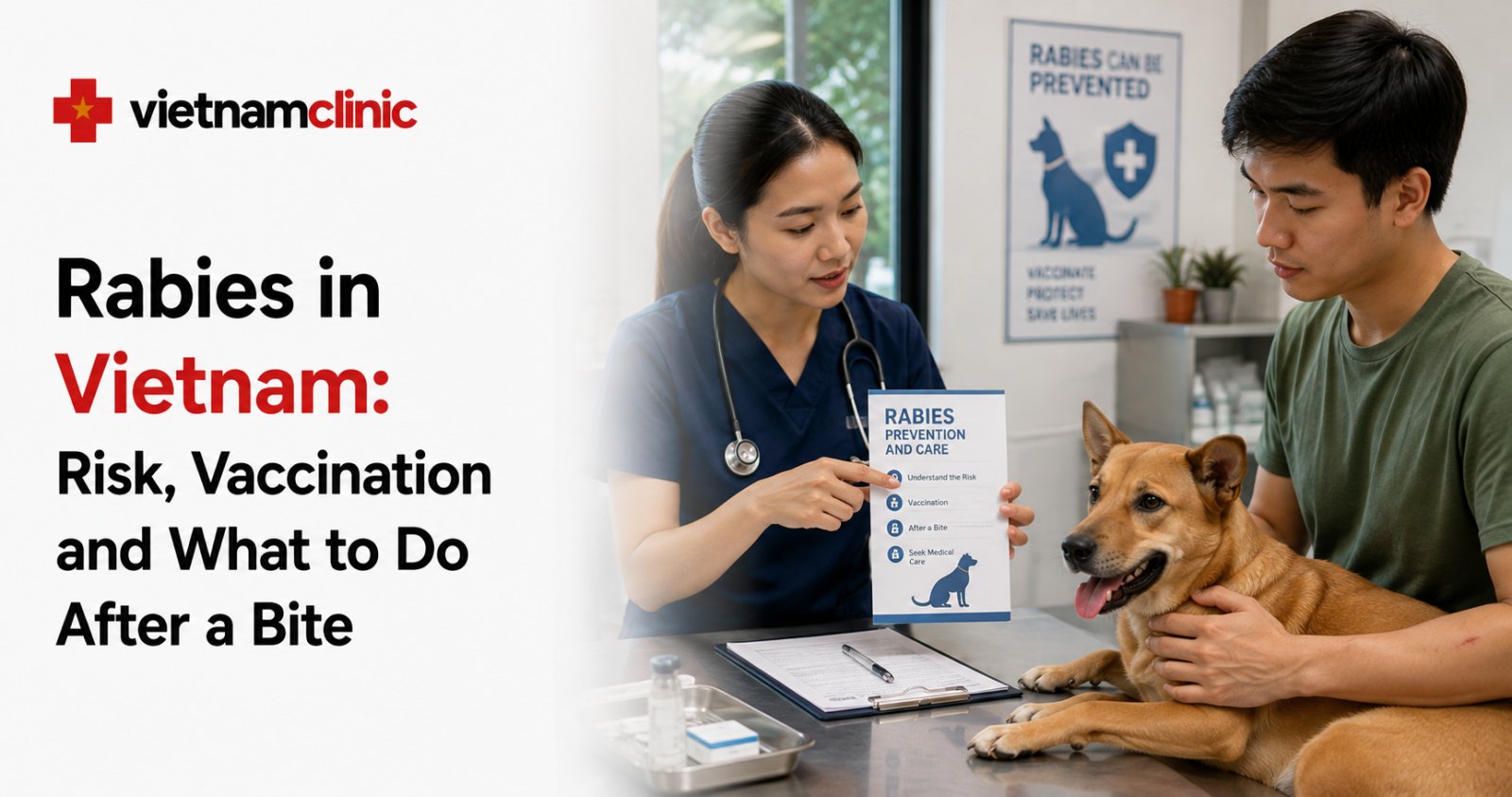
Rabies remains a real health risk in Vietnam. The disease is preventable when appropriate treatment is started after exposure, but once clinical symptoms appear, rabies is almost always fatal.
For travelers, the most important fact is simple: do not wait to see whether an animal becomes sick before seeking medical advice after a potentially risky bite or scratch. Prompt wound cleaning and appropriate post-exposure treatment can prevent the disease.
Dogs are the main source of human rabies in Vietnam, but other mammals can potentially transmit the virus. Travelers should therefore take bites and scratches from dogs, cats, monkeys, bats and other mammals seriously.
How common is rabies in Vietnam?
Rabies is still present in Vietnam rather than being a disease travelers can dismiss as a historical problem.
The World Health Organization states that rabies causes more than 70 deaths in Vietnam each year, with most human cases linked to bites from rabid dogs.
CDC travel guidance also states that dogs infected with rabies are sometimes found in Vietnam.
The risk is not distributed evenly across every part of the country. Exposure may be more difficult to manage in rural or remote areas where access to suitable medical care can take longer.
For the average traveler, the individual risk of contracting rabies is still relatively low. The seriousness comes from the consequences of missing a genuine exposure rather than from rabies being something every visitor is likely to encounter.
Dogs are the main concern, but they are not the only animals that matter
WHO estimates that domestic dogs are responsible for up to 99% of human rabies transmission globally, and dogs are also the principal source of human rabies cases in Vietnam.
Travelers should nevertheless avoid unnecessary contact with unfamiliar mammals, including:
- Dogs.
- Cats.
- Monkeys.
- Bats.
- Other wild mammals.
An animal does not need to look obviously aggressive or severely ill to justify caution.
Do not attempt to pet, feed, rescue or photograph an unfamiliar animal at very close range simply because it appears calm.
What counts as a possible rabies exposure?
Rabies is transmitted mainly through saliva from an infected animal.
The classic exposure is an animal bite that breaks the skin, but bites are not the only situation that matters.
Potential exposures can include:
- A bite that breaks the skin.
- A scratch that breaks the skin and may have been contaminated with saliva.
- Saliva from a potentially rabid animal entering an open wound.
- Saliva reaching the eyes, nose or mouth.
- Certain direct exposures to bats.
Touching an animal or having intact skin licked is generally very different from having saliva enter broken skin or a mucous membrane.
If you are unsure whether an encounter qualifies as an exposure, let a healthcare professional assess it rather than trying to make the decision from photos or internet descriptions.
What should you do immediately after a dog bite in Vietnam?
The first few minutes matter.
If a dog, cat, monkey or another potentially rabid mammal bites or scratches you:
- Wash the wound immediately and thoroughly with soap and running water.
- Continue washing and flushing the area thoroughly rather than briefly rinsing it.
- Apply an appropriate antiseptic if available after washing.
- Seek medical assessment promptly for rabies post-exposure treatment.
- Tell the healthcare professional whether you have previously completed rabies vaccination.
Do not wait for pain, fever or neurological symptoms. Post-exposure treatment is intended to prevent rabies before symptoms appear.
Do not wait for the animal to develop symptoms before seeking care
Travelers sometimes make the mistake of deciding to watch the dog for several days before doing anything else.
Observation of certain domestic animals can form part of professional rabies risk assessment, but this should not replace prompt medical evaluation after a potentially significant exposure.
The situation becomes even less predictable when:
- The animal is stray.
- You cannot identify the owner.
- The vaccination history is unknown.
- The animal disappears.
- The exposure occurred in a remote area.
- The animal is wild.
Get medical advice first. Decisions about observation and continuation of treatment can then be made according to professional guidance.
Rabies symptoms usually appear only after the prevention window has begun
Rabies initially travels through the nervous system before reaching the brain and spinal cord.
The incubation period is variable. Symptoms do not usually appear immediately after the bite.
Early illness can include nonspecific symptoms such as:
- Fever.
- Headache.
- Weakness.
- General discomfort.
- Pain, tingling or unusual sensations around the bite site.
As the disease progresses, severe neurological symptoms can develop.
Once clinical rabies develops, effective treatment options are extremely limited and the disease is almost always fatal.
That is why doctors do not wait for symptoms before treating a genuine exposure.
Post-exposure treatment can prevent rabies
Rabies post-exposure prophylaxis, commonly called PEP, is the treatment given after a possible exposure to prevent the virus from causing disease.
Depending on the nature of the exposure and whether the person has previously been vaccinated, management can involve:
- Thorough wound cleaning.
- A course of rabies vaccination.
- Rabies immunoglobulin or another approved rabies antibody product for certain previously unvaccinated people with significant exposures.
The exact treatment should be determined by a qualified healthcare professional.
Someone who has already completed appropriate pre-exposure rabies vaccination still needs medical care after a bite, but their post-exposure regimen is different from that of an unvaccinated person.
Can you get the rabies vaccine in Vietnam after being bitten?
Yes. CDC currently states that rabies vaccines are typically available throughout most of Vietnam.
That is reassuring, but travelers should still seek treatment quickly rather than assuming every small clinic or pharmacy will stock everything required for post-exposure management.
A suitable hospital, vaccination centre or medical clinic should be able to assess:
- The animal involved.
- Location and severity of the wound.
- Whether the skin was broken.
- Your previous rabies vaccination history.
- Whether rabies immunoglobulin or another antibody product is indicated.
- What vaccine schedule is appropriate.
If you are staying somewhere remote, contact a larger medical facility or your travel insurer if local treatment is uncertain.
Do you need rabies immunoglobulin after every bite?
No.
Rabies immunoglobulin is not automatically required after every animal encounter.
Whether it is indicated depends on factors including:
- Type of exposure.
- Depth and location of wounds.
- Whether saliva contacted broken skin or mucous membranes.
- Previous rabies vaccination status.
For people who have never received rabies vaccination, significant exposures can require both vaccine and rabies immunoglobulin or another approved rabies antibody product.
Previously vaccinated people are managed differently and generally do not receive rabies immunoglobulin as part of standard post-exposure management.
This is one reason medical assessment matters even if you already know you need a vaccine.
Do I need a rabies vaccine before travelling to Vietnam?
Not every tourist needs pre-exposure rabies vaccination.
CDC recommends considering the vaccine according to two main questions:
- Will your activities increase the chance of contact with potentially rabid animals?
- Could you have difficulty obtaining prompt, safe post-exposure treatment if something happens?
Pre-travel rabies vaccination may deserve stronger consideration if you plan to:
- Work with animals.
- Volunteer in animal rescue.
- Spend substantial time around dogs or other mammals.
- Travel extensively in remote areas.
- Cycle or run through areas where encounters with free-roaming dogs are likely.
- Stay in Vietnam for a long period.
- Travel frequently to countries where rabies occurs.
A traveler spending a short holiday mainly in major cities may reasonably make a different decision.
For a broader vaccine checklist, see Vietnam Vaccines for Travelers: What You Need Before Your Trip.
Pre-exposure vaccination does not mean you can ignore a bite
This is one of the most important misconceptions about rabies vaccination.
Pre-exposure vaccination simplifies management and provides valuable protection, but it does not mean that no treatment is needed after a possible rabies exposure.
If you have been vaccinated previously and are bitten or scratched in Vietnam:
- Clean the wound immediately.
- Seek medical assessment.
- Tell the clinician exactly which rabies vaccines you received and when.
- Follow the recommended post-exposure booster schedule.
Keep a digital copy of your vaccination record if you travel frequently.
What about monkey bites in Vietnam?
Monkey bites and scratches deserve medical assessment because monkeys are mammals and can potentially expose humans to rabies and other infections.
The practical problem often arises in tourist areas where visitors feed or approach monkeys for photographs.
Avoid:
- Feeding monkeys by hand.
- Trying to touch them.
- Carrying visible food close to groups of monkeys.
- Attempting to retrieve an object directly from an aggressive animal.
If a monkey bites or scratches you, wash the wound thoroughly and obtain prompt medical advice.
Do not dismiss the exposure because the animal lives at a tourist attraction or regularly interacts with visitors.
What about cat scratches?
Cats can also become infected with rabies.
A superficial interaction with an intact-skinned person is very different from a scratch that breaks the skin, particularly when saliva could have contaminated the claws or wound.
If an unfamiliar cat bites you or creates a significant scratch, clean the area and seek professional assessment of rabies risk.
Cat bites also carry a risk of bacterial infection independent of rabies, so redness, swelling, warmth, pus or increasing pain may require medical attention even when rabies risk is considered low.
Bat exposures should not be ignored
Bats are another potential rabies source.
Direct bat contact deserves professional assessment because their bites can sometimes be small and difficult to recognise.
If you wake to find a bat in circumstances where direct contact may have occurred, or if a bat touches or bites you, seek medical advice rather than assuming that the absence of a large wound means there was no risk.
Children need particular protection around animals
Children may approach animals more readily and may not report a small bite or scratch clearly.
Parents travelling in Vietnam should teach children not to:
- Pet unfamiliar dogs.
- Feed monkeys.
- Pick up stray cats.
- Approach puppies because they appear harmless.
- Touch bats or wild mammals.
Check children for scratches if you know they interacted closely with an animal.
Pre-exposure vaccination may deserve discussion for children who will spend long periods in areas where animal contact is likely, particularly when access to post-exposure treatment could be delayed.
A small bite can still matter
The severity of rabies risk cannot be judged purely by how dramatic the wound looks.
A small puncture or scratch can still provide a route for infected saliva to enter tissue.
Conversely, not every animal bite means that rabies transmission occurred.
The purpose of professional assessment is to determine whether post-exposure treatment is indicated rather than either panicking about every scratch or ignoring a wound because it looks minor.
Tetanus and bacterial infection should also be considered
Rabies is not the only medical issue after an animal bite.
Healthcare professionals may also assess:
- Tetanus vaccination status.
- Risk of bacterial wound infection.
- Need for wound cleaning or repair.
- Injury to tendons, nerves or other structures.
Deep bites to the hands, face or other anatomically sensitive areas deserve particular attention.
Do not focus so exclusively on rabies vaccination that other wound management is forgotten.
Where should you go after an animal bite in Vietnam?
For most uncomplicated bites or scratches, you need a healthcare facility capable of assessing the wound and providing or arranging rabies post-exposure prophylaxis.
In major cities, appropriate services may be available through hospitals, vaccination centres and larger clinics.
Travelers can explore Vietnam Clinic’s comparisons of hospitals in Da Nang, hospitals in Hanoi and hospitals in Ho Chi Minh City when identifying nearby medical facilities.
If you are unsure where to go, your travel insurer's medical assistance service can also help identify an appropriate provider.
For severe injuries, uncontrolled bleeding, loss of consciousness or another emergency, use appropriate emergency medical services rather than searching for a routine vaccination clinic. See Medical Emergencies in Vietnam: Emergency Numbers and What to Do.
What if you are bitten in a remote part of Vietnam?
The priorities remain the same:
- Clean the wound immediately and thoroughly.
- Arrange medical assessment as soon as possible.
- Travel to a facility with appropriate rabies treatment if local care is inadequate.
CDC notes that rabies vaccines are typically available throughout most of Vietnam, but access can still be less straightforward in remote locations.
This is one reason pre-exposure vaccination can be more attractive for travelers spending substantial time far from major healthcare facilities.
Medical evacuation insurance may also be useful for travelers planning very remote itineraries, although most rabies exposures will not require international evacuation when appropriate treatment can be obtained within Vietnam.
Can you continue rabies injections in another city or country?
Travel plans sometimes mean a person begins post-exposure vaccination in Vietnam and needs later doses elsewhere.
In many situations, the series can be continued at another appropriate medical facility, but you should keep accurate documentation showing:
- Vaccine name.
- Date of each dose.
- Route of administration.
- Clinic or hospital.
- Any rabies immunoglobulin or antibody product received.
Show these records to the next clinician before another dose is given.
Do not independently restart, change or abandon a post-exposure schedule because you changed cities.
Rabies is preventable, but fear can lead to bad decisions
Rabies deserves respect because of its severity, but the correct response to an exposure is practical rather than panicked.
After an animal bite or scratch:
- Clean the wound.
- Get assessed promptly.
- Follow the recommended vaccination plan.
- Keep your records.
Do not rely on folk remedies, wait for symptoms or assume that the animal must have looked sick to transmit rabies.
At the same time, a dog walking past you, touching an animal with intact skin or simply seeing stray dogs in Vietnam is not itself a rabies exposure.
How to reduce your risk while travelling
Avoiding bites is easier than managing them.
Useful precautions include:
- Do not pet stray dogs and cats.
- Do not feed unfamiliar animals by hand.
- Avoid handling monkeys at tourist sites.
- Do not approach injured or unusually behaving animals.
- Supervise children around animals.
- Avoid touching bats.
- Consider pre-exposure vaccination if your itinerary or work creates repeated risk.
People staying in Vietnam long term should be especially careful about becoming too comfortable around free-roaming animals simply because they see them every day.
Frequently Asked Questions
The answers below cover common questions from travelers and expats about rabies in Vietnam. Any actual bite, scratch or potential saliva exposure should be assessed according to the individual circumstances rather than relying solely on general online guidance.
Is rabies common in Vietnam?
Rabies remains present in Vietnam. The World Health Organization states that the disease causes more than 70 deaths in Vietnam each year, with dogs responsible for most human cases.
What should I do if a dog bites me in Vietnam?
Immediately wash the wound thoroughly with soap and running water and seek medical assessment promptly for rabies post-exposure treatment. Do not wait for symptoms or rely on the animal appearing healthy.
Do I need a rabies vaccine before travelling to Vietnam?
Not every traveler needs pre-exposure vaccination. CDC recommends considering it when activities increase contact with potentially rabid animals or when prompt access to appropriate post-exposure treatment may be difficult.
Can I get a rabies vaccine in Vietnam?
Yes. CDC states that rabies vaccines are typically available throughout most of Vietnam. After an exposure, seek an appropriate medical facility promptly rather than assuming every small clinic or pharmacy stocks the required treatment.
Do I still need treatment after a bite if I had the rabies vaccine before travelling?
Yes. Previously vaccinated people still require medical assessment and post-exposure vaccination after a significant exposure, although their treatment differs from that used for someone who has never been vaccinated.
Can you get rabies from a monkey bite in Vietnam?
Monkeys are mammals and a bite or scratch should be assessed for rabies and other infection risks. Wash the wound immediately and seek medical advice promptly.
Can a cat transmit rabies in Vietnam?
Yes. Cats can become infected with rabies. A bite or significant scratch from an unfamiliar cat should be cleaned thoroughly and assessed by a healthcare professional.
Is rabies curable once symptoms appear?
Rabies is almost always fatal after clinical symptoms develop. This is why wound cleaning and post-exposure prophylaxis must be started before symptoms appear when an exposure is considered significant.
Conclusion
Rabies is still present in Vietnam, and WHO reports that it causes more than 70 deaths in the country each year, most commonly following bites from rabid dogs.
The good news is that rabies is preventable when appropriate post-exposure treatment is started before symptoms appear. After a potentially risky animal bite or scratch, wash the wound thoroughly and seek medical assessment promptly.
Pre-exposure vaccination is not necessary for every visitor, but it deserves consideration for long-term travelers, people working with animals and those spending significant time in remote areas.
The key rule is simple: after a possible rabies exposure, do not wait for symptoms and do not wait for the animal to become visibly sick before asking for medical advice.
Sources

Writer
Tan Nguyen
Medical writer for Vietnam Clinic. MD, Vietnam National University Ho Chi Minh City.