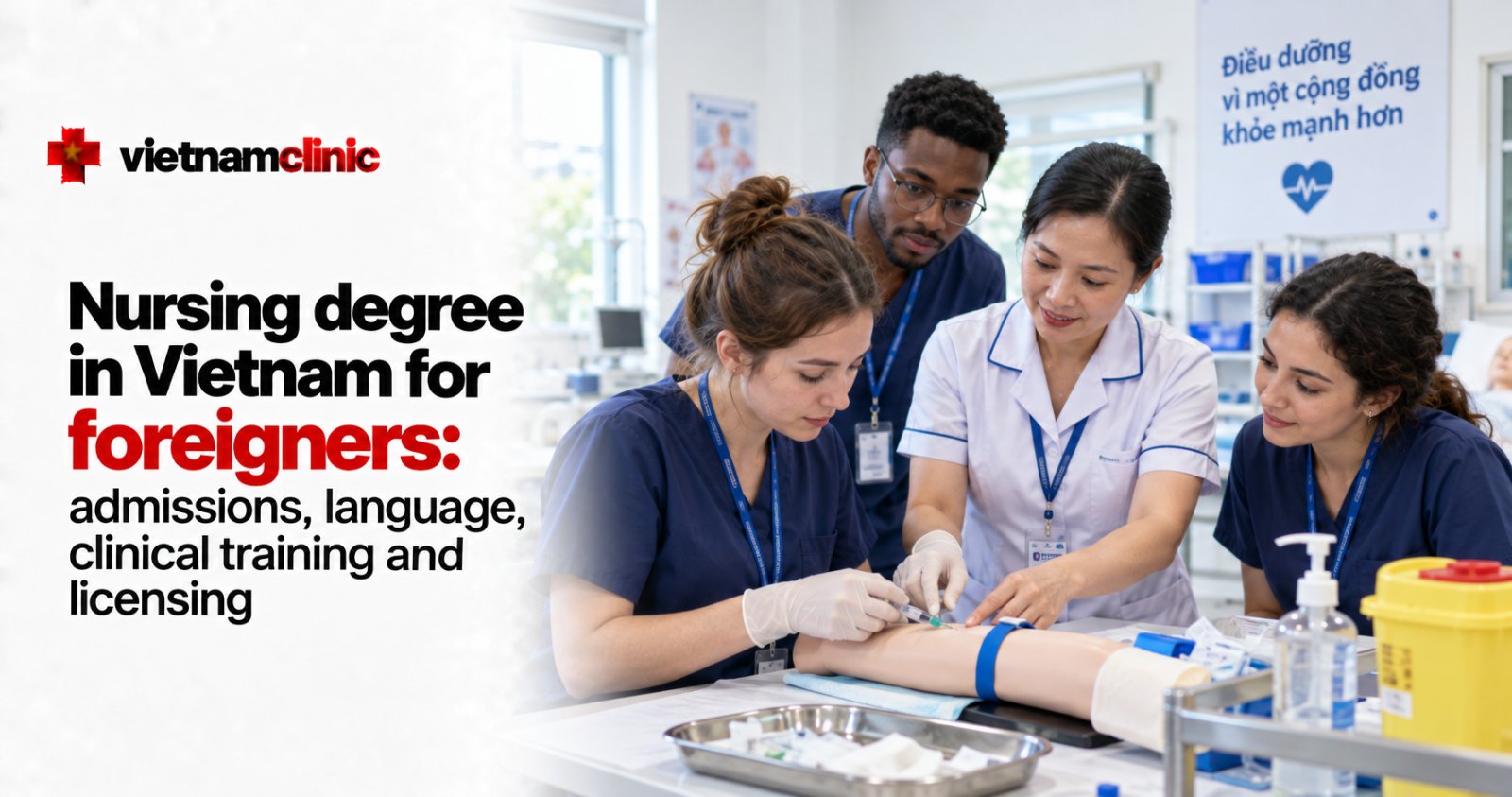
Foreign students can study Nursing in Vietnam at selected universities, but there is no single national admissions route for every institution. The main questions are whether the university accepts foreign applicants, what language the degree uses, how clinical training works and what additional steps are required to practise professionally after graduation.
These questions should be checked separately. Admission to a Nursing degree does not automatically provide a professional licence, and an English-language academic programme may still involve Vietnamese-language communication during clinical placements.
Can foreigners study Nursing in Vietnam?
Yes, there are verified universities in Vietnam that accept international undergraduate students and offer Nursing.
Can Tho University of Medicine and Pharmacy states in its 2026 undergraduate admissions notice that it receives applications from foreign candidates who completed upper-secondary education abroad. The same notice lists Nursing as one of its undergraduate programmes.
VinUniversity also actively admits international undergraduate students and offers a four-year Bachelor of Nursing through its College of Health Sciences.
Availability is still institution-specific. A university that offers Nursing to Vietnamese applicants does not necessarily use the same process for international candidates.
How long is a Nursing degree in Vietnam?
A bachelor's degree in Nursing is commonly four years.
VinUniversity's published 2026 to 2027 tuition information lists the Bachelor of Nursing with a standard duration of four years.
Other universities may structure the degree by credits, and students can take longer if they repeat modules or interrupt their studies. Always check the current curriculum and graduation requirements rather than assuming every Nursing programme follows the same timetable.
Admission requirements for foreign students
There is no universal checklist for all Vietnamese universities.
A foreign applicant should expect to prove completion of secondary education at a level accepted for university entry. Depending on the institution, the application may also require:
- passport and identity documents,
- secondary-school diploma,
- transcripts,
- translated or legalised academic documents,
- proof of language proficiency,
- health documentation,
- application forms,
- and additional international-student paperwork.
Can Tho University of Medicine and Pharmacy's 2026 admissions notice states that foreign applicants who graduated from upper-secondary school, or an equivalent programme, can apply through a foreign-student admissions method.
At VinUni, undergraduate admissions are open to international candidates, and from 2026 the university requires incoming students to meet its published English-language standard.
The exact academic threshold for foreign qualifications can differ from the route used by students taking Vietnam's national high-school examination.
Language of instruction
Do not assume that Nursing is taught in English simply because a university accepts foreigners.
Some universities may teach Nursing primarily in Vietnamese, while others provide English-medium or internationally oriented programmes. VinUni's undergraduate environment is English-focused, but international College of Health Sciences students also face Vietnamese-language expectations connected to clinical communication.
VinUni's 2026 Vietnamese-language guidance for international health-sciences students states that language preparation is intended to support communication during clinical clerkships.
That distinction is important. Classroom language and clinical language are not always the same thing.
Before applying, ask the university to confirm:
- the official teaching language,
- the language used for examinations,
- whether Vietnamese is required before clinical placements,
- the minimum Vietnamese level expected,
- and whether language support is provided.
For broader language context, see Are There English-Speaking Universities in Vietnam?.
Clinical training is a core part of the degree
Nursing is a professional healthcare degree, so students should expect substantial practical and clinical education.
The precise placement structure depends on the university. Students may train in university-affiliated hospitals, partner hospitals or other healthcare facilities.
International applicants should ask:
- when clinical placements begin,
- which hospitals are used,
- how many clinical hours are required,
- what patient-facing responsibilities students have,
- whether Vietnamese proficiency is tested before placements,
- and what happens if a student does not meet the clinical-language requirement on time.
Clinical communication is not a minor issue. Nurses need to understand patients, instructions, documentation and team communication safely.
Tuition for international Nursing students
Tuition varies by university and programme.
Can Tho University of Medicine and Pharmacy lists expected 2026 to 2027 Nursing tuition at 57,137,000 VND per academic year in its general undergraduate fee schedule.
International students should confirm whether that amount applies to their foreign-student route or whether a separate fee schedule is used.
VinUniversity lists Bachelor of Nursing tuition at 349,650,000 VND per academic year for 2026 to 2027 before its published founder-funded tuition support. The university states that admitted students are eligible for a 35 percent education-development subsidy, including international students.
The final amount can therefore differ from the listed tuition depending on programme policy, scholarships and financial aid.
A separate Vietnam Clinic article, Are Universities Free in Vietnam? Tuition Fees for Medical and Health Degrees, explains the broader tuition system.
Other costs to budget for
Nursing students can face additional costs beyond academic tuition.
Depending on the university, these can include:
- uniforms and clinical shoes,
- medical equipment,
- vaccinations or health checks,
- insurance,
- books and online resources,
- accommodation,
- local transport to clinical placements,
- and administrative fees.
Ask whether clinical-placement costs are included in tuition and whether students need to travel to different hospitals.
Qualification awarded
The exact degree title should be confirmed with the university.
A Bachelor of Nursing is an academic qualification. It shows that the student has completed the university's programme, but it should not be confused with automatic permission to work as a licensed nurse.
International students planning to use the qualification outside Vietnam should also check whether the nursing regulator in their destination country recognises the degree and clinical hours.
Does graduating let you work as a nurse in Vietnam?
Not automatically.
Vietnam's Law on Medical Examination and Treatment includes nurses among healthcare professionals subject to practice-licensing conditions.
The licensing framework can include professional competence, health requirements and language conditions, particularly for foreign practitioners.
A foreign graduate who wants to work as a nurse in Vietnam should therefore check the current licensing requirements with the competent health authority when approaching graduation. Rules can change during a four-year degree.
Vietnamese-language requirements for professional practice
Clinical education and professional licensing are separate but related language issues.
A student may be admitted to an English-language programme and still need Vietnamese for patient care. Later, a foreign healthcare practitioner may face additional legal language requirements when applying to practise.
Vietnam's healthcare law contains specific provisions for foreign practitioners and the languages used in medical examination and treatment.
For that reason, an international student who plans to work in Vietnam should treat Vietnamese as part of professional preparation rather than only an admissions requirement.
International admission is not the same as immigration permission
University admission and immigration status are separate processes.
Receiving an offer from a Vietnamese university does not by itself guarantee a visa or other immigration permission. Ask the university's international office which documents it provides for student immigration procedures and what the applicant must complete independently.
Do not pay major non-refundable amounts until you understand the institution's refund policy if immigration documentation is delayed or refused.
How to compare Nursing programmes
A useful comparison looks beyond tuition.
Check:
Programme duration and credits
Confirm how many years and credits are required.
Language
Find out whether the programme is Vietnamese-medium, English-medium or mixed.
Clinical placements
Ask which hospitals are used and how patient-facing placements are supervised.
International eligibility
Confirm that the university accepts your foreign school qualification.
Tuition
Get the fee for your exact student category, not just a general domestic rate.
Professional recognition
Check both Vietnamese licensing rules and the requirements in any country where you may later work.
What to confirm before applying
Before submitting an application or paying a deposit, obtain written answers to the following:
- Are foreign students eligible for this Nursing programme?
- What school qualifications are accepted?
- Does my foreign diploma require formal recognition?
- What is the teaching language?
- What English or Vietnamese level is required?
- What is the 2026 to 2027 tuition for international students?
- Are clinical-placement fees included?
- Which hospitals provide training?
- Are vaccinations or health checks required?
- What qualification is awarded?
- What additional licensing steps are required after graduation?
These questions prevent the most common misunderstanding: assuming that getting into the degree is the same as becoming legally eligible to work as a nurse.
Bottom line
Foreign students can study Nursing in Vietnam at selected universities. Can Tho University of Medicine and Pharmacy explicitly accepts foreign applicants in its 2026 undergraduate admissions framework and offers Nursing, while VinUniversity admits international undergraduates and offers a four-year Bachelor of Nursing.
The best option depends on language, tuition, clinical training and professional plans. Confirm each of those directly with the university and treat professional licensing as a separate step from completing the degree.
Frequently Asked Questions
Can international students study Nursing in Vietnam?
Yes. Some universities explicitly accept foreign undergraduate applicants and offer Nursing. Admission rules are institution-specific, so applicants should confirm eligibility directly.
How long is a Nursing degree in Vietnam?
A bachelor's Nursing programme is commonly four years. The exact credit load, clinical hours and graduation requirements depend on the university.
Can I study Nursing in English in Vietnam?
Some programmes may use English, but applicants should verify the official teaching and assessment language. Clinical placements may still require Vietnamese for safe patient communication.
How much does a Nursing degree cost in Vietnam?
Fees vary widely. CTUMP lists 57.137 million VND per year for Nursing in its general 2026 to 2027 fee schedule, while VinUni lists 349.65 million VND before its published tuition support.
Does a Nursing degree automatically let a foreign graduate work in Vietnam?
No. Graduation and professional licensing are separate. Foreign graduates must meet the healthcare-practice rules in force when they apply to work.
Do foreign Nursing students need Vietnamese?
They may, particularly for clinical placements and patient communication. The required level depends on the university and may also matter later for professional practice.
Sources

Writer
Jonathan García-Allen
Psychologist, book author and digital strategist specializing in mental health. He co-founded Psicología y Mente, one of the world’s most visited mental health websites, with more than 20 million visits per month. He has more than 10 years of experience creating health content and helping psychologists, therapists and clinics grow their online presence through content, SEO and digital marketing

Medical review
Tan Nguyen
Medical writer for Vietnam Clinic. MD, Vietnam National University Ho Chi Minh City.