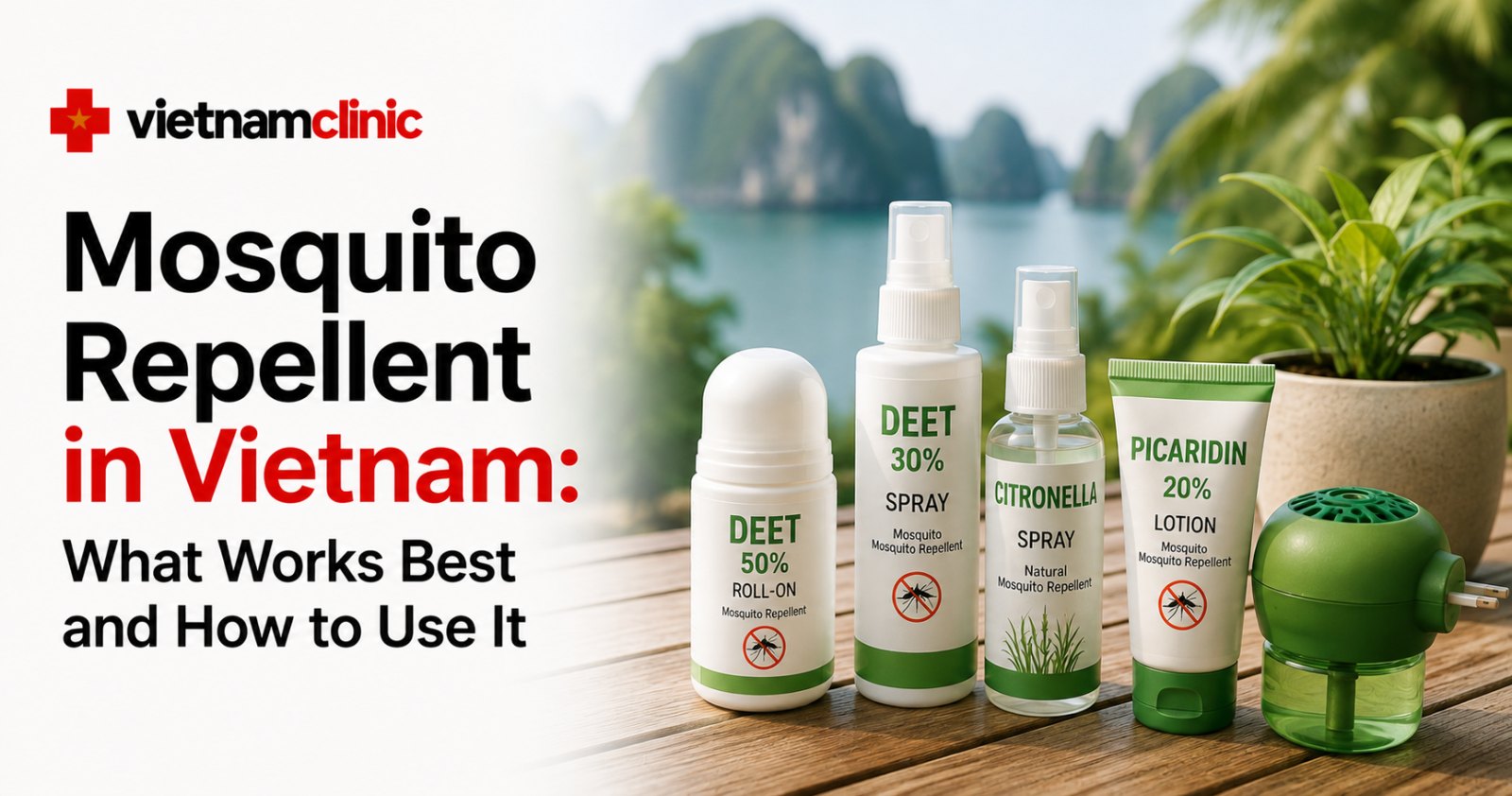
Mosquito repellent is one of the most useful health products to pack or buy when travelling in Vietnam. Mosquitoes are not simply an annoyance: they can transmit infections including dengue, and malaria remains relevant in selected parts of the country.
For most travelers, the best mosquito repellent in Vietnam is a product containing a proven active ingredient such as DEET or picaridin, applied correctly to exposed skin. IR3535 and certain products containing oil of lemon eucalyptus or PMD can also provide protection.
The percentage of active ingredient matters mainly because it affects how long protection lasts. A stronger formulation does not necessarily repel more mosquitoes at every moment, but it can reduce how frequently you need to reapply the product.
What is the best mosquito repellent for Vietnam?
For most adults, two of the easiest options are:
- DEET at 20% or more.
- Picaridin, also called icaridin, in an appropriate concentration according to the product instructions.
CDC specifically recommends a repellent containing at least 20% DEET for protection against ticks and mosquitoes lasting several hours. For mosquito protection alone, it also lists picaridin, DEET, oil of lemon eucalyptus or PMD, IR3535 and 2-undecanone as useful active ingredients.
WHO's Vietnam dengue guidance specifically mentions repellents containing DEET, IR3535 or icaridin as practical measures for preventing mosquito bites.
DEET: the classic choice
DEET has been used as an insect repellent for decades and remains one of the best-established choices for travel to tropical destinations.
Advantages include:
- Strong evidence of effectiveness.
- Broad availability.
- Long protection at higher concentrations.
- Protection against mosquitoes and ticks.
For Vietnam, a product containing around 20% to 30% DEET is a practical choice for many travelers.
Higher concentrations generally extend protection time rather than making the product dramatically more powerful against each mosquito.
A very high concentration may therefore be unnecessary for an ordinary day in Ho Chi Minh City or Da Nang if you are willing to reapply according to the label.
Is 50% DEET better than 20% DEET?
It usually lasts longer, but that does not mean everyone needs it.
A 20% to 30% product can be enough for many everyday situations, while a higher-concentration product may be useful when:
- You will be outdoors for many hours.
- You are hiking or camping.
- Reapplication will be inconvenient.
- Mosquito exposure is intense.
- You are travelling in remote areas.
Always follow the manufacturer's instructions rather than applying more frequently than recommended.
Picaridin or icaridin: an excellent alternative to DEET
Picaridin is also known as icaridin outside some markets.
It is another well-established mosquito repellent recommended by CDC and WHO.
Many travelers prefer it because it generally:
- Feels less oily on the skin.
- Has little or no strong odor.
- Is less likely than DEET to damage certain plastics and synthetic materials.
- Provides effective mosquito protection.
For someone who dislikes the smell or feel of DEET, picaridin is often the most practical alternative.
DEET vs picaridin: which is better for Vietnam?
Both can work very well.
| Feature | DEET | Picaridin |
|---|---|---|
| Mosquito protection | Excellent | Excellent |
| Long history of use | Very extensive | Extensive |
| Odor | Can be noticeable | Usually mild |
| Feel on skin | Can feel oily | Often lighter |
| Effect on some plastics | Can damage some materials | Less likely to do so |
| Good choice for Vietnam | Yes | Yes |
For most travelers, the best choice is simply the one you are comfortable applying consistently.
A repellent sitting unused in your suitcase because you dislike the smell offers no protection.
What about IR3535?
IR3535 is another active ingredient used in mosquito repellents.
WHO includes IR3535 among the repellents recommended for reducing mosquito bites and dengue risk.
It can be a reasonable option when properly formulated and used according to the product label.
As with other repellents, protection time varies according to concentration, formulation, temperature, sweating and other conditions.
Does citronella work?
Citronella-based products can repel mosquitoes to some extent, but protection is often shorter than with established active ingredients such as DEET or picaridin.
For casual evening use in a low-risk setting, some people may find citronella products acceptable.
For travel in a country where dengue is endemic, relying exclusively on a weak or short-lasting botanical product is less reassuring.
If preventing mosquito-borne disease is the priority, choose a product with an active ingredient recommended by major public-health authorities.
What about oil of lemon eucalyptus?
Oil of lemon eucalyptus, or OLE, and its active component PMD appear on CDC's list of effective mosquito-repellent ingredients.
However, these should not be confused with ordinary lemon eucalyptus essential oil.
A formulated repellent containing OLE or PMD is different from applying an essential oil directly to the skin.
CDC also advises against using OLE or PMD products on children under three years of age.
Essential oils are not automatically safer or better
Products marketed as natural can contain ingredients such as:
- Citronella.
- Lemongrass.
- Eucalyptus oils.
- Peppermint.
- Lavender.
Some may provide temporary mosquito-repellent effects, but protection can be shorter and less predictable than with registered repellents containing DEET, picaridin or other established ingredients.
Natural origin does not automatically mean a product is more effective or less likely to irritate the skin.
Why mosquito repellent matters in Vietnam
Vietnam has mosquito-borne diseases that travelers should take seriously.
The most important for many visitors is dengue.
WHO states that dengue occurs in Vietnam and that transmission generally peaks from June to October, with the central and southern parts of the country historically accounting for a large proportion of cases.
Dengue is transmitted by Aedes mosquitoes, which often live close to people in urban and residential environments.
This means you do not need to be trekking through a jungle to encounter mosquitoes capable of transmitting dengue.
Dengue mosquitoes bite during the day
One of the most important practical facts is that mosquitoes transmitting dengue are active during the daytime.
Many travelers protect themselves only at sunset because they associate mosquito bites with evenings.
That is not enough for dengue prevention.
Use mosquito repellent during daytime activities when mosquitoes are present, particularly in areas with active dengue transmission.
WHO recommends protective clothing, mosquito repellent, screens and other mosquito-control measures to reduce dengue risk.
For more information about travel health preparation, see Vaccinations for Vietnam: What Travelers Need Before Their Trip.
What about malaria in Vietnam?
Malaria risk is more geographically limited than dengue risk.
It is mainly relevant in selected rural and forested parts of Vietnam rather than the major urban centers most tourists visit.
Mosquito repellent remains important because the Anopheles mosquitoes that transmit malaria can bite at different times from Aedes mosquitoes.
Travelers visiting malaria-risk areas may need both bite prevention and prescription antimalarial medication depending on the itinerary.
How often should you reapply mosquito repellent?
There is no universal reapplication interval for every product.
Follow the label instructions.
Protection duration depends on:
- Active ingredient.
- Concentration.
- Product formulation.
- Sweating.
- Swimming.
- Temperature.
- Physical activity.
Higher percentages of the active ingredient generally provide longer-lasting protection.
If you are sweating heavily in Vietnam's heat or spending time outdoors for many hours, you may need to reapply according to the manufacturer's instructions.
Does sweating make mosquito repellent less effective?
It can.
Vietnam's heat and humidity can increase sweating, particularly during walking, running or sightseeing.
Heavy sweating may shorten the practical protection time of some products.
Water exposure can have a similar effect.
If you swim, shower or sweat heavily, check the product instructions to determine when reapplication is appropriate.
How should you apply mosquito repellent?
Apply repellent to exposed skin according to the product label.
Useful principles include:
- Apply enough to cover exposed areas evenly.
- Do not spray directly into your face.
- Spray onto your hands first, then apply carefully to the face.
- Avoid eyes and mouth.
- Avoid applying over cuts, wounds or irritated skin.
- Wash repellent off when you no longer need protection.
- Wash hands after application, particularly before eating.
More product does not necessarily mean more protection than the label recommends.
Should mosquito repellent go before or after sunscreen?
When using both products, CDC recommends applying sunscreen first and insect repellent afterward.
This can be especially relevant in Vietnam because travelers may need both products throughout much of the year.
Reapply sunscreen according to its instructions, while following the separate label directions for repellent.
Do not assume the two products need to be reapplied at exactly the same intervals.
Combination sunscreen and repellent products are not always ideal
Sunscreen often needs to be reapplied more frequently than insect repellent.
Using separate products allows each one to be reapplied according to its own instructions.
For a beach day, for example, you may need repeated sunscreen application while a higher-concentration repellent continues providing protection for longer.
Is mosquito repellent safe during pregnancy?
CDC states that registered insect repellents containing recommended active ingredients can be used safely and effectively during pregnancy and breastfeeding when used according to the product label.
This includes products containing ingredients such as:
- DEET.
- Picaridin.
- OLE or PMD where age-appropriate.
- Other approved ingredients.
Preventing mosquito bites can be particularly important during pregnancy because some mosquito-borne infections can cause additional health concerns.
People with unusual medical circumstances can discuss product choice with a healthcare professional.
What mosquito repellent is suitable for children?
Children also need protection from mosquito bites, but products must be used carefully.
CDC advises adults to apply repellent to children rather than allowing young children to handle it themselves.
Do not apply repellent to:
- A child's hands if they may put them in their mouth.
- Eyes.
- Mouth.
- Cuts or irritated skin.
Do not use products containing OLE or PMD on children younger than three years.
Follow age instructions on the specific product label.
Babies need additional physical protection
For very young children, physical barriers are especially useful.
Options include:
- Mosquito netting over strollers or carriers.
- Long, lightweight clothing.
- Screened or air-conditioned rooms.
Make sure netting is properly secured and does not create a suffocation hazard.
Should you spray repellent on clothing?
Some repellents can be used on clothing if the label permits it.
There is also a separate option: permethrin-treated clothing and gear.
CDC recommends permethrin-treated items such as:
- Shirts.
- Trousers.
- Socks.
- Boots.
- Tents.
Permethrin should not be applied directly to the skin.
It is used to treat clothing, mosquito nets and other equipment according to product instructions.
Do you need permethrin-treated clothes in Vietnam?
Most ordinary city travelers probably do not need to treat their entire wardrobe.
It becomes more useful for:
- Trekking.
- Camping.
- Rural travel.
- Long stays in mosquito-heavy environments.
- Forest travel.
A combination of treated clothing and topical repellent can provide stronger protection when mosquito exposure is intense.
Long sleeves can reduce how much repellent you need
WHO recommends clothing that covers as much of the body as practical as part of dengue prevention.
Lightweight long sleeves and trousers can be surprisingly comfortable in Vietnam if the fabric is breathable.
They are particularly useful:
- Around sunrise and sunset.
- Near vegetation.
- In areas with large mosquito populations.
- During outdoor dining.
Repellent can then be concentrated mainly on exposed skin.
Do mosquito coils work?
WHO includes coils and vaporizers among household measures that may reduce mosquito biting.
They can be useful on balconies, patios and other semi-open areas.
However, they should supplement rather than replace personal repellent in environments where mosquito-borne disease is a concern.
Always follow ventilation and safety instructions because coils produce smoke.
Are plug-in mosquito repellents useful?
Electric vaporizers can help reduce mosquitoes indoors.
They may be useful in apartments or hotel rooms, especially where doors are opened frequently.
Other useful indoor measures include:
- Air conditioning.
- Window screens.
- Door screens.
- Mosquito nets.
WHO notes that screens and air conditioning can reduce mosquito contact inside homes.
Does air conditioning stop mosquito bites?
Air conditioning can reduce mosquito activity and usually means doors and windows remain closed, but it does not create complete protection.
A mosquito already inside the room can still bite.
Use screens, repellents or mosquito-control products as appropriate rather than treating air conditioning as a guaranteed mosquito barrier.
Do mosquito bracelets work?
Bracelets are generally much less reliable than applying an effective repellent directly to exposed skin.
A small repellent source around the wrist cannot necessarily protect the ankles, legs, neck and other exposed areas effectively.
For dengue prevention, use proven topical repellents rather than relying on bracelets, ultrasonic devices or similar gadgets as your main protection.
What about ultrasonic mosquito repellents?
There is no good reason to rely on ultrasonic electronic devices as a primary mosquito-bite prevention strategy.
Travel health authorities instead recommend measures with established evidence, including:
- Topical repellents.
- Protective clothing.
- Screens.
- Mosquito nets.
- Permethrin-treated clothing and equipment.
A phone app claiming to repel mosquitoes should not replace these methods.
Can you buy mosquito repellent in Vietnam?
Yes. Mosquito repellents are widely available in Vietnam.
Travelers can find them at places such as:
- Pharmacies.
- Supermarkets.
- Convenience stores.
- Outdoor shops.
- Some hotel shops.
Selection can vary considerably.
Check the active ingredient and concentration rather than choosing solely by packaging or fragrance.
If you cannot read the Vietnamese label easily, look specifically for terms such as:
- DEET.
- Icaridin.
- Picaridin.
- IR3535.
Should you bring repellent from home?
It can be useful, particularly if you already know which formulation works well for your skin.
Bringing your own product also ensures that you have protection immediately after arriving rather than searching for a pharmacy on your first evening.
However, running out is not usually a major problem in cities such as Hanoi, Ho Chi Minh City and Da Nang because repellents are commonly sold locally.
Where are mosquitoes worst in Vietnam?
Mosquito numbers vary according to weather, location and local breeding sites.
You may encounter more mosquitoes around:
- Standing water.
- Gardens.
- Shaded vegetation.
- Construction sites with water containers.
- Rural areas.
- Poorly screened accommodation.
Urban environments can also support large Aedes mosquito populations because these mosquitoes breed effectively in small containers of standing water close to homes.
Rainy weather can increase mosquito breeding
Containers collecting rainwater can create breeding sites around homes, hotels and construction areas.
WHO recommends reducing mosquito breeding by emptying, cleaning or covering containers that hold water.
Potential sites include:
- Buckets.
- Flower pots.
- Bottles.
- Tires.
- Water tanks.
- Construction materials.
Long-term residents can reduce mosquito exposure significantly by checking their own balcony, garden or outdoor area for standing water.
Should you use repellent every day in Vietnam?
Not necessarily every minute of every day.
Use depends on:
- Current mosquito activity.
- Location.
- Season.
- Time spent outdoors.
- Local dengue activity.
- Your accommodation.
For someone spending time outside in a mosquito-prone area, consistent repellent use is sensible.
You may need much less protection while spending the entire day inside an air-conditioned office or hotel with good screens.
What if you are bitten despite using repellent?
No repellent provides perfect protection.
For an ordinary mosquito bite:
- Avoid scratching.
- Keep the skin clean.
- Consider an appropriate anti-itch product if necessary.
Mosquito bites alone do not mean you have dengue or another infection.
Monitor your health if you later develop systemic symptoms such as significant fever, severe headache, muscle or joint pain, rash or marked fatigue.
When should you worry about dengue after mosquito bites?
Most mosquito bites do not cause dengue.
Seek medical advice if you develop a significant febrile illness while in Vietnam or shortly after travel, particularly if symptoms are compatible with dengue.
WHO advises people with suspected dengue to avoid NSAIDs such as ibuprofen and aspirin because of bleeding risk. Paracetamol is generally preferred for fever and pain when appropriate.
Do not try to diagnose dengue based only on the appearance of a mosquito bite.
A practical mosquito-protection routine for Vietnam
For most travelers, a simple routine works well:
- Carry a DEET or picaridin repellent.
- Apply it to exposed skin before spending time outdoors where mosquitoes are active.
- Use sunscreen first and repellent afterward.
- Reapply according to the label, especially after heavy sweating or water exposure where instructed.
- Wear lightweight long clothing when mosquito exposure is high.
- Use screened or air-conditioned accommodation where possible.
- Consider a mosquito net if sleeping in an exposed room.
- Use permethrin-treated clothing for higher-risk rural or outdoor travel.
- Remove standing water around long-term accommodation.
- Continue daytime protection because dengue mosquitoes are active during the day.
What should you pack for a two-week Vietnam trip?
For an ordinary tourist itinerary, a reasonable mosquito kit is simple:
- One effective DEET or picaridin repellent.
- Lightweight long trousers.
- One or two long-sleeved breathable tops.
- Sunscreen.
- Optional anti-itch cream for bites.
Travelers going trekking or camping can add:
- Permethrin-treated clothing.
- A mosquito net where appropriate.
- Additional repellent for longer outdoor exposure.
There is usually no need to travel with a suitcase full of mosquito-control products.
Frequently Asked Questions
The answers below cover common questions about mosquito repellent in Vietnam. Protection duration and age restrictions depend on the individual formulation, so always follow the manufacturer's label.
What is the best mosquito repellent for Vietnam?
DEET and picaridin are two of the best-established choices. CDC recommends products containing 20% or more DEET for protection lasting several hours, while picaridin is also an effective option against mosquitoes.
How much DEET do I need for Vietnam?
A product containing around 20% to 30% DEET is practical for many travelers. Higher concentrations generally provide longer-lasting protection and may be useful for prolonged outdoor or rural exposure.
Is picaridin better than DEET?
Both are effective. Picaridin often feels lighter, has less odor and is less likely to damage plastics, while DEET has an exceptionally long history of use. The best option is usually the one you are comfortable applying consistently.
Do I need mosquito repellent during the day in Vietnam?
Yes. The Aedes mosquitoes that transmit dengue are active during the daytime, so mosquito protection should not be limited to evenings.
Can I buy mosquito repellent in Vietnam?
Yes. Repellents are widely available in pharmacies, supermarkets and convenience stores. Check the active ingredient and concentration rather than relying only on the brand name.
Is mosquito repellent safe during pregnancy?
CDC states that registered insect repellents with recommended active ingredients can be used during pregnancy and breastfeeding when applied according to the product label.
Can children use DEET mosquito repellent?
Children can use appropriate registered repellents when the product instructions permit it. Adults should apply the product for young children and avoid their hands, eyes, mouth and irritated skin. OLE or PMD should not be used in children under three.
Should I put sunscreen or mosquito repellent on first?
Apply sunscreen first and mosquito repellent afterward. Follow each product's separate instructions for reapplication.
Conclusion
The best mosquito repellent for Vietnam is generally one containing a proven active ingredient such as DEET or picaridin. IR3535 and properly formulated OLE or PMD products can also be effective alternatives.
A DEET product containing around 20% or more is a practical choice for many travelers, while picaridin is particularly attractive for people who prefer a lighter feel and less noticeable odor.
Mosquito protection matters throughout Vietnam because dengue is endemic and the mosquitoes that transmit it can bite during the daytime. Repellent works best as part of a broader strategy that includes protective clothing, screened accommodation and reducing standing water.
Choose a product you will actually use consistently, follow the label and remember that the active ingredient matters much more than whether the packaging claims the repellent is tropical, natural or extra strong.
Sources

Writer
Jonathan García-Allen
Psychologist, book author and digital strategist specializing in mental health. He co-founded Psicología y Mente, one of the world’s most visited mental health websites, with more than 20 million visits per month. He has more than 10 years of experience creating health content and helping psychologists, therapists and clinics grow their online presence through content, SEO and digital marketing

Medical review
Tan Nguyen
Medical writer for Vietnam Clinic. MD, Vietnam National University Ho Chi Minh City.