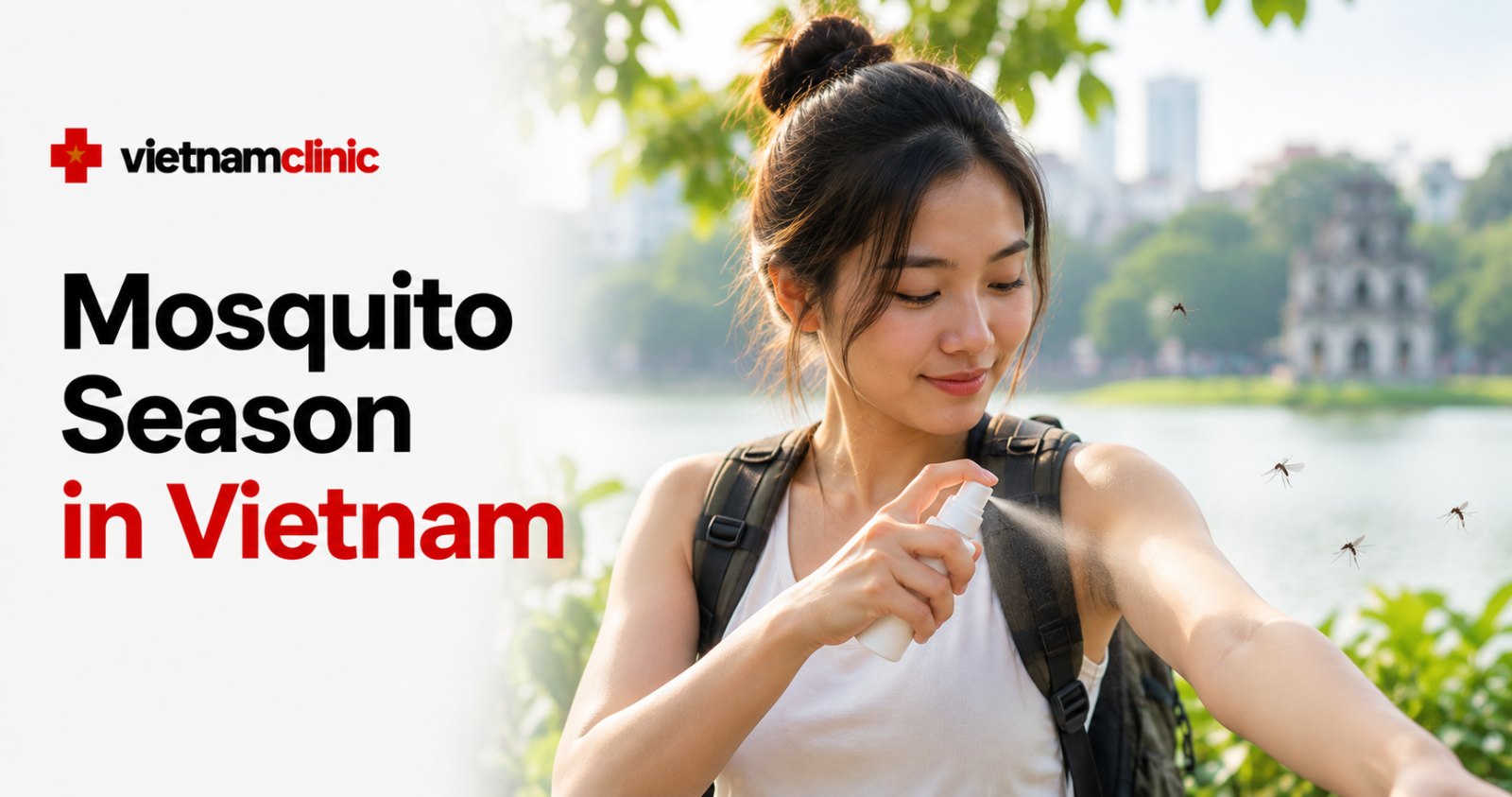
Mosquitoes are present throughout the year in Vietnam, but there is a clear seasonal pattern. Numbers generally increase during warm, humid and rainy periods, when standing water creates more breeding sites.
For travelers and residents, mosquito season in Vietnam is most important during the rainy season, particularly because dengue transmission tends to increase at this time. However, Vietnam's climate varies considerably from north to south, so there is no single mosquito season that applies equally to Hanoi, Da Nang, Ho Chi Minh City and the Mekong Delta.
Dengue can be transmitted throughout the year in Vietnam. The World Health Organization notes that dengue cases nationally tend to peak from June to October, while Vietnam's Ministry of Health has reported particularly high transmission during the broader period from June or July into November.
When is mosquito season in Vietnam?
Mosquito activity can occur throughout the year, but the main period of increased activity generally coincides with the rainy season.
For much of Vietnam, this means mosquito numbers and dengue risk tend to rise from approximately May or June through October or November.
There are important regional differences:
- Southern Vietnam: mosquitoes and dengue can occur year-round, with increased risk during the rainy season
- Central Vietnam: mosquito-borne disease can occur throughout the year, although rainfall patterns influence local peaks
- Northern Vietnam: mosquito activity becomes much more pronounced during the warmer and wetter months, roughly from April to November
- Central Highlands: dengue activity is also more seasonal and commonly increases during the warmer rainy months
The Ministry of Health has historically identified July to October as an especially important period for dengue transmission nationally.
Are there mosquitoes in Vietnam all year?
Yes.
Vietnam does not have a completely mosquito-free season.
This is particularly true in the south, where temperatures remain relatively warm throughout the year. The Ministry of Health notes that dengue occurs year-round in southern and central Vietnam.
In northern areas, colder and drier winter conditions reduce mosquito activity considerably, but they do not mean that mosquitoes disappear everywhere.
The CDC also describes dengue as endemic in Vietnam, with transmission occurring year-round even though cases peak during the summer rainy season.
For travelers, this means mosquito bite prevention is worth considering regardless of the month of travel.
Why are there more mosquitoes during the rainy season?
Rainfall creates additional places where mosquitoes can lay eggs and their larvae can develop.
Common breeding sites include relatively small collections of standing water, such as:
- Buckets
- Plant saucers
- Water storage containers
- Discarded bottles and cans
- Tires
- Gutters
- Outdoor containers
- Construction areas
- Uncovered household water tanks
Warm temperatures and high humidity also favor mosquito survival and reproduction.
WHO notes that rainfall, temperature and humidity all influence mosquito populations and dengue transmission.
Heavy rain itself does not necessarily mean that mosquitoes immediately become more numerous. The increased risk often follows rain because water remains in containers and other breeding sites after the storm has passed.
When is mosquito season in Ho Chi Minh City?
Ho Chi Minh City has a tropical climate with warm temperatures throughout the year.
Its rainy season generally extends through much of the middle and later part of the year, and mosquito populations can increase as rainfall creates more breeding sites.
For practical purposes, mosquito and dengue precautions are particularly important during the rainy months, approximately May to November.
However, residents and travelers should not assume that the dry season eliminates the risk. Dengue transmission is possible throughout the year in southern Vietnam.
Urban environments can support Aedes aegypti, the mosquito that is the main dengue vector in Vietnam, because it breeds efficiently around homes and human settlements.
When is mosquito season in Hanoi?
Hanoi has a more pronounced seasonal climate than southern Vietnam.
Winters are cooler and generally less favorable for mosquito activity, while the warmer, humid months create much better conditions for mosquito reproduction.
In northern Vietnam, the Ministry of Health has historically reported that dengue occurs mainly between approximately April and November.
The highest mosquito activity is generally associated with the hot and rainy summer months.
Travelers visiting Hanoi from late spring through autumn should therefore expect mosquitoes and use bite-prevention measures, especially around areas with vegetation or standing water.
When is mosquito season in Da Nang and central Vietnam?
Da Nang and central Vietnam have a different rainfall pattern from both Hanoi and Ho Chi Minh City.
Rainfall becomes particularly heavy later in the year, and tropical storms can create substantial amounts of standing water.
Mosquitoes can nevertheless be present throughout the year because central Vietnam remains relatively warm.
WHO states that most dengue cases and deaths in Vietnam historically occur in the central and southern regions, although dengue is present across the country.
Because local weather can vary substantially from year to year, it is more useful to think in terms of rainfall, temperature and standing water than to rely on a single fixed start date for mosquito season.
When is mosquito season in the Mekong Delta?
The Mekong Delta has a warm tropical climate that supports mosquitoes throughout the year.
Mosquito activity often becomes more noticeable during the rainy season, when abundant water and high humidity provide favorable breeding conditions.
Southern Vietnam has historically carried a large share of Vietnam's dengue burden, and research on southern Vietnam has found clear seasonal peaks during rainy months despite year-round transmission.
People living in or traveling through the Mekong Delta should therefore use mosquito protection throughout the year and pay particular attention during periods of sustained rainfall.
Is dengue more common during mosquito season?
Yes. Dengue transmission in Vietnam typically increases during the rainy season.
WHO reports that dengue in Vietnam peaks from June to October annually.
Vietnam's Ministry of Health has similarly reported that dengue cases often rise sharply from June through November and that July to October has traditionally been a period of particularly intense transmission.
This does not mean dengue disappears outside these months.
The CDC emphasizes that dengue transmission occurs throughout the year in Vietnam.
For a detailed guide to symptoms and prevention, see Dengue Fever in Vietnam: Symptoms, Risk and Prevention.
What mosquitoes transmit dengue in Vietnam?
Dengue is transmitted mainly by Aedes mosquitoes.
The two important species are:
- Aedes aegypti
- Aedes albopictus
Aedes aegypti is considered the principal dengue vector in Vietnam.
Unlike some mosquitoes that are most active after sunset, Aedes mosquitoes commonly bite during the daytime.
This is important for travelers who assume mosquito protection is needed only in the evening.
Bite prevention during daylight hours is also important in areas where dengue is circulating.
What time of day are dengue mosquitoes most active?
Aedes mosquitoes are primarily daytime biters.
They can bite throughout the day, with activity often increasing during periods after sunrise and before sunset.
However, it is not useful to rely on a precise timetable because mosquito behavior varies with environmental conditions.
If you are in an area where dengue occurs, use protection during the day as well as in the evening.
This is different from the traditional association of mosquitoes only with nighttime biting.
Does the dry season mean there are no mosquitoes?
No.
Even during the dry season, mosquitoes can reproduce in water stored around homes, gardens, hotels and construction sites.
Aedes mosquitoes can use surprisingly small water containers as breeding sites.
Urban environments can therefore maintain mosquito populations even when rainfall is limited.
Southern Vietnam also remains warm enough for mosquito activity throughout much of the dry season.
Travelers visiting Vietnam between December and April should not completely abandon mosquito precautions simply because rainfall is lower.
Which mosquito-borne diseases occur in Vietnam?
Mosquito bites in Vietnam are not only a nuisance. Several mosquito-borne infections are relevant to travelers or residents.
These include:
- Dengue
- Japanese encephalitis
- Zika
- Malaria in selected areas
The level of risk and geographical distribution are very different for each disease.
Dengue is widespread and endemic in Vietnam, including urban areas.
Malaria is much more geographically restricted and is primarily relevant to certain rural and forested areas rather than major cities. See Malaria in Vietnam: Risk Areas, Prevention and Treatment for a separate explanation.
Are mosquitoes a problem in Vietnamese cities?
Yes.
Dengue is often thought of as a tropical jungle disease, but its main mosquito vector is highly adapted to urban environments.
Aedes aegypti frequently breeds close to homes and human activity.
Potential breeding sites can be found in:
- Apartment buildings
- Residential alleys
- Gardens
- Construction sites
- Restaurants and businesses
- Hotels
- Schools
- Outdoor storage areas
Living in a major city therefore does not eliminate dengue risk.
Ho Chi Minh City, Hanoi and Da Nang all experience mosquito activity, although the seasonal pattern differs between them.
Are mosquitoes worse after heavy rain?
They often become more noticeable in the days following periods of rain because standing water provides additional breeding sites.
Rainwater may accumulate in small containers that are easily overlooked.
Removing these water sources is one of the most important forms of household mosquito control.
Vietnamese health authorities regularly encourage residents to eliminate mosquito larvae and standing water as part of dengue prevention campaigns.
After heavy rain, check balconies, gardens, rooftops and outdoor containers for trapped water.
How to protect yourself during mosquito season in Vietnam
Reducing mosquito bites requires several measures rather than relying on one product alone.
Useful precautions include:
- Use an effective insect repellent on exposed skin
- Wear long sleeves and long trousers when practical
- Use screens on windows and doors
- Sleep in air-conditioned or well-screened rooms when possible
- Use a mosquito net when sleeping in accommodation that is not adequately screened
- Remove standing water around accommodation
- Keep water storage containers covered
- Follow local dengue alerts and health advice
For help choosing a product, see Mosquito Repellent in Vietnam: What Works and How to Use It.
You can also compare common active ingredients in Best Mosquito Repellents in Vietnam: What Actually Works.
Which mosquito repellent works best in Vietnam?
The effectiveness of a repellent depends more on the active ingredient and concentration than the brand or country where it was purchased.
Established mosquito repellent active ingredients include:
- DEET
- Picaridin, also called icaridin
- IR3535
- Oil of lemon eucalyptus or PMD in appropriate products
Follow the instructions on the product label, particularly regarding how often it should be reapplied.
Sweating, swimming and heavy rain can reduce how long a repellent remains effective.
Do not assume that a strongly scented herbal product provides the same duration of protection as a repellent containing a well-established active ingredient.
Should you wear mosquito repellent every day in Vietnam?
During periods of high mosquito activity, daily use can be reasonable when you spend time outdoors or in environments where mosquitoes are present.
Because Aedes mosquitoes bite during the daytime, applying repellent only before going out for dinner may leave you unprotected during a substantial part of the risk period.
The need for repellent depends on:
- Location
- Season
- Weather
- Accommodation
- Amount of time spent outdoors
- Current mosquito activity
During rainy-season travel, keeping repellent in a day bag can be practical.
Do mosquito coils work?
Mosquito coils can reduce mosquito activity in the immediate area, particularly in outdoor or semi-open spaces, but they should not be viewed as the only form of protection.
Personal repellent, clothing and physical barriers remain important.
Smoke from coils can also irritate the respiratory system, particularly in poorly ventilated spaces.
Avoid placing burning coils close to beds, curtains or flammable materials.
Do air-conditioned rooms reduce mosquito bites?
Air conditioning can reduce mosquito activity indoors because mosquitoes tend to be less active in cooler environments and windows are often kept closed.
However, air conditioning does not guarantee that a room is mosquito-free.
Mosquitoes may enter when doors are opened or may already be present inside.
Window screens, closed doors and personal repellent provide additional protection.
Do high-rise apartments have mosquitoes?
Yes.
Living on a high floor can reduce exposure in some situations, but it does not guarantee that mosquitoes will be absent.
Mosquitoes can enter elevators, stairwells and buildings with people, and breeding sites may exist on balconies, rooftops or inside structures.
Water collecting in plant pots, drains or containers on a balcony can create local breeding sites even well above street level.
How to reduce mosquitoes around your home
Household mosquito control is especially important during rainy periods.
At least once a week, inspect places where water may collect.
Useful actions include:
- Emptying unused containers
- Scrubbing and refilling pet water bowls
- Emptying plant saucers
- Covering stored water
- Clearing blocked drains and gutters
- Disposing of cans, bottles and other objects that collect rainwater
- Checking balconies and rooftop areas
Aedes mosquitoes often breed close to where people live, so removing small water sources can make a meaningful difference.
What should travelers pack during mosquito season?
A practical mosquito-prevention kit can include:
- Insect repellent
- Lightweight long-sleeved clothing
- Long trousers
- Mosquito net if staying in basic accommodation
- Sunscreen
- Basic thermometer
When using sunscreen and repellent together, follow the product instructions regarding application order.
Travelers staying in modern hotels may not need a mosquito net, but repellent remains useful for outdoor activities, restaurants, sightseeing and daytime excursions.
Should you worry about every mosquito bite?
No.
Most mosquito bites cause only temporary itching and swelling.
A bite itself does not mean you have contracted dengue or another mosquito-borne infection.
The important issue is whether symptoms develop afterward.
Seek medical advice if you develop significant fever or illness after mosquito exposure, particularly if symptoms include:
- High fever
- Severe headache
- Pain behind the eyes
- Muscle or joint pain
- Rash
- Persistent vomiting
- Abdominal pain
- Unusual bleeding
- Severe weakness
Dengue symptoms can initially resemble other viral illnesses, so diagnosis should not be based only on the fact that you remember being bitten by mosquitoes.
When should you see a doctor after mosquito exposure?
A mosquito bite alone usually does not require medical care.
Medical assessment is more important if you develop fever or significant systemic symptoms while in Vietnam or shortly afterward.
Seek prompt care for severe symptoms such as persistent vomiting, significant abdominal pain, bleeding, marked weakness, confusion or difficulty breathing.
Dengue can become more serious around the time the fever begins to decrease, so feeling less feverish does not always mean the illness is resolving normally.
Is mosquito season getting longer in Vietnam?
Mosquito activity is influenced by temperature, rainfall, humidity, urban development and local environmental conditions.
WHO identifies climate and environmental factors as important drivers of dengue transmission, and warmer or wetter conditions can create more favorable environments for mosquitoes.
However, it is difficult to define a fixed national mosquito season because Vietnam stretches across several climate zones.
For practical purposes, residents and travelers should respond to local weather and dengue activity rather than relying only on calendar months.
Frequently Asked Questions
What months are mosquito season in Vietnam?
Mosquitoes are present year-round, but activity generally increases during the rainy season. Dengue cases in Vietnam typically peak from approximately June to October, with higher transmission often extending into November.
What is the worst time of year for mosquitoes in Vietnam?
July through October is generally one of the most important periods for mosquito activity and dengue transmission nationally, although the exact peak differs between regions.
Are there mosquitoes in Vietnam in December?
Yes. Mosquitoes can still be present in December, particularly in southern Vietnam. Activity tends to fall more noticeably during the cooler winter months in northern Vietnam.
Are there mosquitoes in Vietnam during the dry season?
Yes. Mosquito numbers may decrease, but breeding can continue in stored water and small containers. Dengue transmission occurs throughout the year in Vietnam.
When is mosquito season in Ho Chi Minh City?
Mosquitoes are present year-round in Ho Chi Minh City, with increased activity generally associated with the rainy season from roughly May to November.
When is mosquito season in Hanoi?
Mosquito activity in Hanoi is highest during the warm, humid months. Dengue in northern Vietnam has traditionally been more common from approximately April through November.
Is dengue seasonal in Vietnam?
Dengue is transmitted throughout the year, but WHO reports that cases in Vietnam usually peak from June to October. Rainfall, temperature and humidity influence transmission.
Do mosquitoes in Vietnam bite during the day?
Yes. Aedes mosquitoes that transmit dengue are primarily daytime biters, so mosquito repellent and other precautions are important during daylight hours as well as in the evening.
Conclusion
Mosquito season in Vietnam is closely connected to rainfall, heat and humidity, but mosquitoes can be present throughout the year. The main period of increased mosquito activity generally extends from late spring or early summer into autumn, with dengue cases nationally tending to peak between June and October.
Regional differences are important. Southern and central Vietnam can experience dengue throughout the year, while northern Vietnam has a more pronounced mosquito season during the warmer months. Ho Chi Minh City and the Mekong Delta therefore require year-round awareness, whereas mosquito activity in Hanoi usually drops more noticeably during winter.
The most practical approach is to prevent mosquito bites regardless of the month, with extra attention during rainy periods. Use an effective repellent, reduce standing water, wear protective clothing when appropriate and remember that dengue-carrying Aedes mosquitoes often bite during the daytime.
Sources

Writer
Jonathan García-Allen
Psychologist, book author and digital strategist specializing in mental health. He co-founded Psicología y Mente, one of the world’s most visited mental health websites, with more than 20 million visits per month. He has more than 10 years of experience creating health content and helping psychologists, therapists and clinics grow their online presence through content, SEO and digital marketing

Medical review
Tan Nguyen
Medical writer for Vietnam Clinic. MD, Vietnam National University Ho Chi Minh City.